Reforge has joined Miro ↗
Article details
Transform your marketing team with the Marketing Competency Matrix, co-created by Kiran Akkineni and Stephanie Kwok. Understand the key competencies required across product marketing, brand marketing, and growth marketing domains, empowering you to hire strategically and develop talent effectively.
Two of the key inputs for building a strong marketing team are the people you hire and how you develop them.
Hiring for talent alone isn’t enough. You need to have a firm understanding of the peaks and valleys of your team’s skillset, so you know exactly what skills to look for in the hiring process and where to focus professional development efforts.
But how do you know which skills to evaluate marketers against?
Enter the Marketing Competency Matrix, a framework co-created by **Stephanie Kwok **(Formerly EIR at Reforge and FanDuel), and Kiran Akkineni (SVP, Digital Customer Experience @ Callaway Golf, Formerly Zulily, Expedia). It was originally designed for their popular Marketing Leadership course to help leaders build a system for evaluating, developing, and hiring a great team.
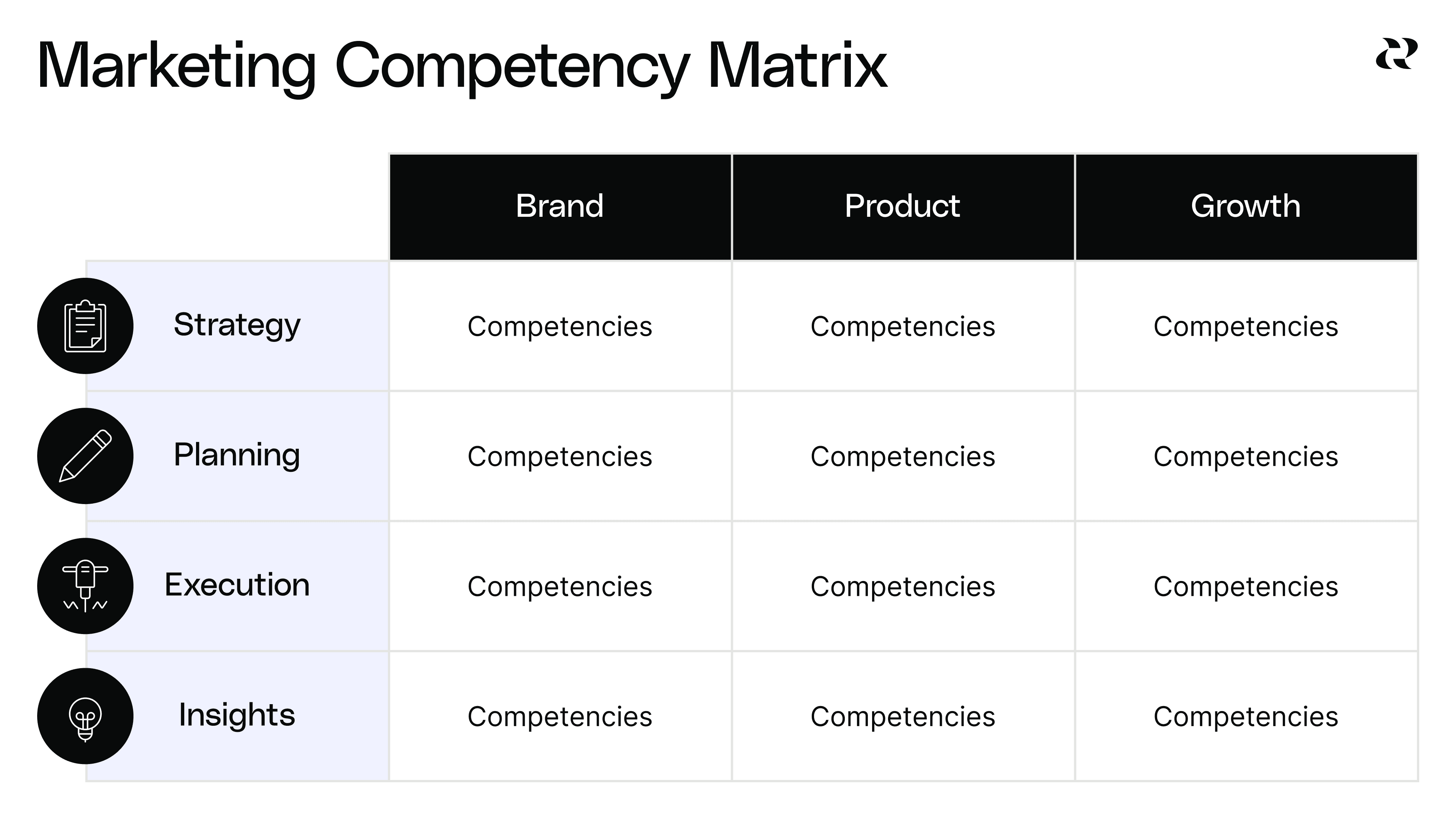
The matrix outlines the four marketing work types (Strategy, Planning, Execution, Insights) by each of the three primary marketing domains (Product, Brand, Growth) and defines the key competencies a team member needs to have in order to excel at each intersection.
In this article, we’ll cover:
The Purpose of the Marketing Competency Matrix
A Brief Overview of Each Competency
How to Use the Competency Matrix
Examples of Marketing Competency Matrices in the Real World
The Purpose of the Marketing Competency Matrix
A common misstep among marketing leaders when defining team competencies is focusing solely on work activities or domain knowledge.
Work activities refer to the types of tasks that need to be done within a marketing role, such as strategy, planning, execution, and insights. These activities are about how the work is carried out, focusing on the processes and actions involved in marketing efforts.
Domain knowledge, on the other hand, pertains to the specific expertise required in a marketing domain, such as brand marketing, product marketing, or growth marketing. This knowledge is about understanding the specific area of marketing one is working in, including the strategies, tools, and approaches unique to that domain.
Focusing on one or the other oversimplifies the complexities of skill development. In reality, competencies emerge from the intersection of both work activities and domain expertise. It's crucial to map out these intersections in detail.
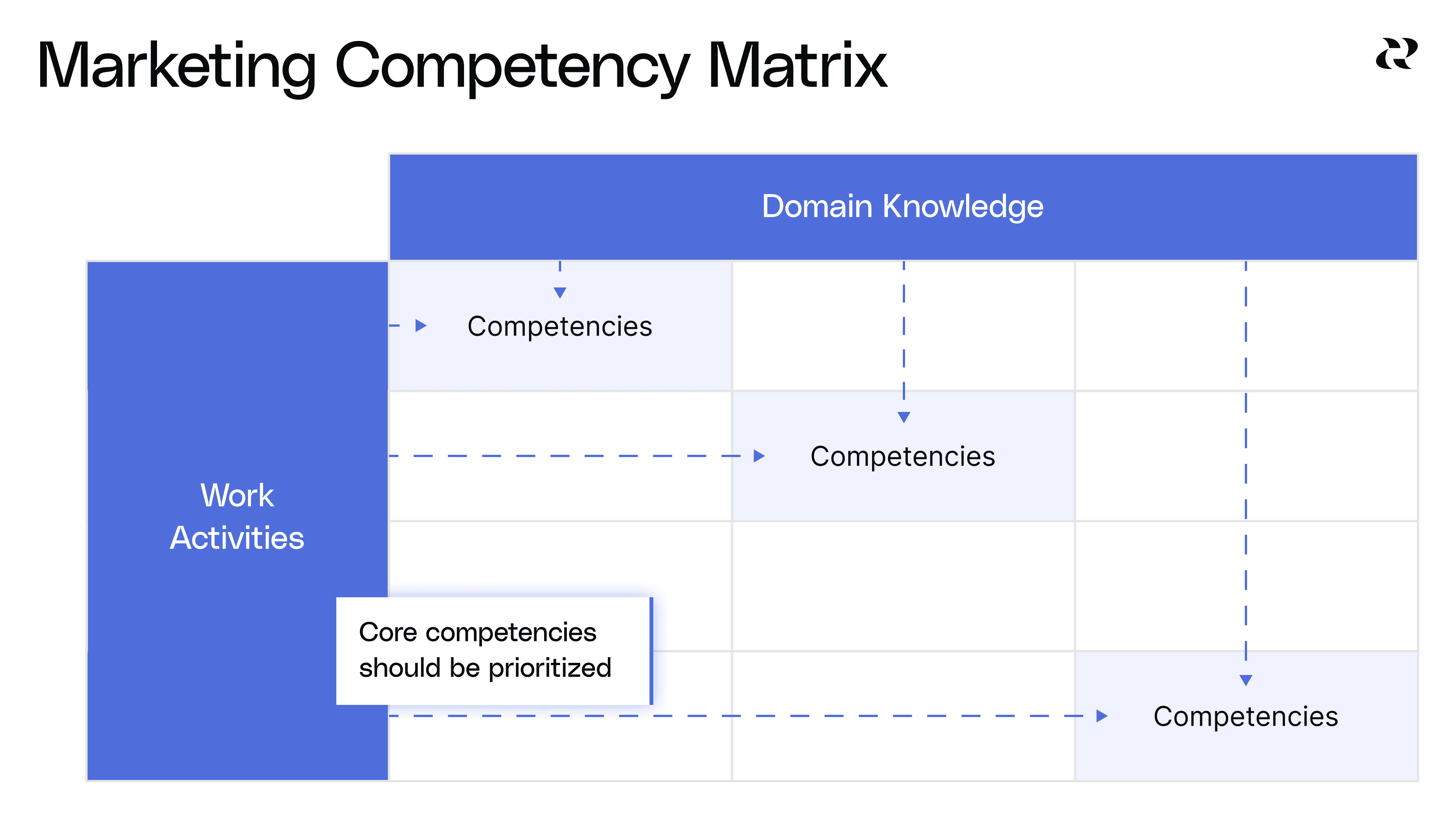
In addition to giving you a framework to map out these intersections, the Competency Matrix serves two other purposes:
It’s a competency starter kit for the three primary marketing domains of brand, product, and growth. It won’t be perfect for every team, but it gives you a jumping off point if you have these domains on your team.
Its second purpose is as a framework for defining hard competencies for other domains, when you inevitably need to go outside of product, growth, and brand. For example, you could use this framework for a Performance Marketing or Content Marketing team.
Now, we’ll reveal the full competency matrix and briefly describe each competency listed. For more in-depth descriptions and explorations into each skill, consider membership to take the on-demand Marketing Leadership course.
A Brief Overview of the Key Competencies in Product, Growth, and Brand Marketing
The Marketing Competency Matrix starts with Brand Marketing - the art and science of identifying what your product or company stands for, who it will serve, and why it serves those users or customers uniquely well.
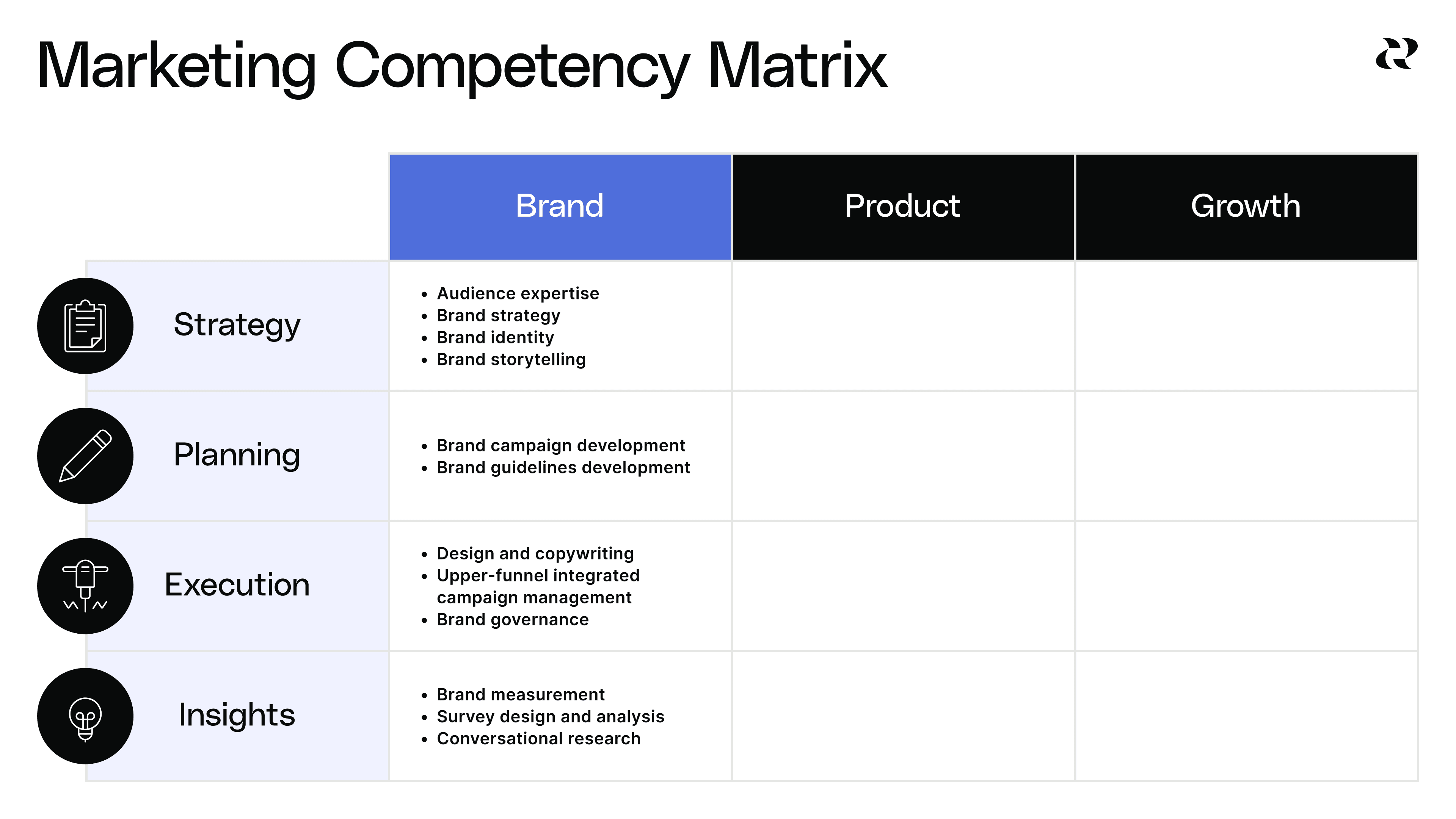
Brand Strategy Competencies
Audience expertise: Building a strong understanding of who the customer is and the problems they need solved.
Brand strategy: Using audience expertise and knowledge of business/product goals to develop the long-term vision for the brand.
Brand identity: Translating the brand vision into the emotional, visual, verbal, and other sensory cues that bring a brand to life.
Brand storytelling: The ability to build a narrative that captures your company’s values and emotionally connects with your target customers.
Let’s dive into Brand Planning, next, which focuses on how a Brand Marketer can formulate plans based on their / the business's strategy.
Brand Planning Competencies
Brand campaign development: Marketers should know how to translate brand identity into brand campaigns that actually reach the target consumer through different forms of media.
Brand guidelines development: Developing a style guide that defines the emotional, visual, verbal, and experiential elements of the brand; including tone of voice, typography, and more.
Next, let’s touch on the Brand Execution competencies, which focus on bringing the planning and strategy to life.
Brand Execution Competencies
Design and copywriting: The ability to craft specific campaign touchpoints, using visuals and text, that convey the right message or narrative to customers and drive desired outcomes for your strategy.
Upper-funnel integrated campaign management: Brand marketers need to work closely with channel owners, designers, copywriters, and more x-functional partners to set up campaigns and monitor performance.
Brand governance: Stewardship of your brand - you need to monitor the adherence to strategic brand guidelines.
Finally, let’s move into **Brand Insights, **which are the inputs for the other competencies in this section.
Brand Insights Competencies
Brand measurement: The ability to track brand health through a software stack, metric definition, and more.
Survey design and analysis: The ability to launch surveys and analyze the results to inform brand strategy improvement.
Conversational research: Designing and facilitating interviews/focus group conversations and synthesizing the insights.
Need to level up you or your team's brand marketing competencies? Check out our on-demand Brand Marketing course, created with Josh Grau, Kira Klaas, and Patrick Moran, available for Reforge members.
Now, we’ll move into the next domain, Product Marketing.
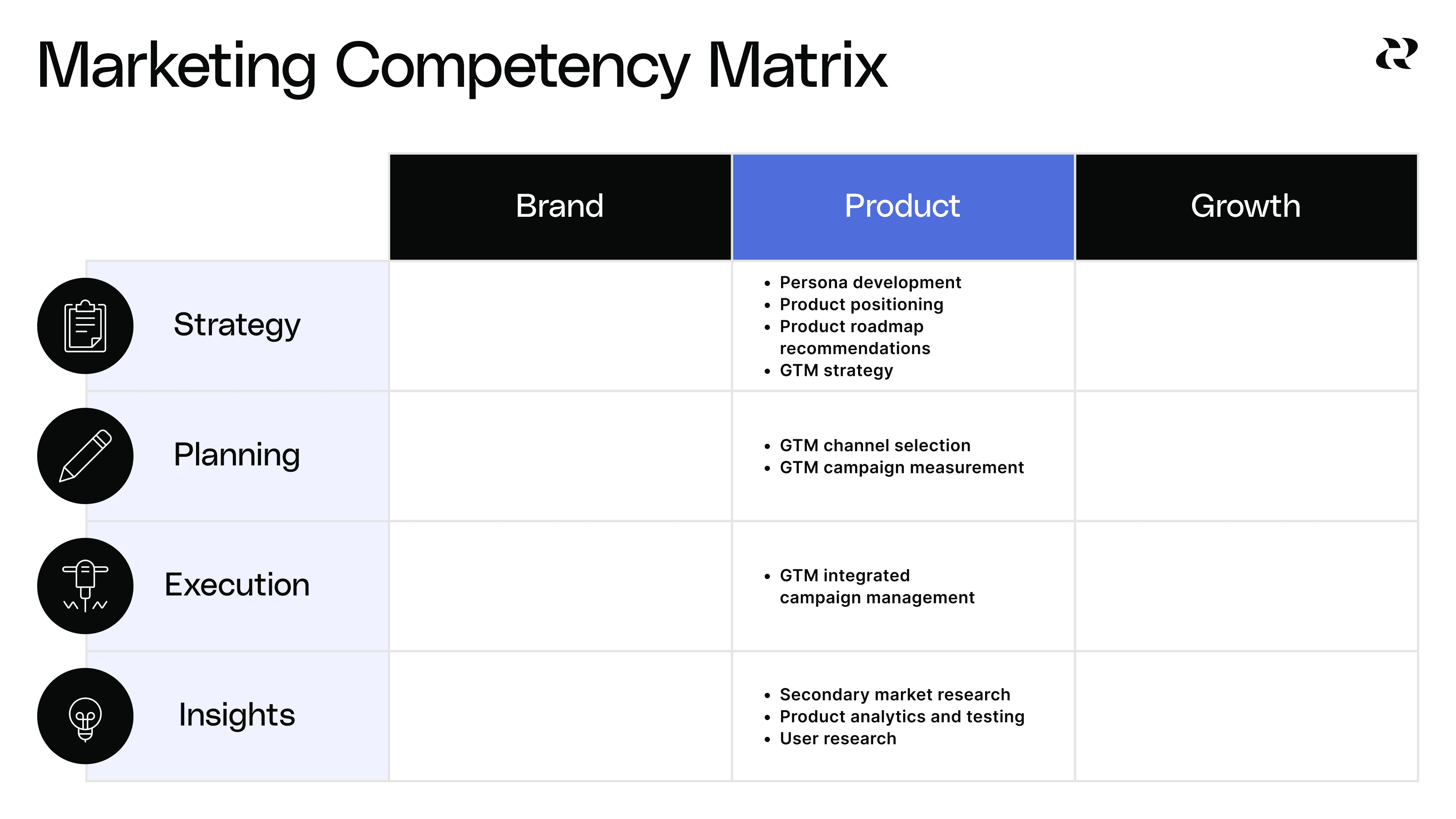
Product Marketing shares what your organization is doing to deliver on its brand promise, including packaging and presenting products in a way that allows customers to understand their value and see how they differ from alternatives
Product Marketing Strategy Competencies
Persona development: Gathering and analyzing data on users and potential customers to define who they are and what they need.
Product positioning: Knowing how to develop a unique value prop that stands out against competitors and alternatives.
Product roadmap recommendations: Using user, market, and competitor knowledge to develop recommendations for what the product team should build, and for whom.
Go-to-market strategy: Defining which customer segments the product is for, messaging the key benefits, as well as influencing the pricing and packaging.
Now, we’ll dive into the Product Marketing Planning Competencies, which focus on how marketers map out their GTM activities.
Product Marketing Planning Competencies
GTM channel selection: Determining which channels will reach the target audience.
GTM campaign measurement: Defining success metrics and setting the targets to monitor ahead of their go-to-market launch.
Moving on to the core Product Marketing Execution Competency, which addresses how a marketer manages stakeholders for campaigns.
Product Marketing Execution Competency
GTM integrated campaign management: Once the GTM plan is set, this competency involves the marketer’s ability to oversee the execution of the plan from stakeholder management to creative briefs, and more.
Finally, let’s touch on the Product Marketing Insights Competencies, which cover how marketers gather the inputs for their strategy.
Product Marketing Insights Competencies
Secondary market research: Understanding of how to ramp up quickly on the market by understanding TAM, market growth, share, etc. Methods include industry reports, competitive intel, and more.
Product analytics: Gathering data on product usage through user testing to uncover preferences and inform future positioning / GTM.
User research: Designing/facilitating focus groups, interviews, and surveys.
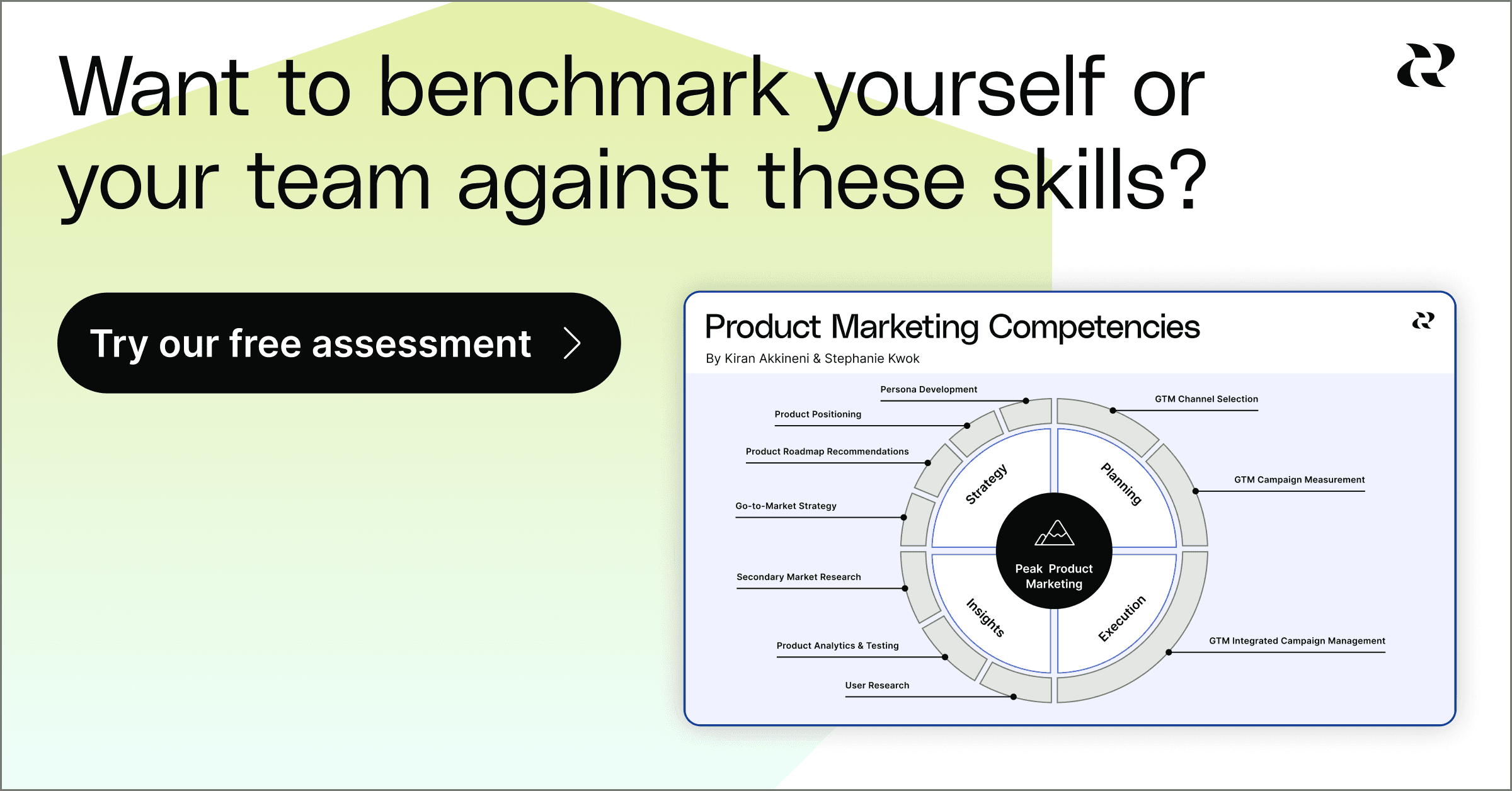
If you’re looking to level up your Product Marketing competencies, check out our Product Marketing course, available on-demand for members. It was created by Meghan Keaney Anderson (Jasper, HubSpot), and Mary Sheehan (Adobe).
Now, let’s go through the Growth Marketing domain competencies. Growth Marketing is the use of triggers, channels, messaging, and personalization to bring new and existing customers into the product to experience its value.
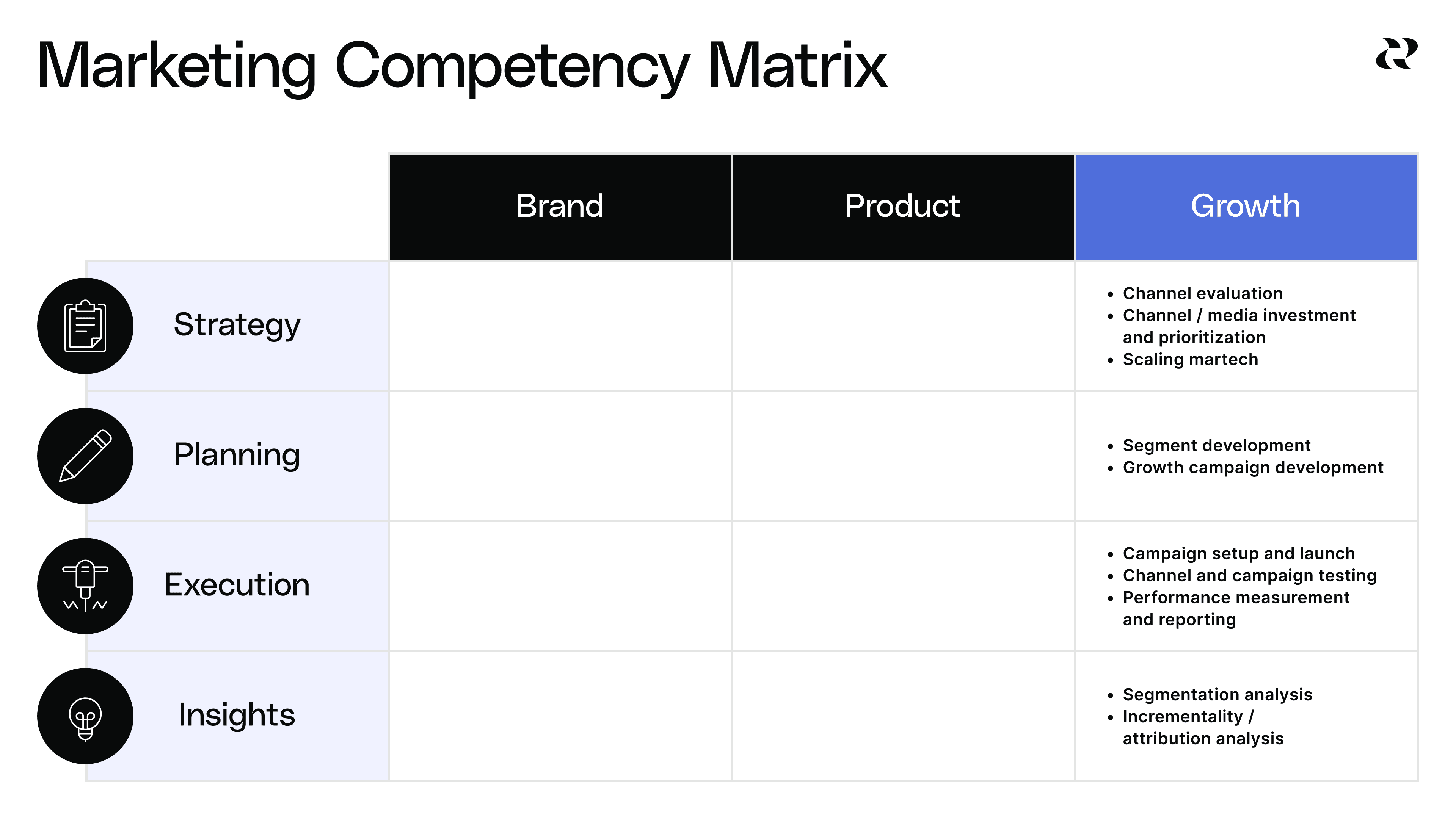
Growth Marketing Strategy Competencies
Channel evaluation: Detailed understanding of channel landscape, characteristics, and fit for your product and audience.
Channel or media investment and prioritization: The ability to look at a channel portfolio and identify payback periods, potential, and risks.
Scaling MarTech: Knowledge of how to scale tools and technology by knowing when and where to invest in that MarTech.
Next, we’ll dive into the Growth Marketing Planning Competencies.
Growth Marketing Planning Competencies
Segment development: Identify and tag key customer segments to tailor lifecycle marketing touchpoints.
Growth campaign development: Leverage understanding of growth model to build touchpoints that drive desired user actions in the product.
We’re getting close to the end here. Next up, Growth Marketing Execution Competencies.
Growth Marketing Execution Competencies
Campaign setup and launch: The ability to deploy a campaign according to plan and optimize that campaign over time.
Channel and campaign testing: Experimentation to optimize channels and campaigns through a hypothesis-driven approach to designing tests.
Performance measurement and reporting: Gathering, analyzing, and synthesizing that data to optimize current/future campaigns and touchpoints.
Finally, we’ll outline the Growth Marketing Insights Competencies.
Growth Marketing Insights Competencies
Segmentation analysis: Comfort with working with large data sets and translating the idea into clearly defined segments that can be tagged in the data.
Incrementality or attribution analysis: Understanding how different channels are performing relative to others and using that understanding to assign credit to each channel.
Do you need to upskill yourself / your team in Growth Marketing? Consider our on-demand Growth Marketing course, created by Brittany Bingham (Interim CMO at Clockwise) and Mark Fiske (Operating Partner at H.I.G Capital).
To visualize the matrix in it’s entirety, here’s the filled out version:
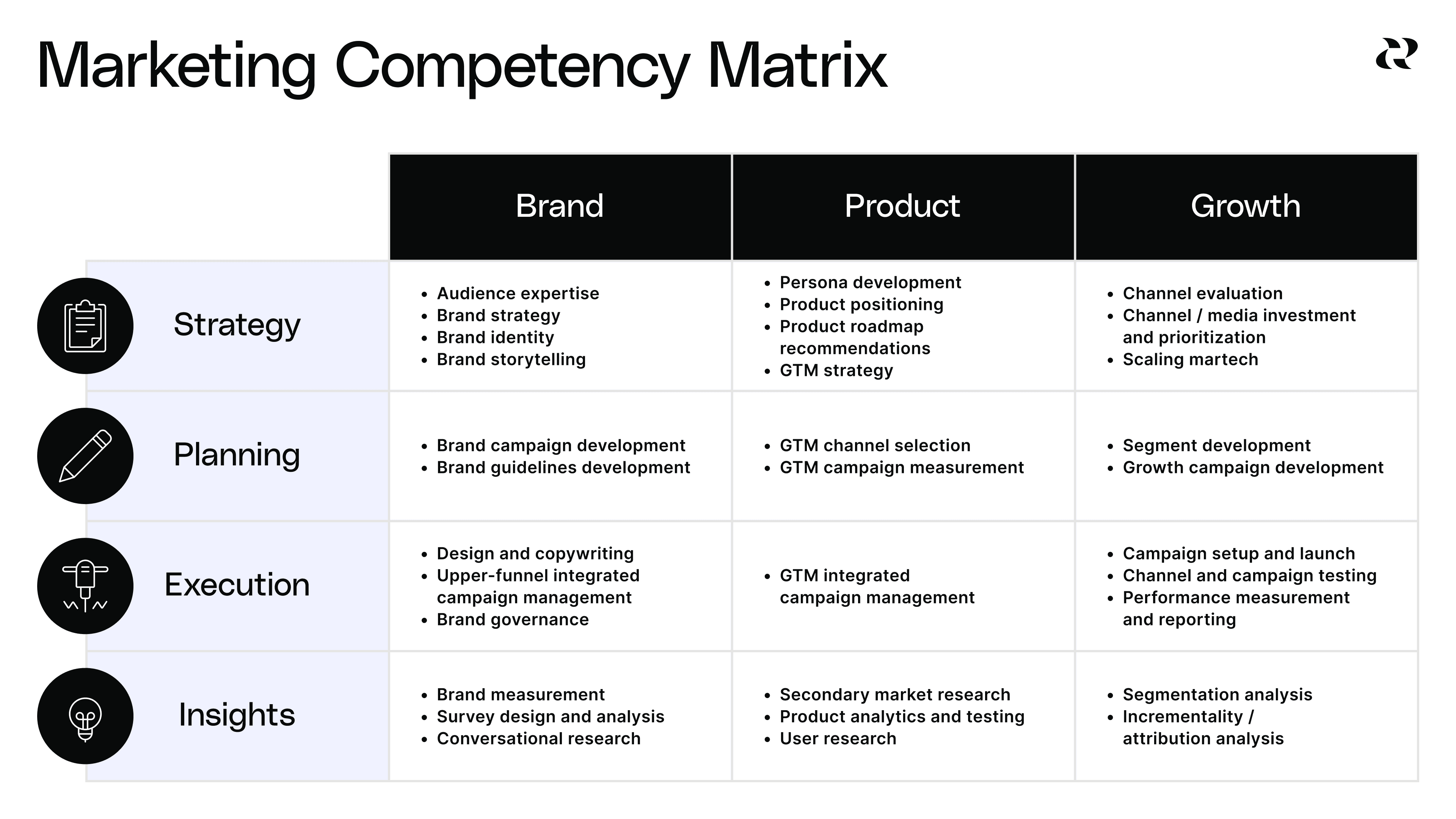
How to Use the Competency Matrix
This matrix is a tool, not a rule. Use it as a starting point, but make sure to customize it for your specific business model, team needs, etc.
Once created, you should refer to the matrix to identify the competencies you should prioritize in hiring and developing team members.
For the team development use case, specifically, we recommend deploying the competency model to power the following cycle:
Build and Evaluate (Don't Share Yet): Once your matrix is established, use it to evaluate your team to prep for a formal performance evaluation.
Deliver Formal Evaluation: Use a customized matrix template for the marketer you’re evaluating to document quantitative rankings and qualitative notes to the marketer about how they measure up against each competency.
Co-create Custom Development Plan: Based on the individual’s growth areas, work with them to create a custom learning plan to help them close that skill gap.
Execute Development Plan: On a set cadence, connect with the marketer on the progress of their learning and how they’ve applied it to their work.
Using the competency matrix to power this loop will help you build a better marketing team.
Examples of Marketing Competencies in the Real World
The best way to start to apply a concept is to see some examples from real operators and learn how they thought about it and put it into practice.
No team’s competency matrix will be exactly the same. So to help you visualize how these can differ, we sourced some different Artifacts of matrixes and job leveling frameworks.
Portfolio/Product Marketing and Management Career Journey by Div Manickam
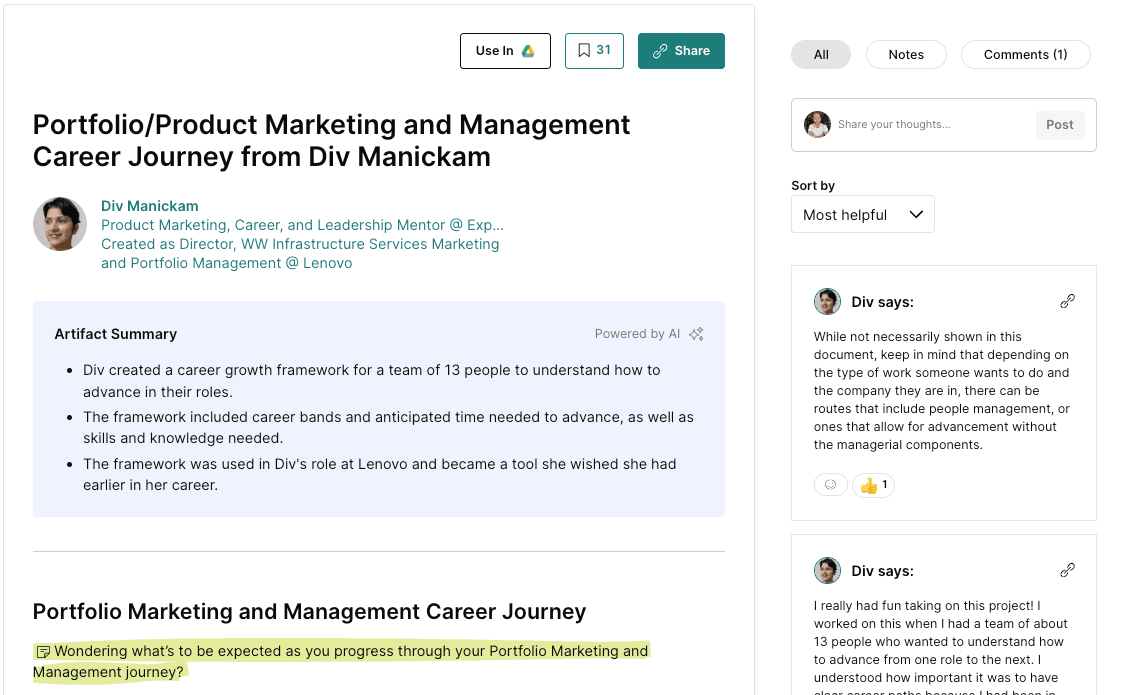
Div created a career growth framework for a team of 13 people to understand how to advance their roles. It’s a powerful example of specificity -- Div broke out and explained the difference between skills/knowledge, process, and deliverables across the different job levels.
Marketing Team Job Leveling Matrix at Biteable by Mike Wong
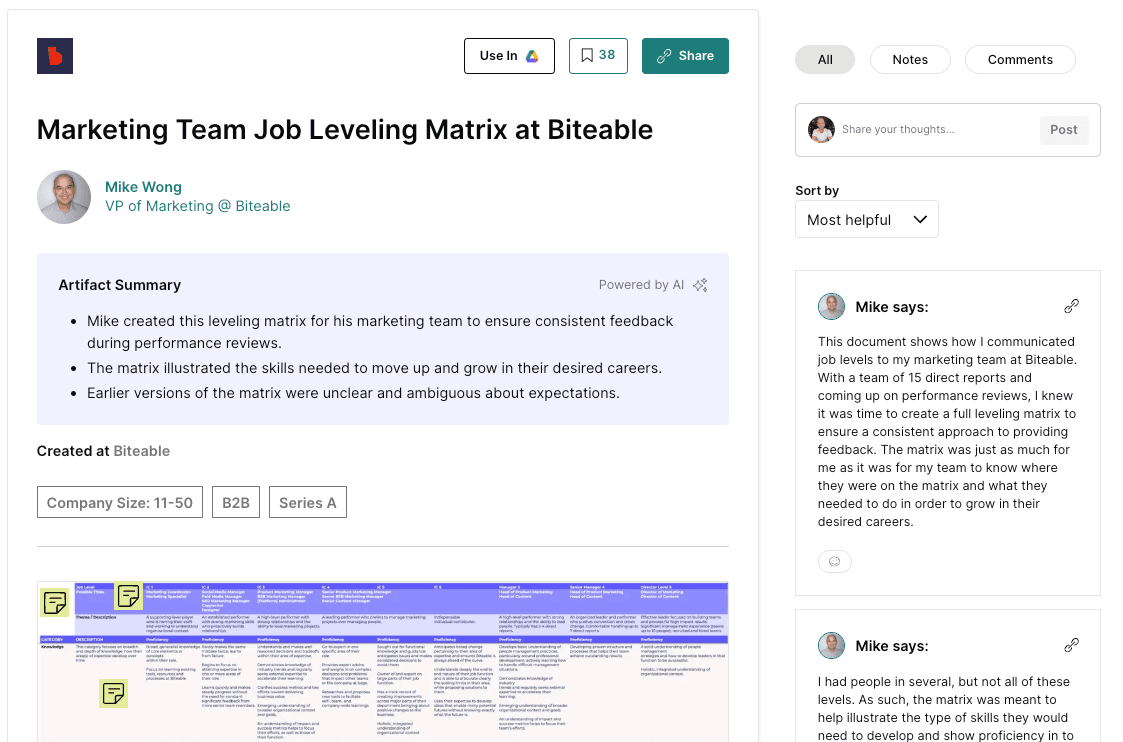
This leveling matrix was created to ensure consistent feedback during performance reviews. As you’ll notice, Mike intersects job levels (columns) with work activities (rows). One way you could remix this is to add a layer for domain knowledge, as well, as we talked about in this post.
Product Competency Matrix at Tripadvisor by Ravi Mehta
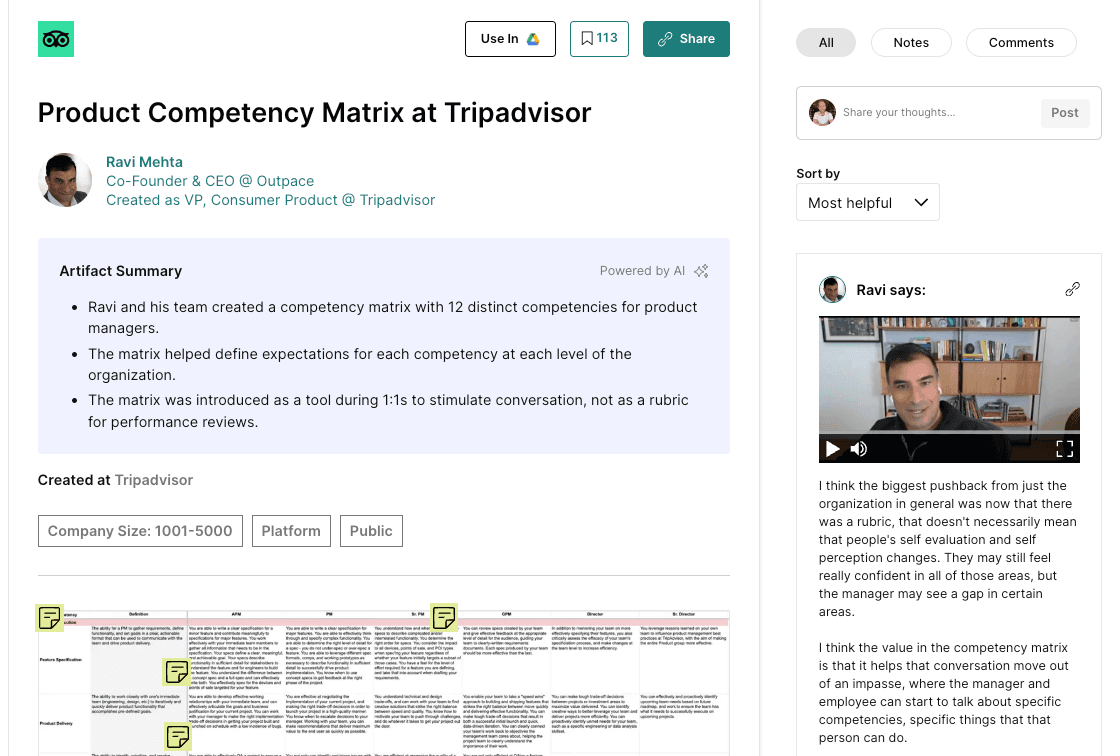
This is not designed for marketers, but it’s a great example of combining domain knowledge (it’s built only for PMs) and work activities (the rows). Ravi and his team created a competency matrix with 12 distinct competencies for product managers to define expectations for each competency at each level of the organization.
All of these Artifacts are free to access. For any of the courses mentioned throughout the blog post, Reforge members have access to those courses on-demand.
Conclusion
The Marketing Competency Matrix delineates the four marketing work types by each of the three primary marketing domains, and defines the key competencies a new hire needs to have in order to excel at each intersection.
This matrix, and competency models/matrices in general, help leaders approach hiring and development systematically so they can build against their weaknesses and know exactly where their strengths are on the team.
They also reduce the ambiguity of what success and progression looks like for team members, which helps them take their career growth into their own hands.
In other words, it takes the randomness out of building a high-performing team.
We hope this framework helps you get started on your journey to implementing this at your organization, but if you need help designing and deploying a competency model for your team, reach out to us for a demo of Reforge for Teams. We've helped some amazing companies rethink job leveling, competencies, and then equip them with the always-on content they need to close the skill gaps on their team.
Explore Reforge for Teams Here
Transform your marketing team with the Marketing Competency Matrix, co-created by Kiran Akkineni and Stephanie Kwok. Understand the key competencies required across product marketing, brand marketing, and growth marketing domains, empowering you to hire strategically and develop talent effectively.
Two of the key inputs for building a strong marketing team are the people you hire and how you develop them.
Hiring for talent alone isn’t enough. You need to have a firm understanding of the peaks and valleys of your team’s skillset, so you know exactly what skills to look for in the hiring process and where to focus professional development efforts.
But how do you know which skills to evaluate marketers against?
Enter the Marketing Competency Matrix, a framework co-created by **Stephanie Kwok **(Formerly EIR at Reforge and FanDuel), and Kiran Akkineni (SVP, Digital Customer Experience @ Callaway Golf, Formerly Zulily, Expedia). It was originally designed for their popular Marketing Leadership course to help leaders build a system for evaluating, developing, and hiring a great team.
The matrix outlines the four marketing work types (Strategy, Planning, Execution, Insights) by each of the three primary marketing domains (Product, Brand, Growth) and defines the key competencies a team member needs to have in order to excel at each intersection.
In this article, we’ll cover:
The Purpose of the Marketing Competency Matrix
A Brief Overview of Each Competency
How to Use the Competency Matrix
Examples of Marketing Competency Matrices in the Real World
The Purpose of the Marketing Competency Matrix
A common misstep among marketing leaders when defining team competencies is focusing solely on work activities or domain knowledge.
Work activities refer to the types of tasks that need to be done within a marketing role, such as strategy, planning, execution, and insights. These activities are about how the work is carried out, focusing on the processes and actions involved in marketing efforts.
Domain knowledge, on the other hand, pertains to the specific expertise required in a marketing domain, such as brand marketing, product marketing, or growth marketing. This knowledge is about understanding the specific area of marketing one is working in, including the strategies, tools, and approaches unique to that domain.
Focusing on one or the other oversimplifies the complexities of skill development. In reality, competencies emerge from the intersection of both work activities and domain expertise. It's crucial to map out these intersections in detail.
In addition to giving you a framework to map out these intersections, the Competency Matrix serves two other purposes:
It’s a competency starter kit for the three primary marketing domains of brand, product, and growth. It won’t be perfect for every team, but it gives you a jumping off point if you have these domains on your team.
Its second purpose is as a framework for defining hard competencies for other domains, when you inevitably need to go outside of product, growth, and brand. For example, you could use this framework for a Performance Marketing or Content Marketing team.
Now, we’ll reveal the full competency matrix and briefly describe each competency listed. For more in-depth descriptions and explorations into each skill, consider membership to take the on-demand Marketing Leadership course.
A Brief Overview of the Key Competencies in Product, Growth, and Brand Marketing
The Marketing Competency Matrix starts with Brand Marketing - the art and science of identifying what your product or company stands for, who it will serve, and why it serves those users or customers uniquely well.
Brand Strategy Competencies
Audience expertise: Building a strong understanding of who the customer is and the problems they need solved.
Brand strategy: Using audience expertise and knowledge of business/product goals to develop the long-term vision for the brand.
Brand identity: Translating the brand vision into the emotional, visual, verbal, and other sensory cues that bring a brand to life.
Brand storytelling: The ability to build a narrative that captures your company’s values and emotionally connects with your target customers.
Let’s dive into Brand Planning, next, which focuses on how a Brand Marketer can formulate plans based on their / the business's strategy.
Brand Planning Competencies
Brand campaign development: Marketers should know how to translate brand identity into brand campaigns that actually reach the target consumer through different forms of media.
Brand guidelines development: Developing a style guide that defines the emotional, visual, verbal, and experiential elements of the brand; including tone of voice, typography, and more.
Next, let’s touch on the Brand Execution competencies, which focus on bringing the planning and strategy to life.
Brand Execution Competencies
Design and copywriting: The ability to craft specific campaign touchpoints, using visuals and text, that convey the right message or narrative to customers and drive desired outcomes for your strategy.
Upper-funnel integrated campaign management: Brand marketers need to work closely with channel owners, designers, copywriters, and more x-functional partners to set up campaigns and monitor performance.
Brand governance: Stewardship of your brand - you need to monitor the adherence to strategic brand guidelines.
Finally, let’s move into **Brand Insights, **which are the inputs for the other competencies in this section.
Brand Insights Competencies
Brand measurement: The ability to track brand health through a software stack, metric definition, and more.
Survey design and analysis: The ability to launch surveys and analyze the results to inform brand strategy improvement.
Conversational research: Designing and facilitating interviews/focus group conversations and synthesizing the insights.
Need to level up you or your team's brand marketing competencies? Check out our on-demand Brand Marketing course, created with Josh Grau, Kira Klaas, and Patrick Moran, available for Reforge members.
Now, we’ll move into the next domain, Product Marketing.
Product Marketing shares what your organization is doing to deliver on its brand promise, including packaging and presenting products in a way that allows customers to understand their value and see how they differ from alternatives
Product Marketing Strategy Competencies
Persona development: Gathering and analyzing data on users and potential customers to define who they are and what they need.
Product positioning: Knowing how to develop a unique value prop that stands out against competitors and alternatives.
Product roadmap recommendations: Using user, market, and competitor knowledge to develop recommendations for what the product team should build, and for whom.
Go-to-market strategy: Defining which customer segments the product is for, messaging the key benefits, as well as influencing the pricing and packaging.
Now, we’ll dive into the Product Marketing Planning Competencies, which focus on how marketers map out their GTM activities.
Product Marketing Planning Competencies
GTM channel selection: Determining which channels will reach the target audience.
GTM campaign measurement: Defining success metrics and setting the targets to monitor ahead of their go-to-market launch.
Moving on to the core Product Marketing Execution Competency, which addresses how a marketer manages stakeholders for campaigns.
Product Marketing Execution Competency
GTM integrated campaign management: Once the GTM plan is set, this competency involves the marketer’s ability to oversee the execution of the plan from stakeholder management to creative briefs, and more.
Finally, let’s touch on the Product Marketing Insights Competencies, which cover how marketers gather the inputs for their strategy.
Product Marketing Insights Competencies
Secondary market research: Understanding of how to ramp up quickly on the market by understanding TAM, market growth, share, etc. Methods include industry reports, competitive intel, and more.
Product analytics: Gathering data on product usage through user testing to uncover preferences and inform future positioning / GTM.
User research: Designing/facilitating focus groups, interviews, and surveys.
If you’re looking to level up your Product Marketing competencies, check out our Product Marketing course, available on-demand for members. It was created by Meghan Keaney Anderson (Jasper, HubSpot), and Mary Sheehan (Adobe).
Now, let’s go through the Growth Marketing domain competencies. Growth Marketing is the use of triggers, channels, messaging, and personalization to bring new and existing customers into the product to experience its value.
Growth Marketing Strategy Competencies
Channel evaluation: Detailed understanding of channel landscape, characteristics, and fit for your product and audience.
Channel or media investment and prioritization: The ability to look at a channel portfolio and identify payback periods, potential, and risks.
Scaling MarTech: Knowledge of how to scale tools and technology by knowing when and where to invest in that MarTech.
Next, we’ll dive into the Growth Marketing Planning Competencies.
Growth Marketing Planning Competencies
Segment development: Identify and tag key customer segments to tailor lifecycle marketing touchpoints.
Growth campaign development: Leverage understanding of growth model to build touchpoints that drive desired user actions in the product.
We’re getting close to the end here. Next up, Growth Marketing Execution Competencies.
Growth Marketing Execution Competencies
Campaign setup and launch: The ability to deploy a campaign according to plan and optimize that campaign over time.
Channel and campaign testing: Experimentation to optimize channels and campaigns through a hypothesis-driven approach to designing tests.
Performance measurement and reporting: Gathering, analyzing, and synthesizing that data to optimize current/future campaigns and touchpoints.
Finally, we’ll outline the Growth Marketing Insights Competencies.
Growth Marketing Insights Competencies
Segmentation analysis: Comfort with working with large data sets and translating the idea into clearly defined segments that can be tagged in the data.
Incrementality or attribution analysis: Understanding how different channels are performing relative to others and using that understanding to assign credit to each channel.
Do you need to upskill yourself / your team in Growth Marketing? Consider our on-demand Growth Marketing course, created by Brittany Bingham (Interim CMO at Clockwise) and Mark Fiske (Operating Partner at H.I.G Capital).
To visualize the matrix in it’s entirety, here’s the filled out version:
How to Use the Competency Matrix
This matrix is a tool, not a rule. Use it as a starting point, but make sure to customize it for your specific business model, team needs, etc.
Once created, you should refer to the matrix to identify the competencies you should prioritize in hiring and developing team members.
For the team development use case, specifically, we recommend deploying the competency model to power the following cycle:
Build and Evaluate (Don't Share Yet): Once your matrix is established, use it to evaluate your team to prep for a formal performance evaluation.
Deliver Formal Evaluation: Use a customized matrix template for the marketer you’re evaluating to document quantitative rankings and qualitative notes to the marketer about how they measure up against each competency.
Co-create Custom Development Plan: Based on the individual’s growth areas, work with them to create a custom learning plan to help them close that skill gap.
Execute Development Plan: On a set cadence, connect with the marketer on the progress of their learning and how they’ve applied it to their work.
Using the competency matrix to power this loop will help you build a better marketing team.
Examples of Marketing Competencies in the Real World
The best way to start to apply a concept is to see some examples from real operators and learn how they thought about it and put it into practice.
No team’s competency matrix will be exactly the same. So to help you visualize how these can differ, we sourced some different Artifacts of matrixes and job leveling frameworks.
Portfolio/Product Marketing and Management Career Journey by Div Manickam
Div created a career growth framework for a team of 13 people to understand how to advance their roles. It’s a powerful example of specificity -- Div broke out and explained the difference between skills/knowledge, process, and deliverables across the different job levels.
Marketing Team Job Leveling Matrix at Biteable by Mike Wong
This leveling matrix was created to ensure consistent feedback during performance reviews. As you’ll notice, Mike intersects job levels (columns) with work activities (rows). One way you could remix this is to add a layer for domain knowledge, as well, as we talked about in this post.
Product Competency Matrix at Tripadvisor by Ravi Mehta
This is not designed for marketers, but it’s a great example of combining domain knowledge (it’s built only for PMs) and work activities (the rows). Ravi and his team created a competency matrix with 12 distinct competencies for product managers to define expectations for each competency at each level of the organization.
All of these Artifacts are free to access. For any of the courses mentioned throughout the blog post, Reforge members have access to those courses on-demand.
Conclusion
The Marketing Competency Matrix delineates the four marketing work types by each of the three primary marketing domains, and defines the key competencies a new hire needs to have in order to excel at each intersection.
This matrix, and competency models/matrices in general, help leaders approach hiring and development systematically so they can build against their weaknesses and know exactly where their strengths are on the team.
They also reduce the ambiguity of what success and progression looks like for team members, which helps them take their career growth into their own hands.
In other words, it takes the randomness out of building a high-performing team.
We hope this framework helps you get started on your journey to implementing this at your organization, but if you need help designing and deploying a competency model for your team, reach out to us for a demo of Reforge for Teams. We've helped some amazing companies rethink job leveling, competencies, and then equip them with the always-on content they need to close the skill gaps on their team.
Explore Reforge for Teams Here