
Reforge has joined Miro ↗
Team development is a core component of a Product Leader’s job. Good Product Leaders view it as another task. Great Product Leaders embrace it as the key input to increased business impact.
How Team Development Drives Business Impact
Product Leaders often gravitate towards emphasizing product outcomes, but true excellence lies in prioritizing team capability.
Ravi Mehta, former CPO at Tinder, stresses the importance of enabling every team member to deliver their best work, "As a product leader, I continuously ask myself: Am I enabling every PM on the team to do their best work?”
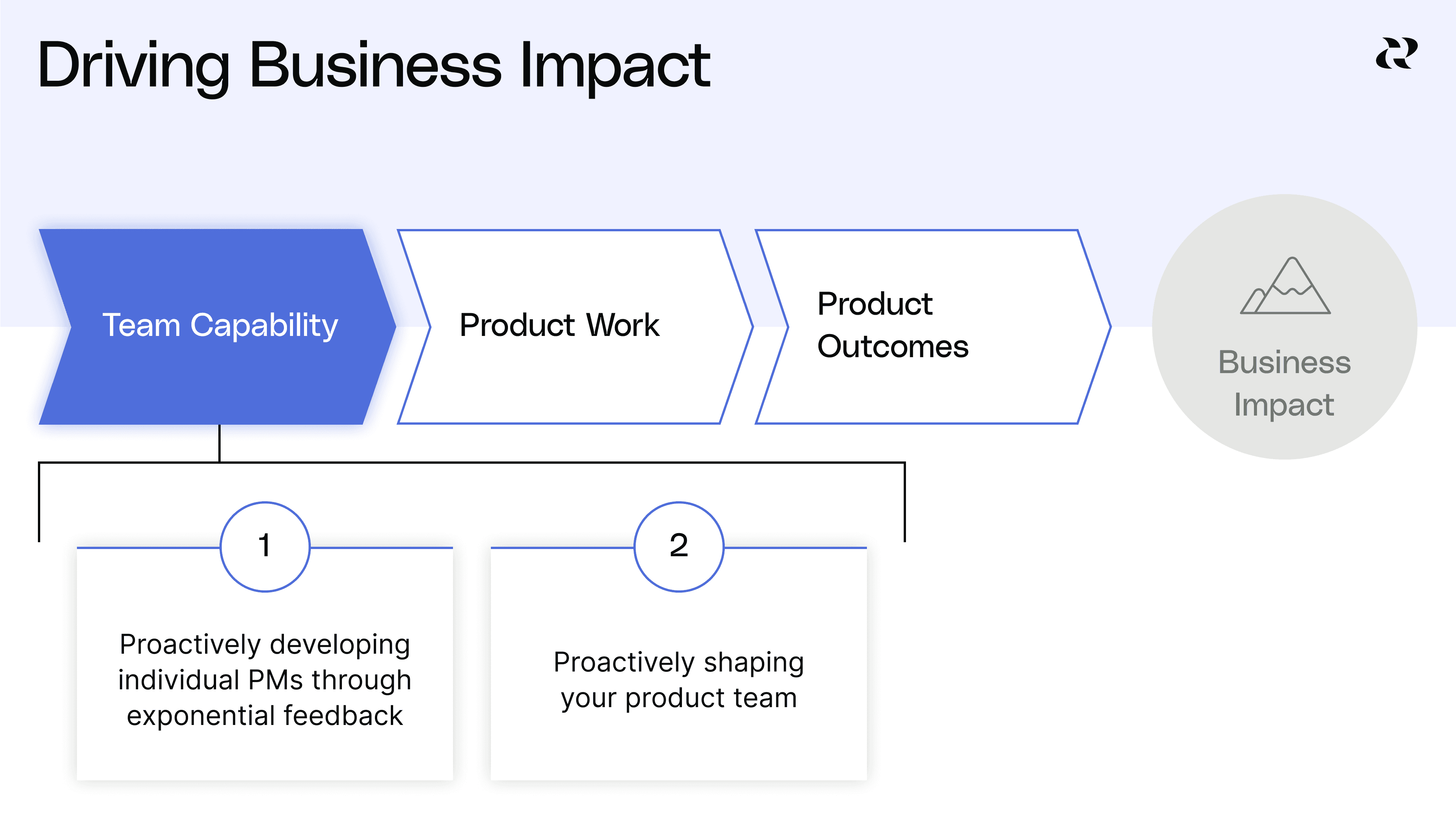
Team capability is made up of two inputs: (1) proactively developing individual PMs through exponential feedback and (2) proactively developing the team by choosing where to invest Product Leader time.
Product Leaders are often aware of the first—they might focus on giving feedback to individual PMs with the assumption that this is all that's needed to develop team capability. But to truly develop team capability, Product Leaders need to zoom out and take a holistic look at how they deploy their time across the team.
Let’s explore each concept in more detail and show how Reforge aids in achieving both objectives.
Change the Way PMs Are Evaluated for More Effective Development
Traditional performance management falls short in proactively developing PMs. At most companies, performance management means a formal performance review once or twice a year, which usually includes a generic set of questions and requires the supervisor to summarize performance using a single performance rating.
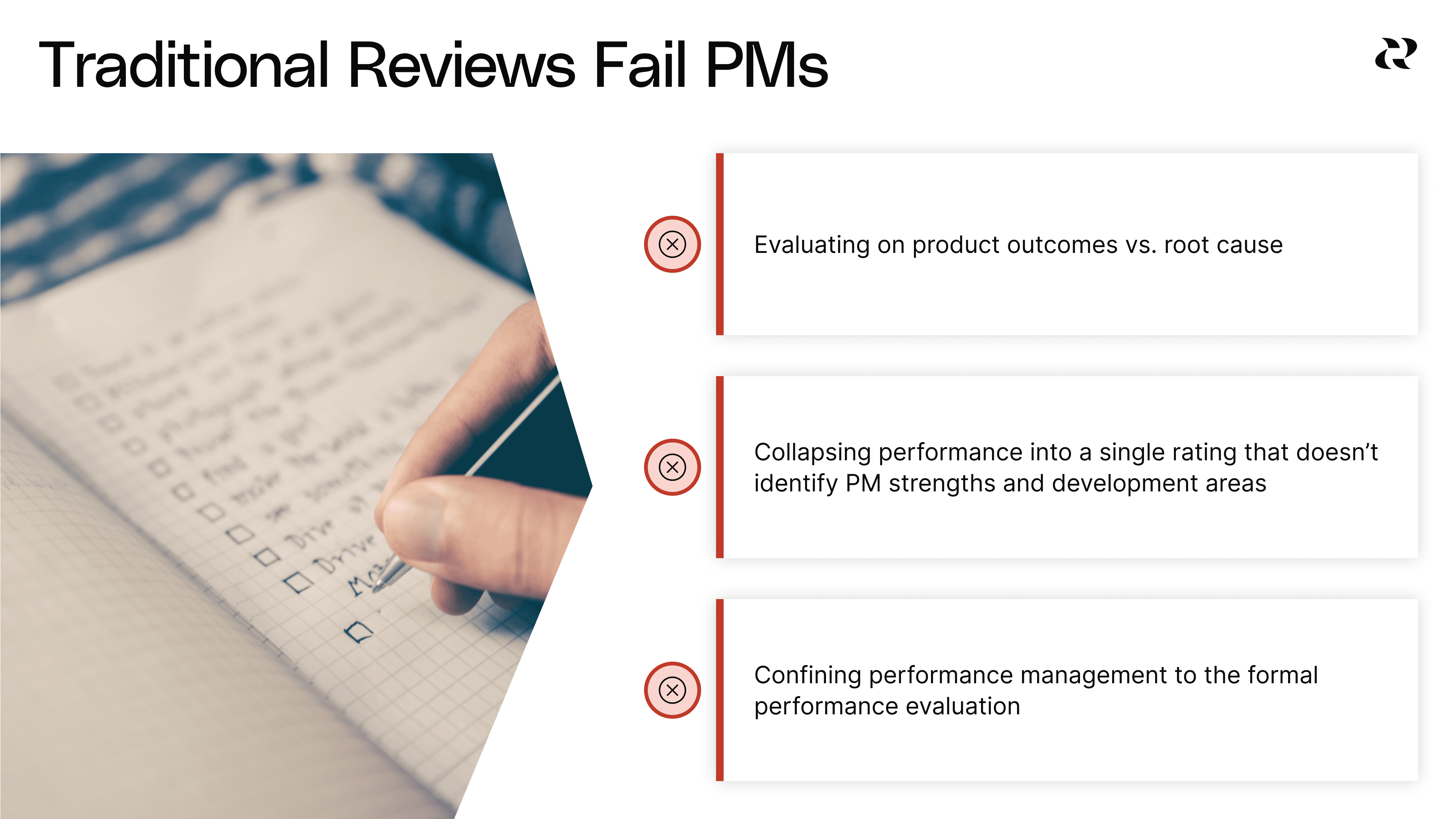
These are not effective for proactively developing PMs for three main reasons:
Evaluating on product outcomes vs. root cause.
Collapsing performance into a single rating that doesn't identify PM strengths and development areas.
Confining performance management to the formal performance evaluation.
A smarter way forward is to create a Culture of Exponential Feedback. This lets the Product Leader actively boost the team's performance. This culture grows by digging into the reasons behind PM performance, assessing PMs based on product-specific skills, making practical development plans, and following through with regular feedback.
We call this the Exponential Feedback Loop:
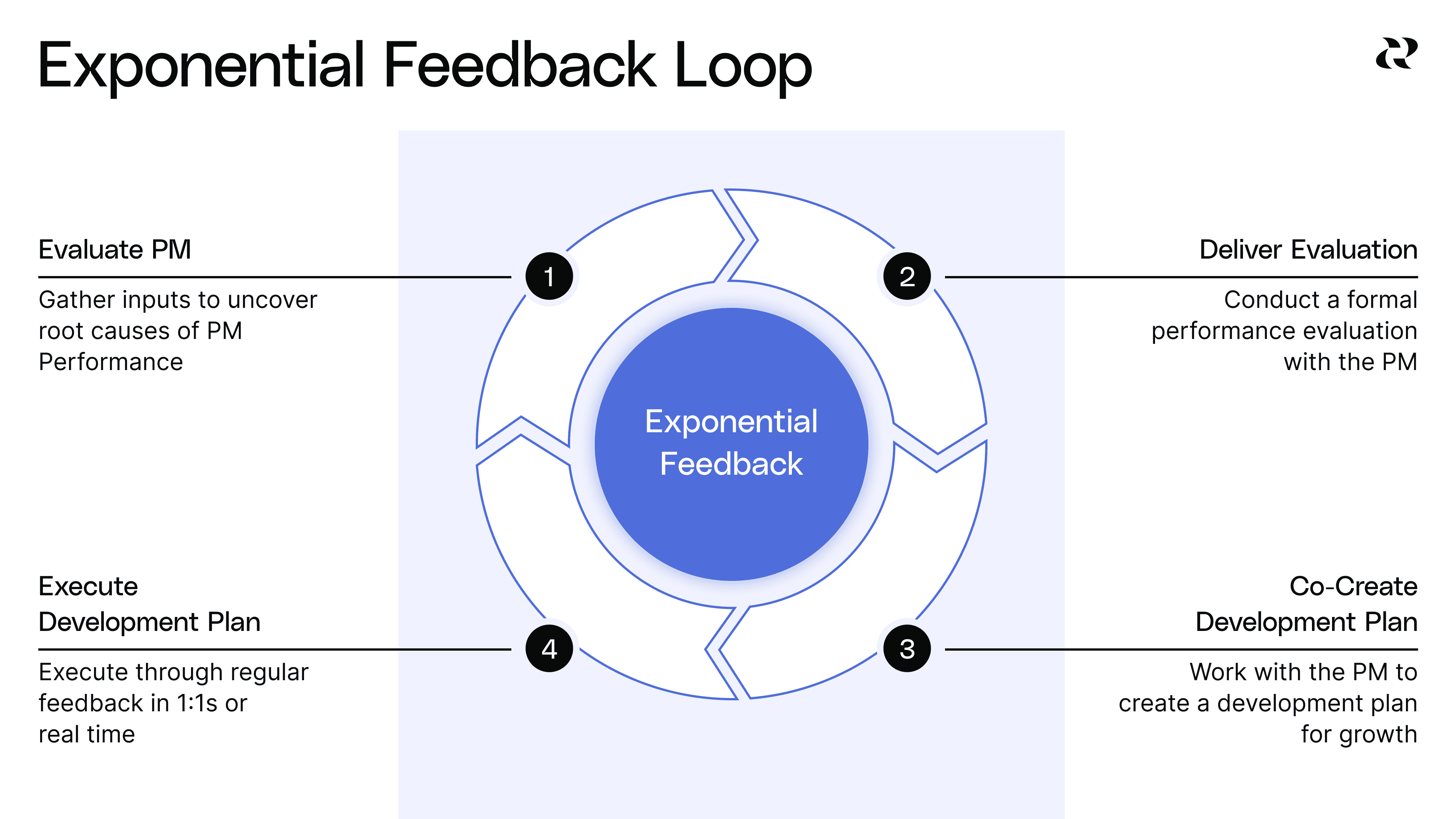
The Exponential Feedback loop gives managers a concrete, repeatable process to adhere to when working to help develop their PMs.
The good news? Product Teams can use Reforge to power this entire feedback loop, starting with the Product Competency Model.
Evaluate PMs with a Structured Competency Model
In the traditional approach to PM evaluations, Product Leaders primarily evaluate the "what"—which means they focus on product outcomes or their intuition of PM performance. But this is not sufficient to understand, evaluate, and develop PM performance.
Because product management is such a fluid profession, many teams lack a standardized list of competencies that they evaluate their PMs against.
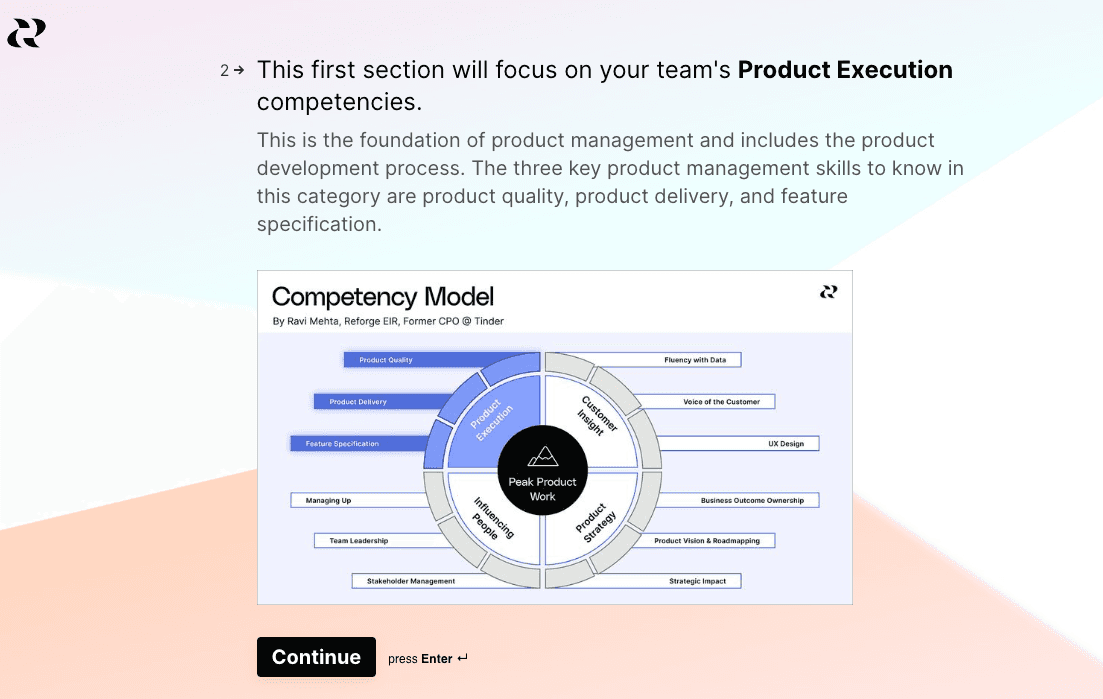
To help Product Leaders do this, we developed the Product Manager Competency Model in collaboration with Ravi Mehta.
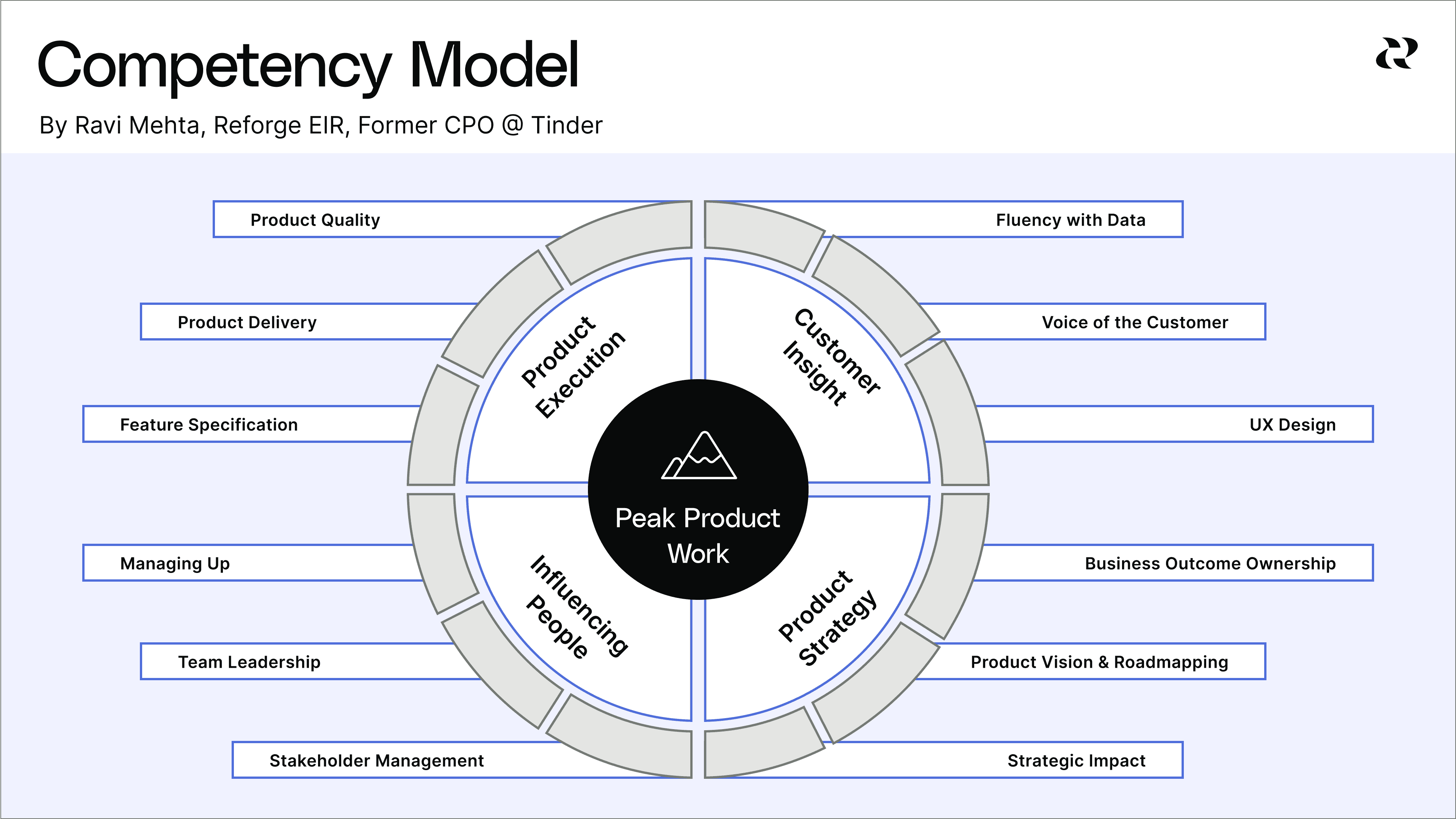
According to Ravi, this model is the closest thing to a mutually-exclusive, collectively-exhaustive definition of product management in the world right now. The competency model has three key benefits:
Grounds performance in product-specific competencies: Product Leaders can better understand Product Manager strengths and weaknesses, then offer evidence-based and actionable feedback.
Identifies team-wide competency gaps: Product Leaders can understand which product-specific competencies are missing from their overall team.
Helps make informed personnel decisions: Product Leaders can assign more informed and structured performance ratings to facilitate decision making.
It’s important to note, here, that even the best product managers you know won’t master each skill.
“ Most product managers — even peak product managers — excel at only a handful of these competencies. The difference between the average product manager and the peak product manager is an understanding of gaps and the ability to unite a team that fills those gaps.” Ravi Mehta
To help understand the gaps on your team, Reforge offers a free assessment against each of these competencies, and offers on-demand content to help develop each of these competency areas.
How to Use Reforge to Apply the Competency Model and Power the Exponential Feedback Loop
Now that you understand the Exponential Feedback Loop, as well as the Competency Model, let’s explore how you can use Reforge to help develop your PM team using these two frameworks.
Step 1: Evaluate PM against the Competency Model
Evaluating PMs across all 12 competencies gives Product Leaders a holistic understanding of PM performance. This makes it easier for Product Leaders to assign performance ratings that reflect PM performance, and therefore enables more informed personnel decision making.
Step 2: Deliver Formal Evaluation
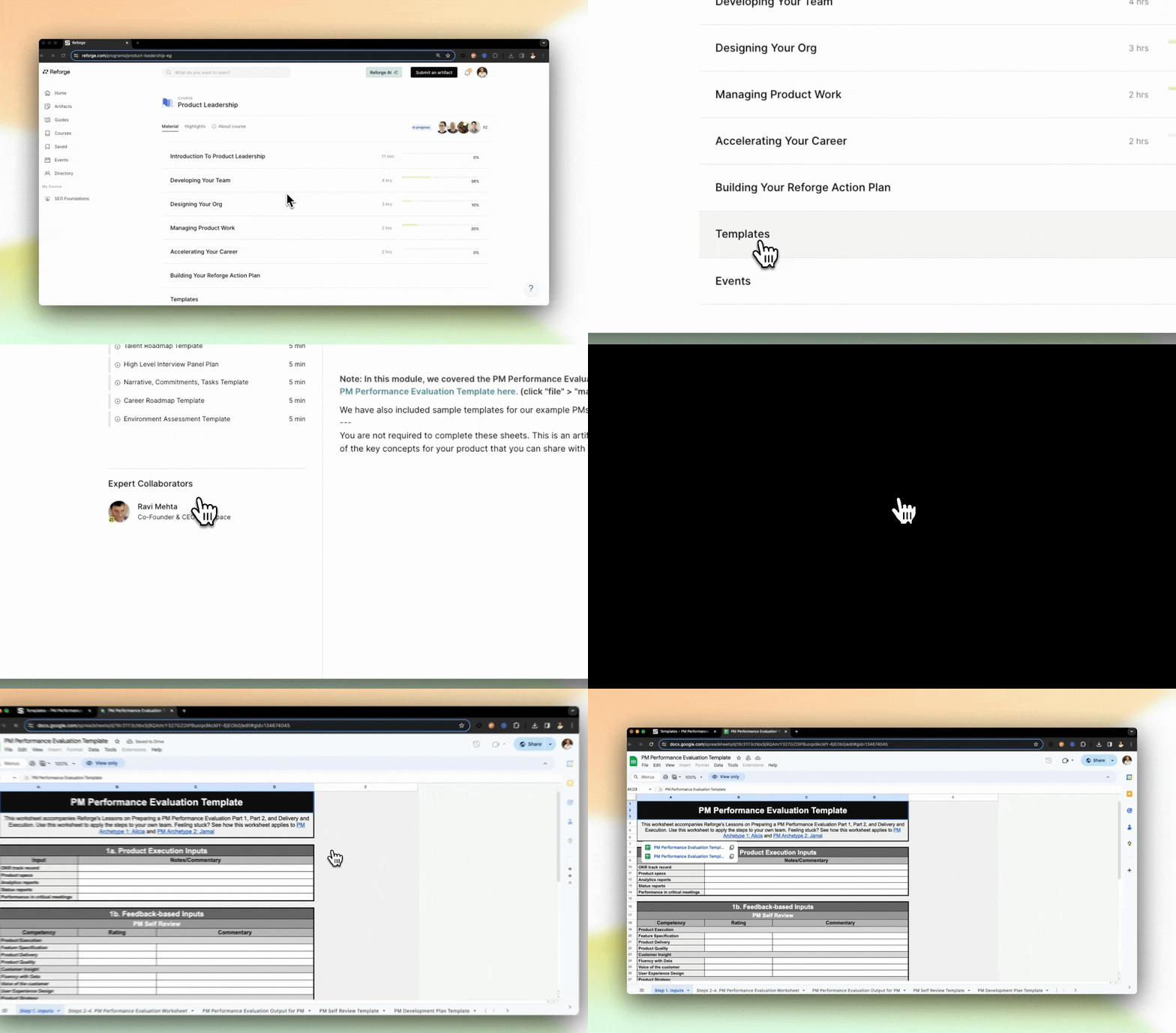
Use the PM Performance Evaluation Template from our on-demand Product Leadership Course to give quantitative rankings and qualitative notes to the PM about how they measure up against each competency. Again, you can use our assessment to help here.
Step 3: Co-create Custom Development Plan
Based on the individual PM’s growth areas, work with them to co-create custom learning tracks with Reforge content to accelerate their growth. The feature you’d use to do this is called “Collections” and it allows you to piece together content from within and outside of the Reforge ecosystem.

Step 4: Execute Development Plan
On a set cadence, connect with the PM on the progress of their learning and how they’ve applied it to their work. You should use a combination of the PM Performance Evaluation Template and the Collection you make for this.
Simply put, Reforge can both equip the managers on your Product Team with the tools they need to assess ICs, as well as provide the on-demand access to material that helps ICs make those assessments actionable.
Next, we’ll talk about how leaders can best leverage their time, and how Reforge can help extend some of their training bandwidth.
Proactively Develop the Team by Choosing Where to Invest Product Leader Time
By using a combination of exponential feedback and competencies to enhance PM performance, Product Leaders increase their leverage.
Reforge supports this by offering standardized onboarding, training paths, and courses to “subsidize” training time. It enables leaders to balance time investment efficiently, ensuring high-performing PMs are rewarded while supporting the development of others.
Helen Sims, former Head of Product at Reforge and former Airbnb PM, explains it:
"As a Product Leader, enabling five PMs to be as good as you are will allow you to scale your impact much more effectively than if you try to scale yourself across five different areas."
Many Product Leaders do not explicitly consider how their time is split among the team. As a result, they tend to over-invest their time in supporting junior (or struggling) PMs, and the natural consequence is less time invested in high performing PMs.
To balance the time spent on enabling junior PMs, leaders have used Reforge the following ways.
Outsource onboarding and training paths for Junior PMs
Reforge's pre-built learning paths: You can assign junior PMs a specific course in Reforge to complete as part of their onboarding, establishing shared vocabulary and educating them on your approach to product management from the beginning of their tenure.

Custom Learning Paths for Unique Needs: You can pick and choose Reforge content and curate custom learning paths based on your company’s / employee’s unique needs with collections.
Reward and Invest In High Performing PMs
To balance the scale and invest in the growth of high performing PMs, leaders have historically used live courses as a lever for this.
Live courses are an investment in a premium experience with peers and industry-leading experts. In a live course, an executive-level host guides a cohort of peers through a course, where they meet weekly for discussion, case-studies, and interviews with featured guests.
Managers invest in these for high performing ICs as a way to signal their commitment to the IC’s continued professional growth at the company.
You can preview the live course experience here:
By using a combination of the structured on-demand training and live programming that Reforge offers, Product Leaders are able to distribute their time more effectively.
Conclusion
Team development is a core component of a Product Leader’s job. Good Product Leaders view it as another task. Great Product Leaders embrace it as the key input to increased business impact.
Reforge for Teams helps product orgs define competencies, assess their team against them, and then provide both a plan of action and the content to level up against those competencies.
Demo Reforge for Teams Today —>
💡 Key Takeaways
Why Team Development is Important:
Business Impact Focus:
Product Leaders should prioritize team capability in addition to product outcomes for lasting business impact.
Developing individual PMs and investing Product Leader time wisely contribute to sustained team effectiveness.
Scaling Impact through Exponential Feedback:
Exponential feedback is crucial for PM development beyond traditional evaluations.
Balancing time investment, focusing on competencies, and creating development plans lead to compounding returns.
How Reforge Helps with Team Development:
Use Competency Model to Power Exponential Feedback Loop:
Reforge helps establish a Culture of Exponential Feedback, assessing PMs on vetted competencies that allow you to benchmark and measure the skillset of PMs.
Create custom, actionable development plans in Reforge and match them with on-demand content for continuous improvement.
Balancing Product Leader Time:
Reforge aids leaders in balancing time investment by offering both standardized and custom onboarding and training paths.
Live courses on Reforge reward high-performing PMs, fostering continued professional growth within the team.


Team development is a core component of a Product Leader’s job. Good Product Leaders view it as another task. Great Product Leaders embrace it as the key input to increased business impact.
How Team Development Drives Business Impact
Product Leaders often gravitate towards emphasizing product outcomes, but true excellence lies in prioritizing team capability.
Ravi Mehta, former CPO at Tinder, stresses the importance of enabling every team member to deliver their best work, "As a product leader, I continuously ask myself: Am I enabling every PM on the team to do their best work?”
Team capability is made up of two inputs: (1) proactively developing individual PMs through exponential feedback and (2) proactively developing the team by choosing where to invest Product Leader time.
Product Leaders are often aware of the first—they might focus on giving feedback to individual PMs with the assumption that this is all that's needed to develop team capability. But to truly develop team capability, Product Leaders need to zoom out and take a holistic look at how they deploy their time across the team.
Let’s explore each concept in more detail and show how Reforge aids in achieving both objectives.
Change the Way PMs Are Evaluated for More Effective Development
Traditional performance management falls short in proactively developing PMs. At most companies, performance management means a formal performance review once or twice a year, which usually includes a generic set of questions and requires the supervisor to summarize performance using a single performance rating.
These are not effective for proactively developing PMs for three main reasons:
Evaluating on product outcomes vs. root cause.
Collapsing performance into a single rating that doesn't identify PM strengths and development areas.
Confining performance management to the formal performance evaluation.
A smarter way forward is to create a Culture of Exponential Feedback. This lets the Product Leader actively boost the team's performance. This culture grows by digging into the reasons behind PM performance, assessing PMs based on product-specific skills, making practical development plans, and following through with regular feedback.
We call this the Exponential Feedback Loop:
The Exponential Feedback loop gives managers a concrete, repeatable process to adhere to when working to help develop their PMs.
The good news? Product Teams can use Reforge to power this entire feedback loop, starting with the Product Competency Model.
Evaluate PMs with a Structured Competency Model
In the traditional approach to PM evaluations, Product Leaders primarily evaluate the "what"—which means they focus on product outcomes or their intuition of PM performance. But this is not sufficient to understand, evaluate, and develop PM performance.
Because product management is such a fluid profession, many teams lack a standardized list of competencies that they evaluate their PMs against.
To help Product Leaders do this, we developed the Product Manager Competency Model in collaboration with Ravi Mehta.
According to Ravi, this model is the closest thing to a mutually-exclusive, collectively-exhaustive definition of product management in the world right now. The competency model has three key benefits:
Grounds performance in product-specific competencies: Product Leaders can better understand Product Manager strengths and weaknesses, then offer evidence-based and actionable feedback.
Identifies team-wide competency gaps: Product Leaders can understand which product-specific competencies are missing from their overall team.
Helps make informed personnel decisions: Product Leaders can assign more informed and structured performance ratings to facilitate decision making.
It’s important to note, here, that even the best product managers you know won’t master each skill.
“ Most product managers — even peak product managers — excel at only a handful of these competencies. The difference between the average product manager and the peak product manager is an understanding of gaps and the ability to unite a team that fills those gaps.” Ravi Mehta
To help understand the gaps on your team, Reforge offers a free assessment against each of these competencies, and offers on-demand content to help develop each of these competency areas.
How to Use Reforge to Apply the Competency Model and Power the Exponential Feedback Loop
Now that you understand the Exponential Feedback Loop, as well as the Competency Model, let’s explore how you can use Reforge to help develop your PM team using these two frameworks.
Step 1: Evaluate PM against the Competency Model
Evaluating PMs across all 12 competencies gives Product Leaders a holistic understanding of PM performance. This makes it easier for Product Leaders to assign performance ratings that reflect PM performance, and therefore enables more informed personnel decision making.
Step 2: Deliver Formal Evaluation
Use the PM Performance Evaluation Template from our on-demand Product Leadership Course to give quantitative rankings and qualitative notes to the PM about how they measure up against each competency. Again, you can use our assessment to help here.
Step 3: Co-create Custom Development Plan
Based on the individual PM’s growth areas, work with them to co-create custom learning tracks with Reforge content to accelerate their growth. The feature you’d use to do this is called “Collections” and it allows you to piece together content from within and outside of the Reforge ecosystem.
Step 4: Execute Development Plan
On a set cadence, connect with the PM on the progress of their learning and how they’ve applied it to their work. You should use a combination of the PM Performance Evaluation Template and the Collection you make for this.
Simply put, Reforge can both equip the managers on your Product Team with the tools they need to assess ICs, as well as provide the on-demand access to material that helps ICs make those assessments actionable.
Next, we’ll talk about how leaders can best leverage their time, and how Reforge can help extend some of their training bandwidth.
Proactively Develop the Team by Choosing Where to Invest Product Leader Time
By using a combination of exponential feedback and competencies to enhance PM performance, Product Leaders increase their leverage.
Reforge supports this by offering standardized onboarding, training paths, and courses to “subsidize” training time. It enables leaders to balance time investment efficiently, ensuring high-performing PMs are rewarded while supporting the development of others.
Helen Sims, former Head of Product at Reforge and former Airbnb PM, explains it:
"As a Product Leader, enabling five PMs to be as good as you are will allow you to scale your impact much more effectively than if you try to scale yourself across five different areas."
Many Product Leaders do not explicitly consider how their time is split among the team. As a result, they tend to over-invest their time in supporting junior (or struggling) PMs, and the natural consequence is less time invested in high performing PMs.
To balance the time spent on enabling junior PMs, leaders have used Reforge the following ways.
Outsource onboarding and training paths for Junior PMs
Reforge's pre-built learning paths: You can assign junior PMs a specific course in Reforge to complete as part of their onboarding, establishing shared vocabulary and educating them on your approach to product management from the beginning of their tenure.
Custom Learning Paths for Unique Needs: You can pick and choose Reforge content and curate custom learning paths based on your company’s / employee’s unique needs with collections.
Reward and Invest In High Performing PMs
To balance the scale and invest in the growth of high performing PMs, leaders have historically used live courses as a lever for this.
Live courses are an investment in a premium experience with peers and industry-leading experts. In a live course, an executive-level host guides a cohort of peers through a course, where they meet weekly for discussion, case-studies, and interviews with featured guests.
Managers invest in these for high performing ICs as a way to signal their commitment to the IC’s continued professional growth at the company.
You can preview the live course experience here:
By using a combination of the structured on-demand training and live programming that Reforge offers, Product Leaders are able to distribute their time more effectively.
Conclusion
Team development is a core component of a Product Leader’s job. Good Product Leaders view it as another task. Great Product Leaders embrace it as the key input to increased business impact.
Reforge for Teams helps product orgs define competencies, assess their team against them, and then provide both a plan of action and the content to level up against those competencies.
Demo Reforge for Teams Today —>
💡 Key Takeaways
Why Team Development is Important:
Business Impact Focus:
Product Leaders should prioritize team capability in addition to product outcomes for lasting business impact.
Developing individual PMs and investing Product Leader time wisely contribute to sustained team effectiveness.
Scaling Impact through Exponential Feedback:
Exponential feedback is crucial for PM development beyond traditional evaluations.
Balancing time investment, focusing on competencies, and creating development plans lead to compounding returns.
How Reforge Helps with Team Development:
Use Competency Model to Power Exponential Feedback Loop:
Reforge helps establish a Culture of Exponential Feedback, assessing PMs on vetted competencies that allow you to benchmark and measure the skillset of PMs.
Create custom, actionable development plans in Reforge and match them with on-demand content for continuous improvement.
Balancing Product Leader Time:
Reforge aids leaders in balancing time investment by offering both standardized and custom onboarding and training paths.
Live courses on Reforge reward high-performing PMs, fostering continued professional growth within the team.