Reforge has joined Miro ↗
Research Plan: What Is It & How To Write It [with Templates]
In today's fast-paced world, comprehensive data and analytics are crucial for businesses and institutions to streamline their decision-making processes. Therefore, to gather truly valuable insights, a meticulously designed research proposal is necessary. This is where many research teams fall short, focusing only on general research planning instead of creating a holistic research plan.Basic research planning encompasses only the initial stages of a research project, focusing on defining research questions, timelines, objectives, and methods. While crucial, it offers only a rudimentary outline of the research approach.
On the other hand, a well-executed research plan is a detailed, systematic, and structured document that outlines every aspect of the project. It ensures a focused, organized, and rigorous approach that maximizes the quality and reliability of the research findings.
What Is a Research Plan?
A research plan is a comprehensive document that outlines the entirety of your research project. It details the research process, from defining the problem statement and research objectives to selecting the research method and outlining the expected outcomes. This plan serves as a blueprint for your research activities, ensuring a focused and efficient approach.
The objective, methodology, and method depend on the context of your research. For instance, social media or UX research plans may focus on qualitative research methodologies, while a scientific research strategy might involve formulating hypotheses and conducting experiments.
How To Write a Research Plan in 6 Steps
Crafting an effective research plan empowers you to conduct a focused and productive investigation. Here's a step-by-step guide to help you create a plan tailored to your specific needs:
Define the Purpose of Your Project
As a starting point for your research plan, you need to clearly articulate what you aim to achieve with your research. What questions are you seeking to answer? What problem are you trying to solve? Properly defining the project’s purpose ensures your research remains focused and avoids scope creep.
Identify Research Objectives
After you have defined what the main goal for the project is, you will have to identify the specific steps or objectives needed to achieve your goal. This will help you streamline your process in a more efficient way.
Noting down individual objectives can be especially helpful if a large group is working on the project, as they can allocate tasks more effectively according to each person’s expertise. Even if a single person is conducting the research, the identified steps can assist them in sorting tasks according to their priority.
Develop a Hypothesis
In some research projects, you might benefit from developing a hypothesis, which, in basic terms, is a tentative prediction about the outcome of your investigation. The research plan will then include the tests and methodologies to help accurately confirm or disprove the original hypothesis.
Choose a Suitable Research Method and Sample
Choose the research methods best suited to gather the kind of data you need. Qualitative methods like focus groups, user interviews, and usability testing provide rich, in-depth insights. Quantitative methods like close-ended questionnaires offer broader data points.
A combination of both quantitative and qualitative research methods can be used if you want to take a more holistic approach. Next, identify your research sample. Define the demographics of your ideal participant and the sample size you need to come to get relevant insights.
Recruit Participants and Distribute Tasks
If you’re the one leading the research study, recruiting participants can help simplify the tasks. You can divide all the work according to each person’s proficiency, allowing you to prioritize the managerial tasks of your plan, such as how you will display your results.
Set a Realistic Timeline
Establish a clear timeline for each stage of your research, allocating sufficient time for tasks like data collection, analysis, and reporting. It is best practice to allow for extra time when noting down each task’s deadline in case a team member isn’t able to meet it or in case of any unexpected developments. A timeline is crucial even if you’re working alone, as it allows you to organize your time accordingly.
Why Do You Need a Research Plan?
A research plan is more than just a document. It's a roadmap for all your research activities. A well-defined plan helps you stay organized and focused on achieving your objectives.
The plan serves as an effective tool for transparent communication among team members and stakeholders. It also makes it easier to track the progress of research goals, ensuring everyone is on the same page.
7 Marketing Plan Templates Built and Used by Leading Companies
Actual case studies of effective research planning processes can give you valuable insight. Here are seven plan templates with different use cases created and used by renowned companies:
1. Jobs To Be Done User Research Guide at Replit
Tabish Gilani, Director Head of Product at Replit, created a user research interview guide to teach employees how to conduct interviews efficiently using the Jobs to be Done (JTBD) Framework. It is an excellent resource for companies that need to generate large-scale interview campaigns where users are “difficult to find.”
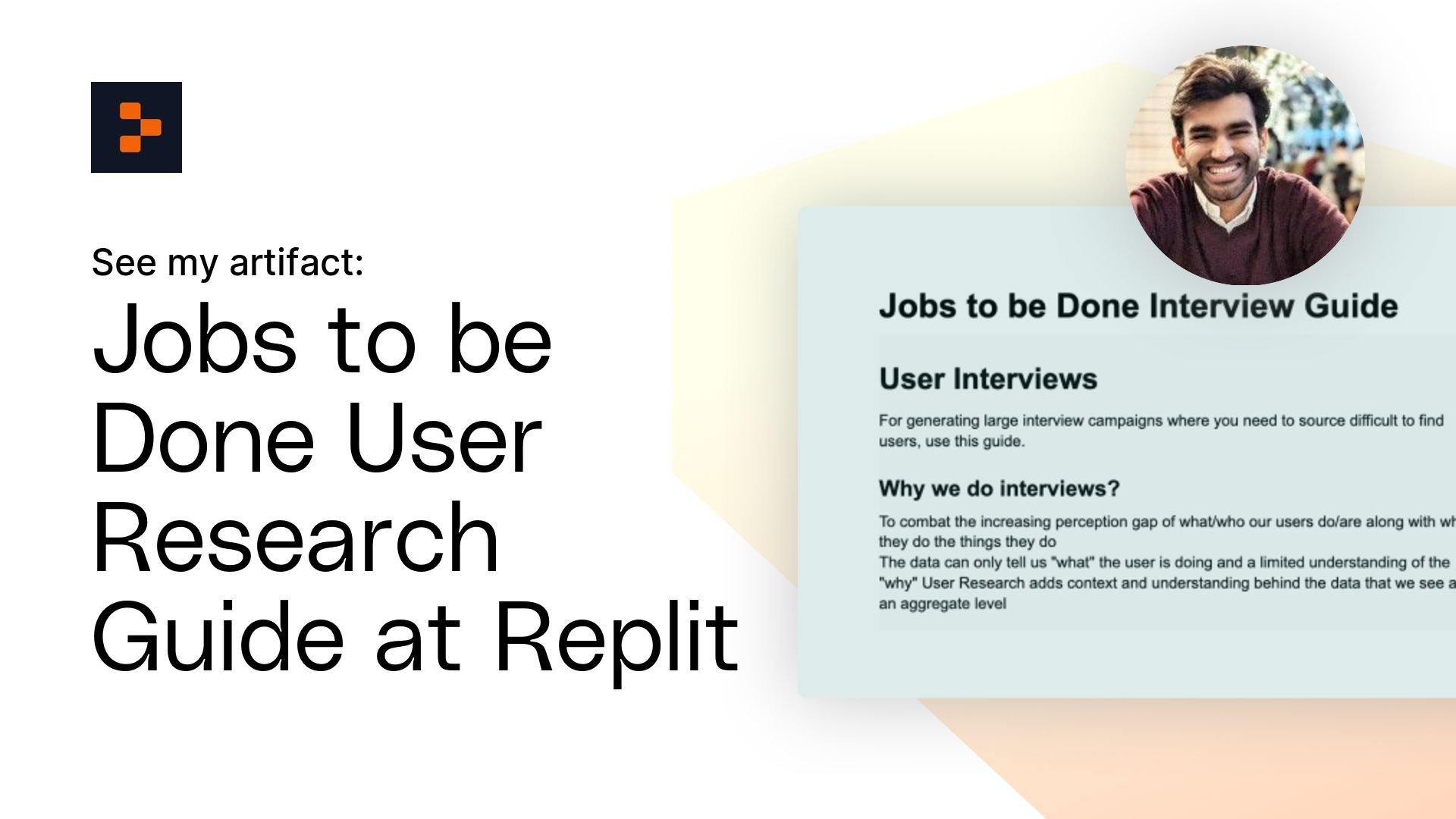
The interviews were meant to help get a more comprehensive outlook on Replit users worldwide regarding who they are, what they do, and why. The framework especially helped them with effective segmentation, as Replit is used globally for several different reasons. Therefore, according to geography, unique patterns and behaviors would be found that basic usage data cannot provide insight into.
Through the JTBD framework, they were able to interview users to pinpoint product themes to help them better understand their Ideal User Profile. This included the four forces influencing the point of view of the product, two of which are pull forces that attract the user and two push forces that repel them. They also specified four broad segmentations of behavioral, geographical, psychographic, and demographic to help them find relevant interviewees.
2. Design Methods Research Planning for Facebook Audience Insights
Behzod Sirjani, the Senior User Experience Researcher at Facebook, took an unconventional research approach that successfully helped them redesign the Audience Insight tool, which didn’t get great feedback when it was launched.
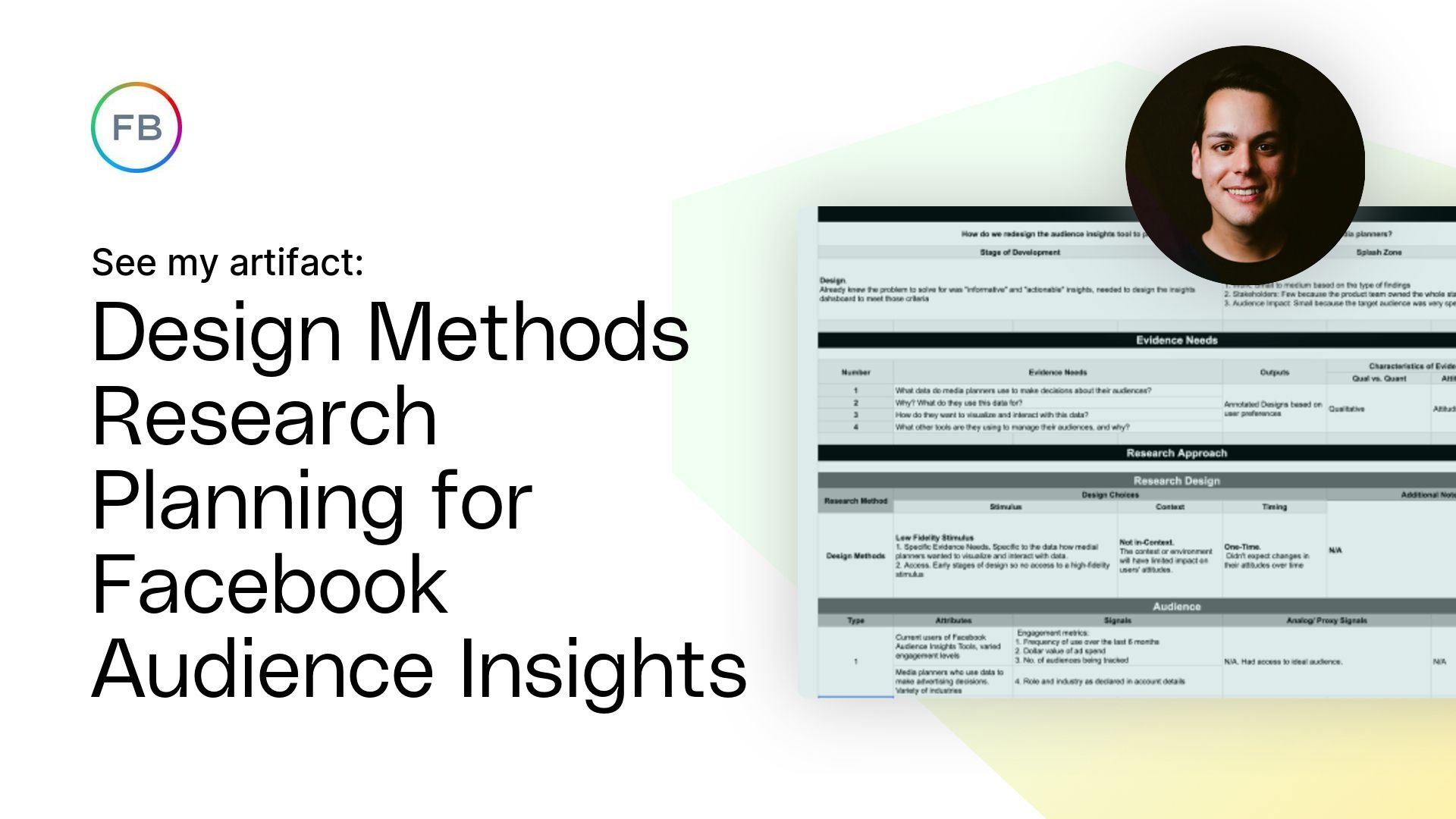
When designing the research plan, they prioritized making it fun and qualitative to get a subjective view of what users would want the ad tool to look like and why. These answers would also give a good insight into what competitors are doing right without having to go through competitive analysis.
Behzod didn’t just rely on interviews to get customer feedback. They took the approach of giving the user a blank page and marker to draw what they think will be useful for them. Then, they can ask why that will help them and delve into deeper conversations. This is great if you do not want to restrict answers.
They also kept rolling recruitment to reach higher-value customers and not spend excessive time with each. This approach worked as the team did not want empirical research but points that could help them learn and adapt to user preferences.
3. Enterprise App Management Research - Discussion Guide at Slack
Head of Research Operations at Slack, Behzod Sirjani, created an effective discussion guide used when conducting interviews with Slack Enterprise App Admin customers. This is especially helpful for B2B contexts, which was the case here.
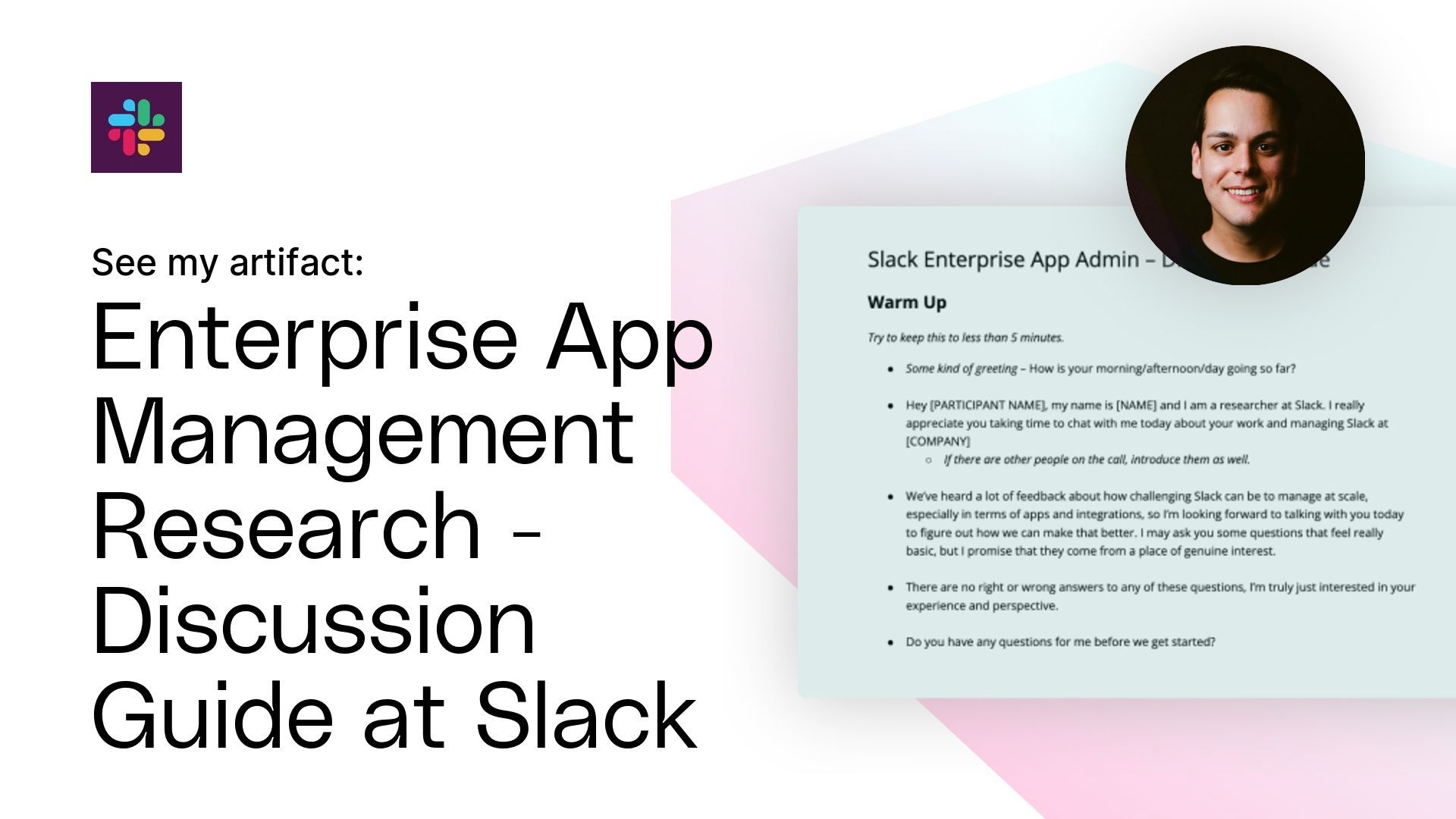
The first part of the discussion focuses on warm-up questions to orient the participant and build a rapport. This allows the interviewer to gauge the answering style and adapt their questions accordingly for higher effectiveness.
The second part is designed to get context regarding the company and processes. The third section consists of the core questions, which are meant to take the most amount of time. This part of the discussion is where the interviewer delves deeper into how the product is managed and used and any challenges faced. At the end, the guide gives prompts on how to wrap up the discussion and get any information that may have been missed or could be discussed further.
4. Research Plan - Concept Testing at Niagahoster
Muhammad Aditya Ardiansyah, UX Researcher at Niagahoster, curated a research plan that is incredibly useful for people who want to gain insight into a feature. The plan focused mainly on getting insights about the concept and conducting usability testing.
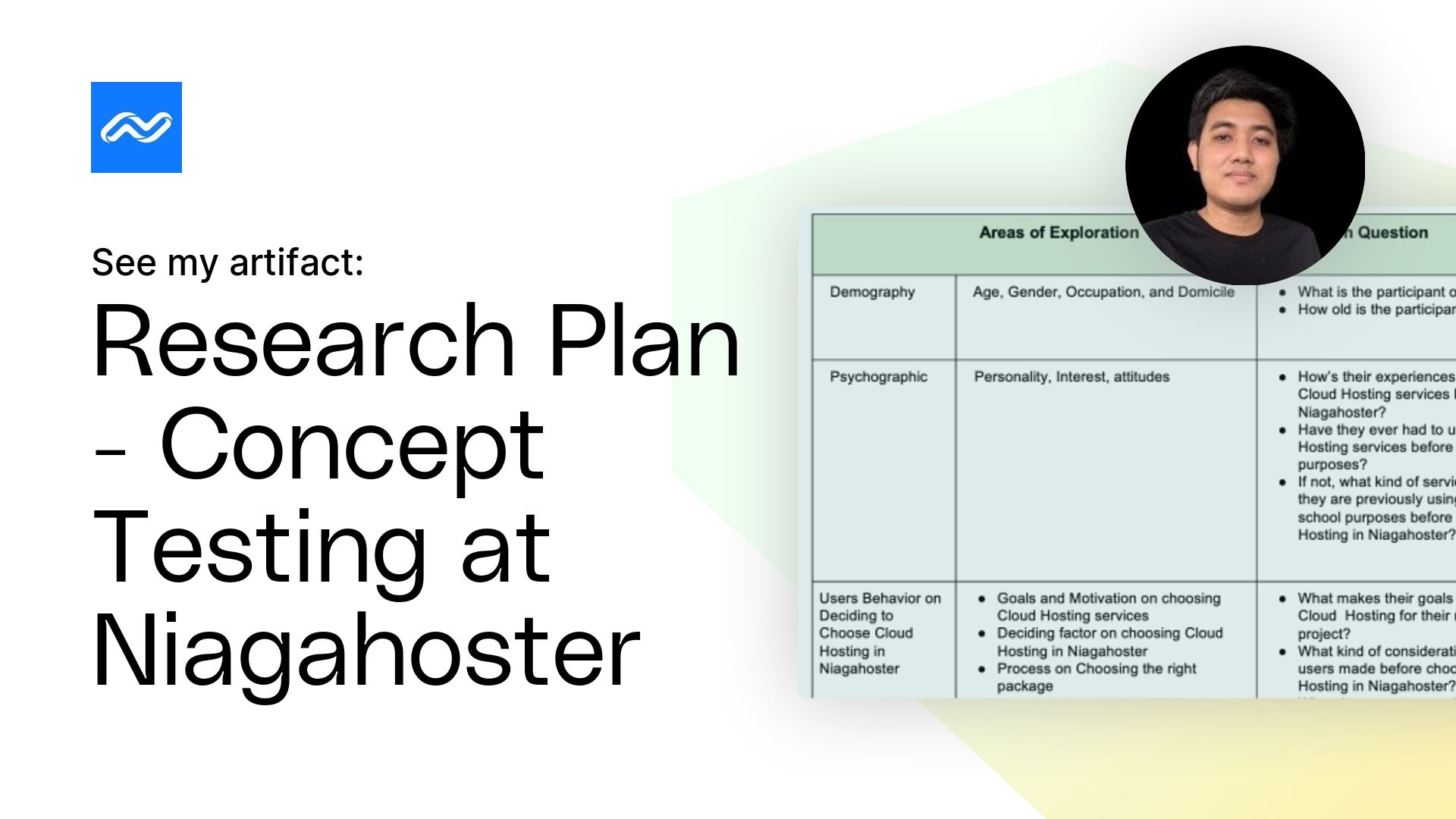
The team first created hypotheses to validate if their feature is easy to use and useful. Their research plan also highlighted the in-depth process of creating two profile types that would include three participants each. The methods will involve in-depth interviews and moderated usability testing research to get a holistic idea of the attitudes and behaviors of users towards the product.
To incentivize participation, the research team gave a reward in the form of a discount voucher for their product, company merchandise, or money.
5. Automatic Outreach Research Process and Tracker at Coda
Coda Product Manager Matt Woods used the latest management software to help automate the process of reaching out to participants and tracking their feedback. This makes the guide particularly useful for those who want to schedule calls on scale.
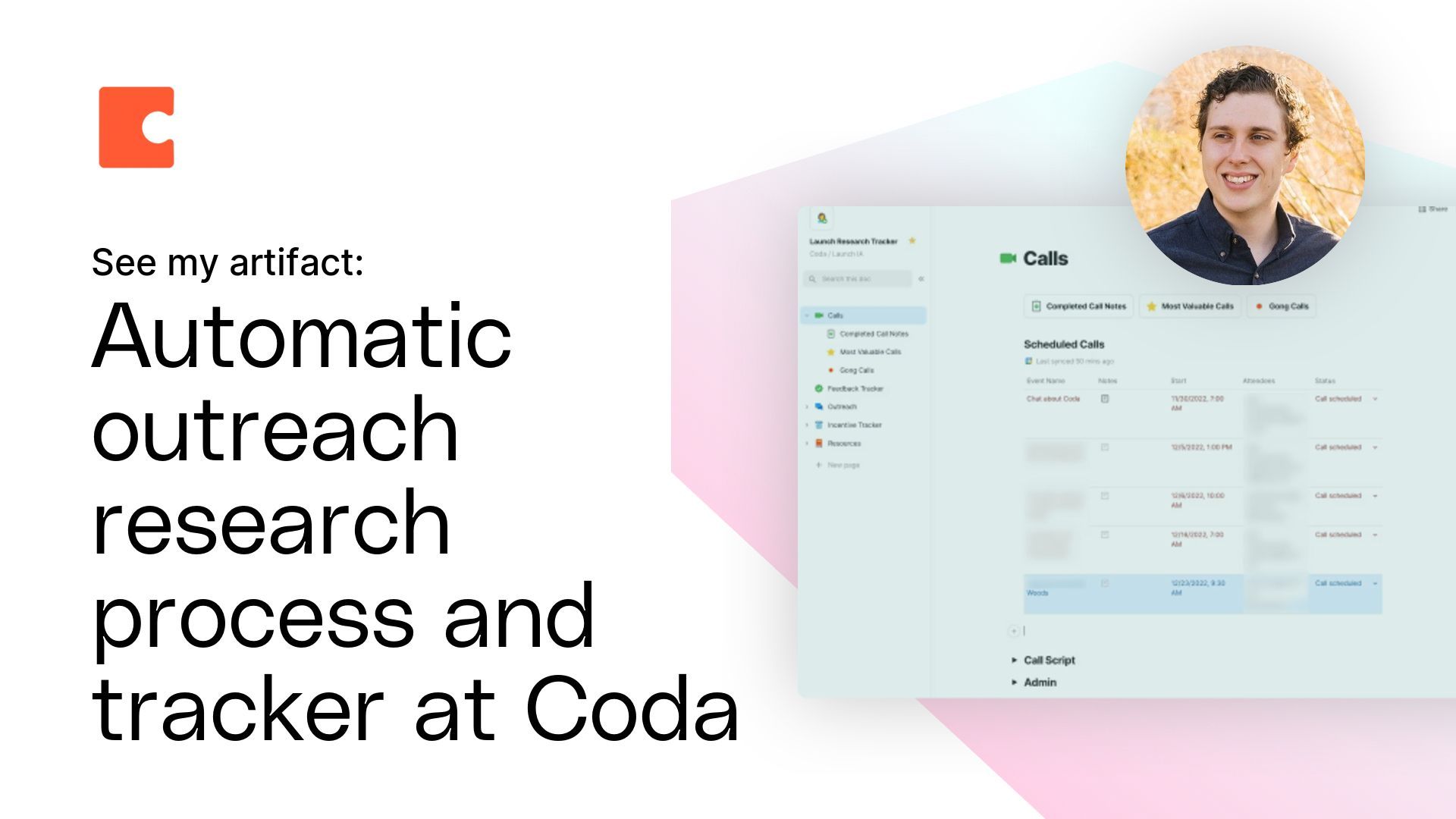
This innovative method allowed for a streamlined interviewing process. It has proven to help the Coda product team get valuable insights regarding customer pains and improved user intuition.
6. Automatically Scheduling Customer Interviews at VEED
Thomas Christensen, Senior Product Manager, Growth at VEED.IO created a system that allowed them to conduct continuous interview research sessions. This was to improve user intuition and reveal the pains, desires, and unmet needs of their target market.
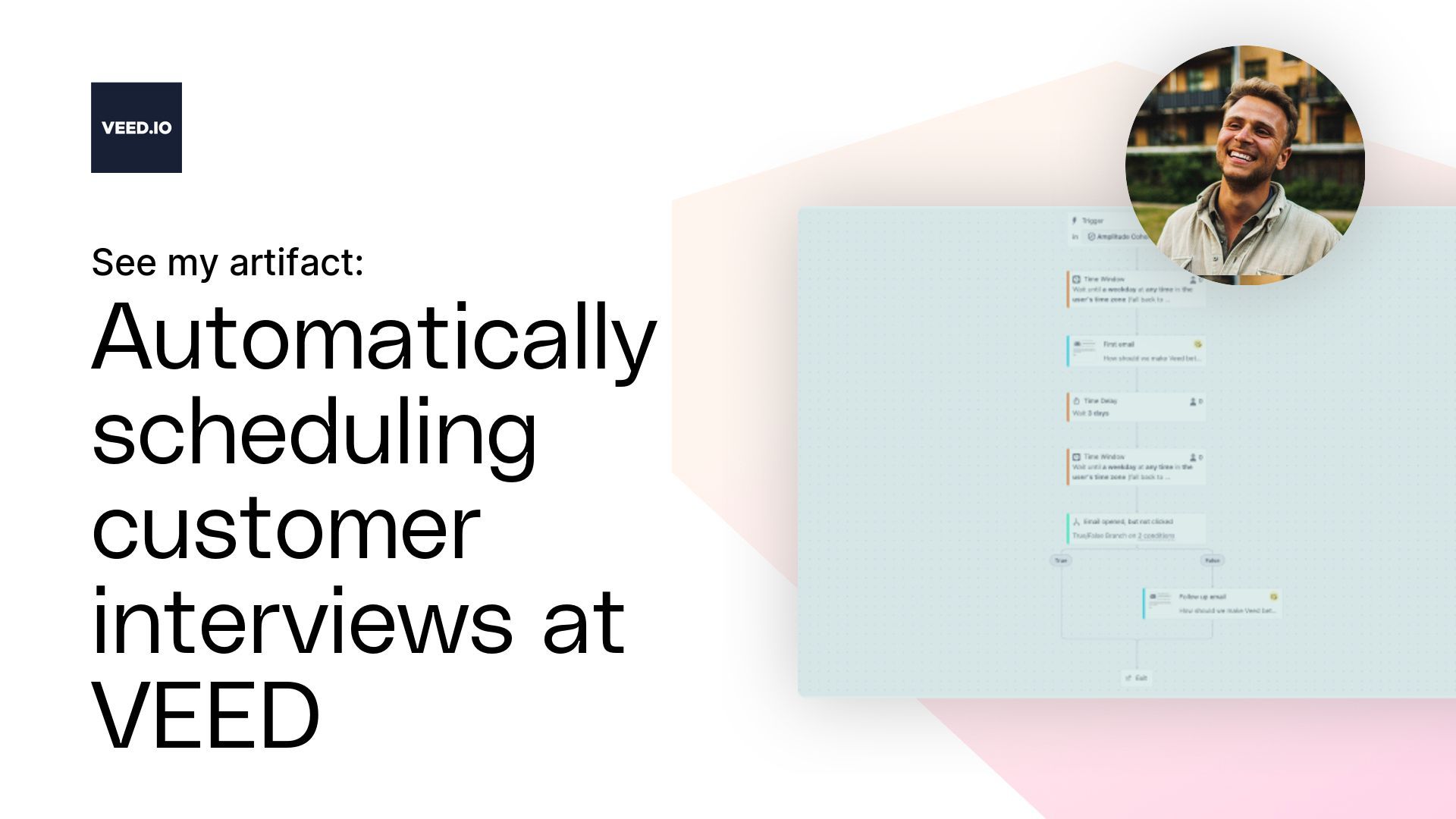
They segmented users into three groups:
“Habit users” who make videos every week
“Aha users” who just created their first video
New users who did not make a video at all.
This allowed them to cater their outreach methods accordingly. For example, the first two types of users were sent recruitment emails. The third type was reached out via the app itself.
This approach also helped personalize the email and messages to get more responses. This guide is excellent if you want to scale your outreach process in a convenient way.
7. Qualitative and Quantitative Design Research Approach at Reforge
Lead Product Designer at Reforge, Ali Riehle, created a diagram to help guide their cross-functional research project. This spectacular guide can help you create a research plan that uses both quantitative and qualitative methods.
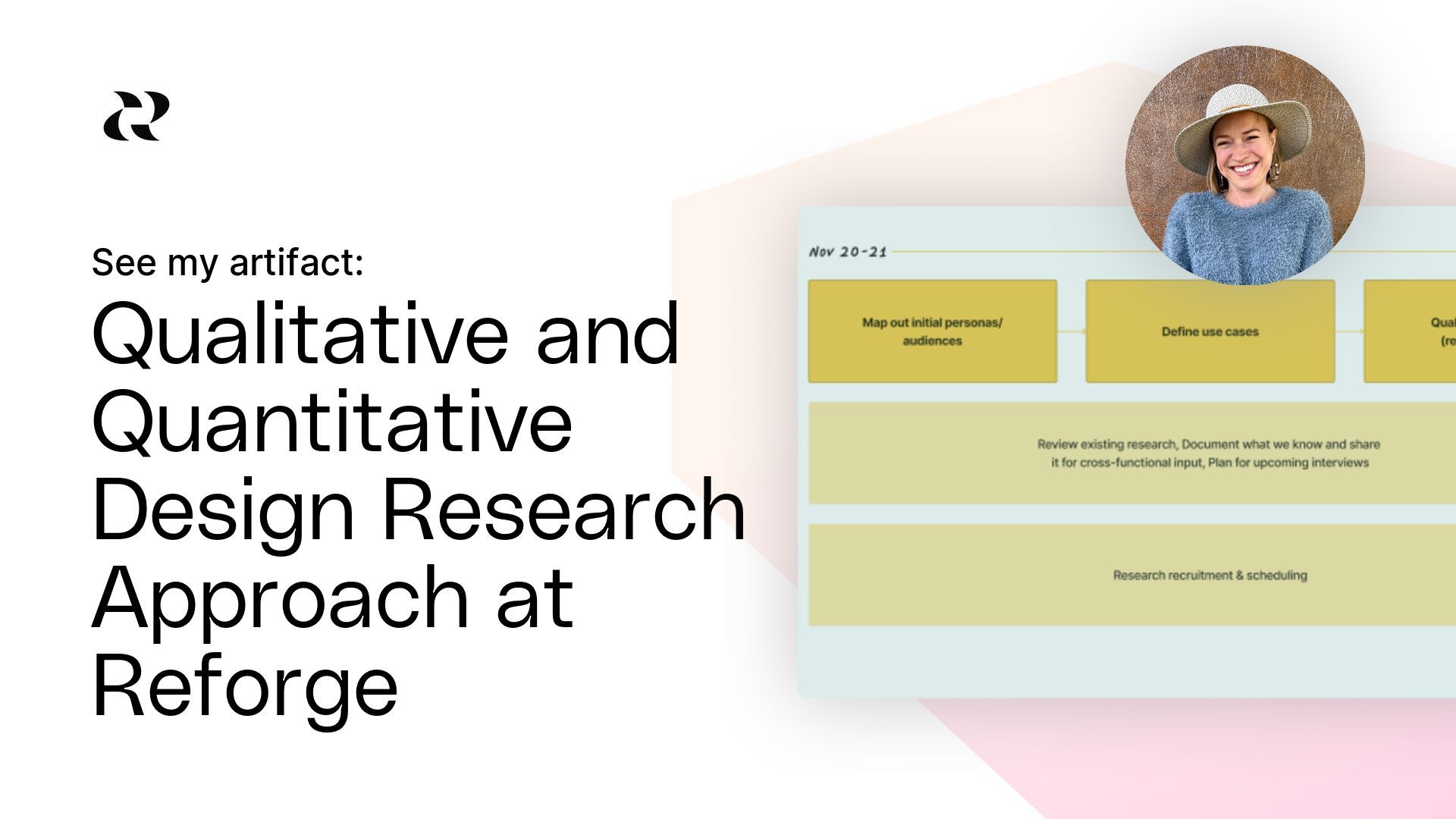
The structured approach using the diagram allowed each stage and task to be distinguished, which helped streamline communication and collaboration across the three different pods. The research outcomes heavily and positively contributed to the creation of Reforge’s strategy for 2024.
Click here to discover more of our Research Plan artifacts.
How To Customize a Research Plan Template
When selecting a template to customize for your research project, make sure it covers all essential components, such as:
Introduction: Briefly introduce the research topic and target audience.
Background: Define the problem or opportunity you're addressing.
Objectives: Clearly outline your specific research goals.
Methodology: Explain how you'll collect and analyze data.
Timeline: Set realistic deadlines for each research stage.
Expected Outcomes: Describe the anticipated results of your research.
Communication Plan: Outline how you'll present your research findings.
Explore Artifacts of All Kinds
AI
Career Development
Data Analysis
Growth
Leadership
Marketing
Product Development
Strategy
Team Operations
User Research
Topics Related to Research Plans
Research Plan: What Is It & How To Write It [with Templates]
In today's fast-paced world, comprehensive data and analytics are crucial for businesses and institutions to streamline their decision-making processes. Therefore, to gather truly valuable insights, a meticulously designed research proposal is necessary. This is where many research teams fall short, focusing only on general research planning instead of creating a holistic research plan.Basic research planning encompasses only the initial stages of a research project, focusing on defining research questions, timelines, objectives, and methods. While crucial, it offers only a rudimentary outline of the research approach.
On the other hand, a well-executed research plan is a detailed, systematic, and structured document that outlines every aspect of the project. It ensures a focused, organized, and rigorous approach that maximizes the quality and reliability of the research findings.
What Is a Research Plan?
A research plan is a comprehensive document that outlines the entirety of your research project. It details the research process, from defining the problem statement and research objectives to selecting the research method and outlining the expected outcomes. This plan serves as a blueprint for your research activities, ensuring a focused and efficient approach.
The objective, methodology, and method depend on the context of your research. For instance, social media or UX research plans may focus on qualitative research methodologies, while a scientific research strategy might involve formulating hypotheses and conducting experiments.
How To Write a Research Plan in 6 Steps
Crafting an effective research plan empowers you to conduct a focused and productive investigation. Here's a step-by-step guide to help you create a plan tailored to your specific needs:
Define the Purpose of Your Project
As a starting point for your research plan, you need to clearly articulate what you aim to achieve with your research. What questions are you seeking to answer? What problem are you trying to solve? Properly defining the project’s purpose ensures your research remains focused and avoids scope creep.
Identify Research Objectives
After you have defined what the main goal for the project is, you will have to identify the specific steps or objectives needed to achieve your goal. This will help you streamline your process in a more efficient way.
Noting down individual objectives can be especially helpful if a large group is working on the project, as they can allocate tasks more effectively according to each person’s expertise. Even if a single person is conducting the research, the identified steps can assist them in sorting tasks according to their priority.
Develop a Hypothesis
In some research projects, you might benefit from developing a hypothesis, which, in basic terms, is a tentative prediction about the outcome of your investigation. The research plan will then include the tests and methodologies to help accurately confirm or disprove the original hypothesis.
Choose a Suitable Research Method and Sample
Choose the research methods best suited to gather the kind of data you need. Qualitative methods like focus groups, user interviews, and usability testing provide rich, in-depth insights. Quantitative methods like close-ended questionnaires offer broader data points.
A combination of both quantitative and qualitative research methods can be used if you want to take a more holistic approach. Next, identify your research sample. Define the demographics of your ideal participant and the sample size you need to come to get relevant insights.
Recruit Participants and Distribute Tasks
If you’re the one leading the research study, recruiting participants can help simplify the tasks. You can divide all the work according to each person’s proficiency, allowing you to prioritize the managerial tasks of your plan, such as how you will display your results.
Set a Realistic Timeline
Establish a clear timeline for each stage of your research, allocating sufficient time for tasks like data collection, analysis, and reporting. It is best practice to allow for extra time when noting down each task’s deadline in case a team member isn’t able to meet it or in case of any unexpected developments. A timeline is crucial even if you’re working alone, as it allows you to organize your time accordingly.
Why Do You Need a Research Plan?
A research plan is more than just a document. It's a roadmap for all your research activities. A well-defined plan helps you stay organized and focused on achieving your objectives.
The plan serves as an effective tool for transparent communication among team members and stakeholders. It also makes it easier to track the progress of research goals, ensuring everyone is on the same page.
7 Marketing Plan Templates Built and Used by Leading Companies
Actual case studies of effective research planning processes can give you valuable insight. Here are seven plan templates with different use cases created and used by renowned companies:
1. Jobs To Be Done User Research Guide at Replit
Tabish Gilani, Director Head of Product at Replit, created a user research interview guide to teach employees how to conduct interviews efficiently using the Jobs to be Done (JTBD) Framework. It is an excellent resource for companies that need to generate large-scale interview campaigns where users are “difficult to find.”
The interviews were meant to help get a more comprehensive outlook on Replit users worldwide regarding who they are, what they do, and why. The framework especially helped them with effective segmentation, as Replit is used globally for several different reasons. Therefore, according to geography, unique patterns and behaviors would be found that basic usage data cannot provide insight into.
Through the JTBD framework, they were able to interview users to pinpoint product themes to help them better understand their Ideal User Profile. This included the four forces influencing the point of view of the product, two of which are pull forces that attract the user and two push forces that repel them. They also specified four broad segmentations of behavioral, geographical, psychographic, and demographic to help them find relevant interviewees.
2. Design Methods Research Planning for Facebook Audience Insights
Behzod Sirjani, the Senior User Experience Researcher at Facebook, took an unconventional research approach that successfully helped them redesign the Audience Insight tool, which didn’t get great feedback when it was launched.
When designing the research plan, they prioritized making it fun and qualitative to get a subjective view of what users would want the ad tool to look like and why. These answers would also give a good insight into what competitors are doing right without having to go through competitive analysis.
Behzod didn’t just rely on interviews to get customer feedback. They took the approach of giving the user a blank page and marker to draw what they think will be useful for them. Then, they can ask why that will help them and delve into deeper conversations. This is great if you do not want to restrict answers.
They also kept rolling recruitment to reach higher-value customers and not spend excessive time with each. This approach worked as the team did not want empirical research but points that could help them learn and adapt to user preferences.
3. Enterprise App Management Research - Discussion Guide at Slack
Head of Research Operations at Slack, Behzod Sirjani, created an effective discussion guide used when conducting interviews with Slack Enterprise App Admin customers. This is especially helpful for B2B contexts, which was the case here.
The first part of the discussion focuses on warm-up questions to orient the participant and build a rapport. This allows the interviewer to gauge the answering style and adapt their questions accordingly for higher effectiveness.
The second part is designed to get context regarding the company and processes. The third section consists of the core questions, which are meant to take the most amount of time. This part of the discussion is where the interviewer delves deeper into how the product is managed and used and any challenges faced. At the end, the guide gives prompts on how to wrap up the discussion and get any information that may have been missed or could be discussed further.
4. Research Plan - Concept Testing at Niagahoster
Muhammad Aditya Ardiansyah, UX Researcher at Niagahoster, curated a research plan that is incredibly useful for people who want to gain insight into a feature. The plan focused mainly on getting insights about the concept and conducting usability testing.
The team first created hypotheses to validate if their feature is easy to use and useful. Their research plan also highlighted the in-depth process of creating two profile types that would include three participants each. The methods will involve in-depth interviews and moderated usability testing research to get a holistic idea of the attitudes and behaviors of users towards the product.
To incentivize participation, the research team gave a reward in the form of a discount voucher for their product, company merchandise, or money.
5. Automatic Outreach Research Process and Tracker at Coda
Coda Product Manager Matt Woods used the latest management software to help automate the process of reaching out to participants and tracking their feedback. This makes the guide particularly useful for those who want to schedule calls on scale.
This innovative method allowed for a streamlined interviewing process. It has proven to help the Coda product team get valuable insights regarding customer pains and improved user intuition.
6. Automatically Scheduling Customer Interviews at VEED
Thomas Christensen, Senior Product Manager, Growth at VEED.IO created a system that allowed them to conduct continuous interview research sessions. This was to improve user intuition and reveal the pains, desires, and unmet needs of their target market.
They segmented users into three groups:
“Habit users” who make videos every week
“Aha users” who just created their first video
New users who did not make a video at all.
This allowed them to cater their outreach methods accordingly. For example, the first two types of users were sent recruitment emails. The third type was reached out via the app itself.
This approach also helped personalize the email and messages to get more responses. This guide is excellent if you want to scale your outreach process in a convenient way.
7. Qualitative and Quantitative Design Research Approach at Reforge
Lead Product Designer at Reforge, Ali Riehle, created a diagram to help guide their cross-functional research project. This spectacular guide can help you create a research plan that uses both quantitative and qualitative methods.
The structured approach using the diagram allowed each stage and task to be distinguished, which helped streamline communication and collaboration across the three different pods. The research outcomes heavily and positively contributed to the creation of Reforge’s strategy for 2024.
Click here to discover more of our Research Plan artifacts.
How To Customize a Research Plan Template
When selecting a template to customize for your research project, make sure it covers all essential components, such as:
Introduction: Briefly introduce the research topic and target audience.
Background: Define the problem or opportunity you're addressing.
Objectives: Clearly outline your specific research goals.
Methodology: Explain how you'll collect and analyze data.
Timeline: Set realistic deadlines for each research stage.
Expected Outcomes: Describe the anticipated results of your research.
Communication Plan: Outline how you'll present your research findings.
Explore Artifacts of All Kinds
AI
Career Development
Data Analysis
Growth
Leadership
Marketing
Product Development
Strategy
Team Operations
User Research
Topics Related to Research Plans