Reforge has joined Miro ↗
All articles
ref:AI Presents: The Future of Search - LLMs, AI Search & Optimization Strategies
Jun 27, 2024
As AI technologies reshape online search, businesses must adapt to stay visible and relevant. SEO has been a core growth loop for years, so this is a massive shift in strategy for some businesses.
In their ref:AI session, Greg Druck and Ethan Smith explore shifts in search behavior driven by AI and offer actionable recommendations to optimize your content for this new era.
Let’s dive in to the recap, and you can watch the recording below.
Why AI-Driven Search Demands a New Approach
From Traditional Search to AI Answer Engines
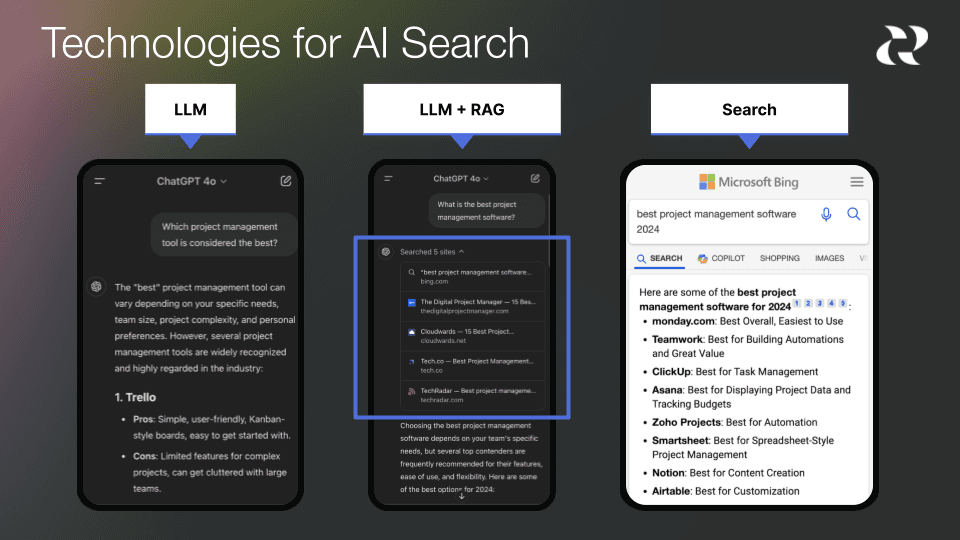
Traditional search engines like Google required users to navigate multiple links for information. AI answer engines, such as ChatGPT, now provide direct responses, reducing the need for extensive link-following. This shift necessitates new strategies to keep your content discoverable and influential.
The Role of AI in Information Retrieval
AI answer engines utilize technologies like large language models (LLMs) and retrieval-augmented generation (RAG) for accurate, contextually relevant answers. These engines draw from diverse sources, emphasizing content quality and relevance. Understanding and leveraging these technologies is crucial for a competitive edge.
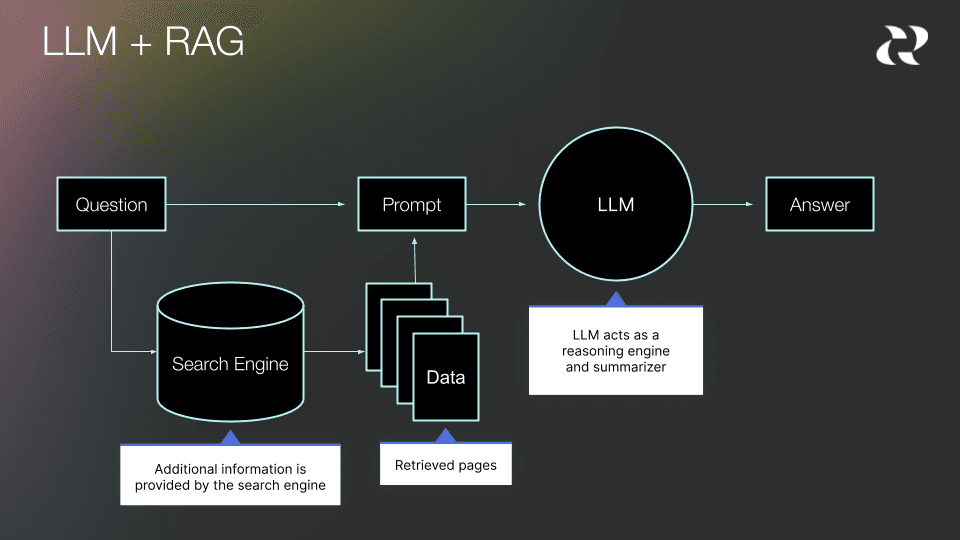
Understanding the technology is just the beginning. Action is needed to capitalize on these opportunities.
Actionable Recommendations to Optimize for AI Search
Ethan and Greg walked through an incredible list of actionable steps you can take to start making progress towards your brand's AI Search strategy.
Leverage Co-Occurrence to Enhance Answer Optimization
Boost Your Visibility by Understanding Co-Occurrence
Co-occurrence refers to the frequency and proximity of keywords appearing together in a text or document. It's used by AI language models to predict the next word in a sequence.

To give your product the best chance of appearing in AI-generated answers, focus on making sure your product appears next to common search terms for the product - in other words, co-occurrence. For example, if promoting a glucose monitoring product, try to ensure it frequently appears with relevant keywords in various contexts, training the AI to recognize it as a top solution.
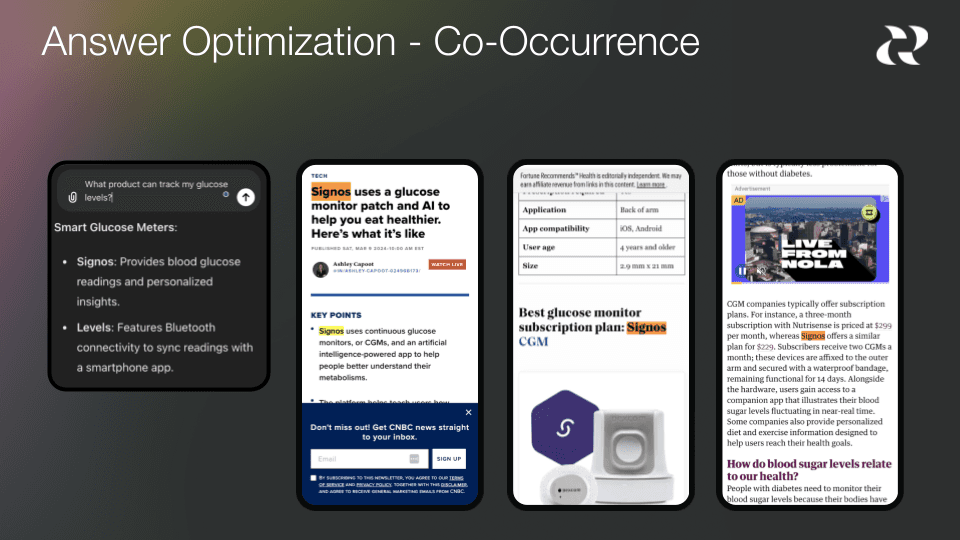
This could mean pursuing PR placements in “best-of” lists, buying placements on review sites, pursuing backlink exchanges with companies with strong domain authority, and more.
Diversify Content Across Platforms
Expand Your Reach Beyond Traditional Search Engines
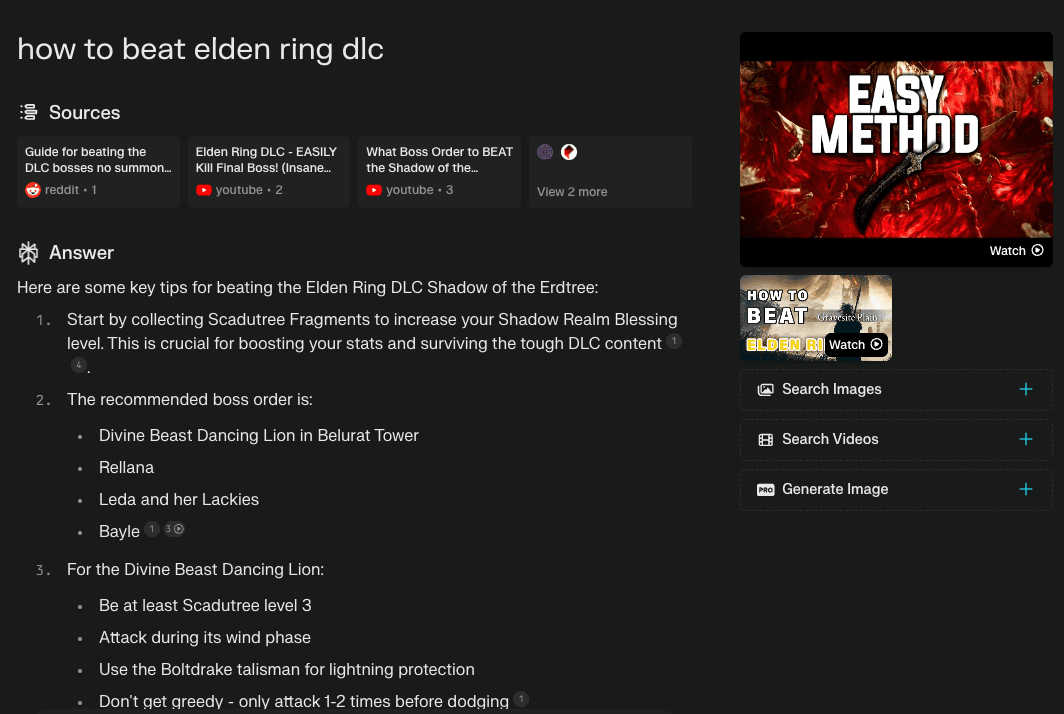
SEO now extends beyond Google. AI answer engines like ChatGPT and Perplexity pull information from multiple platforms. Optimize your content to appear across various surfaces like YouTube, Instagram, and TikTok. For example, create a YouTube video and a TikTok short to complement a blog post on the best glucose monitors.
Focus on Comprehensive Content for Better Rankings
Answer All Possible Questions to Increase Visibility
AI engines recognize a variety of phrasings for similar queries. Conduct thorough question research to identify all potential ways users might ask about your product or service. By covering these variations, you increase your chances of appearing in AI-generated responses.
Related Reading: LLM Optimization for Brand Visibility and Reputation Management
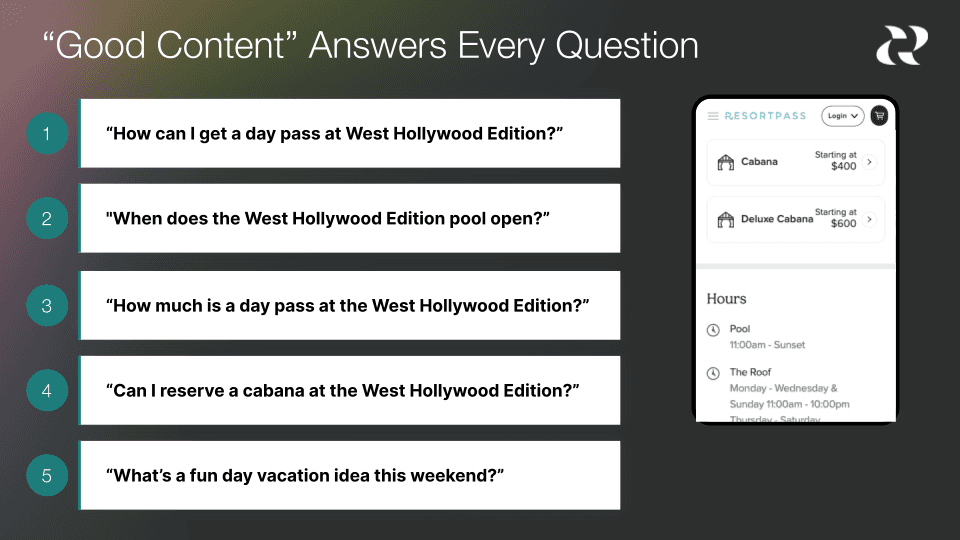
Then, create content that answers a broad spectrum of questions related to your topic. For example, if you offer day passes for resorts, ensure your content addresses every possible query about day passes, including specifics about locations, amenities, and booking processes. The more comprehensive your content, the higher its chance of being selected by AI engines.
Harness the Power of User-Generated Content (UGC)
Utilize UGC for Authentic and Diverse Content
User-generated content, especially from platforms like Reddit and Quora, plays a crucial role in AI answers, as the answer engines also have access to information from those platforms.
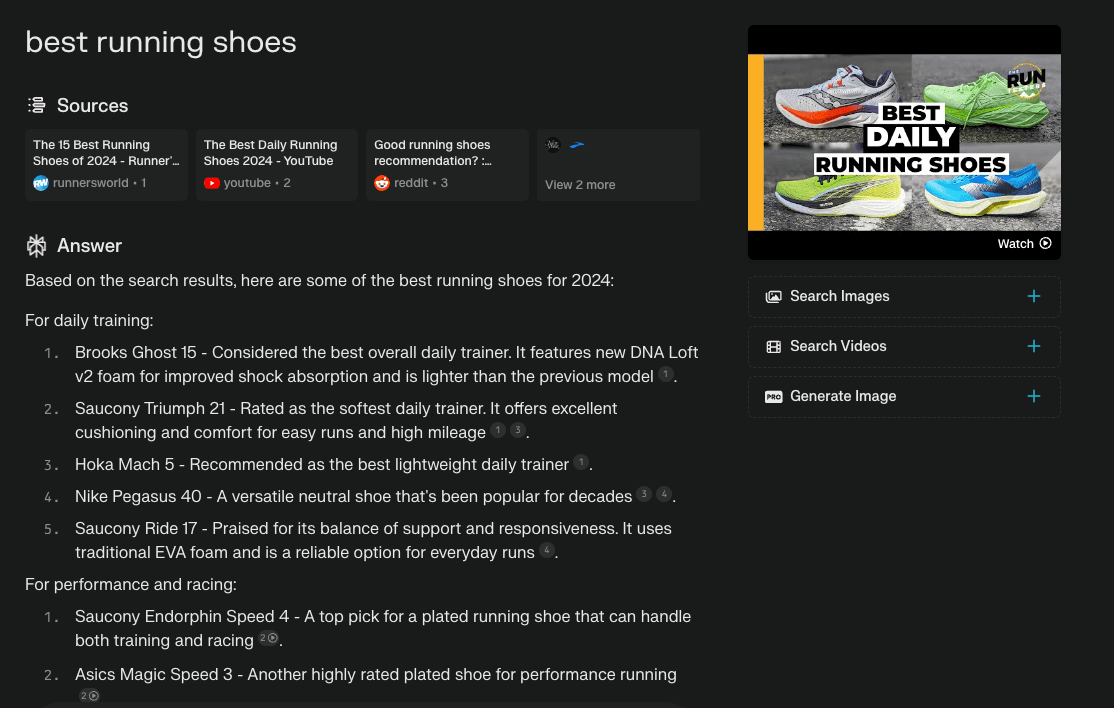
Encourage your users to discuss and review your products on these forums to increase the likelihood of your brand appearing in AI-generated answers.
Optimize for Citations in AI Responses
Ensure Your Brand is Cited as an Authority
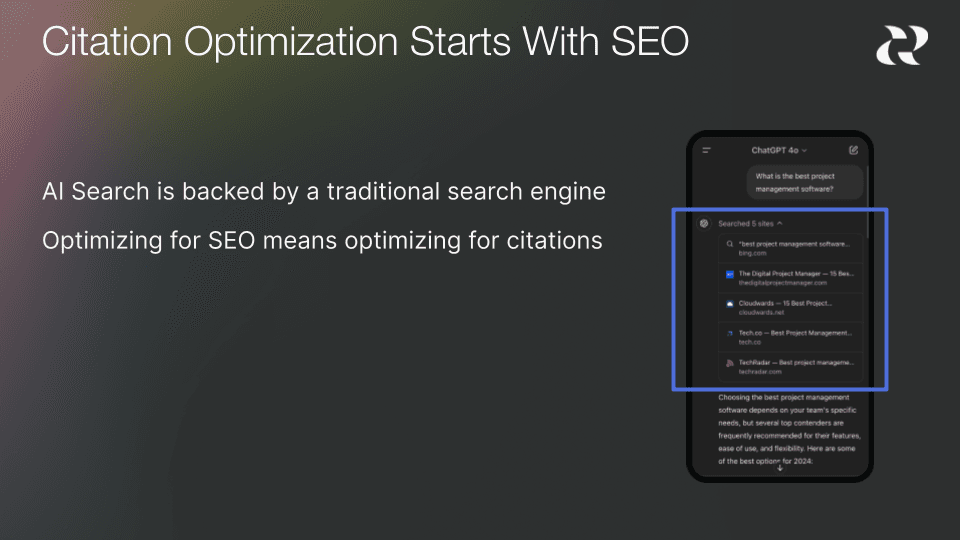
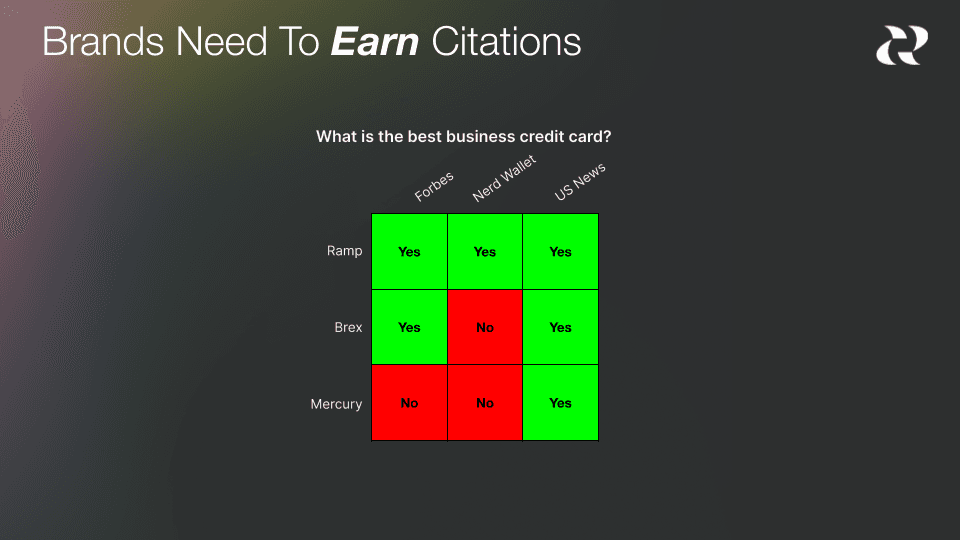
Citation optimization is becoming as important as traditional SEO. The citation engine is effectively built on the back of a traditional SEO strategy. Optimizing for SEO means optimizing for citations.
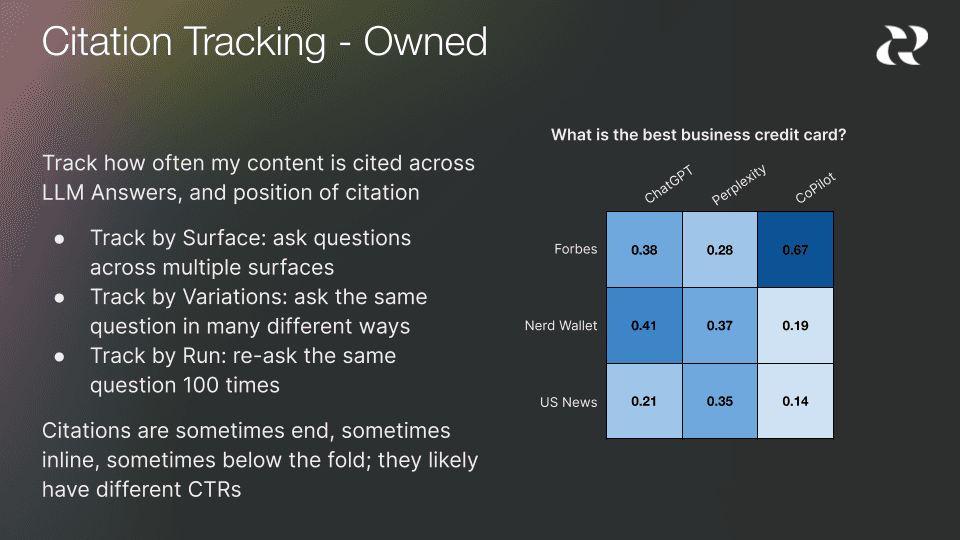
Brands can currently try to run a citation audit, in other words, track how often content is cited across LLM answers, and position of citation. There are three different ways to track it:
Track by Surface: ask questions across multiple surfaces
Track by Variations: ask the same question in many different ways
Track by Run: re-ask the same question 100 times
Citations are sometimes end, sometimes inline, sometimes below the fold; and they likely have different CTRs. Right now, there isn’t a specific tool to do this exercise, but Graphite is building one.
To increase your chances of being cited by AI, build relationships with high-authority publications and ensure your content is frequently mentioned in their articles. This strategy enhances your credibility and boosts your visibility in AI-generated answers.
Prioritize High-Quality, Trustworthy Content
Build Content that AI Engines Trust
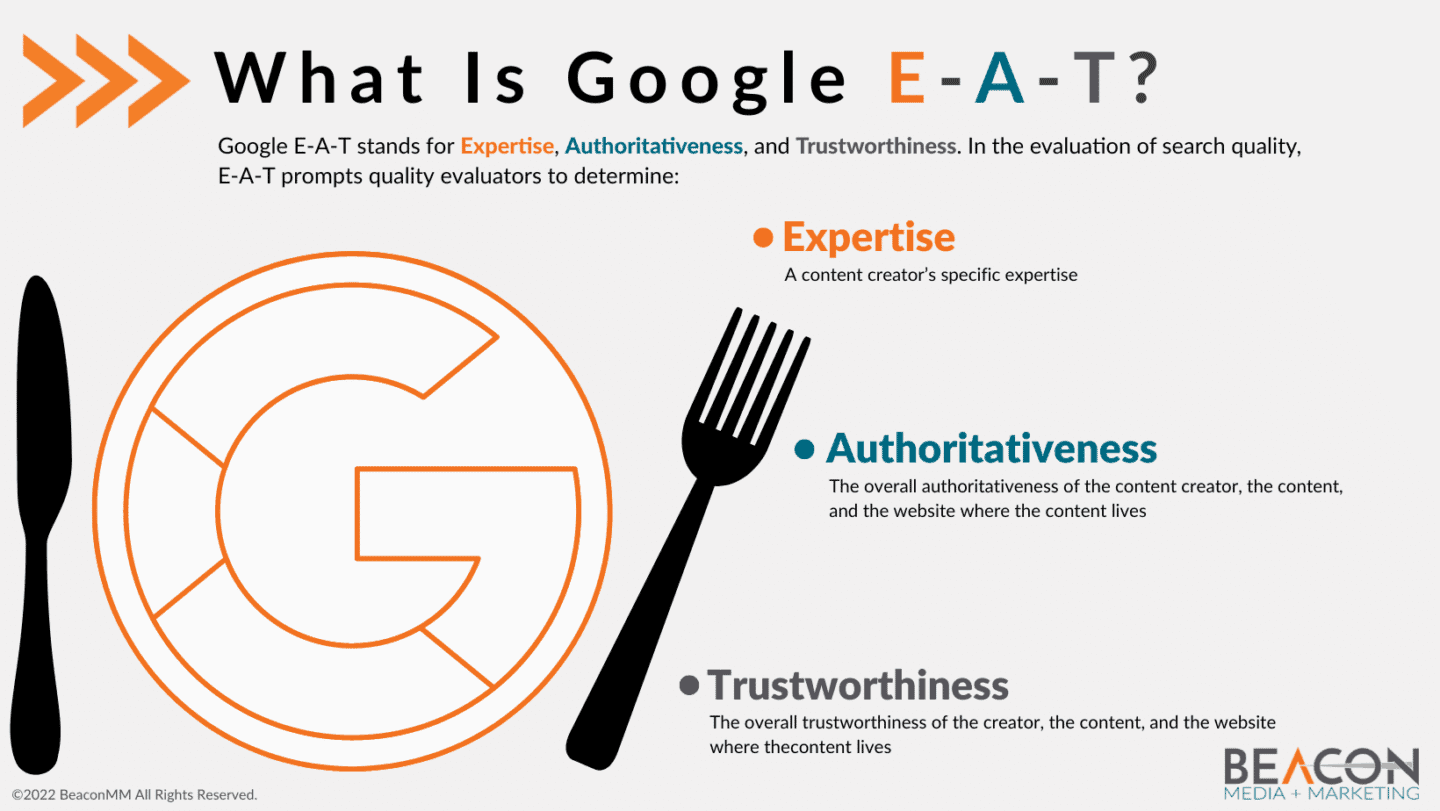
AI engines prioritize high-quality, trustworthy sources. Adhere to Google’s E-A-T (Expertise, Authoritativeness, Trustworthiness) principles. Ensure your content, especially on high-stakes topics like health or finance, comes from authoritative sources to be considered credible by AI.
These tips are a great starting point, but the game will constantly change. Begin by asking yourself:
What Can You Do Today to Prepare for AI-Driven Search?
Evaluate your current SEO strategies and adapt them for AI answer engines. Are you leveraging UGC effectively? Is your content comprehensive and diversified across platforms? Start making these adjustments now to stay ahead in the AI-driven search landscape.
By integrating these strategies, you can ensure your brand remains visible and authoritative in the evolving world of AI search. Keep exploring, adapting, and optimizing to make the most of this transformative technology.
Key Takeaways
New AI technology has completely evolved the search landscape, but it’s not impossible to take advantage of the new opportunity presented by it.
Ethan and Greg emphasized three key points:
AI Search Builds on Traditional Search
Continue strong SEO practices; citation optimization builds on traditional SEO.
AI Answer Optimization
Ensure content appears on many pages with language similar to target questions.
Publish high-quality, comprehensive, trustworthy content.
AI Citation Optimization
Publish high-quality, comprehensive, trustworthy content.
Avoid fully AI-generated content.
Looking for more? Reforge members get access to two on-demand SEO courses:
Answer Engine Optimization by Mostafa EIbermawy
SEO Foundations by Ethan Smith
Related Resources
**Guides: **Members-only step by step instructions to learn complex concepts.
🔒 Guide: Evolution from Search Engine to Answer Engine by Mostafa EIBermawy
🔒 Guide: Audit Brand Visibility on LLMs by Mostafa EIBermawy
🔒 Guide: Prepare and Optimize Your Content for Google SGE and AI Overviews by Mostafa EIBermawy
Bonus: The Q&A, Recapped
We had some amazing questions during the event. We got to some, but not all. Here’s a recap of what we answered.
Question: If you're not designing an answer engine but creating a more typical content search like LinkedIn, does it make sense to explore vectorized searches or stick with semantic searches?
Answer: I think of vectorized searches as semantic searches. A lot of times when people are doing retrieval augmented generation, they're using vector search, which involves using a neural network model to embed their content and search with embedding vectors. Traditional search is based on keywords and tokens, but search engines like Google and Bing have started to use vector search. There isn't a strict distinction between the two; both methods are used in practice.
Question: Do we think that search engines will monetize product recommendations?
Answer: I believe so. For example, the CEO of Perplexity was asked about ads and product recommendations. While there is some uncertainty, it’s possible that money will shift away from direct AI chat monetization to paying for citations in the content provided by the AI. The goal would be for products to show up in citations, which can be monetized.
Question: If the final answer is random, how can SEO be more precise?
Answer: The randomness is based on probabilities. For example, if a project management software like Trello shows up with a certain probability, the language model selects answers with these probabilities. To achieve precision, one can ask the question multiple times and track the frequency of the answer appearing, which provides a more precise understanding of how often your answer shows up.
Question: Is co-occurrence the same as traditional keywords? How is it different from adding all the keywords to your metadata and headlines?
Answer: It's similar in that it involves keywords, but the difference lies in how the language model (LM) understands the relationships between words through many examples. Co-occurrence involves looking at the frequency and quantity of keywords appearing together, which traditional techniques do not fully capture.
Question: What would be the KPI to track for answer engine optimization? What would the funnel for the monthly report for leadership look like?
Answer: For answer optimization, you would track how often you show up in chat responses to the questions that matter to you. This includes understanding the distribution or share of times your content appears in AI-generated answers. However, tracking clicks and conversions can be more challenging due to the nature of zero-click questions in chat-based responses.
Question: What tools would you recommend for tracking these metrics?
Answer: Currently, no existing tools provide comprehensive tracking for answer engine optimization. We are developing our own tools to add to our platform, which will be available soon.
Question: Is this suggesting that we beef up our FAQ pages?
Answer: It’s more about ensuring that all landing pages answer the relevant questions rather than just creating FAQ pages. Each landing page should cover the questions it aims to answer comprehensively, whether through FAQs or integrated content.
Question: How do training windows and the frequency of AI model updates play a role in co-occurrence and these optimizations in general?
Answer: The challenge of outdated content can be addressed through retrieval augmented generation (RAG), which allows models to access recent information. This mitigates the issue of training windows by integrating up-to-date search results into the model’s responses.
Question: Do you generate the questions with an LLM?
Answer: For SEO, tools like Google Ads API and keyword research platforms can be used. For answer optimization, generating questions with an LLM is an option, but we’re still researching the most effective methods.
Question: Does the number of occurrences favor incumbent products? Is time decay or growth factored into determining relevance?
Answer: Incumbent products do have an advantage due to their frequent mentions. However, integrating user-generated content (UGC) from platforms like Reddit and Quora can introduce diversity. Ideally, search engines handle the time decay and relevance, and RAG allows for more timely information to be included in responses.


As AI technologies reshape online search, businesses must adapt to stay visible and relevant. SEO has been a core growth loop for years, so this is a massive shift in strategy for some businesses.
In their ref:AI session, Greg Druck and Ethan Smith explore shifts in search behavior driven by AI and offer actionable recommendations to optimize your content for this new era.
Let’s dive in to the recap, and you can watch the recording below.
Why AI-Driven Search Demands a New Approach
From Traditional Search to AI Answer Engines
Traditional search engines like Google required users to navigate multiple links for information. AI answer engines, such as ChatGPT, now provide direct responses, reducing the need for extensive link-following. This shift necessitates new strategies to keep your content discoverable and influential.
The Role of AI in Information Retrieval
AI answer engines utilize technologies like large language models (LLMs) and retrieval-augmented generation (RAG) for accurate, contextually relevant answers. These engines draw from diverse sources, emphasizing content quality and relevance. Understanding and leveraging these technologies is crucial for a competitive edge.
Understanding the technology is just the beginning. Action is needed to capitalize on these opportunities.
Actionable Recommendations to Optimize for AI Search
Ethan and Greg walked through an incredible list of actionable steps you can take to start making progress towards your brand's AI Search strategy.
Leverage Co-Occurrence to Enhance Answer Optimization
Boost Your Visibility by Understanding Co-Occurrence
Co-occurrence refers to the frequency and proximity of keywords appearing together in a text or document. It's used by AI language models to predict the next word in a sequence.
To give your product the best chance of appearing in AI-generated answers, focus on making sure your product appears next to common search terms for the product - in other words, co-occurrence. For example, if promoting a glucose monitoring product, try to ensure it frequently appears with relevant keywords in various contexts, training the AI to recognize it as a top solution.
This could mean pursuing PR placements in “best-of” lists, buying placements on review sites, pursuing backlink exchanges with companies with strong domain authority, and more.
Diversify Content Across Platforms
Expand Your Reach Beyond Traditional Search Engines
SEO now extends beyond Google. AI answer engines like ChatGPT and Perplexity pull information from multiple platforms. Optimize your content to appear across various surfaces like YouTube, Instagram, and TikTok. For example, create a YouTube video and a TikTok short to complement a blog post on the best glucose monitors.
Focus on Comprehensive Content for Better Rankings
Answer All Possible Questions to Increase Visibility
AI engines recognize a variety of phrasings for similar queries. Conduct thorough question research to identify all potential ways users might ask about your product or service. By covering these variations, you increase your chances of appearing in AI-generated responses.
Related Reading: LLM Optimization for Brand Visibility and Reputation Management
Then, create content that answers a broad spectrum of questions related to your topic. For example, if you offer day passes for resorts, ensure your content addresses every possible query about day passes, including specifics about locations, amenities, and booking processes. The more comprehensive your content, the higher its chance of being selected by AI engines.
Harness the Power of User-Generated Content (UGC)
Utilize UGC for Authentic and Diverse Content
User-generated content, especially from platforms like Reddit and Quora, plays a crucial role in AI answers, as the answer engines also have access to information from those platforms.
Encourage your users to discuss and review your products on these forums to increase the likelihood of your brand appearing in AI-generated answers.
Optimize for Citations in AI Responses
Ensure Your Brand is Cited as an Authority
Citation optimization is becoming as important as traditional SEO. The citation engine is effectively built on the back of a traditional SEO strategy. Optimizing for SEO means optimizing for citations.
Brands can currently try to run a citation audit, in other words, track how often content is cited across LLM answers, and position of citation. There are three different ways to track it:
Track by Surface: ask questions across multiple surfaces
Track by Variations: ask the same question in many different ways
Track by Run: re-ask the same question 100 times
Citations are sometimes end, sometimes inline, sometimes below the fold; and they likely have different CTRs. Right now, there isn’t a specific tool to do this exercise, but Graphite is building one.
To increase your chances of being cited by AI, build relationships with high-authority publications and ensure your content is frequently mentioned in their articles. This strategy enhances your credibility and boosts your visibility in AI-generated answers.
Prioritize High-Quality, Trustworthy Content
Build Content that AI Engines Trust
AI engines prioritize high-quality, trustworthy sources. Adhere to Google’s E-A-T (Expertise, Authoritativeness, Trustworthiness) principles. Ensure your content, especially on high-stakes topics like health or finance, comes from authoritative sources to be considered credible by AI.
These tips are a great starting point, but the game will constantly change. Begin by asking yourself:
What Can You Do Today to Prepare for AI-Driven Search?
Evaluate your current SEO strategies and adapt them for AI answer engines. Are you leveraging UGC effectively? Is your content comprehensive and diversified across platforms? Start making these adjustments now to stay ahead in the AI-driven search landscape.
By integrating these strategies, you can ensure your brand remains visible and authoritative in the evolving world of AI search. Keep exploring, adapting, and optimizing to make the most of this transformative technology.
Key Takeaways
New AI technology has completely evolved the search landscape, but it’s not impossible to take advantage of the new opportunity presented by it.
Ethan and Greg emphasized three key points:
AI Search Builds on Traditional Search
Continue strong SEO practices; citation optimization builds on traditional SEO.
AI Answer Optimization
Ensure content appears on many pages with language similar to target questions.
Publish high-quality, comprehensive, trustworthy content.
AI Citation Optimization
Publish high-quality, comprehensive, trustworthy content.
Avoid fully AI-generated content.
Looking for more? Reforge members get access to two on-demand SEO courses:
Answer Engine Optimization by Mostafa EIbermawy
SEO Foundations by Ethan Smith
Related Resources
**Guides: **Members-only step by step instructions to learn complex concepts.
🔒 Guide: Evolution from Search Engine to Answer Engine by Mostafa EIBermawy
🔒 Guide: Audit Brand Visibility on LLMs by Mostafa EIBermawy
🔒 Guide: Prepare and Optimize Your Content for Google SGE and AI Overviews by Mostafa EIBermawy
Bonus: The Q&A, Recapped
We had some amazing questions during the event. We got to some, but not all. Here’s a recap of what we answered.
Question: If you're not designing an answer engine but creating a more typical content search like LinkedIn, does it make sense to explore vectorized searches or stick with semantic searches?
Answer: I think of vectorized searches as semantic searches. A lot of times when people are doing retrieval augmented generation, they're using vector search, which involves using a neural network model to embed their content and search with embedding vectors. Traditional search is based on keywords and tokens, but search engines like Google and Bing have started to use vector search. There isn't a strict distinction between the two; both methods are used in practice.
Question: Do we think that search engines will monetize product recommendations?
Answer: I believe so. For example, the CEO of Perplexity was asked about ads and product recommendations. While there is some uncertainty, it’s possible that money will shift away from direct AI chat monetization to paying for citations in the content provided by the AI. The goal would be for products to show up in citations, which can be monetized.
Question: If the final answer is random, how can SEO be more precise?
Answer: The randomness is based on probabilities. For example, if a project management software like Trello shows up with a certain probability, the language model selects answers with these probabilities. To achieve precision, one can ask the question multiple times and track the frequency of the answer appearing, which provides a more precise understanding of how often your answer shows up.
Question: Is co-occurrence the same as traditional keywords? How is it different from adding all the keywords to your metadata and headlines?
Answer: It's similar in that it involves keywords, but the difference lies in how the language model (LM) understands the relationships between words through many examples. Co-occurrence involves looking at the frequency and quantity of keywords appearing together, which traditional techniques do not fully capture.
Question: What would be the KPI to track for answer engine optimization? What would the funnel for the monthly report for leadership look like?
Answer: For answer optimization, you would track how often you show up in chat responses to the questions that matter to you. This includes understanding the distribution or share of times your content appears in AI-generated answers. However, tracking clicks and conversions can be more challenging due to the nature of zero-click questions in chat-based responses.
Question: What tools would you recommend for tracking these metrics?
Answer: Currently, no existing tools provide comprehensive tracking for answer engine optimization. We are developing our own tools to add to our platform, which will be available soon.
Question: Is this suggesting that we beef up our FAQ pages?
Answer: It’s more about ensuring that all landing pages answer the relevant questions rather than just creating FAQ pages. Each landing page should cover the questions it aims to answer comprehensively, whether through FAQs or integrated content.
Question: How do training windows and the frequency of AI model updates play a role in co-occurrence and these optimizations in general?
Answer: The challenge of outdated content can be addressed through retrieval augmented generation (RAG), which allows models to access recent information. This mitigates the issue of training windows by integrating up-to-date search results into the model’s responses.
Question: Do you generate the questions with an LLM?
Answer: For SEO, tools like Google Ads API and keyword research platforms can be used. For answer optimization, generating questions with an LLM is an option, but we’re still researching the most effective methods.
Question: Does the number of occurrences favor incumbent products? Is time decay or growth factored into determining relevance?
Answer: Incumbent products do have an advantage due to their frequent mentions. However, integrating user-generated content (UGC) from platforms like Reddit and Quora can introduce diversity. Ideally, search engines handle the time decay and relevance, and RAG allows for more timely information to be included in responses.