Reforge has joined Miro ↗
Article details
Most companies are lying to themselves about AI transformation. It’s easy to write a memo about how your company is fully adopting AI, but talk doesn’t change behavior.
This gap is bigger than most realize. Companies are shipping AI products faster than customers can keep up and LinkedIn is flooded with hot takes. There is so much noise out there.
“AI will enable solo founders to build billion-dollar companies.”
“We built our entire SaaS product in 48 hours using nothing but GPT-4 prompts.”
“Our AI agent automatically maintains and evolves our codebase.”
“We replaced our entire customer support team with an AI.”
I’ve been spending time talking to more 50 VP and C-Level product leaders to try and get a sense of what is actually happening. One exec summed up what I heard on almost every single call: “We’re caught in a tension between the narrative that ‘everyone is doing AI’ and our reality of still exploring the right fit.” For most, it’s getting uncomfortable to balance urgency with the inherently slow nature of organizational change.
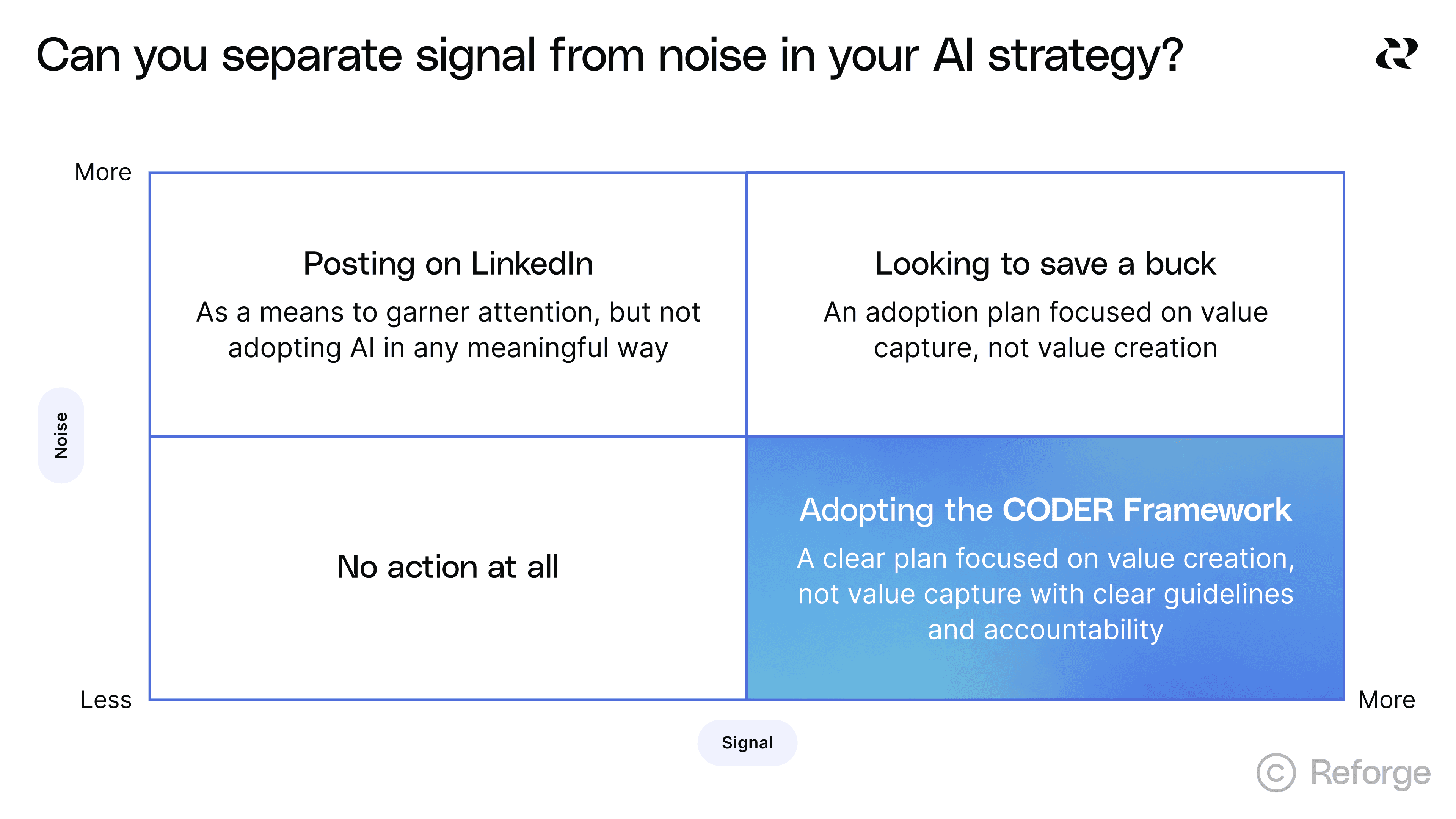
I believe the goal is total AI transformation. The first step is gaining efficiency, but the second (and harder) step is finding new ways to create value for your customers.
To unlock that second step, there are a few fundamental ideas you need to accept:
Every person in your company can now write, design and code. The lines between roles are blurring and this can completely change the way work gets done.
Layering in AI to improve existing process will offer only incremental benefits, with the most useful side effect being that your team learns to use AI.
Your new job is create an organization that is both willing and able to rethink work from the ground up.
The work isn’t easy, but the opportunity is massive. In this article, I’ll share our CODER framework for AI adoption, but first let’s talk talk about the scope of change and the common barriers to it.
Stop Running In Place: Capture Value, Not Just Efficiency
Here's where most companies get AI adoption wrong. They focus on making existing work 10-15% more efficient instead of asking what new possibilities exist.
The first wave of AI adoption has been about value capture—using AI to cut costs and squeeze more efficiency from current processes. Customer support chatbots, automated code reviews, and AI-powered content generation all fall into this category. These applications deliver measurable ROI, but they're essentially defensive moves. Defense alone doesn’t put enough points on the board to win.
The real competitive advantage comes from value creation—using AI to deliver entirely new capabilities to your customers. Box CEO Aaron Levie put this niceIy in a LinkedIn post: “In most businesses there’s a near infinite backlog of this kind of work if you just start to ask the question of ‘what if X thing was all of a sudden 100X cheaper or more accessible, what more could you do?’”
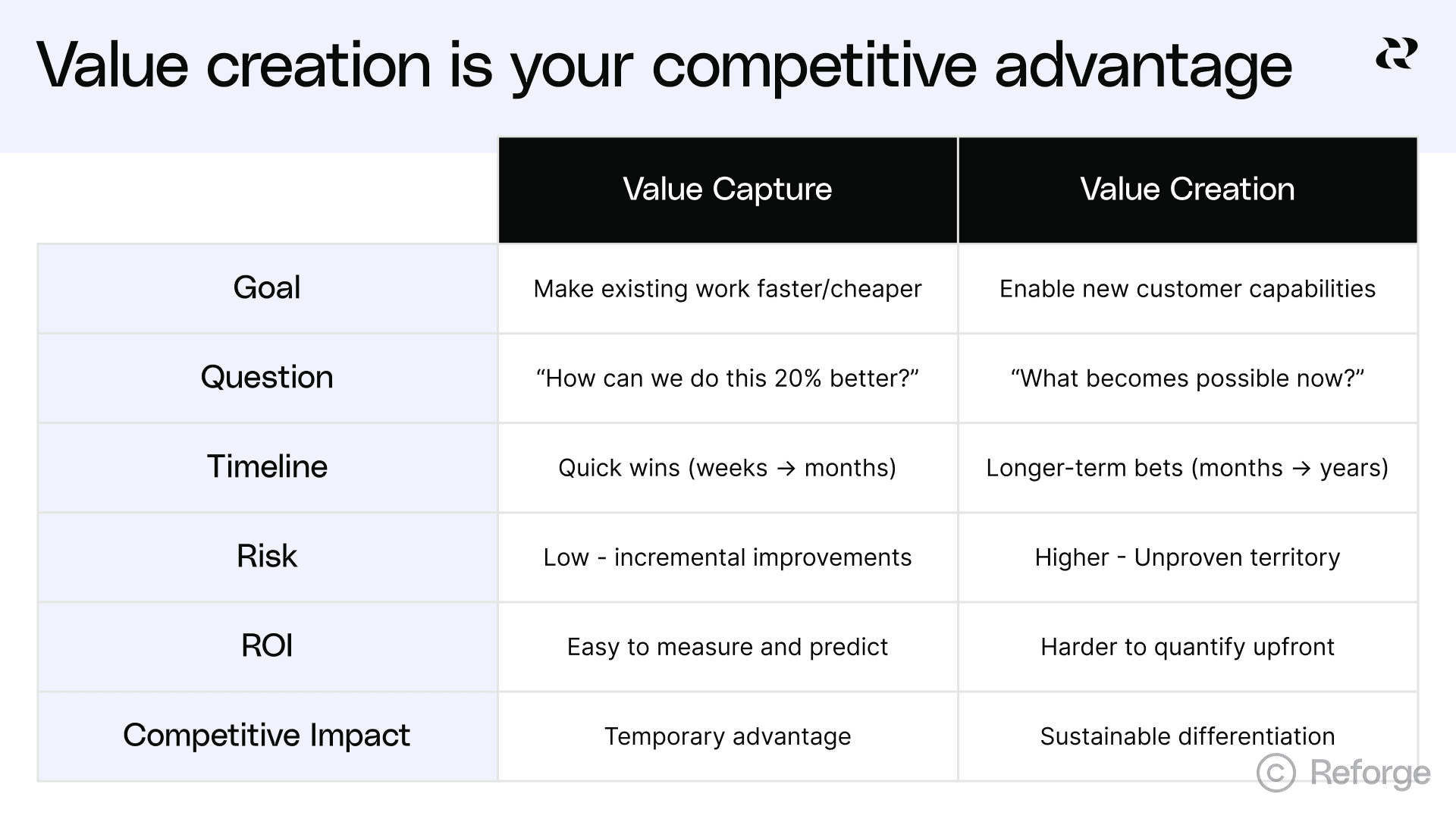
Value Capture: Just a Starting Point
Most AI implementations start here because the ROI is obvious and the risk is low. You're essentially making your existing processes faster or cheaper.
Here are some common value capture applications:
Customer support chatbots that handle 70% of tickets
AI code reviews that catch bugs before deployment
Automated content generation for marketing campaigns
Expense report processing and invoice management
Companies love value capture because it's easy to measure, quick to implement, and doesn't require fundamental changes to how work gets done. But the ceiling here is low. You're competing on efficiency, not differentiation. Your competitors can implement the same cost savings, which means you're all running to stay in the same place.
Value Creation: The Competitive Moat
Value capture asks, "How can we do this 15% better?" Value creation asks, "What work aren't we doing because it was previously impossible or prohibitively expensive?”
Here are a few examples of value creation:
Duolingo doubled their language courses in one year. And that’s not just content creation. AI grades the difficulty of courses for individual users in real-time. It can adjust lessons to be easier when a user is struggling or more difficult when they need to be challenged. (Source) CEO Luis von Ahn believes that the company owes this to its customers. He wrote on LinkedIn that, “Being AI-first means we will need to rethink much of how we work. Making minor tweaks to systems designed for humans won’t get us there.”
HubSpot's AI-powered marketing insights analyze customer behavior patterns across thousands of companies to provide personalized recommendations. This wasn't possible when insights required manual analysis. Because it has access to data across marketing, sales and support, HubSpot can provide a truly comprehensive view of customers that wasn’t previously possible. Nicholas Holland, Head of AI and SVP Product at HubSpot believes that ”software as a service” is turning into “results as a service.” He wrote in a blog post that, “We’re not building AI because it’s the latest tech trend — we’re using AI to deliver what customers are actually after: more leads, faster sales cycles, and better customer satisfaction.”
Notion's AI workspace doesn't just help you write faster—it understands your entire knowledge base and can synthesize information across documents in ways that fundamentally change how teams collaborate. The company believes this solves a handful of problems for AI adopters. Buy just one tool and you get integrated workflows across many use-cases, plus data security and a single learning curve for users.
Here's how to identify value creation opportunities:
Start with customer problems you've dismissed as "too hard":
What features do you tell customers "we can't build" because of resource constraints?
What customer requests get deprioritized because they're too time-intensive?
What would you offer if you had unlimited developer hours?
And look for "impossible economics":
What services require too much human involvement to scale?
What personalizations are too expensive to deliver?
What insights take too long to generate to be actionable?
Value capture is table stakes at this point. Value creation is how you gain a competitive advantage.
The Five Barriers to AI-Adoption (and Why It Won’t Happen by Accident)
AI transformation isn't blocked by technology limitations, it's blocked by organizational friction. As one product leader told me, "We have access to the same AI tools as everyone else, but we can't seem to get out of our own way."
Your AI adoption moves at the speed of the weakest part of your system. Most leaders don't even know what that part is, which means they're trying to solve the wrong problems.
Here are the five barriers that consistently emerge:
1. Political Barriers: When Roles Collide
AI gives everyone superpowers, but your org chart was designed for the pre-AI world. Engineers can now prototype UX flows, designers can write functional code, and PMs can create production-ready designs.
Rekki CTO Borislav Nikolov realized that non-technical employees were increasingly capable of at least simple coding. And while this sounds amazing in theory, in practice it creates political chaos.
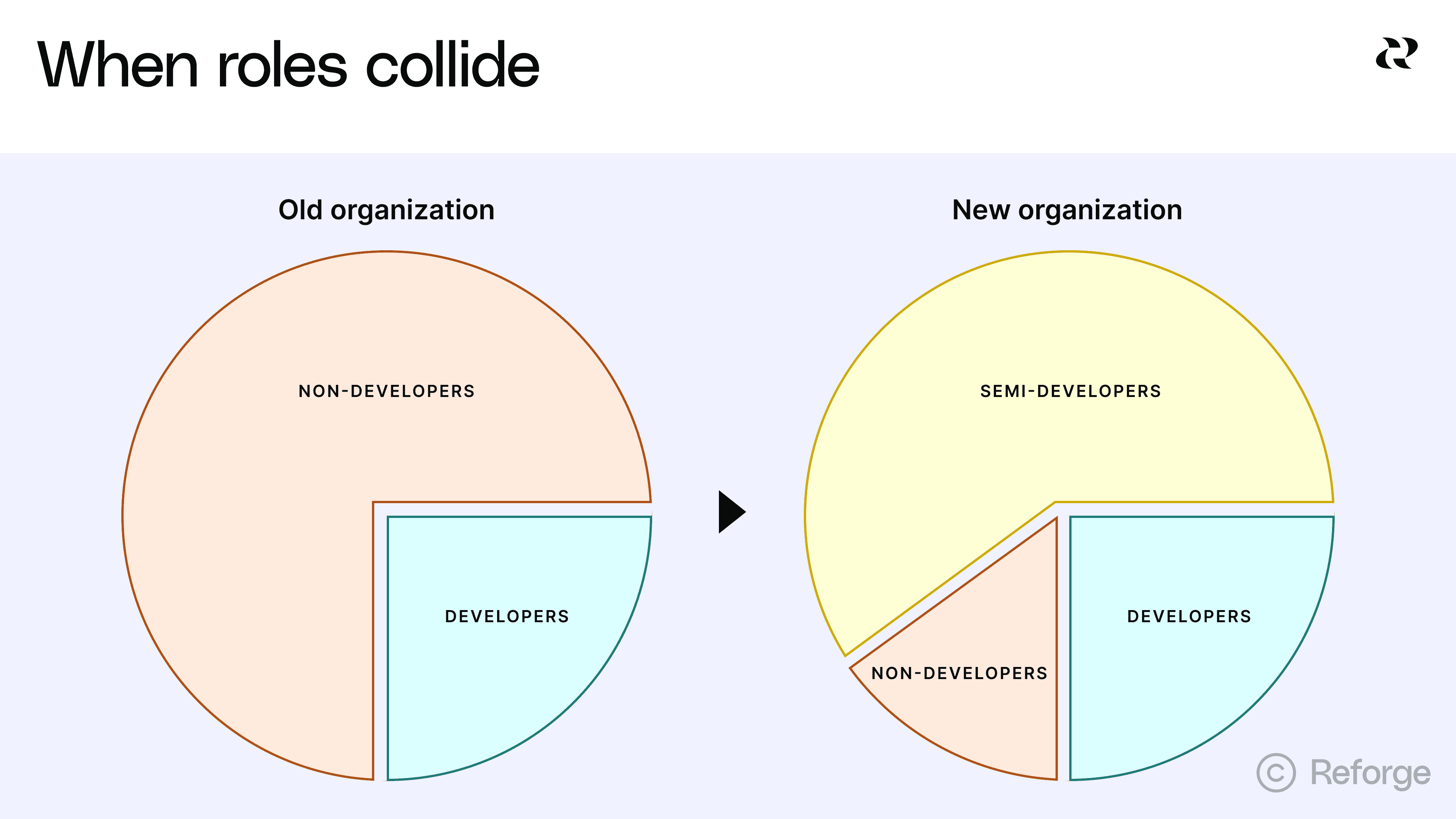
Traditional role boundaries are dissolving, but the political structures built around those boundaries remain intact. Your people want to experiment, but they're afraid of stepping on toes or being seen as overstepping their role. When they bump into red tape, they don’t want to “tattle” on their peers, so they drop projects rather than running the issue up the chain of command.
Takeaway: Teams are excited about AI capabilities but hesitant to use them because of unclear boundaries.
2. Retrofitting: The Incremental Trap
Most companies approach AI adoption by asking, "How can we make our existing processes 10% better?" This leads to retrofitting—layering AI onto existing workflows instead of reimagining them entirely.
Retrofitting feels safe and logical, but it only delivers incremental gains. You might save 30 minutes on a task that takes three hours and your team will get valuable exposure to AI tools, but you're missing the opportunity to approach the problem from a new angle. And in some cases, there’s a chance to eliminate the task entirely.
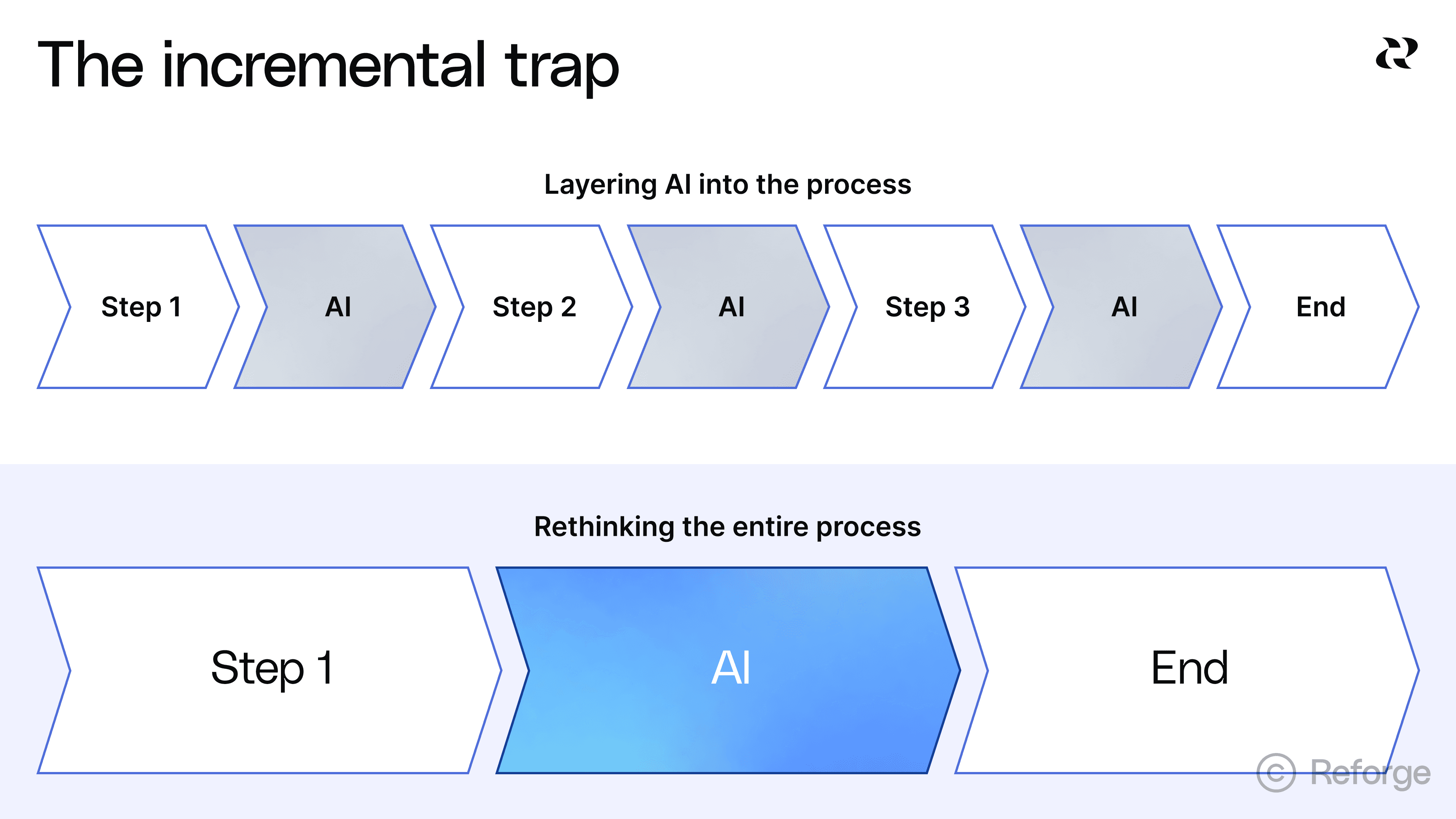
This is why so many CIOs are questioning the ROI of their AI investments. They're taking on the cost of AI tools and then measuring gains from incremental improvements rather than the transformational benefits of reimagined processes.
Takeaway: Your team is using AI to do existing work faster, but you're not seeing breakthrough improvements or entirely new capabilities.
3. Procurement Barriers: When Defense Controls Offense
Legal, IT, and finance teams have an important job—playing defense for the organization. But when defense controls the pace of change, you don't score points.
This shows up as:
Legal teams taking weeks to review one turn of revisions on AI tool agreements (adding up to months)
IT creating endless security checkboxes for low-risk experimentation
Finance applying 2022's "cut all SaaS spending" mentality to 2025's AI transformation
You’ll see news stories about massive adoption of new AI tools, but this is driven mostly by prosumers and startups. Larger B2B companies are still sorting out how to handle company-wide adoption.
The deeper problem is that these teams are often several steps removed from understanding the potential impact of AI tools. They focus on risk mitigation without weighing the opportunity cost of moving slowly. This is their job, of course, but as with other parts of organizational change, no one was fully prepared for just how transformative AI is. It’s happening faster and offering more promise than anything in the last 20+ years.
Livestorm CEO Gilles Bertaux wrote on LinkedIn that his team is aiming for “100% AI adoption across all possible tools.” Specifically, he pushing his team to create agents and his philosophy is to create a solid foundation so that everyone can get to work:
Do the heavy lifting upfront (data sources, templates, prebuilt agents) so others can just build. …the technical setup is handled by Data Ops and myself, but agent building should not be officially assigned to a single team to avoid bottlenecks and ensure broader team learning.
Takeaway: Your most innovative people are frustrated by procurement timelines, or they're working around official processes entirely. The folks who are open to AI but not leading the way won’t even bother if there’s friction between them and new tools.
4. Knowledge Barriers: Surface Learning Isn't Enough
Reading newsletters and listening to podcasts won't drive organizational transformation. Most companies treat AI knowledge like any other professional development—allocate a small budget, share some resources, and expect people to figure it out.
But AI represents a step-function change that requires deeper, more coordinated learning. People need hands-on experience with tools, frameworks for thinking about problems differently, and time to develop new mental models.
Takeaway: People know AI is important and can speak the language, but they're not exactly sure how to change their day-to-day work.
5. Permission Barriers: The Fear of Doing Something Wrong
"I don't know if I have permission to do this, and I just don't want to do anything wrong."
This sentiment came up in nearly every conversation I had. Smart, capable people are paralyzed by uncertainty about what they're allowed to experiment with. They see AI's potential but don't know the boundaries.
The solution isn't necessarily giving everyone permission to use any AI tool—it's about communicating very clearly what people can and can't do. Some companies segment their employees, giving different groups different levels of access while they build confidence and governance.
Takeaway: People are asking lots of questions about permission, or worse, they're not experimenting at all because they're afraid of crossing an invisible line.
Most organizations struggle with multiple barriers simultaneously, but identifying your primary bottleneck is crucial. Are your people held back by unclear permissions, slow procurement, or role confusion?
The next step is building a systematic approach to address these barriers while driving real adoption. That's where having the CODER framework becomes essential.
The Reforge CODER Framework for AI Adoption
In programming, good code transforms inputs into predictable outputs through systematic steps. The CODER Framework does the same for AI adoption. It takes organizational chaos and transforms it into structured change through five essential elements.
A PM at a publicly-traded SaaS company told me this story that captures exactly what happens without the CODER framework. The CEO wrote an internal manifesto about the company’s commitment to AI. This PM was inspired to use to a vibe coding tool to prototype a new feature and quickly built something promising. But just as quickly, engineering and design pumped the brakes. The PM got discouraged and set the project aside.
A few weeks later at a company happy hour, this PM showed the prototype to the CEO, who was excited about it. And also frustrated that the chance for speed was lost to red tape. The next morning, the CEO green-lit the project and kicked off an evaluation of how the product is planning to adopt AI.
The CODER framework ensures you don’t leave this to a chance meeting at happy hour. Here are the required elements:
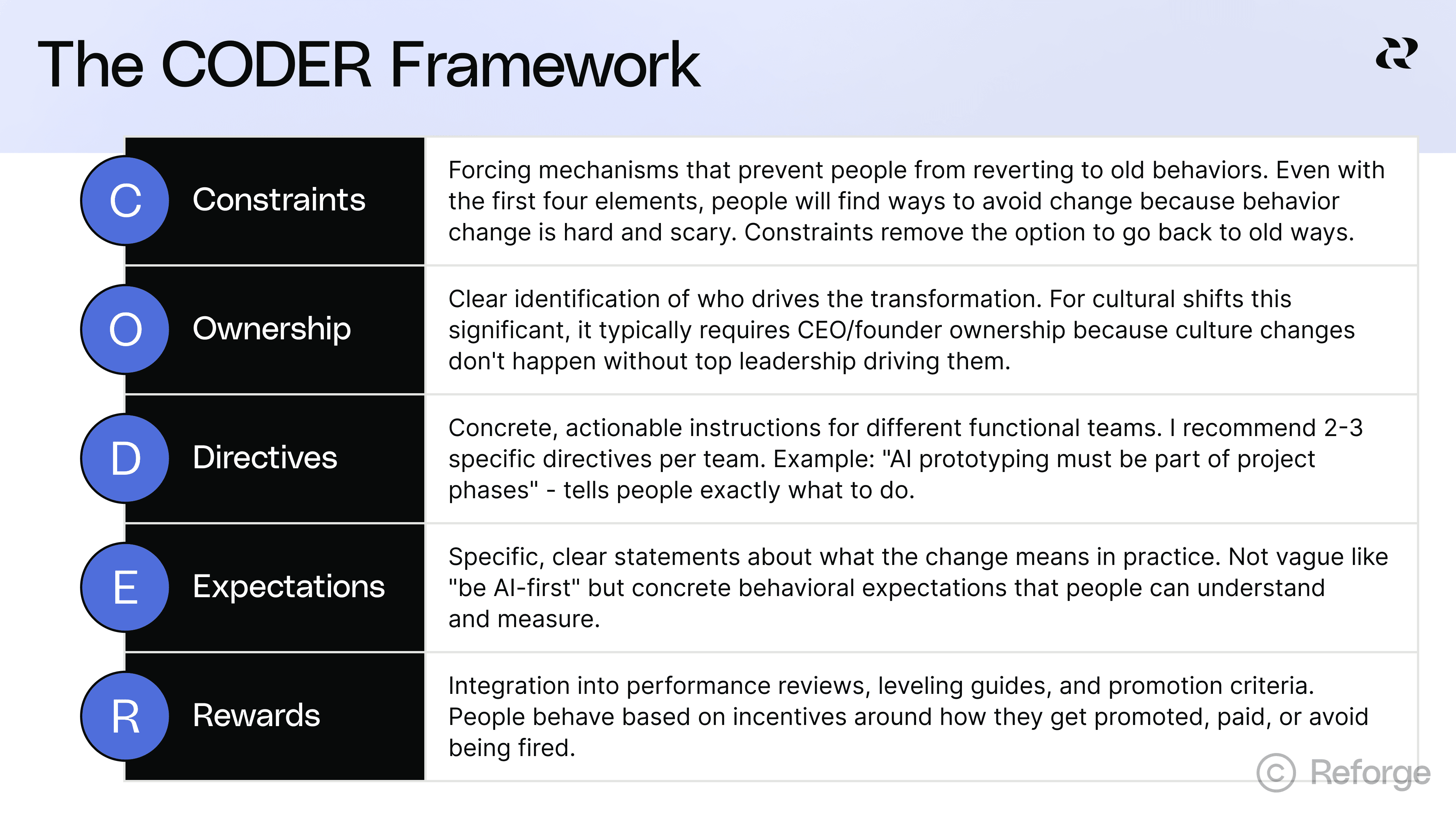
Here’s how Shopify’s memo lines up with this framework:
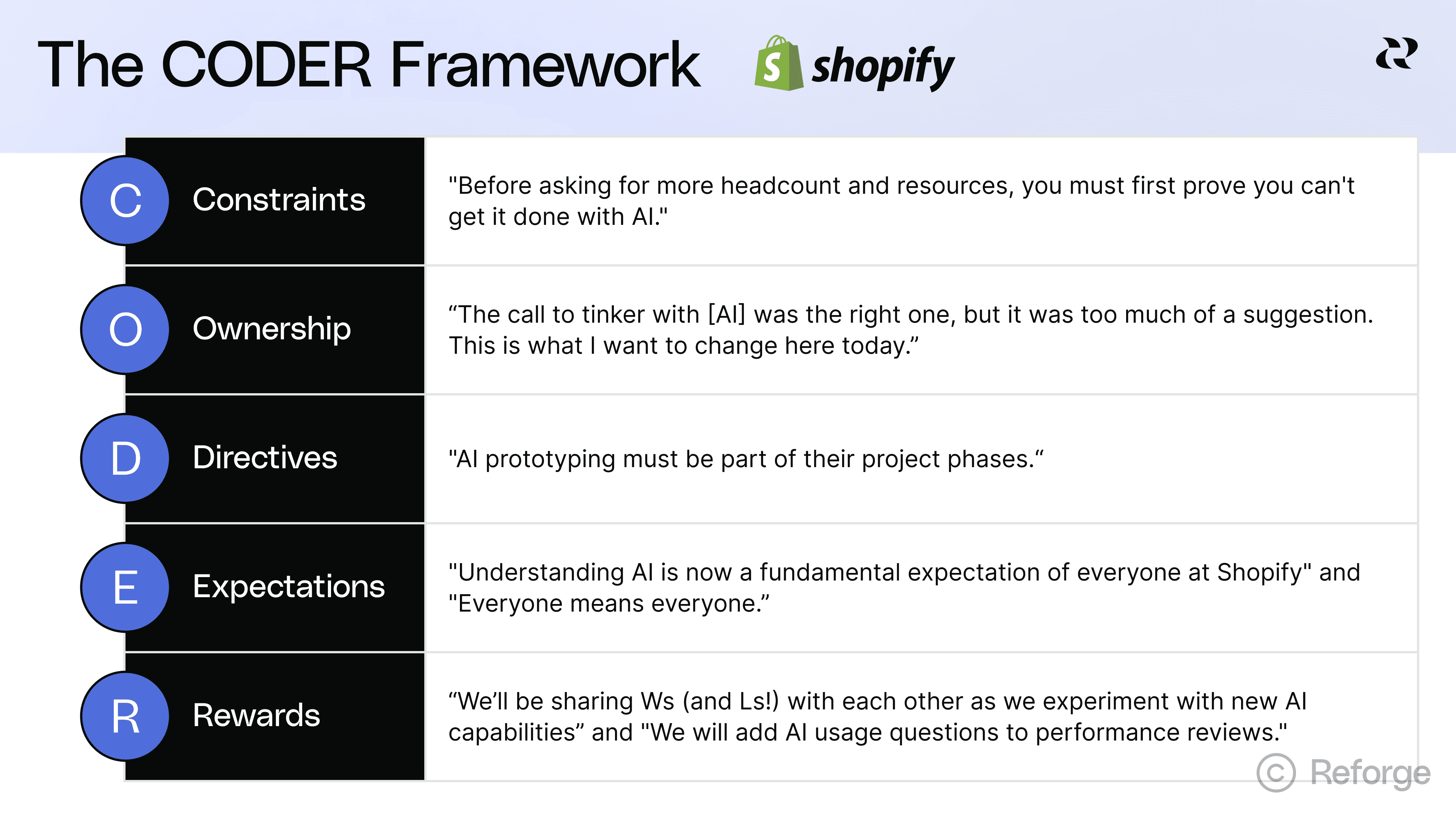
And here’s a more detailed look at each step of the adoption framework to help you understand exactly how to drive this change.
1. Constraints: The Most Important Element
Constraints are the most critical element of the framework. The psychology behind constraints is simple: they make the new behavior easier than the old behavior. Instead of AI adoption being an extra step, it becomes the natural path forward.
Here’s an example I heard from a leader at a leading AI company. They benchmark their team sizes against other companies with similar revenue and then cap their internal team sizes at 1/5 the benchmark. This forced their finance team, as an example, to learn SQL instead of asking to hire more analysts.
Behavior change is hard and scary, so people default to familiar approaches when pressure builds. Effective constraints fall into four categories:
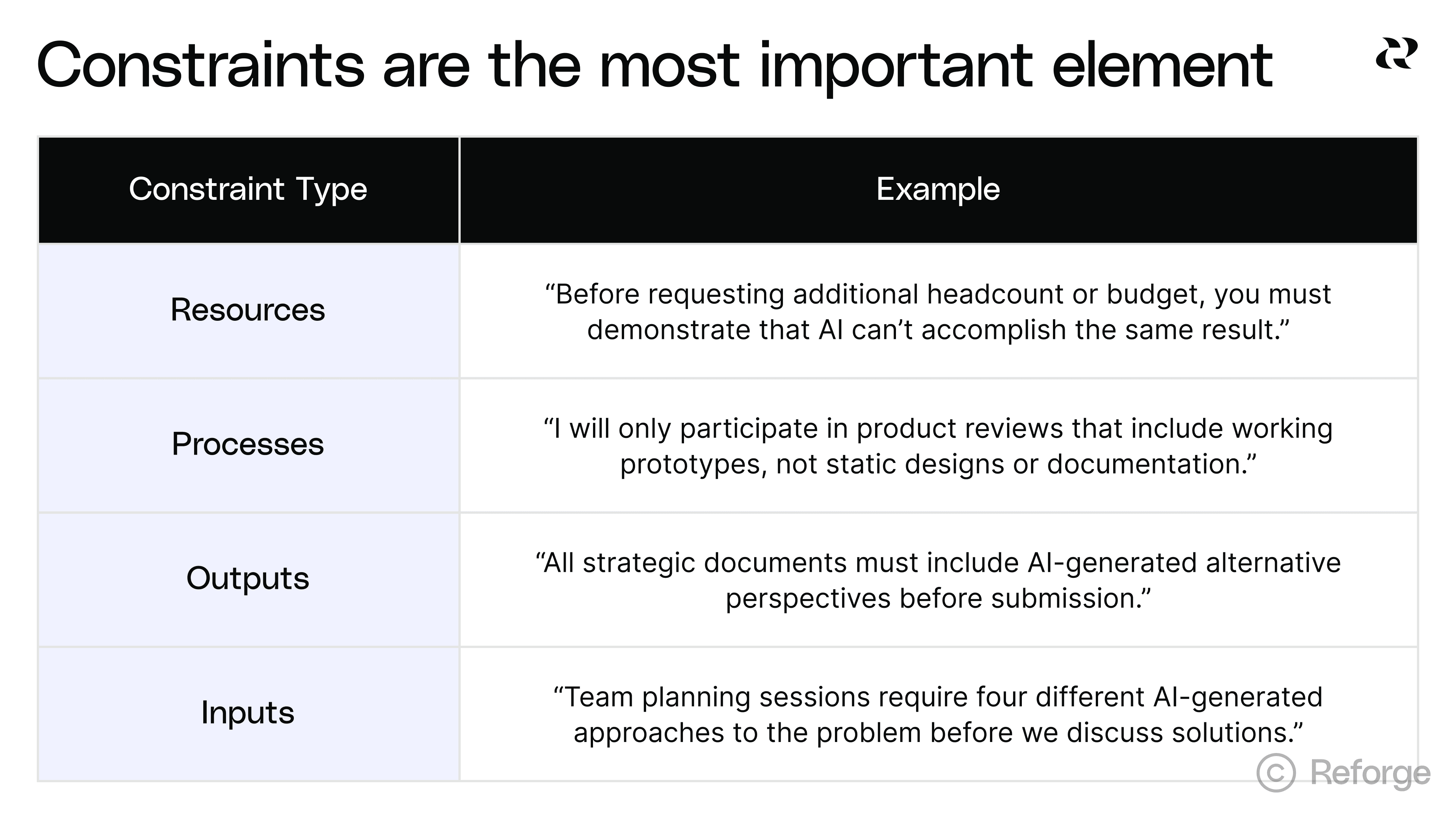
One particularly effective constraint I encountered was a CEO who announced, "I will only review work that demonstrates AI augmentation. If you can't show me how AI made your output better, faster, or more creative, we'll reschedule until you can."
This constraint forced every team to integrate AI into their workflows, not as an experiment, but as a requirement for leadership engagement.
2. Ownership: Someone Has to Drive the Bus
Who actually owns this transformation? You can't just declare that "we are AI-first" and expect change to happen. Someone needs to be the primary driver, making decisions and removing obstacles when teams get stuck.
For cultural shifts this significant, ownership typically needs to live at the CEO or founder level. This isn't because they need to become AI experts, but because changing how an entire organization works requires authority that only senior leadership possesses.
Take Shopify's approach. Tobi Lütke took personal ownership of the transformation. When teams hit procurement barriers or role confusion, they had clear escalation paths and decision-making authority.
But ownership can't stop at the top. Each functional leader needs to own the transformation for their specific teams:
The CPO owns how product teams integrate AI into development workflows
The CTO owns engineering adoption and technical infrastructure
The CMO owns marketing's transition to AI-assisted content creation
Some companies create a dedicated "VP of AI" role to coordinate across functions. This person acts as a bridge between teams that want to adopt AI and defensive functions (legal, IT, finance) that need to evaluate risk. Instead of having five different product managers trying to work through procurement individually, they have a single point of coordination.
3. Directives: Turn Inspiration Into Specific Action
Expectations set the bar, but directives tell people exactly what to do. This is where you move from "what good looks like" to "here's your next step."
The sweet spot is 2-3 specific directives per functional team. Too few leaves people confused about where to start. Too many creates overwhelm and analysis paralysis.
Effective directives are immediately actionable. People should be able to start implementing them right after hearing them, without waiting for additional resources or approval.
Here are examples of strong directives across different functions:
Product Development:
"All project phases must include AI prototyping before design reviews"
"User story creation requires AI-assisted persona validation"
Sales:
"CRM updates must use AI transcription and summary tools for all customer calls"
"Competitive intelligence reports require AI analysis of publicly available data"
Customer Success:
"Support ticket resolution must attempt AI-assisted solutions before escalation"
"Customer health scoring must incorporate AI analysis of usage patterns and communication sentiment"
Notice that these directives don't just say "use AI"—they specify exactly when and how AI should be integrated into existing workflows.
4. Expectations: Make the Abstract Concrete
Clear expectations translate high-level vision into specific, observable behaviors. Instead of vague aspirations, you need crystal clear statements about what AI adoption looks like in practice.
Good expectations have three characteristics:
Specificity: Instead of "use AI effectively," try "every product feature must include at least one AI-generated prototype in the review process."
Universality: Make it clear that expectations apply to everyone. As one CEO I spoke with put it: "Everyone means everyone. Nobody gets to opt out because they're 'not technical' or 'too senior.'"
Measurability: People should be able to assess whether they're meeting expectations without subjective interpretation.
And here's how different functions might translate general AI expectations into specific behaviors:
Product teams: "All user research synthesis must use AI analysis tools before presenting findings"
Engineering teams: "Code reviews must include AI-assisted security and performance analysis"
Marketing teams: "Campaign briefs require three AI-generated creative concepts before external agency work begins"
The goal isn't to micromanage, but to give people clear starting points when they ask, "What does AI adoption mean for my role?"
5. Rewards: Make It Matter for Careers
People change their behavior when change affects their career progression. Without accountability mechanisms, even the best intentions fade when deadlines get tight.
Accountability needs to be built into your existing performance management systems:
Performance Reviews: AI adoption becomes part of formal review processes. Not as an add-on, but integrated into how you evaluate core job performance.
Leveling Guides: Update role progression requirements to include AI competency. People can't advance to senior levels without demonstrating how they use AI to enhance their work.
Promotion Criteria: Make AI adoption a factor in promotion decisions. This creates clear career incentives for people who might otherwise see AI as "extra work."
One startup I spoke with restructured their engineering career ladder to include "AI-assisted development" as a core competency. Engineers couldn't reach senior levels without showing proficiency in code generation, automated testing, and AI-enhanced debugging.
Zapier measures AI fluency by role along a spectrum of adoption. This helps the team understand exactly what is expected of them and helps them understand how to up-skill.
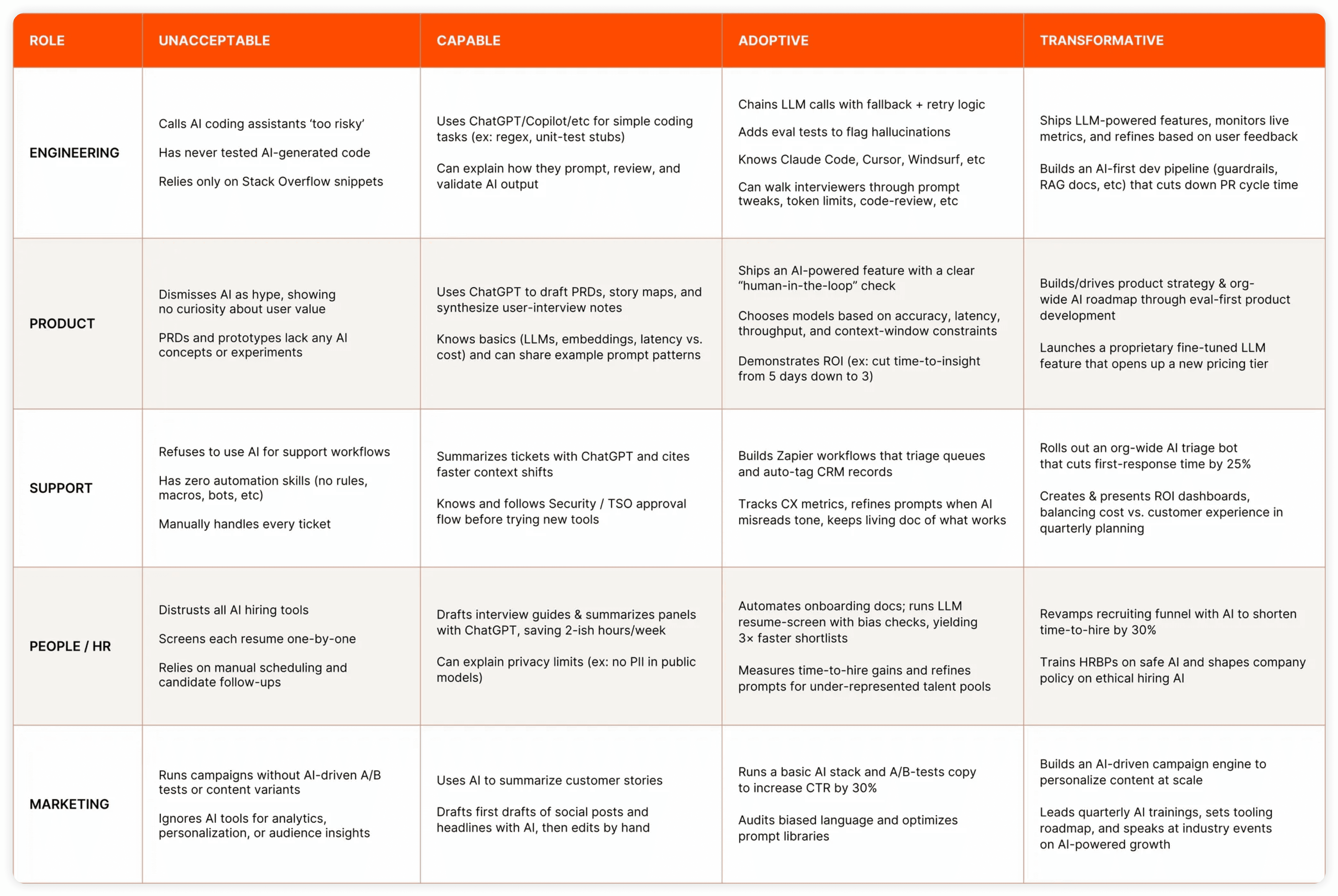
Rewards and accountability work because they align personal career growth with organizational AI adoption. People stop seeing AI as something they should do and start seeing it as something they must do to advance.
Good change doesn’t happen by accident.
The CODER framework works because it addresses transformation at multiple levels simultaneously. You're not just hoping people will change—you're creating systems that make change inevitable.
The next step is understanding how to apply this framework to your specific situation, which means thinking about your team's readiness for change.
The Three Types of AI Adopters: Catalysts, Converts, and Anchors
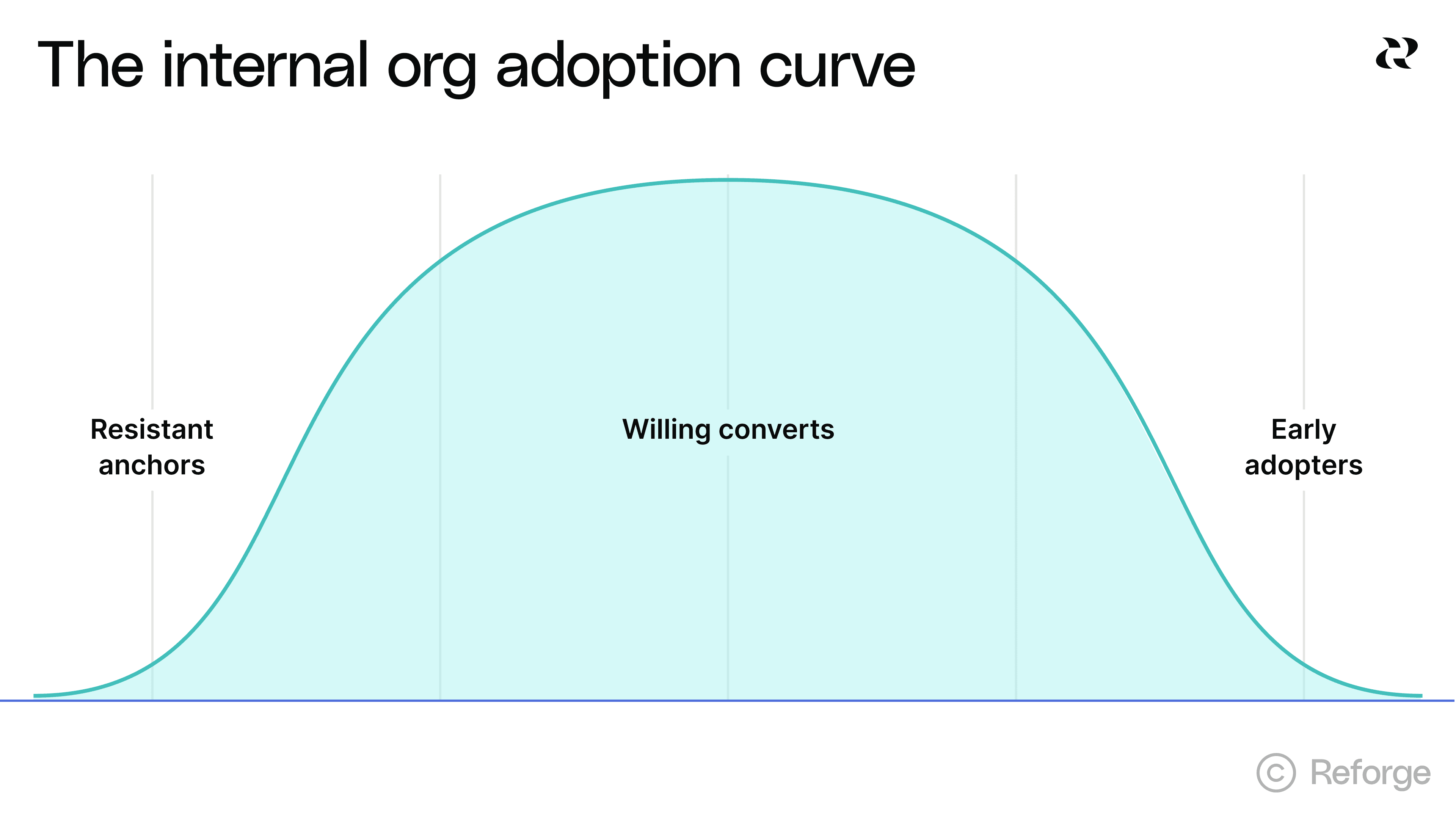
Not everyone will embrace AI change at the same pace, and you can expect to find varying levels of motivation and capability.
Every company has three distinct types of people when it comes to adopting new ways of working. Understanding each groups is critical because they require a completely different approaches.
In most organizations, you'll find roughly:
15-20% catalysts
60-70% converts
15-20% anchors
Your transformation success depends on converting the middle group while managing the extremes. You can't rely on catalysts alone (they're too small a percentage), and you can't let anchors slow down the entire organization.
Catalysts: Your Early Adopters
These are the people already experimenting with AI tools on personal accounts. They're finding ways around whatever rules you've set because they understand that staying current is non-negotiable for their careers.
Catalysts are deeply curious and intrinsically motivated. They're the ones who sign up for courses on their own time, fight to get AI tools expensed, and constantly share what they're learning with teammates.
What catalysts need from you:
Get out of their way!
Remove friction and barriers
Give them bigger, more challenging problems to solve
Amplify their successes to other teams
What not to do: Assume everyone is a catalyst. Only a small percentage are truly excited about AI and pushing the limits inside your company.
Founders and executives tend to be catalysts by nature, but you can’t expect that from an entire team. Very few people will adapt based only on your enthusiasm. Acknowledge that roughly 70% of your team needs structured support. Create learning paths, provide examples, and build scaffolding for the converts while giving catalysts room to experiment.
Converts: The Willing Majority
This is your largest group. Converts are willing to adopt AI, but they need support, structure, and clear guidance. They're not resistant to change, but they're also not going to figure it out entirely on their own.
Converts thrive with clear expectations, visible incentives, and scaffolding that helps them build confidence. They need to know the rules of the game and see that leadership is serious about the change.
What converts need from you:
Structured training and clear examples
Visible incentives tied to career progression
Regular check-ins and feedback
Internal success stories they can learn from
What not to do: Skip constraints. This group is willing to evolve, but still need constraints to prevent people from reverting to the “old way” of work.
Anchors: The Skeptics and Resisters
Every organization has people who will drag their feet on change. Some are skeptical about AI's value. Others are scared of learning new ways of working and maybe worried about job security. The most problematic are those who engage in quiet resistance, stalling programs while appearing to participate.
The hard truth about anchors is that you can't wait for them to come around gradually. The competitive stakes are too high, and the pace of change is too fast.
What anchors need from you:
Crystal clear expectations and timelines
Binary choices: get on board or get off the team
Support if they choose to adapt
Decisive action if they continue to resist
What not to do: Assume skeptics will eventually see the light if you just provide enough evidence and patience.
This comes back to accountability and expectations. Offer support for those willing to adapt, but don't let resistance slow down the entire organization. The reality is that in some cases the most compassionate thing you can do is help people find roles that better match their interests.
Create Dedicated Time and Space
Everyone has a choice when approaching their work. “Do I do my work the old known way and guarantee it gets done well?” Or, “do I risk experimenting with AI and if it doesn’t work I may miss the mark or have to play catch up?” You have to create dedicated time and space to break this cycle.
One simple way to build momentum is to create run hackathons. This could be an hour, a day or a week. Create time and space for people to tinker. This frees them up from day-to-day work to think more deeply, and helps even anchors start to see and feel what it’s like to be AI-native.
Zapier paused all work for an entire to host a massive hackathon. CEO Wade Foster insisted on “Full-company participation.” Here’s his assessment:
We wanted everyone in the company regardless of technical capability to get a tactile feel for what was changing. For engineering that might be building AI features. For non-technical teams that might mean adopting AI products in your day to day tasks. The message was "Everyone, let's get hands on keyboards. Build something real to develop a sense of what is possible with AI. Learn together." The hackathon and our other activities promoting AI worked. Usage surged. But more importantly, the AI builder mentality stuck.
Here’s a section of Zapier AI adoption handbook with more info.
You don’t need to stop the entire company for a week, but a series of 1-2 hackathons can be the tip of the spear to get people moving. It also creates camaraderie around AI. You want people to feel pulled to AI rather than pushed to it. Actually doing it is much more effective that directives and memos.
There’s Still Time to Gain a Competitive Advantage
The window for competitive advantage through AI adoption still exists but is narrowing rapidly. This is happening across every industry and category right now. Companies that implement the CODER framework in 2025 will build sustainable advantages over those that continue to experiment without systematic change.
The question isn't whether AI will transform how work gets done. The question is whether you'll lead that transformation or watch it happen around you.
A few recommendations:
Check out Reforge Insights - You have tons of data and customer feedback. Reforge Insights aggregates that data, analyzes it with AI, and helps you make smart, fast product decisions.
Reforge’s Product Strategy and AI Strategy courses to help you identify value creation opportunities within your own business.


Most companies are lying to themselves about AI transformation. It’s easy to write a memo about how your company is fully adopting AI, but talk doesn’t change behavior.
This gap is bigger than most realize. Companies are shipping AI products faster than customers can keep up and LinkedIn is flooded with hot takes. There is so much noise out there.
“AI will enable solo founders to build billion-dollar companies.”
“We built our entire SaaS product in 48 hours using nothing but GPT-4 prompts.”
“Our AI agent automatically maintains and evolves our codebase.”
“We replaced our entire customer support team with an AI.”
I’ve been spending time talking to more 50 VP and C-Level product leaders to try and get a sense of what is actually happening. One exec summed up what I heard on almost every single call: “We’re caught in a tension between the narrative that ‘everyone is doing AI’ and our reality of still exploring the right fit.” For most, it’s getting uncomfortable to balance urgency with the inherently slow nature of organizational change.
I believe the goal is total AI transformation. The first step is gaining efficiency, but the second (and harder) step is finding new ways to create value for your customers.
To unlock that second step, there are a few fundamental ideas you need to accept:
Every person in your company can now write, design and code. The lines between roles are blurring and this can completely change the way work gets done.
Layering in AI to improve existing process will offer only incremental benefits, with the most useful side effect being that your team learns to use AI.
Your new job is create an organization that is both willing and able to rethink work from the ground up.
The work isn’t easy, but the opportunity is massive. In this article, I’ll share our CODER framework for AI adoption, but first let’s talk talk about the scope of change and the common barriers to it.
Stop Running In Place: Capture Value, Not Just Efficiency
Here's where most companies get AI adoption wrong. They focus on making existing work 10-15% more efficient instead of asking what new possibilities exist.
The first wave of AI adoption has been about value capture—using AI to cut costs and squeeze more efficiency from current processes. Customer support chatbots, automated code reviews, and AI-powered content generation all fall into this category. These applications deliver measurable ROI, but they're essentially defensive moves. Defense alone doesn’t put enough points on the board to win.
The real competitive advantage comes from value creation—using AI to deliver entirely new capabilities to your customers. Box CEO Aaron Levie put this niceIy in a LinkedIn post: “In most businesses there’s a near infinite backlog of this kind of work if you just start to ask the question of ‘what if X thing was all of a sudden 100X cheaper or more accessible, what more could you do?’”
Value Capture: Just a Starting Point
Most AI implementations start here because the ROI is obvious and the risk is low. You're essentially making your existing processes faster or cheaper.
Here are some common value capture applications:
Customer support chatbots that handle 70% of tickets
AI code reviews that catch bugs before deployment
Automated content generation for marketing campaigns
Expense report processing and invoice management
Companies love value capture because it's easy to measure, quick to implement, and doesn't require fundamental changes to how work gets done. But the ceiling here is low. You're competing on efficiency, not differentiation. Your competitors can implement the same cost savings, which means you're all running to stay in the same place.
Value Creation: The Competitive Moat
Value capture asks, "How can we do this 15% better?" Value creation asks, "What work aren't we doing because it was previously impossible or prohibitively expensive?”
Here are a few examples of value creation:
Duolingo doubled their language courses in one year. And that’s not just content creation. AI grades the difficulty of courses for individual users in real-time. It can adjust lessons to be easier when a user is struggling or more difficult when they need to be challenged. (Source) CEO Luis von Ahn believes that the company owes this to its customers. He wrote on LinkedIn that, “Being AI-first means we will need to rethink much of how we work. Making minor tweaks to systems designed for humans won’t get us there.”
HubSpot's AI-powered marketing insights analyze customer behavior patterns across thousands of companies to provide personalized recommendations. This wasn't possible when insights required manual analysis. Because it has access to data across marketing, sales and support, HubSpot can provide a truly comprehensive view of customers that wasn’t previously possible. Nicholas Holland, Head of AI and SVP Product at HubSpot believes that ”software as a service” is turning into “results as a service.” He wrote in a blog post that, “We’re not building AI because it’s the latest tech trend — we’re using AI to deliver what customers are actually after: more leads, faster sales cycles, and better customer satisfaction.”
Notion's AI workspace doesn't just help you write faster—it understands your entire knowledge base and can synthesize information across documents in ways that fundamentally change how teams collaborate. The company believes this solves a handful of problems for AI adopters. Buy just one tool and you get integrated workflows across many use-cases, plus data security and a single learning curve for users.
Here's how to identify value creation opportunities:
Start with customer problems you've dismissed as "too hard":
What features do you tell customers "we can't build" because of resource constraints?
What customer requests get deprioritized because they're too time-intensive?
What would you offer if you had unlimited developer hours?
And look for "impossible economics":
What services require too much human involvement to scale?
What personalizations are too expensive to deliver?
What insights take too long to generate to be actionable?
Value capture is table stakes at this point. Value creation is how you gain a competitive advantage.
The Five Barriers to AI-Adoption (and Why It Won’t Happen by Accident)
AI transformation isn't blocked by technology limitations, it's blocked by organizational friction. As one product leader told me, "We have access to the same AI tools as everyone else, but we can't seem to get out of our own way."
Your AI adoption moves at the speed of the weakest part of your system. Most leaders don't even know what that part is, which means they're trying to solve the wrong problems.
Here are the five barriers that consistently emerge:
1. Political Barriers: When Roles Collide
AI gives everyone superpowers, but your org chart was designed for the pre-AI world. Engineers can now prototype UX flows, designers can write functional code, and PMs can create production-ready designs.
Rekki CTO Borislav Nikolov realized that non-technical employees were increasingly capable of at least simple coding. And while this sounds amazing in theory, in practice it creates political chaos.
Traditional role boundaries are dissolving, but the political structures built around those boundaries remain intact. Your people want to experiment, but they're afraid of stepping on toes or being seen as overstepping their role. When they bump into red tape, they don’t want to “tattle” on their peers, so they drop projects rather than running the issue up the chain of command.
Takeaway: Teams are excited about AI capabilities but hesitant to use them because of unclear boundaries.
2. Retrofitting: The Incremental Trap
Most companies approach AI adoption by asking, "How can we make our existing processes 10% better?" This leads to retrofitting—layering AI onto existing workflows instead of reimagining them entirely.
Retrofitting feels safe and logical, but it only delivers incremental gains. You might save 30 minutes on a task that takes three hours and your team will get valuable exposure to AI tools, but you're missing the opportunity to approach the problem from a new angle. And in some cases, there’s a chance to eliminate the task entirely.
This is why so many CIOs are questioning the ROI of their AI investments. They're taking on the cost of AI tools and then measuring gains from incremental improvements rather than the transformational benefits of reimagined processes.
Takeaway: Your team is using AI to do existing work faster, but you're not seeing breakthrough improvements or entirely new capabilities.
3. Procurement Barriers: When Defense Controls Offense
Legal, IT, and finance teams have an important job—playing defense for the organization. But when defense controls the pace of change, you don't score points.
This shows up as:
Legal teams taking weeks to review one turn of revisions on AI tool agreements (adding up to months)
IT creating endless security checkboxes for low-risk experimentation
Finance applying 2022's "cut all SaaS spending" mentality to 2025's AI transformation
You’ll see news stories about massive adoption of new AI tools, but this is driven mostly by prosumers and startups. Larger B2B companies are still sorting out how to handle company-wide adoption.
The deeper problem is that these teams are often several steps removed from understanding the potential impact of AI tools. They focus on risk mitigation without weighing the opportunity cost of moving slowly. This is their job, of course, but as with other parts of organizational change, no one was fully prepared for just how transformative AI is. It’s happening faster and offering more promise than anything in the last 20+ years.
Livestorm CEO Gilles Bertaux wrote on LinkedIn that his team is aiming for “100% AI adoption across all possible tools.” Specifically, he pushing his team to create agents and his philosophy is to create a solid foundation so that everyone can get to work:
Do the heavy lifting upfront (data sources, templates, prebuilt agents) so others can just build. …the technical setup is handled by Data Ops and myself, but agent building should not be officially assigned to a single team to avoid bottlenecks and ensure broader team learning.
Takeaway: Your most innovative people are frustrated by procurement timelines, or they're working around official processes entirely. The folks who are open to AI but not leading the way won’t even bother if there’s friction between them and new tools.
4. Knowledge Barriers: Surface Learning Isn't Enough
Reading newsletters and listening to podcasts won't drive organizational transformation. Most companies treat AI knowledge like any other professional development—allocate a small budget, share some resources, and expect people to figure it out.
But AI represents a step-function change that requires deeper, more coordinated learning. People need hands-on experience with tools, frameworks for thinking about problems differently, and time to develop new mental models.
Takeaway: People know AI is important and can speak the language, but they're not exactly sure how to change their day-to-day work.
5. Permission Barriers: The Fear of Doing Something Wrong
"I don't know if I have permission to do this, and I just don't want to do anything wrong."
This sentiment came up in nearly every conversation I had. Smart, capable people are paralyzed by uncertainty about what they're allowed to experiment with. They see AI's potential but don't know the boundaries.
The solution isn't necessarily giving everyone permission to use any AI tool—it's about communicating very clearly what people can and can't do. Some companies segment their employees, giving different groups different levels of access while they build confidence and governance.
Takeaway: People are asking lots of questions about permission, or worse, they're not experimenting at all because they're afraid of crossing an invisible line.
Most organizations struggle with multiple barriers simultaneously, but identifying your primary bottleneck is crucial. Are your people held back by unclear permissions, slow procurement, or role confusion?
The next step is building a systematic approach to address these barriers while driving real adoption. That's where having the CODER framework becomes essential.
The Reforge CODER Framework for AI Adoption
In programming, good code transforms inputs into predictable outputs through systematic steps. The CODER Framework does the same for AI adoption. It takes organizational chaos and transforms it into structured change through five essential elements.
A PM at a publicly-traded SaaS company told me this story that captures exactly what happens without the CODER framework. The CEO wrote an internal manifesto about the company’s commitment to AI. This PM was inspired to use to a vibe coding tool to prototype a new feature and quickly built something promising. But just as quickly, engineering and design pumped the brakes. The PM got discouraged and set the project aside.
A few weeks later at a company happy hour, this PM showed the prototype to the CEO, who was excited about it. And also frustrated that the chance for speed was lost to red tape. The next morning, the CEO green-lit the project and kicked off an evaluation of how the product is planning to adopt AI.
The CODER framework ensures you don’t leave this to a chance meeting at happy hour. Here are the required elements:
Here’s how Shopify’s memo lines up with this framework:
And here’s a more detailed look at each step of the adoption framework to help you understand exactly how to drive this change.
1. Constraints: The Most Important Element
Constraints are the most critical element of the framework. The psychology behind constraints is simple: they make the new behavior easier than the old behavior. Instead of AI adoption being an extra step, it becomes the natural path forward.
Here’s an example I heard from a leader at a leading AI company. They benchmark their team sizes against other companies with similar revenue and then cap their internal team sizes at 1/5 the benchmark. This forced their finance team, as an example, to learn SQL instead of asking to hire more analysts.
Behavior change is hard and scary, so people default to familiar approaches when pressure builds. Effective constraints fall into four categories:
One particularly effective constraint I encountered was a CEO who announced, "I will only review work that demonstrates AI augmentation. If you can't show me how AI made your output better, faster, or more creative, we'll reschedule until you can."
This constraint forced every team to integrate AI into their workflows, not as an experiment, but as a requirement for leadership engagement.
2. Ownership: Someone Has to Drive the Bus
Who actually owns this transformation? You can't just declare that "we are AI-first" and expect change to happen. Someone needs to be the primary driver, making decisions and removing obstacles when teams get stuck.
For cultural shifts this significant, ownership typically needs to live at the CEO or founder level. This isn't because they need to become AI experts, but because changing how an entire organization works requires authority that only senior leadership possesses.
Take Shopify's approach. Tobi Lütke took personal ownership of the transformation. When teams hit procurement barriers or role confusion, they had clear escalation paths and decision-making authority.
But ownership can't stop at the top. Each functional leader needs to own the transformation for their specific teams:
The CPO owns how product teams integrate AI into development workflows
The CTO owns engineering adoption and technical infrastructure
The CMO owns marketing's transition to AI-assisted content creation
Some companies create a dedicated "VP of AI" role to coordinate across functions. This person acts as a bridge between teams that want to adopt AI and defensive functions (legal, IT, finance) that need to evaluate risk. Instead of having five different product managers trying to work through procurement individually, they have a single point of coordination.
3. Directives: Turn Inspiration Into Specific Action
Expectations set the bar, but directives tell people exactly what to do. This is where you move from "what good looks like" to "here's your next step."
The sweet spot is 2-3 specific directives per functional team. Too few leaves people confused about where to start. Too many creates overwhelm and analysis paralysis.
Effective directives are immediately actionable. People should be able to start implementing them right after hearing them, without waiting for additional resources or approval.
Here are examples of strong directives across different functions:
Product Development:
"All project phases must include AI prototyping before design reviews"
"User story creation requires AI-assisted persona validation"
Sales:
"CRM updates must use AI transcription and summary tools for all customer calls"
"Competitive intelligence reports require AI analysis of publicly available data"
Customer Success:
"Support ticket resolution must attempt AI-assisted solutions before escalation"
"Customer health scoring must incorporate AI analysis of usage patterns and communication sentiment"
Notice that these directives don't just say "use AI"—they specify exactly when and how AI should be integrated into existing workflows.
4. Expectations: Make the Abstract Concrete
Clear expectations translate high-level vision into specific, observable behaviors. Instead of vague aspirations, you need crystal clear statements about what AI adoption looks like in practice.
Good expectations have three characteristics:
Specificity: Instead of "use AI effectively," try "every product feature must include at least one AI-generated prototype in the review process."
Universality: Make it clear that expectations apply to everyone. As one CEO I spoke with put it: "Everyone means everyone. Nobody gets to opt out because they're 'not technical' or 'too senior.'"
Measurability: People should be able to assess whether they're meeting expectations without subjective interpretation.
And here's how different functions might translate general AI expectations into specific behaviors:
Product teams: "All user research synthesis must use AI analysis tools before presenting findings"
Engineering teams: "Code reviews must include AI-assisted security and performance analysis"
Marketing teams: "Campaign briefs require three AI-generated creative concepts before external agency work begins"
The goal isn't to micromanage, but to give people clear starting points when they ask, "What does AI adoption mean for my role?"
5. Rewards: Make It Matter for Careers
People change their behavior when change affects their career progression. Without accountability mechanisms, even the best intentions fade when deadlines get tight.
Accountability needs to be built into your existing performance management systems:
Performance Reviews: AI adoption becomes part of formal review processes. Not as an add-on, but integrated into how you evaluate core job performance.
Leveling Guides: Update role progression requirements to include AI competency. People can't advance to senior levels without demonstrating how they use AI to enhance their work.
Promotion Criteria: Make AI adoption a factor in promotion decisions. This creates clear career incentives for people who might otherwise see AI as "extra work."
One startup I spoke with restructured their engineering career ladder to include "AI-assisted development" as a core competency. Engineers couldn't reach senior levels without showing proficiency in code generation, automated testing, and AI-enhanced debugging.
Zapier measures AI fluency by role along a spectrum of adoption. This helps the team understand exactly what is expected of them and helps them understand how to up-skill.
Rewards and accountability work because they align personal career growth with organizational AI adoption. People stop seeing AI as something they should do and start seeing it as something they must do to advance.
Good change doesn’t happen by accident.
The CODER framework works because it addresses transformation at multiple levels simultaneously. You're not just hoping people will change—you're creating systems that make change inevitable.
The next step is understanding how to apply this framework to your specific situation, which means thinking about your team's readiness for change.
The Three Types of AI Adopters: Catalysts, Converts, and Anchors
Not everyone will embrace AI change at the same pace, and you can expect to find varying levels of motivation and capability.
Every company has three distinct types of people when it comes to adopting new ways of working. Understanding each groups is critical because they require a completely different approaches.
In most organizations, you'll find roughly:
15-20% catalysts
60-70% converts
15-20% anchors
Your transformation success depends on converting the middle group while managing the extremes. You can't rely on catalysts alone (they're too small a percentage), and you can't let anchors slow down the entire organization.
Catalysts: Your Early Adopters
These are the people already experimenting with AI tools on personal accounts. They're finding ways around whatever rules you've set because they understand that staying current is non-negotiable for their careers.
Catalysts are deeply curious and intrinsically motivated. They're the ones who sign up for courses on their own time, fight to get AI tools expensed, and constantly share what they're learning with teammates.
What catalysts need from you:
Get out of their way!
Remove friction and barriers
Give them bigger, more challenging problems to solve
Amplify their successes to other teams
What not to do: Assume everyone is a catalyst. Only a small percentage are truly excited about AI and pushing the limits inside your company.
Founders and executives tend to be catalysts by nature, but you can’t expect that from an entire team. Very few people will adapt based only on your enthusiasm. Acknowledge that roughly 70% of your team needs structured support. Create learning paths, provide examples, and build scaffolding for the converts while giving catalysts room to experiment.
Converts: The Willing Majority
This is your largest group. Converts are willing to adopt AI, but they need support, structure, and clear guidance. They're not resistant to change, but they're also not going to figure it out entirely on their own.
Converts thrive with clear expectations, visible incentives, and scaffolding that helps them build confidence. They need to know the rules of the game and see that leadership is serious about the change.
What converts need from you:
Structured training and clear examples
Visible incentives tied to career progression
Regular check-ins and feedback
Internal success stories they can learn from
What not to do: Skip constraints. This group is willing to evolve, but still need constraints to prevent people from reverting to the “old way” of work.
Anchors: The Skeptics and Resisters
Every organization has people who will drag their feet on change. Some are skeptical about AI's value. Others are scared of learning new ways of working and maybe worried about job security. The most problematic are those who engage in quiet resistance, stalling programs while appearing to participate.
The hard truth about anchors is that you can't wait for them to come around gradually. The competitive stakes are too high, and the pace of change is too fast.
What anchors need from you:
Crystal clear expectations and timelines
Binary choices: get on board or get off the team
Support if they choose to adapt
Decisive action if they continue to resist
What not to do: Assume skeptics will eventually see the light if you just provide enough evidence and patience.
This comes back to accountability and expectations. Offer support for those willing to adapt, but don't let resistance slow down the entire organization. The reality is that in some cases the most compassionate thing you can do is help people find roles that better match their interests.
Create Dedicated Time and Space
Everyone has a choice when approaching their work. “Do I do my work the old known way and guarantee it gets done well?” Or, “do I risk experimenting with AI and if it doesn’t work I may miss the mark or have to play catch up?” You have to create dedicated time and space to break this cycle.
One simple way to build momentum is to create run hackathons. This could be an hour, a day or a week. Create time and space for people to tinker. This frees them up from day-to-day work to think more deeply, and helps even anchors start to see and feel what it’s like to be AI-native.
Zapier paused all work for an entire to host a massive hackathon. CEO Wade Foster insisted on “Full-company participation.” Here’s his assessment:
We wanted everyone in the company regardless of technical capability to get a tactile feel for what was changing. For engineering that might be building AI features. For non-technical teams that might mean adopting AI products in your day to day tasks. The message was "Everyone, let's get hands on keyboards. Build something real to develop a sense of what is possible with AI. Learn together." The hackathon and our other activities promoting AI worked. Usage surged. But more importantly, the AI builder mentality stuck.
Here’s a section of Zapier AI adoption handbook with more info.
You don’t need to stop the entire company for a week, but a series of 1-2 hackathons can be the tip of the spear to get people moving. It also creates camaraderie around AI. You want people to feel pulled to AI rather than pushed to it. Actually doing it is much more effective that directives and memos.
There’s Still Time to Gain a Competitive Advantage
The window for competitive advantage through AI adoption still exists but is narrowing rapidly. This is happening across every industry and category right now. Companies that implement the CODER framework in 2025 will build sustainable advantages over those that continue to experiment without systematic change.
The question isn't whether AI will transform how work gets done. The question is whether you'll lead that transformation or watch it happen around you.
A few recommendations:
Check out Reforge Insights - You have tons of data and customer feedback. Reforge Insights aggregates that data, analyzes it with AI, and helps you make smart, fast product decisions.
Reforge’s Product Strategy and AI Strategy courses to help you identify value creation opportunities within your own business.