Reforge has joined Miro ↗
Article details
Chegg's 87.5% valuation drop. Stack Overflow's traffic decline. These are early examples of Product Market Fit Collapse, but there will certainly be more cases as AI roils established markets. Several early AI darlings—like Jasper and Tome—have had to shift strategies to deal with intense competition. Incumbents like Adobe have moved fast, closing off the window of opportunity that AI‑first design startups hoped to exploit. Others remain insulated, at least for now. Airbnb’s CEO, Brian Chesky, says weaving AI into the product will take years. Clearly, they aren’t facing imminent threat from the Gen AI boom.
So, why are some companies vulnerable while others stand on solid ground?
This question is critical—not just to help you understand the risk—but to help you figure out how to respond.
In this post, I'll give you a sneak peak into the AI Disruption Risk Assessment, introduced in the first week of AI Strategy. It provides a comprehensive risk assessment and the first step needed to build an incisive AI product strategy.
We Live in an Era of Heightened Competition
Historically, the bar for Product Market Fit raised gradually over time. Jeff Bezos once wrote in a shareholder letter:
One thing I love about customers is that they are divinely discontent. Their expectations are never static – they go up. It’s human nature. We didn’t ascend from our hunter-gatherer days by being satisfied. People have a voracious appetite for a better way, and yesterday’s ‘wow’ quickly becomes today’s ‘ordinary’. I see that cycle of improvement happening at a faster rate than ever before.
That was in 1998.
In the Reforge Product Strategy program, Casey Winters and Fareed Mosavat describe this as the Product Market Fit Treadmill:
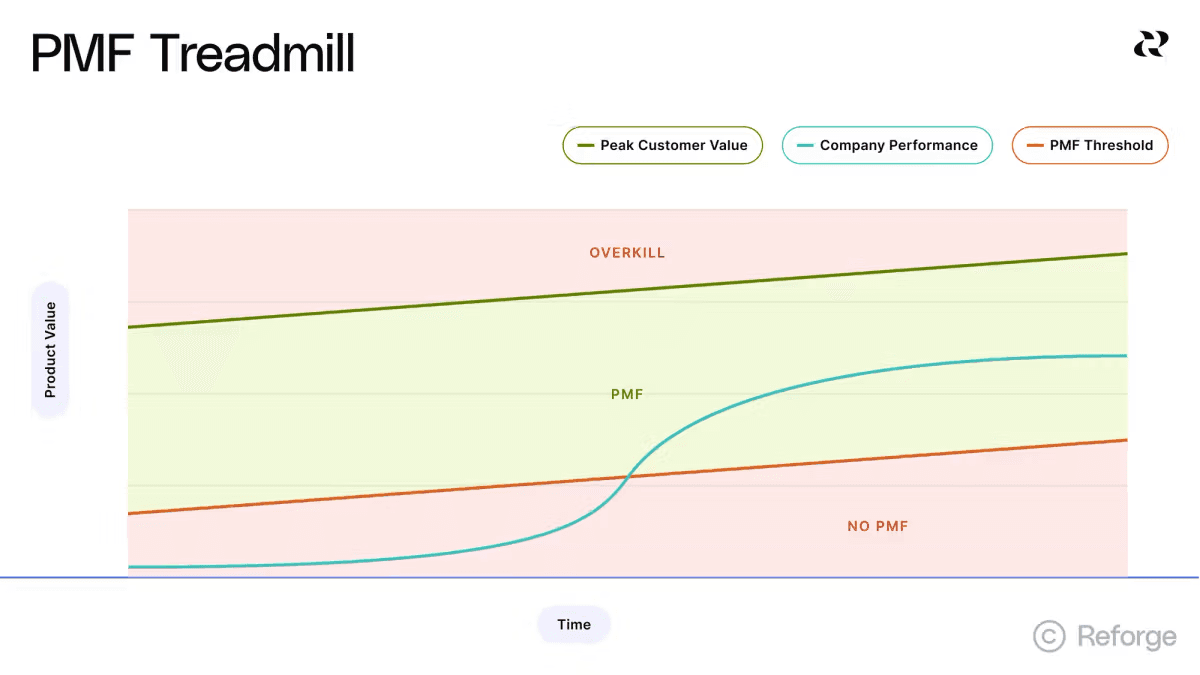
The red line is the PMF Threshold. During a technology shift, the PMF threshold accelerates:
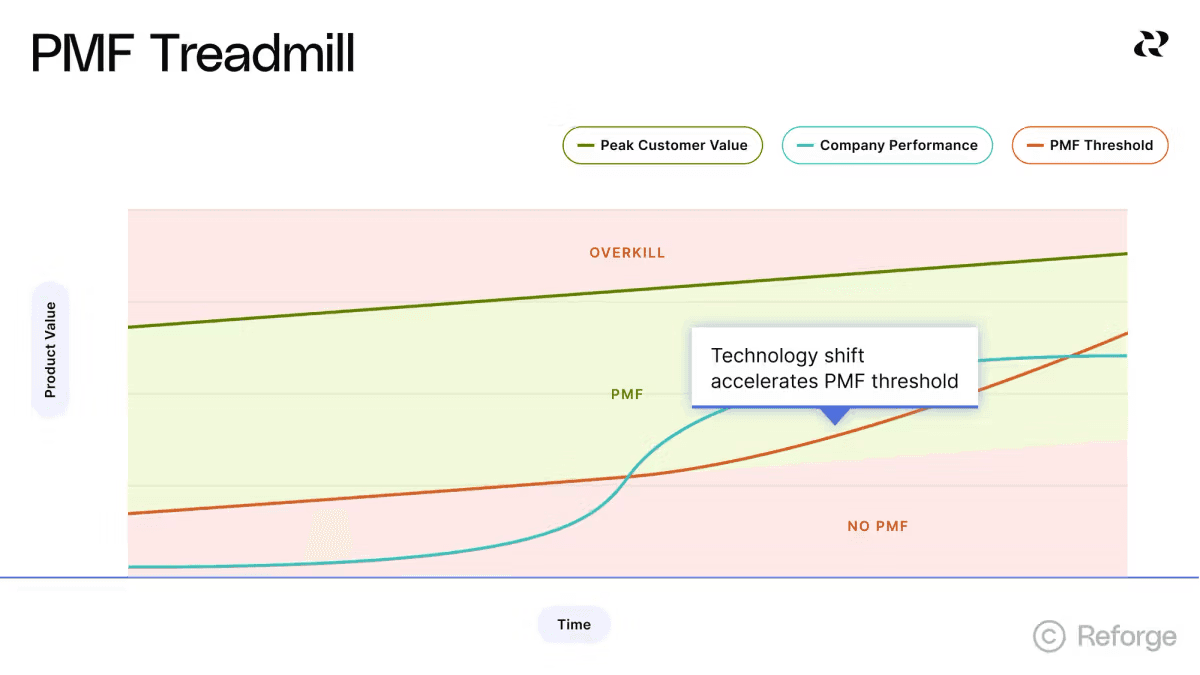
In this past, this acceleration happened over time, primarily because of “technology diffusion”. In other words, it took time for people to come online or get mobile phones. The diffusion of AI technology is much more rapid. It took ChatGPT just 5 days to reach 1 million users.
Customer expectations aren’t rising at a predictable, linear pace over longer periods of time—they are spiking nearly instantly:
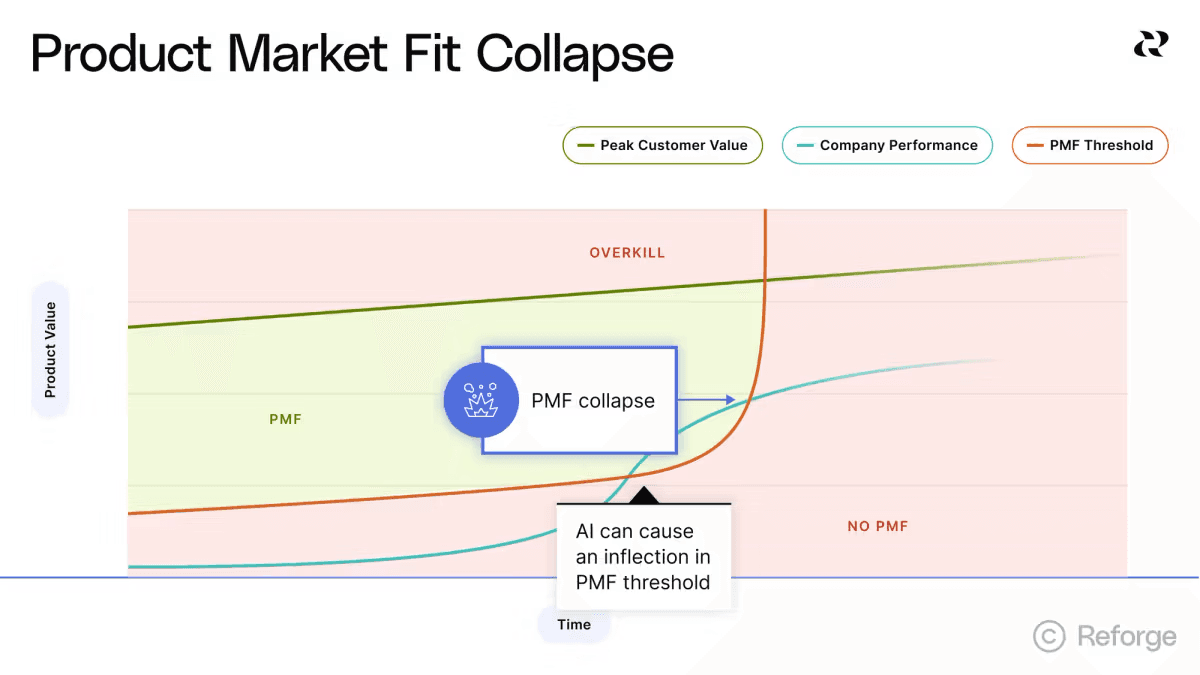
This creates Product Market Fit Collapse, a phenomenon unprecedented in the history of tech.
Example: Stack Overflow's Collapse
Software developers routinely run into roadblocks—those hard‑to‑fix bugs that grind progress to a halt. To keep moving, they need quick, reliable answers. For years, that meant turning to Stack Overflow.
Then, in late 2021, GitHub Copilot and ChatGPT appeared, offering faster, more personalized guidance. Almost overnight, the steady river of visits to Stack Overflow began to recede, its decline swift and unmistakable:
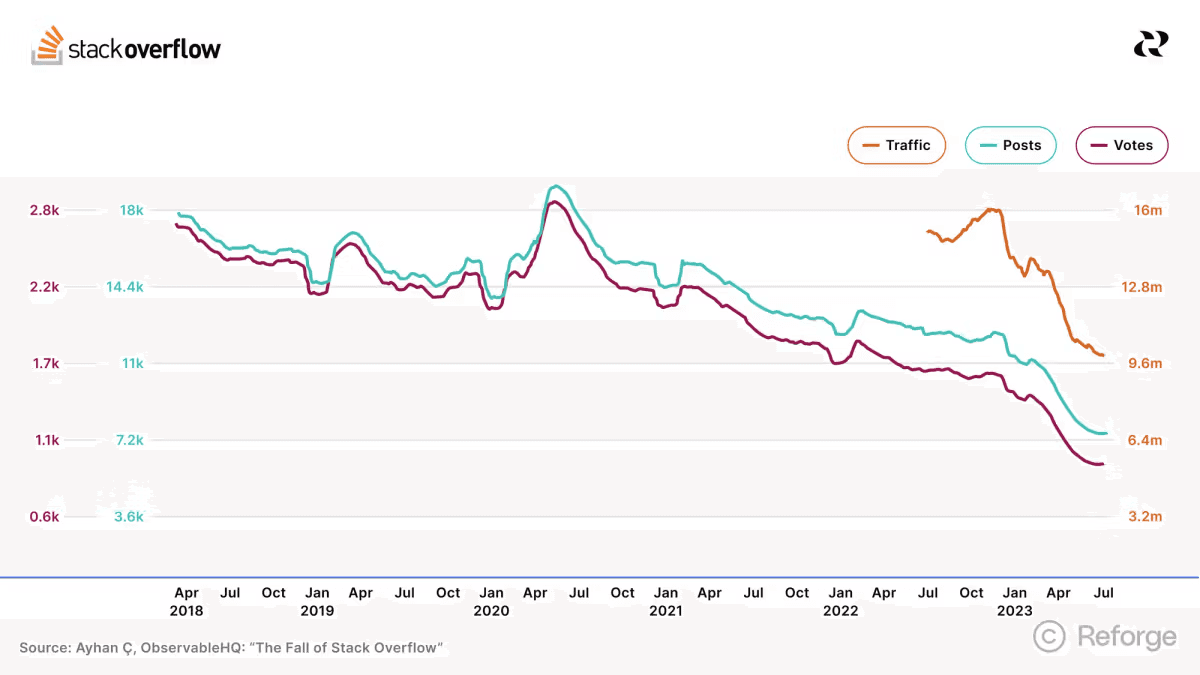
The problem developers face hasn’t changed, but the solution has shifted—from Stack Overflow’s Q&A forum to AI assistants. Stack Overflow once thrived on a virtuous loop: more questions drew more answers, which attracted still more questions. As developers migrated elsewhere, that loop snapped, and the site saw sharp drops in posts, upvotes, and—ultimately—traffic.
Below, we’ll see how Stack Overflow could have better assessed their risk and responded more effectively.
Are You At Risk?
So, why are some companies vulnerable while others stand on solid ground?
This question is critical—not just to help you understand the risk—but to help you figure out how to respond.
Here's a special peek into the AI Disruption Risk Assessment, introduced in the first week of AI Strategy, which provides a comprehensive risk assessment and the insight needed to build an incisive AI product strategy. Specifically, we look at four areas to understand the risks your product & company are facing:
Use Case - How will AI impact how users engage with your product?
Growth Model - How will AI impact your product’s growth model?
Defensibility - How will AI impact your product’s defensibility?
Business Model - How will AI impact how your product monetizes?
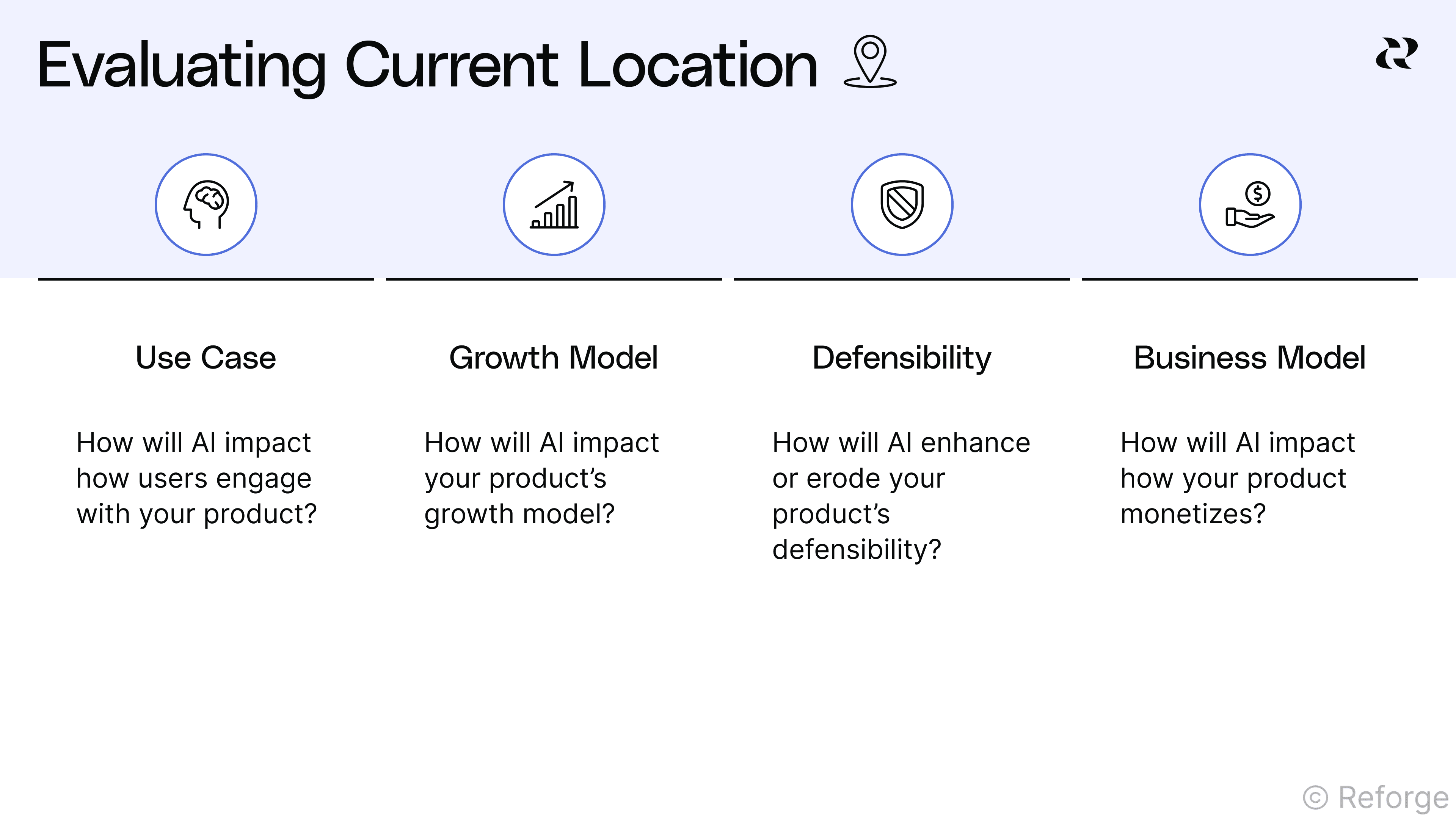
The AI Disruption Risk Assessment
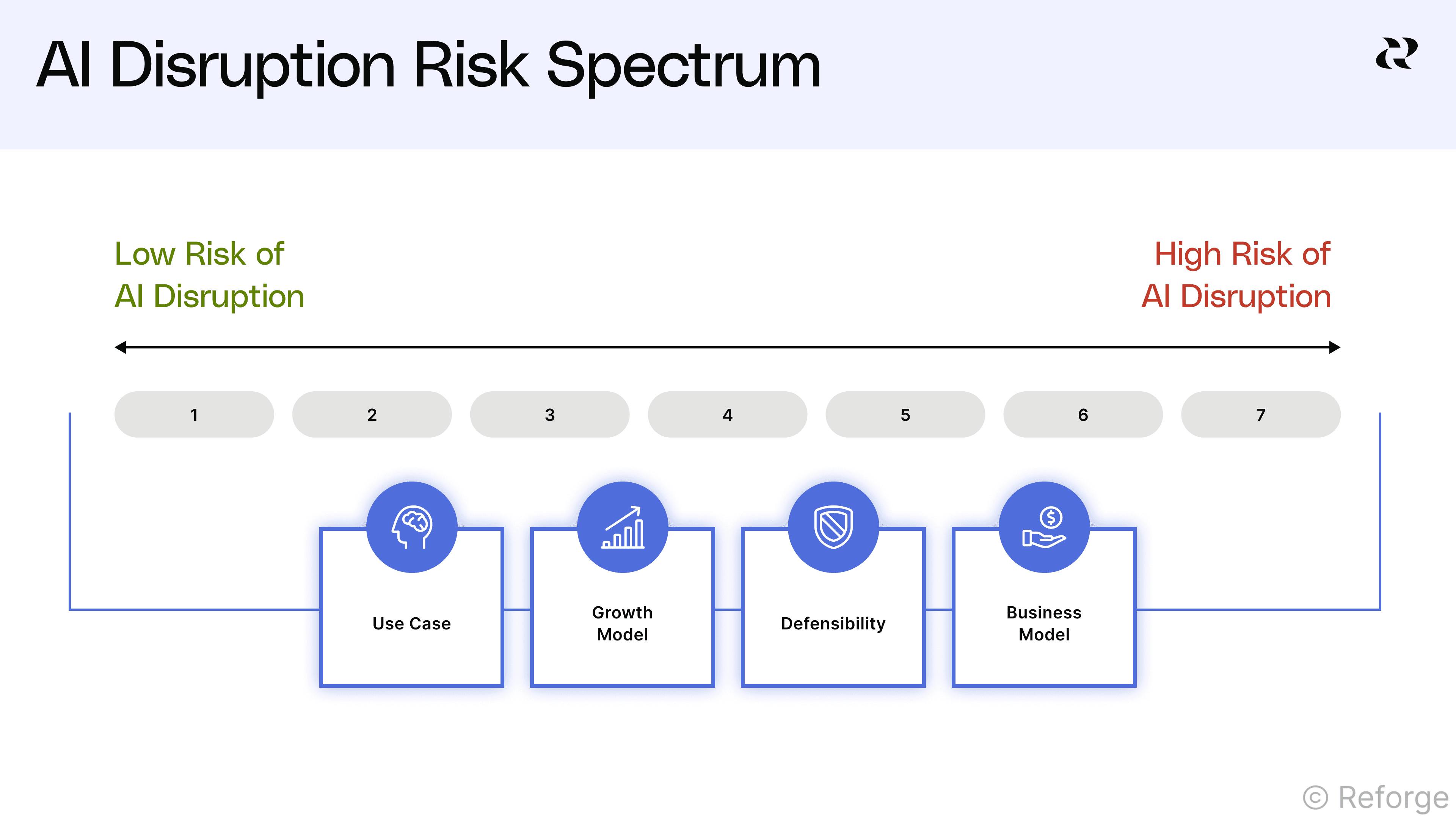
You’ll evaluate how your product stacks up across 18 distinct factors in those 4 risk areas. To help with your evaluation you can use:
AI Disruption Risk Tool - An online tool that was “vibe coded” using v0.dev with a single prompt based on the contents of this article.
AI Disruption Risk Assessment Template - A Google Sheets template that you can use individually or with your team. Just use “File > Make a copy” to get started. Shout out to Philip Jones for creating V1 of this template during our first AI Strategy cohort.
At the end of the evaluation, you’ll have a clearer understanding of where your product stands today, how urgently you’ll need to react, and which areas to focus on to improve your strategic position.
Let’s look at each of the factors in detail:
Use Case Risk
Growth Model Risk
Defensibility Risk
Business Model Risk
1. Evaluating Use Case Risk
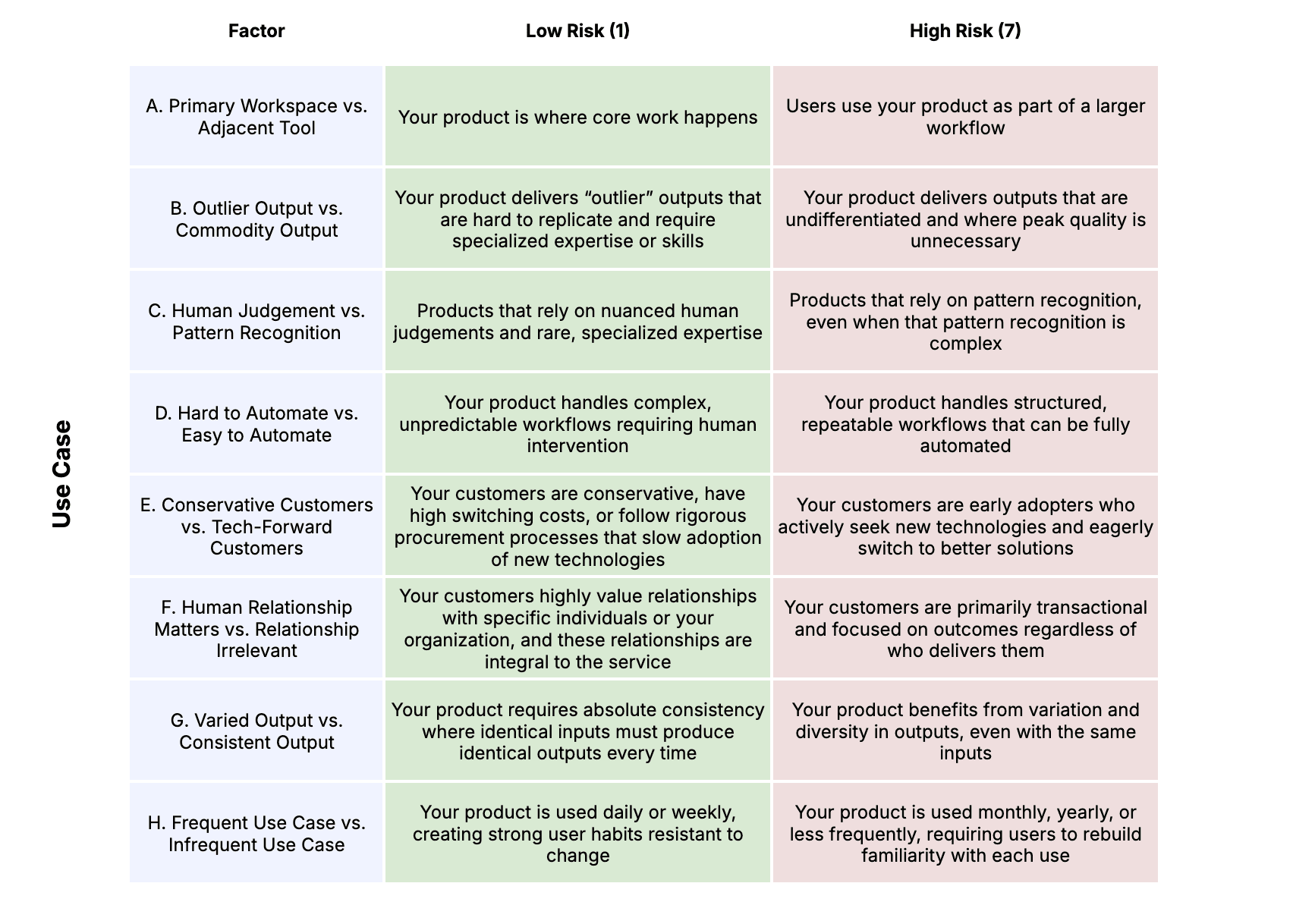
As we’ve discussed, customer expectations increase during technology shifts. This affects how customers engage with your product. In order to understand how these changes impact your product, we need to look at eight factors:
A. Primary Workspace vs. Adjacent Tool
Is your product where core work happens (i.e., a primary workspace) or is it part of a larger workflow (i.e., an adjacent tool)? Gen AI’s killer use case emerges when the user creates something — in the coding environment (e.g., GitHub Copilot), the writing surface (e.g., Notion AI), or the design canvas (e.g., Figma). Your product is more easily replaced if it sits “downstream” or outside of the user’s workspace.
We’ve seen this across several examples. Despite being an early mover, Jasper (an adjacent tool) lost product market fit when primary workspaces like Notion and Office added AI capabilities. We also saw this with Stack Overflow which is a companion to development environments like Visual Studio Code (where Github Copilot plugs into). Now that developers can get answers without leaving their environment, Stack Overflow is unnecessary.
This is one of the hardest factors to overcome, but it is possible. For example, Grammarly (which is often used as an adjacent tool) recently acquired Coda to establish themselves as the primary workspace for a segment of their customers.
B. Outlier Output vs. Commodity Output
Is your product used to deliver “outlier” outputs of exceptional quality or will “commodity” quality suffice for your users? Although AI has improved dramatically, it often falls short when compared to peak human output. Products serving the most demanding use cases are at less risk of being disrupted by AI. In contrast, some use cases are satisfied with fast, good-enough answers (like basic tech support or market research). In these cases, users will switch to AI products that can deliver acceptable results quickly, easily, and affordably.
Although the quality bar achievable by AI will continue to increase, there will always be an “outlier” level that AI can’t replicate—and customers who seek out that level of quality. Professional products, like Figma and Procreate, will be used to generate a peak level of output that can’t be matched by Uizard and MidJourney.
As we discussed, Chegg, Stack Overflow, and Getty Images are vulnerable because their users only need content that is “good enough.” By contrast, a professional tool like Figma faces no immediate threat and can roll out its AI roadmap at a more deliberate pace.
C. Human Judgement vs. Pattern Recognition
Does your product/service rely on human judgement or can sophisticated pattern recognition take its place?
Although LLMs are very capable, particularly the latest reasoning models, they rely on a sophisticated form of pattern recognition. In many cases, this sophisticated pattern recognition is all that is necessary. For example, we looked at EvenUp, a company that is using AI to write legal “demand letters”. These letters follow complex, but predictable patterns that once required hundreds of hours of work for legal assistants, paralegals, and junior lawyers. Similarly, LLMs are now better than doctors at diagnosing common medical conditions.
However, AI doesn’t work well in all use cases, especially cases that require nuanced judgement or when there is limited training data. AI will play a more limited role in complex trial law, like class action lawsuits, or treating rare diseases.
D. Hard to Automate vs. Easy to Automate
Can your product's core use case be fully automated, or does it involve workflows that AI can’t easily replace? This distinction is crucial when assessing AI disruption risk. Products handling structured tasks with clear parameters can be completely automated, while those requiring human creativity, judgment, and adaptation remain resistant to full automation.
This distinction is clear in content creation. AI tools like Spiral can easily turn existing material—say, a podcast transcript—into derivative pieces such as social‑media posts. In contrast, creating original, compelling source material—developing a brand voice, crafting a narrative strategy, or producing thought leadership—remains challenging for AI to fully automate because it requires deep contextual understanding and creative insight that varies with each project.
E. Conservative Customers vs. Tech-Forward Customers
Where do your customers fall on the technology adoption curve? The profile of your customer base significantly impacts your vulnerability to AI disruption. Tech-forward early adopters are quick to experiment with new tools and will readily abandon existing solutions when better alternatives emerge. In contrast, conservative customers, anchored by established processes, adopt innovations slowly—giving you a buffer against rapid disruption
Fareed Mosavat had a good point in a recent podcast:
“We’re seeing the real disruption today at the tip of the adoption curve (code, design, tech, students). Businesses that cater to less savvy customers are likely less susceptible.”
The earlier your audience sits on the adoption curve, the faster Product Market Fit can crumble. These users willingly test new tools, drop old habits, and show little loyalty when a clear upgrade appears. They’re often tech‑savvy—like developers—or younger consumers with the time and curiosity to explore new tech. That’s why Stack Overflow’s developer base and Chegg’s student audience were among the first to see their Product Market Fit Collapse.
F. Human Relationship Matters vs. Relationship Irrelevant
Do your customers value the people behind the product—therapists, trainers, account managers, etc.—or do they care only about the outcome? When buyers form strong ties with individual providers, those relationships create a moat that shields the business from AI substitutes. But if customers are outcome‑focused and indifferent to who delivers, they're much more likely to embrace AI solutions.
That’s why marketplaces like Fiverr and 99designs, where speed and price trump creator identity, are vulnerable to image generators such as Adobe Firefly and Midjourney. In contrast, platforms like Substack, Patreon, and BetterHelp put more emphasis on individual relationships and are in a stronger position as a result.
G. Varied Output vs. Consistent Output
How much do consistency and repeatability matter in your product’s output? Generative AI is inherently probabilistic—it can produce different results from the same input. That makes it ideal for tasks where variation is welcome or even valuable, and a poor fit where strict uniformity is essential.
A marketing copy platform, like Writer or Copy.ai, benefits from AI’s ability to generate fresh, unexpected ideas; each run yields new concepts, exactly what users want. Financial‑reporting software, by contrast, must return the same figures every time—any variation could create serious compliance issues, regulatory concerns, or decision-making errors.
H. Frequent Use Case vs. Infrequent Use Case
How often do users need to use your product? Reforge’s Mastering Retention program calls this the product’s natural frequency—the rhythm at which people face the problem you solve and reach for a solution. That rhythm shapes every engagement and retention strategy.
Some products are used frequently—Slack, Instagram, and YouTube, for example, are opened weekly, daily, or even continuously throughout the day. Other products, like Zillow and Carvana, may be used only every few years.
Frequently used products occupy the habit zone. To break the habit, a new AI product must offer what Intel’s Andy Grove called a “10x force”—a ten‑fold jump in value that makes switching irresistible. Infrequently used products fall into the forgettable zone. Often, users forget your product exists and start their search from scratch—giving new AI competitors an opportunity to win out.
2. Evaluating Growth Model Risk
Your Growth Model answers a deceptively simple question: How does your product grow? Ask around your team and you’ll likely hear a mix of responses—some pointing to product quality, others to funnels or financial models.
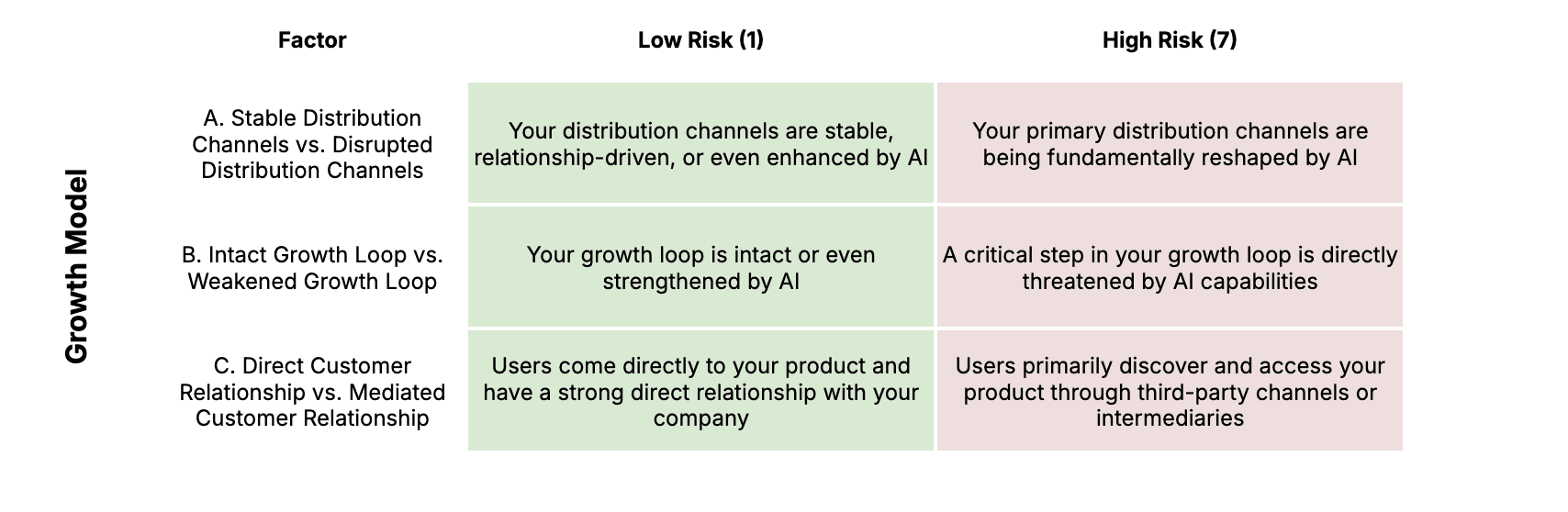
AI is changing how products grow—sometimes subtly, sometimes fundamentally. To understand its impact on your Growth Model, consider three key factors:
A. Stable Distribution Channels vs. Disrupted Distribution Channels
We need to start by examining the distribution channels your Growth Model depends on. Are those channels being disrupted by AI? AI is changing user behavior—not just within your product, but across every platform where users spend time.
For example, AI is disrupting Google Search:
ChatGPT, Claude, and Perplexity are taking traffic away from Google
Google’s “AI Overview” feature is pulling clicks away from organic results
A flood of AI-generated content is prompting Google to update its algorithm—often in unpredictable ways.
As a result, companies that rely heavily on SEO, like Tripadvisor, Yelp, and Stack Overflow, are at risk. As we’ll see below, this risk is compounded by the fact that AI is also weakening the UGC growth loop that often drives strong SEO distribution. Meanwhile, other companies are finding their distribution channels unaffected by AI or, in some cases, AI is even accelerating distribution. For example, enterprise sales channels have been strengthened by AI, as they benefit from AI-powered prospect identification (Clay) and engagement tools (Day.ai).
B. Intact Growth Loop vs. Weakened Growth Loop
Is AI strengthening or undermining the fundamental mechanisms that drive your product's growth? Every successful product has a core growth loop—a self-reinforcing cycle that creates sustainable expansion. Behind each step in that loop is a "why" that motivates user action. When AI disrupts these motivations, previously positive growth loops can quickly reverse direction.
For example, this vulnerability is particularly evident in user-generated content (UGC) platforms like Stack Overflow and Chegg. Their growth loops historically relied on contributors receiving recognition, reputation, and the satisfaction of helping others. As AI tools can now generate similar answers instantly, the incentive for human contribution diminishes, and the entire growth loop begins to unravel.
In contrast, growth loops centered on sharing and collaboration typically withstand AI disruption or even benefit from it, as their value stems from human connections rather than content. For example, Granola, the AI note-taking tool, has grown quickly in part due to exceptional sharing features.
C. Direct Customer Relationship vs. Mediated Customer Relationship
Do customers access your product directly, or through a third party? Direct relationships build stronger loyalty and retention. Products that rely on intermediaries are more exposed—especially as those channels shift or get disrupted by AI.
The contrast between Tripadvisor and Airbnb illustrates this dynamic. Tripadvisor relies heavily on search engine traffic—users typically visit Tripadvisor after searching on Google
Tripadvisor and Airbnb show this contrast clearly. Tripadvisor depends on search traffic, with nearly 70% of users coming through Google. That reliance makes them vulnerable to search disruption. Tripadvisor recently announced a partnership with Perplexity, a critical step as they anticipate changes to their primary distribution channel. Airbnb, by contrast, has built direct relationships with travelers and hosts—only about 20% of its traffic comes from Google. They are in a more resilient position, and this explains why they aren’t in a hurry to launch their AI-powered app.
3. Evaluating Defensibility Risk
Defensibility is what keeps competitors from eating your lunch. It’s the set of advantages that not only help you win today, but make it hard for others to catch up tomorrow. Without defensibility, growth is just momentum—vulnerable to the next wave of disruption.
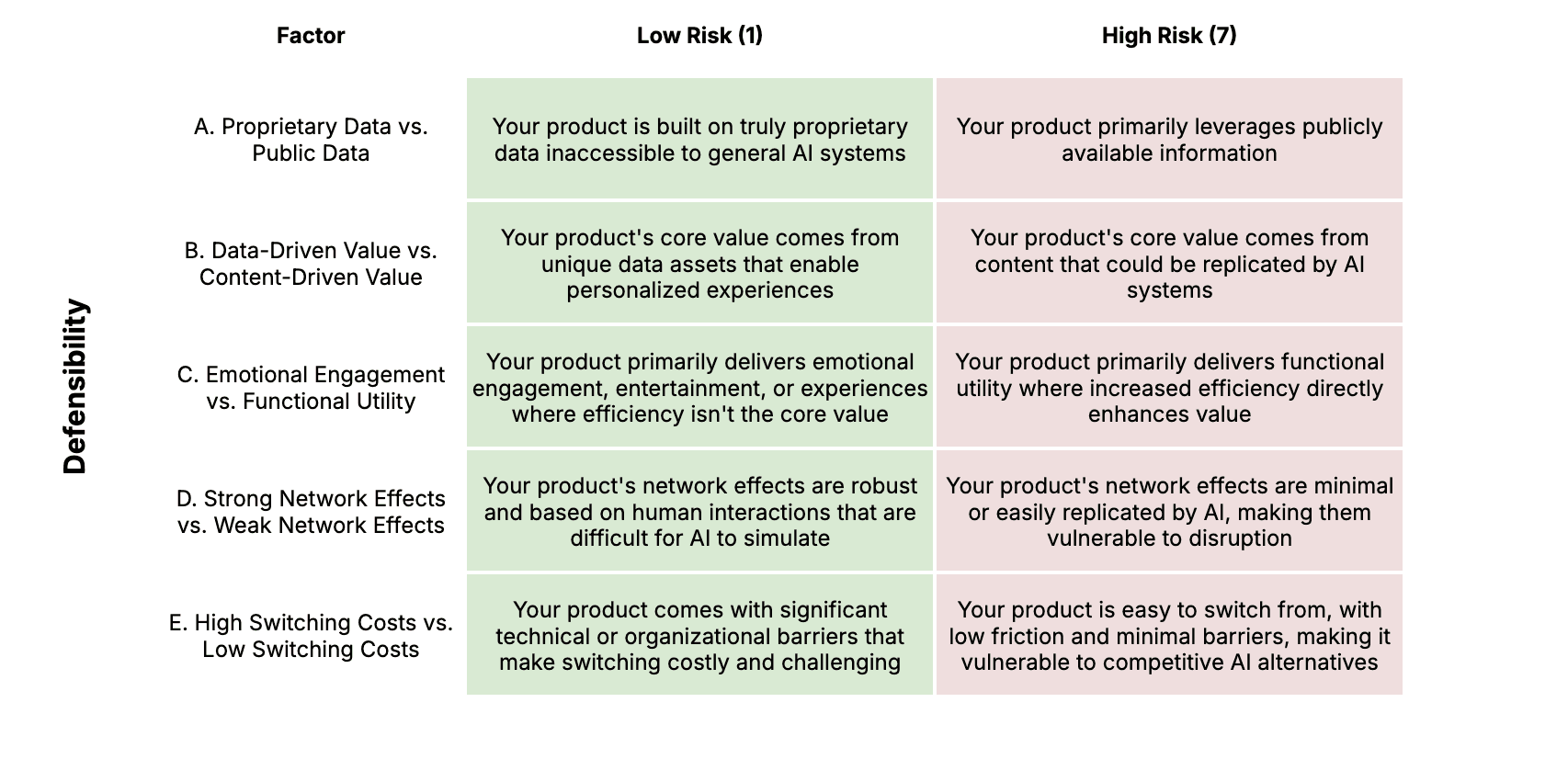
AI is shifting how moats of defensibility are built—and in some cases, eroding them altogether. To understand how defensible your product remains in an AI-powered world, you need to evaluate five factors:
A. Proprietary Data vs. Public Data
Does your product rely on publicly available information, or do you own unique, proprietary data that AI systems can't easily access? In an AI-driven world, data really is the new oil—but with a key distinction: only proprietary data creates a lasting advantage. Products built on public information face high disruption risk, as frontier AI companies like OpenAI and Anthropic can tap into and synthesize the same sources.
For example, OpenAI’s Deep Research feature significantly increases the PMF threshold for market research companies, putting companies like Gartner, Forrester, and eMarketer in a challenging position. In contrast, analytics platforms like Reforge Insight Analytics or Amplitude hold strong positions because they process proprietary customer data that remains inaccessible to general AI models. This proprietary data creates unique insights that can't be replicated without access to the underlying information.
B. Data-Driven Value vs. Content-Driven Value
Is your product’s value rooted in unique data that enables personalized experiences—or in general-purpose content that AI can easily replicate?
Products that primarily offer informational content—like articles, guides, or summaries—are highly vulnerable, as AI systems can now generate that content quickly and at scale. In contrast, products that use unique, proprietary data to power personalized experiences are much harder to replicate and therefore more defensible.
Consider the difference between WebMD and Hims. WebMD provides general medical information and symptom checkers—content that AI models like ChatGPT can now generate with similar quality. Hims, on the other hand, delivers personalized treatment based on individual health data and medical history. Because this experience is rooted in proprietary patient data, it’s far more difficult for general-purpose AI to copy without access to the same underlying information.
C. Emotional Engagement vs. Functional Utility
Does your product deliver value by providing functional utility or emotional engagement? Products focused on pure utility—helping users accomplish specific tasks efficiently—face high disruption risk as AI dramatically improves efficiency. In contrast, products delivering emotional engagement and entertainment value remain more resilient because their core value proposition revolves around the experience rather than pure efficiency.
This is why we’ve seen AI impact the creation side of the entertainment industry, but not the consumer side. AI is being used to more efficiently development games, generate special effects, and write scripts (i.e., its being used for the functional utility of making creation more efficient). However, there have been limited consumer-facing examples. The best games and shows rely on an emotional connection with the audience that transcends what AI is capable of today.
D. Strong Network Effects vs. Weak Network Effects
Does your product have strong networks effects that can’t be replaced or simulated by AI? Traditional network effects rely on a simple formula: “more users = more value”. In the past, platforms like Quora benefited significantly from network effects—the size of Quora’s network made it easy for users to either find answers in the pre-existing archives or get new questions answered quickly by a large, active user base.
However, these network effects are being disrupted by AI. Today, an LLM can “simulate” the benefits of Quora’s large user base by generating high quality, personalized answers. Quora is facing challenges similar to Stack Overflow and Chegg.
But, some network effects endure. A crafts marketplace like Etsy benefits from complex human-driven dynamics—curation, trust, and community engagement—that remain challenging for AI to replicate, preserving the unique value that comes from a genuine network of users (rather than a repository of content).
Consider whether your product’s network value comes from genuine user interactions that are hard for AI to replicate or from factors that AI can easily mimic.
E. High Switching Costs vs. Low Switching Costs
Is it easy to switch from your product to a competitor, or are there significant technical and organizational barriers in place? For example, it’s easy for me to try out a new note-taking app. I can download it, give it a try, and see if it improves my personal productivity. However, the barriers are much higher for a document platform like Notion that is deeply integrated into a team’s workflows. This is why AI note-taking apps, like Granola, have captured people’s attention, but AI hasn’t threatened incumbent document platforms like Notion, Google Docs, and Office.
Different customer segments have different thresholds for how much gain is needed to overcome switching costs. Enterprise customers, for instance, often need a 5-10x improvement to justify the switch due to the complexity of procurement, training, and integration, whereas individual consumers might switch for a 2x improvement if the benefit is clear and immediate.
Additionally, factors such as data portability and evolving data regulation have made some elements of switching easier, altering both the friction to switch and the potential rewards. Understanding this ratio is key to assessing how vulnerable your customer base is to AI alternatives.
4. Evaluating Business Model Risk
Your Business Model answers another essential question: How does your product make money?
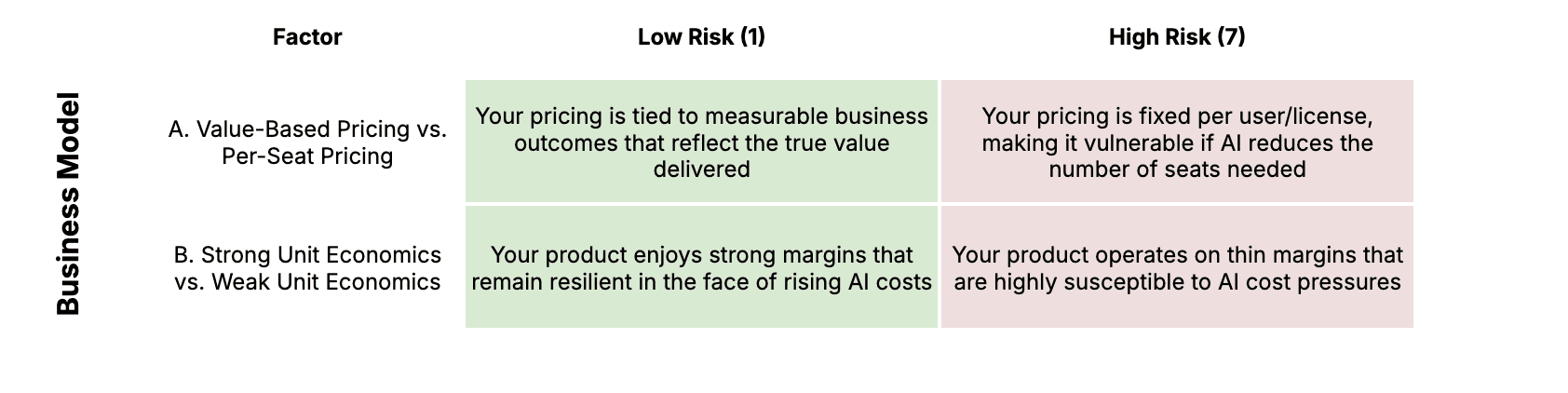
The key dimensions of your monetization model can shift in a world shaped by AI. Importantly, while software has traditionally benefited from near-zero marginal costs, AI introduces non-trivial costs that must be factored into monetization decisions.
Let’s take a closer look at how AI impacts two of the most critical factors:
A. Value-Based Pricing vs. Per-Seat Pricing
How well does your pricing reflect the value your product delivers?
Pricing has never been a perfect science, but AI makes it even trickier. Traditional per-seat models assume each user needs access—but with AI, one person can often do the work of many. As a result, customers may buy fewer seats, and your revenue shrinks even as your product delivers more value.
At the same time, AI introduces meaningful costs. Not all users are equal—some use AI heavily, racking up compute costs, while others barely engage. Flat per-user pricing can lead to power users becoming unprofitable, while light users quietly subsidize them.
That’s why companies are rethinking their pricing. Intercom, for example, moved from per-seat pricing to charging based on AI-resolved support tickets—a model that tracks more closely with delivered value.
And don’t forget the competitive landscape. Many customers now benchmark enterprise AI tools against consumer apps like ChatGPT. Their expectations are anchored—and their willingness to pay may be lower than you think.
B. Strong Unit Economics vs. Weak Unit Economics
How vulnerable are your profit margins to AI disruption? As we’ve discussed, AI introduces significant variable expenses through compute costs that scale with usage. Products operating on already thin margins face high risk as these new costs further compress profitability.
Previously, we discussed how freelancer marketplaces like Fiverr and Upwork find themselves competing with Gen AI-powered design tools. These marketplaces operate on relatively thin margins (approximately 20%) as they balance between creator compensation and platform sustainability. They now face increasing pressure from AI-powered creation tools developed by companies like Adobe, which enjoys much healthier margins (around 40%). Adobe can absorb AI compute costs while maintaining profitability, while also potentially capturing market share from gig workers with automated creative solutions.
Putting It All Together: Your AI Vulnerability Score
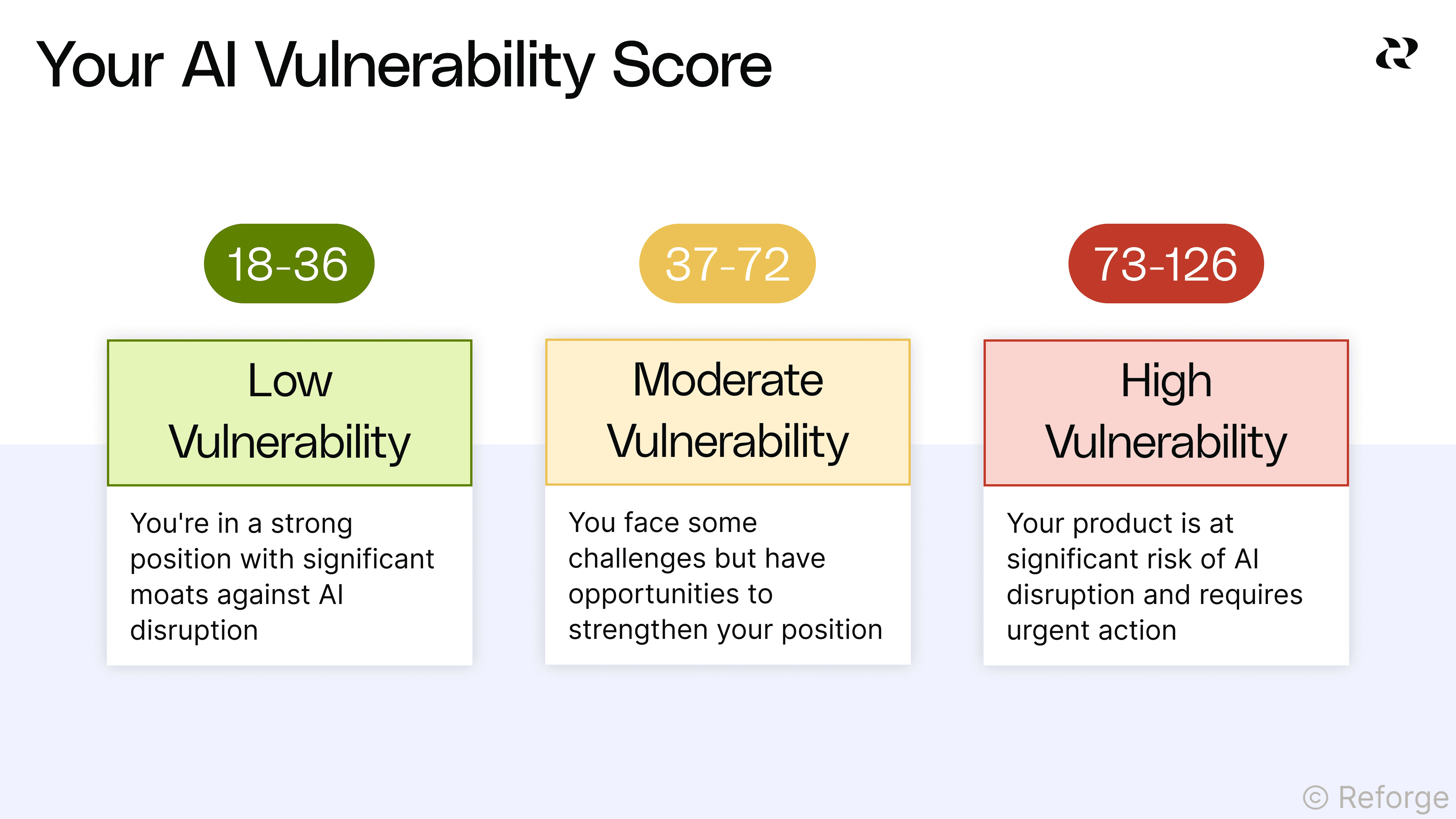
Now that you've evaluated your product across all 18 factors, it's time to calculate your overall vulnerability score. For each factor, you assigned a score from 1 (Low Risk) to 7 (High Risk). Add these scores together to determine your total vulnerability score:
18-36: Low Vulnerability – You're in a strong position with significant moats against AI disruption
37-72: Moderate Vulnerability – You face some challenges but have opportunities to strengthen your position
73-126: High Vulnerability – Your product is at significant risk of AI disruption and requires urgent action
This score provides a starting point, but the real value comes from identifying specific areas of weakness. Look for factors where you scored 5 or higher—these represent your most pressing vulnerabilities and should be prioritized in your AI strategy.
More Product Market Fit Collapse Is Coming
We are at the very beginning of the AI technology shift. As AI improves—at an ever increasing rate—customer expectations will increase, and companies will need to evolve to stay relevant. The rules have changed—and most leaders aren’t ready:
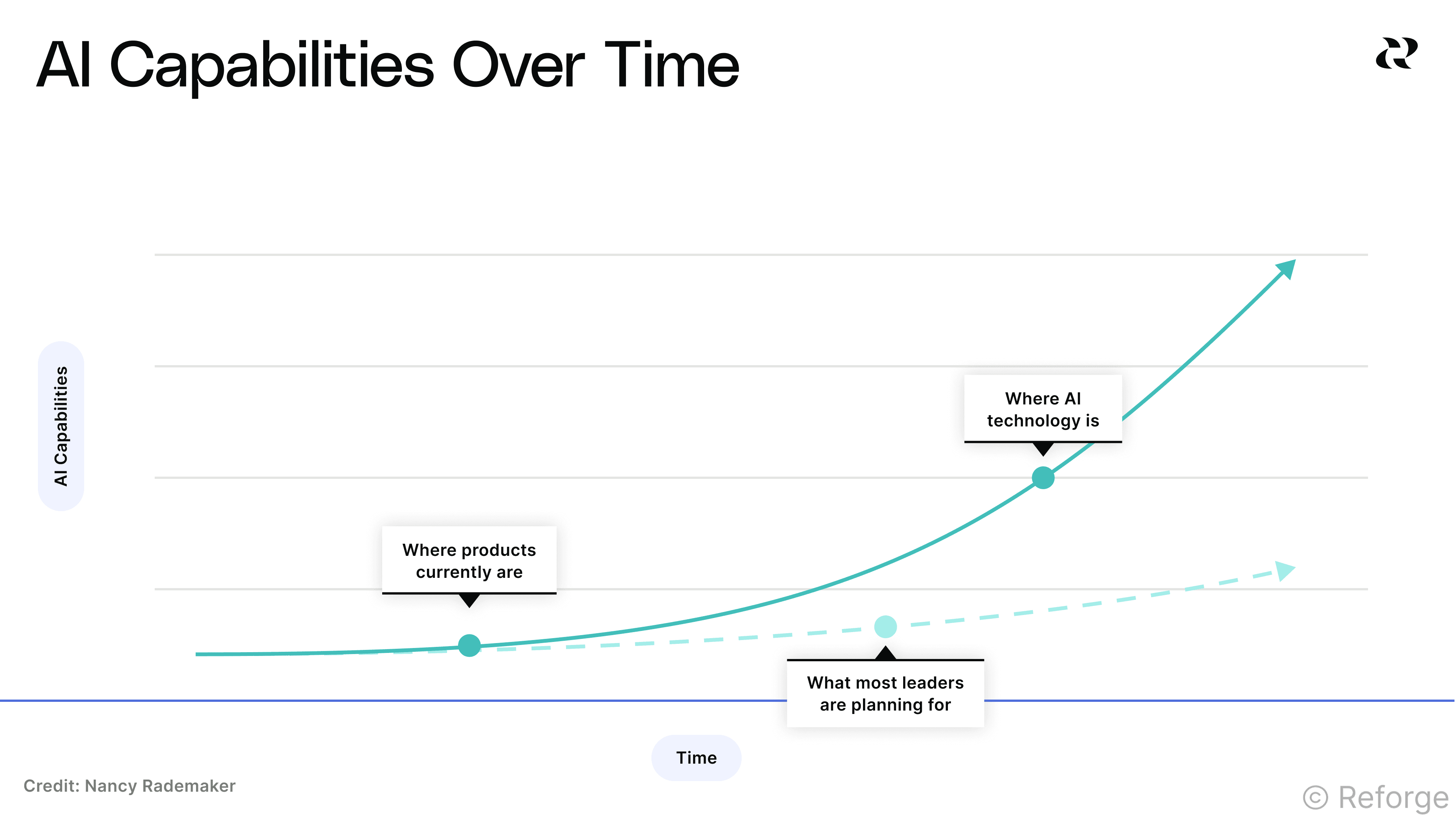
The AI Disruption Risk Assessment is your first step. It helps you understand where your product stands today, so you can start building the strategy you’ll need for tomorrow.
If you want to dive deeper, Reforge’s AI Strategy program is designed for this moment. It gives you the tools, frameworks, and strategic insight to not just survive the AI shift—but to lead through it. Because in the AI era, standing still means falling behind.


Chegg's 87.5% valuation drop. Stack Overflow's traffic decline. These are early examples of Product Market Fit Collapse, but there will certainly be more cases as AI roils established markets. Several early AI darlings—like Jasper and Tome—have had to shift strategies to deal with intense competition. Incumbents like Adobe have moved fast, closing off the window of opportunity that AI‑first design startups hoped to exploit. Others remain insulated, at least for now. Airbnb’s CEO, Brian Chesky, says weaving AI into the product will take years. Clearly, they aren’t facing imminent threat from the Gen AI boom.
So, why are some companies vulnerable while others stand on solid ground?
This question is critical—not just to help you understand the risk—but to help you figure out how to respond.
In this post, I'll give you a sneak peak into the AI Disruption Risk Assessment, introduced in the first week of AI Strategy. It provides a comprehensive risk assessment and the first step needed to build an incisive AI product strategy.
We Live in an Era of Heightened Competition
Historically, the bar for Product Market Fit raised gradually over time. Jeff Bezos once wrote in a shareholder letter:
One thing I love about customers is that they are divinely discontent. Their expectations are never static – they go up. It’s human nature. We didn’t ascend from our hunter-gatherer days by being satisfied. People have a voracious appetite for a better way, and yesterday’s ‘wow’ quickly becomes today’s ‘ordinary’. I see that cycle of improvement happening at a faster rate than ever before.
That was in 1998.
In the Reforge Product Strategy program, Casey Winters and Fareed Mosavat describe this as the Product Market Fit Treadmill:
The red line is the PMF Threshold. During a technology shift, the PMF threshold accelerates:
In this past, this acceleration happened over time, primarily because of “technology diffusion”. In other words, it took time for people to come online or get mobile phones. The diffusion of AI technology is much more rapid. It took ChatGPT just 5 days to reach 1 million users.
Customer expectations aren’t rising at a predictable, linear pace over longer periods of time—they are spiking nearly instantly:
This creates Product Market Fit Collapse, a phenomenon unprecedented in the history of tech.
Example: Stack Overflow's Collapse
Software developers routinely run into roadblocks—those hard‑to‑fix bugs that grind progress to a halt. To keep moving, they need quick, reliable answers. For years, that meant turning to Stack Overflow.
Then, in late 2021, GitHub Copilot and ChatGPT appeared, offering faster, more personalized guidance. Almost overnight, the steady river of visits to Stack Overflow began to recede, its decline swift and unmistakable:
The problem developers face hasn’t changed, but the solution has shifted—from Stack Overflow’s Q&A forum to AI assistants. Stack Overflow once thrived on a virtuous loop: more questions drew more answers, which attracted still more questions. As developers migrated elsewhere, that loop snapped, and the site saw sharp drops in posts, upvotes, and—ultimately—traffic.
Below, we’ll see how Stack Overflow could have better assessed their risk and responded more effectively.
Are You At Risk?
So, why are some companies vulnerable while others stand on solid ground?
This question is critical—not just to help you understand the risk—but to help you figure out how to respond.
Here's a special peek into the AI Disruption Risk Assessment, introduced in the first week of AI Strategy, which provides a comprehensive risk assessment and the insight needed to build an incisive AI product strategy. Specifically, we look at four areas to understand the risks your product & company are facing:
Use Case - How will AI impact how users engage with your product?
Growth Model - How will AI impact your product’s growth model?
Defensibility - How will AI impact your product’s defensibility?
Business Model - How will AI impact how your product monetizes?
The AI Disruption Risk Assessment
You’ll evaluate how your product stacks up across 18 distinct factors in those 4 risk areas. To help with your evaluation you can use:
AI Disruption Risk Tool - An online tool that was “vibe coded” using v0.dev with a single prompt based on the contents of this article.
AI Disruption Risk Assessment Template - A Google Sheets template that you can use individually or with your team. Just use “File > Make a copy” to get started. Shout out to Philip Jones for creating V1 of this template during our first AI Strategy cohort.
At the end of the evaluation, you’ll have a clearer understanding of where your product stands today, how urgently you’ll need to react, and which areas to focus on to improve your strategic position.
Let’s look at each of the factors in detail:
Use Case Risk
Growth Model Risk
Defensibility Risk
Business Model Risk
1. Evaluating Use Case Risk
As we’ve discussed, customer expectations increase during technology shifts. This affects how customers engage with your product. In order to understand how these changes impact your product, we need to look at eight factors:
A. Primary Workspace vs. Adjacent Tool
Is your product where core work happens (i.e., a primary workspace) or is it part of a larger workflow (i.e., an adjacent tool)? Gen AI’s killer use case emerges when the user creates something — in the coding environment (e.g., GitHub Copilot), the writing surface (e.g., Notion AI), or the design canvas (e.g., Figma). Your product is more easily replaced if it sits “downstream” or outside of the user’s workspace.
We’ve seen this across several examples. Despite being an early mover, Jasper (an adjacent tool) lost product market fit when primary workspaces like Notion and Office added AI capabilities. We also saw this with Stack Overflow which is a companion to development environments like Visual Studio Code (where Github Copilot plugs into). Now that developers can get answers without leaving their environment, Stack Overflow is unnecessary.
This is one of the hardest factors to overcome, but it is possible. For example, Grammarly (which is often used as an adjacent tool) recently acquired Coda to establish themselves as the primary workspace for a segment of their customers.
B. Outlier Output vs. Commodity Output
Is your product used to deliver “outlier” outputs of exceptional quality or will “commodity” quality suffice for your users? Although AI has improved dramatically, it often falls short when compared to peak human output. Products serving the most demanding use cases are at less risk of being disrupted by AI. In contrast, some use cases are satisfied with fast, good-enough answers (like basic tech support or market research). In these cases, users will switch to AI products that can deliver acceptable results quickly, easily, and affordably.
Although the quality bar achievable by AI will continue to increase, there will always be an “outlier” level that AI can’t replicate—and customers who seek out that level of quality. Professional products, like Figma and Procreate, will be used to generate a peak level of output that can’t be matched by Uizard and MidJourney.
As we discussed, Chegg, Stack Overflow, and Getty Images are vulnerable because their users only need content that is “good enough.” By contrast, a professional tool like Figma faces no immediate threat and can roll out its AI roadmap at a more deliberate pace.
C. Human Judgement vs. Pattern Recognition
Does your product/service rely on human judgement or can sophisticated pattern recognition take its place?
Although LLMs are very capable, particularly the latest reasoning models, they rely on a sophisticated form of pattern recognition. In many cases, this sophisticated pattern recognition is all that is necessary. For example, we looked at EvenUp, a company that is using AI to write legal “demand letters”. These letters follow complex, but predictable patterns that once required hundreds of hours of work for legal assistants, paralegals, and junior lawyers. Similarly, LLMs are now better than doctors at diagnosing common medical conditions.
However, AI doesn’t work well in all use cases, especially cases that require nuanced judgement or when there is limited training data. AI will play a more limited role in complex trial law, like class action lawsuits, or treating rare diseases.
D. Hard to Automate vs. Easy to Automate
Can your product's core use case be fully automated, or does it involve workflows that AI can’t easily replace? This distinction is crucial when assessing AI disruption risk. Products handling structured tasks with clear parameters can be completely automated, while those requiring human creativity, judgment, and adaptation remain resistant to full automation.
This distinction is clear in content creation. AI tools like Spiral can easily turn existing material—say, a podcast transcript—into derivative pieces such as social‑media posts. In contrast, creating original, compelling source material—developing a brand voice, crafting a narrative strategy, or producing thought leadership—remains challenging for AI to fully automate because it requires deep contextual understanding and creative insight that varies with each project.
E. Conservative Customers vs. Tech-Forward Customers
Where do your customers fall on the technology adoption curve? The profile of your customer base significantly impacts your vulnerability to AI disruption. Tech-forward early adopters are quick to experiment with new tools and will readily abandon existing solutions when better alternatives emerge. In contrast, conservative customers, anchored by established processes, adopt innovations slowly—giving you a buffer against rapid disruption
Fareed Mosavat had a good point in a recent podcast:
“We’re seeing the real disruption today at the tip of the adoption curve (code, design, tech, students). Businesses that cater to less savvy customers are likely less susceptible.”
The earlier your audience sits on the adoption curve, the faster Product Market Fit can crumble. These users willingly test new tools, drop old habits, and show little loyalty when a clear upgrade appears. They’re often tech‑savvy—like developers—or younger consumers with the time and curiosity to explore new tech. That’s why Stack Overflow’s developer base and Chegg’s student audience were among the first to see their Product Market Fit Collapse.
F. Human Relationship Matters vs. Relationship Irrelevant
Do your customers value the people behind the product—therapists, trainers, account managers, etc.—or do they care only about the outcome? When buyers form strong ties with individual providers, those relationships create a moat that shields the business from AI substitutes. But if customers are outcome‑focused and indifferent to who delivers, they're much more likely to embrace AI solutions.
That’s why marketplaces like Fiverr and 99designs, where speed and price trump creator identity, are vulnerable to image generators such as Adobe Firefly and Midjourney. In contrast, platforms like Substack, Patreon, and BetterHelp put more emphasis on individual relationships and are in a stronger position as a result.
G. Varied Output vs. Consistent Output
How much do consistency and repeatability matter in your product’s output? Generative AI is inherently probabilistic—it can produce different results from the same input. That makes it ideal for tasks where variation is welcome or even valuable, and a poor fit where strict uniformity is essential.
A marketing copy platform, like Writer or Copy.ai, benefits from AI’s ability to generate fresh, unexpected ideas; each run yields new concepts, exactly what users want. Financial‑reporting software, by contrast, must return the same figures every time—any variation could create serious compliance issues, regulatory concerns, or decision-making errors.
H. Frequent Use Case vs. Infrequent Use Case
How often do users need to use your product? Reforge’s Mastering Retention program calls this the product’s natural frequency—the rhythm at which people face the problem you solve and reach for a solution. That rhythm shapes every engagement and retention strategy.
Some products are used frequently—Slack, Instagram, and YouTube, for example, are opened weekly, daily, or even continuously throughout the day. Other products, like Zillow and Carvana, may be used only every few years.
Frequently used products occupy the habit zone. To break the habit, a new AI product must offer what Intel’s Andy Grove called a “10x force”—a ten‑fold jump in value that makes switching irresistible. Infrequently used products fall into the forgettable zone. Often, users forget your product exists and start their search from scratch—giving new AI competitors an opportunity to win out.
2. Evaluating Growth Model Risk
Your Growth Model answers a deceptively simple question: How does your product grow? Ask around your team and you’ll likely hear a mix of responses—some pointing to product quality, others to funnels or financial models.
AI is changing how products grow—sometimes subtly, sometimes fundamentally. To understand its impact on your Growth Model, consider three key factors:
A. Stable Distribution Channels vs. Disrupted Distribution Channels
We need to start by examining the distribution channels your Growth Model depends on. Are those channels being disrupted by AI? AI is changing user behavior—not just within your product, but across every platform where users spend time.
For example, AI is disrupting Google Search:
ChatGPT, Claude, and Perplexity are taking traffic away from Google
Google’s “AI Overview” feature is pulling clicks away from organic results
A flood of AI-generated content is prompting Google to update its algorithm—often in unpredictable ways.
As a result, companies that rely heavily on SEO, like Tripadvisor, Yelp, and Stack Overflow, are at risk. As we’ll see below, this risk is compounded by the fact that AI is also weakening the UGC growth loop that often drives strong SEO distribution. Meanwhile, other companies are finding their distribution channels unaffected by AI or, in some cases, AI is even accelerating distribution. For example, enterprise sales channels have been strengthened by AI, as they benefit from AI-powered prospect identification (Clay) and engagement tools (Day.ai).
B. Intact Growth Loop vs. Weakened Growth Loop
Is AI strengthening or undermining the fundamental mechanisms that drive your product's growth? Every successful product has a core growth loop—a self-reinforcing cycle that creates sustainable expansion. Behind each step in that loop is a "why" that motivates user action. When AI disrupts these motivations, previously positive growth loops can quickly reverse direction.
For example, this vulnerability is particularly evident in user-generated content (UGC) platforms like Stack Overflow and Chegg. Their growth loops historically relied on contributors receiving recognition, reputation, and the satisfaction of helping others. As AI tools can now generate similar answers instantly, the incentive for human contribution diminishes, and the entire growth loop begins to unravel.
In contrast, growth loops centered on sharing and collaboration typically withstand AI disruption or even benefit from it, as their value stems from human connections rather than content. For example, Granola, the AI note-taking tool, has grown quickly in part due to exceptional sharing features.
C. Direct Customer Relationship vs. Mediated Customer Relationship
Do customers access your product directly, or through a third party? Direct relationships build stronger loyalty and retention. Products that rely on intermediaries are more exposed—especially as those channels shift or get disrupted by AI.
The contrast between Tripadvisor and Airbnb illustrates this dynamic. Tripadvisor relies heavily on search engine traffic—users typically visit Tripadvisor after searching on Google
Tripadvisor and Airbnb show this contrast clearly. Tripadvisor depends on search traffic, with nearly 70% of users coming through Google. That reliance makes them vulnerable to search disruption. Tripadvisor recently announced a partnership with Perplexity, a critical step as they anticipate changes to their primary distribution channel. Airbnb, by contrast, has built direct relationships with travelers and hosts—only about 20% of its traffic comes from Google. They are in a more resilient position, and this explains why they aren’t in a hurry to launch their AI-powered app.
3. Evaluating Defensibility Risk
Defensibility is what keeps competitors from eating your lunch. It’s the set of advantages that not only help you win today, but make it hard for others to catch up tomorrow. Without defensibility, growth is just momentum—vulnerable to the next wave of disruption.
AI is shifting how moats of defensibility are built—and in some cases, eroding them altogether. To understand how defensible your product remains in an AI-powered world, you need to evaluate five factors:
A. Proprietary Data vs. Public Data
Does your product rely on publicly available information, or do you own unique, proprietary data that AI systems can't easily access? In an AI-driven world, data really is the new oil—but with a key distinction: only proprietary data creates a lasting advantage. Products built on public information face high disruption risk, as frontier AI companies like OpenAI and Anthropic can tap into and synthesize the same sources.
For example, OpenAI’s Deep Research feature significantly increases the PMF threshold for market research companies, putting companies like Gartner, Forrester, and eMarketer in a challenging position. In contrast, analytics platforms like Reforge Insight Analytics or Amplitude hold strong positions because they process proprietary customer data that remains inaccessible to general AI models. This proprietary data creates unique insights that can't be replicated without access to the underlying information.
B. Data-Driven Value vs. Content-Driven Value
Is your product’s value rooted in unique data that enables personalized experiences—or in general-purpose content that AI can easily replicate?
Products that primarily offer informational content—like articles, guides, or summaries—are highly vulnerable, as AI systems can now generate that content quickly and at scale. In contrast, products that use unique, proprietary data to power personalized experiences are much harder to replicate and therefore more defensible.
Consider the difference between WebMD and Hims. WebMD provides general medical information and symptom checkers—content that AI models like ChatGPT can now generate with similar quality. Hims, on the other hand, delivers personalized treatment based on individual health data and medical history. Because this experience is rooted in proprietary patient data, it’s far more difficult for general-purpose AI to copy without access to the same underlying information.
C. Emotional Engagement vs. Functional Utility
Does your product deliver value by providing functional utility or emotional engagement? Products focused on pure utility—helping users accomplish specific tasks efficiently—face high disruption risk as AI dramatically improves efficiency. In contrast, products delivering emotional engagement and entertainment value remain more resilient because their core value proposition revolves around the experience rather than pure efficiency.
This is why we’ve seen AI impact the creation side of the entertainment industry, but not the consumer side. AI is being used to more efficiently development games, generate special effects, and write scripts (i.e., its being used for the functional utility of making creation more efficient). However, there have been limited consumer-facing examples. The best games and shows rely on an emotional connection with the audience that transcends what AI is capable of today.
D. Strong Network Effects vs. Weak Network Effects
Does your product have strong networks effects that can’t be replaced or simulated by AI? Traditional network effects rely on a simple formula: “more users = more value”. In the past, platforms like Quora benefited significantly from network effects—the size of Quora’s network made it easy for users to either find answers in the pre-existing archives or get new questions answered quickly by a large, active user base.
However, these network effects are being disrupted by AI. Today, an LLM can “simulate” the benefits of Quora’s large user base by generating high quality, personalized answers. Quora is facing challenges similar to Stack Overflow and Chegg.
But, some network effects endure. A crafts marketplace like Etsy benefits from complex human-driven dynamics—curation, trust, and community engagement—that remain challenging for AI to replicate, preserving the unique value that comes from a genuine network of users (rather than a repository of content).
Consider whether your product’s network value comes from genuine user interactions that are hard for AI to replicate or from factors that AI can easily mimic.
E. High Switching Costs vs. Low Switching Costs
Is it easy to switch from your product to a competitor, or are there significant technical and organizational barriers in place? For example, it’s easy for me to try out a new note-taking app. I can download it, give it a try, and see if it improves my personal productivity. However, the barriers are much higher for a document platform like Notion that is deeply integrated into a team’s workflows. This is why AI note-taking apps, like Granola, have captured people’s attention, but AI hasn’t threatened incumbent document platforms like Notion, Google Docs, and Office.
Different customer segments have different thresholds for how much gain is needed to overcome switching costs. Enterprise customers, for instance, often need a 5-10x improvement to justify the switch due to the complexity of procurement, training, and integration, whereas individual consumers might switch for a 2x improvement if the benefit is clear and immediate.
Additionally, factors such as data portability and evolving data regulation have made some elements of switching easier, altering both the friction to switch and the potential rewards. Understanding this ratio is key to assessing how vulnerable your customer base is to AI alternatives.
4. Evaluating Business Model Risk
Your Business Model answers another essential question: How does your product make money?
The key dimensions of your monetization model can shift in a world shaped by AI. Importantly, while software has traditionally benefited from near-zero marginal costs, AI introduces non-trivial costs that must be factored into monetization decisions.
Let’s take a closer look at how AI impacts two of the most critical factors:
A. Value-Based Pricing vs. Per-Seat Pricing
How well does your pricing reflect the value your product delivers?
Pricing has never been a perfect science, but AI makes it even trickier. Traditional per-seat models assume each user needs access—but with AI, one person can often do the work of many. As a result, customers may buy fewer seats, and your revenue shrinks even as your product delivers more value.
At the same time, AI introduces meaningful costs. Not all users are equal—some use AI heavily, racking up compute costs, while others barely engage. Flat per-user pricing can lead to power users becoming unprofitable, while light users quietly subsidize them.
That’s why companies are rethinking their pricing. Intercom, for example, moved from per-seat pricing to charging based on AI-resolved support tickets—a model that tracks more closely with delivered value.
And don’t forget the competitive landscape. Many customers now benchmark enterprise AI tools against consumer apps like ChatGPT. Their expectations are anchored—and their willingness to pay may be lower than you think.
B. Strong Unit Economics vs. Weak Unit Economics
How vulnerable are your profit margins to AI disruption? As we’ve discussed, AI introduces significant variable expenses through compute costs that scale with usage. Products operating on already thin margins face high risk as these new costs further compress profitability.
Previously, we discussed how freelancer marketplaces like Fiverr and Upwork find themselves competing with Gen AI-powered design tools. These marketplaces operate on relatively thin margins (approximately 20%) as they balance between creator compensation and platform sustainability. They now face increasing pressure from AI-powered creation tools developed by companies like Adobe, which enjoys much healthier margins (around 40%). Adobe can absorb AI compute costs while maintaining profitability, while also potentially capturing market share from gig workers with automated creative solutions.
Putting It All Together: Your AI Vulnerability Score
Now that you've evaluated your product across all 18 factors, it's time to calculate your overall vulnerability score. For each factor, you assigned a score from 1 (Low Risk) to 7 (High Risk). Add these scores together to determine your total vulnerability score:
18-36: Low Vulnerability – You're in a strong position with significant moats against AI disruption
37-72: Moderate Vulnerability – You face some challenges but have opportunities to strengthen your position
73-126: High Vulnerability – Your product is at significant risk of AI disruption and requires urgent action
This score provides a starting point, but the real value comes from identifying specific areas of weakness. Look for factors where you scored 5 or higher—these represent your most pressing vulnerabilities and should be prioritized in your AI strategy.
More Product Market Fit Collapse Is Coming
We are at the very beginning of the AI technology shift. As AI improves—at an ever increasing rate—customer expectations will increase, and companies will need to evolve to stay relevant. The rules have changed—and most leaders aren’t ready:
The AI Disruption Risk Assessment is your first step. It helps you understand where your product stands today, so you can start building the strategy you’ll need for tomorrow.
If you want to dive deeper, Reforge’s AI Strategy program is designed for this moment. It gives you the tools, frameworks, and strategic insight to not just survive the AI shift—but to lead through it. Because in the AI era, standing still means falling behind.