Reforge has joined Miro ↗
AI is on a path to automate historical product management skills and tasks—from process workflows to data analysis and feature deployment. As a result, the competitive advantage is shifting away from conventional process skills and best practices. The new differentiator? Product intuition.
To Win In AI Era, You Can’t Just Follow Process
The product management landscape is undergoing its most significant transformation since the technology shift from on-premise to cloud. Many product leaders see AI as just another tool in their arsenal. This is a dangerous misconception. At Reforge, we believe the industry is underestimating AI's impact on product development over the next five years.
As I described in AI-Native Product Teams:
The shift from on-premise to cloud wasn't merely a hosting change; it revolutionized every aspect of how we build, ship, and grow software products. AI represents a similar inflection point.
Our belief at Reforge is that the technology shift to AI will completely redefine product teams and in a lot of ways I think the ecosystem is underestimating not overestimating the impact it will have over the next decade.
AI is shifting the constraints and possibilities around what products and features we build, how we build and grow those products, and the roles, teams, and org structures we use. The next generation of product teams will be trained as AI-native from day one. They will think, work, and build differently
As AI reshapes how we build and ship products, the fundamental skills that made product managers successful are being redefined. While process and best practices have been an important part historically, they're no longer enough to win in the AI era.
While process helps solve certain problems, it’s never enough. Sachin Rekhi, who led product on LinkedIn Sales Navigator and creator of Mastering Product Management tells this story in an excellent video on Building Your Product Intuition. In his presentation brings in an excellent quote from Jeff Bezos:
Leaders are right a lot. They have strong judgement and good instincts. They seek diverse perspectives, and work to disconfirm their beliefs.
What Bezos is talking about here is that you can’t just process in order to win. You ultimately have to take bets. Those bets are informed by instincts and judgement. Those bets ultimately have to be the right ones in order to win.
As AI Automates, Product Intuition Becomes King
The next great divide in product management won't be about skills or processes – it will be about intuition. AI is systematically automating some core functions that have been key parts of product management for decades.
Process Automation
Best practices are being encoded into AI systems
Standard workflows are becoming automated
Traditional PM tools are being AI-enhanced
Intelligence Automation
Data gathering and analysis is becoming easier/instant
Competitive intelligence is being automated
Market research is being transformed by AI
Execution Acceleration
Build times are compressing dramatically
Testing cycles are becoming near-instantaneous
Feature deployment is being streamlined
This automation wave creates an uncomfortable truth: many of the skills that made product managers or product teams gain an edge in the past are becoming commoditized. As that happens, we will witness a fundamental shift in what drives competitive advantage.
The New Scarce Resource
In this transformed landscape, something more fundamental emerges as the key differentiator: product intuition. Scott Belsky, former CPO of Adobe and Reforge investor, captures this shift perfectly:
"Until now, skills have been a major differentiator for humanity. However, in the age of AI, taste will become more important than skills as much of skill-based work and productivity is offloaded to compute. Taste seems more scarce these days, and increasingly differentiating in the age of AI."
This is a classic “the skills that got you here, won’t get you there” situation. Intuition and Taste can feel vague. So the question emerges - how do we build a sophisticated pattern recognition engine that can:
Identify emerging customer needs before they're obvious
Spot market opportunities that data alone can't reveal
Make confident bets in ambiguous situations
Synthesize disparate signals into coherent product vision
The Historical Problem With Building and Scaling Intuition
Given that product intuition and taste become the scarcity that leads to winning, product teams need to think about how they build, cultivate, and scale it across the team as the organization grows. Historically, this is has been incredibly difficult. Instead, organizations opt for installing more processes to create controls around the lack of scaled product intuition.
Part of those processes to try and be customer informed involve:
Lots of market research, user surveys, etc.
Scaling teams of specialists to do more of those things.
Presentations presenting summaries, averages, etc
Sachin in his presentation goes back to a Bezos quote on why this doesn’t build product intuition:
Market research and customer surveys can become proxies for customers - something that’s especially dangerous when you’re inventing and designing products. “Fifty-five percent of eta testers report being satisfied with this feature. That is up from 47% in the first survey.” That’s hard to interpret and could unintentionally mislead.
Good inventors and designers deeply understand their customer. They spend tremendous energy developing that intuition. They study and understand many anecdotes rather than the averages you find on surveys. They live with the design.
As Bezos points out - summaries, averages, and single numbers don’t build product intuition. They are too abstract. Getting lots of reps with the actual raw feedback and experience the customer had done.
Machine Learning Analogy For Product Intuition
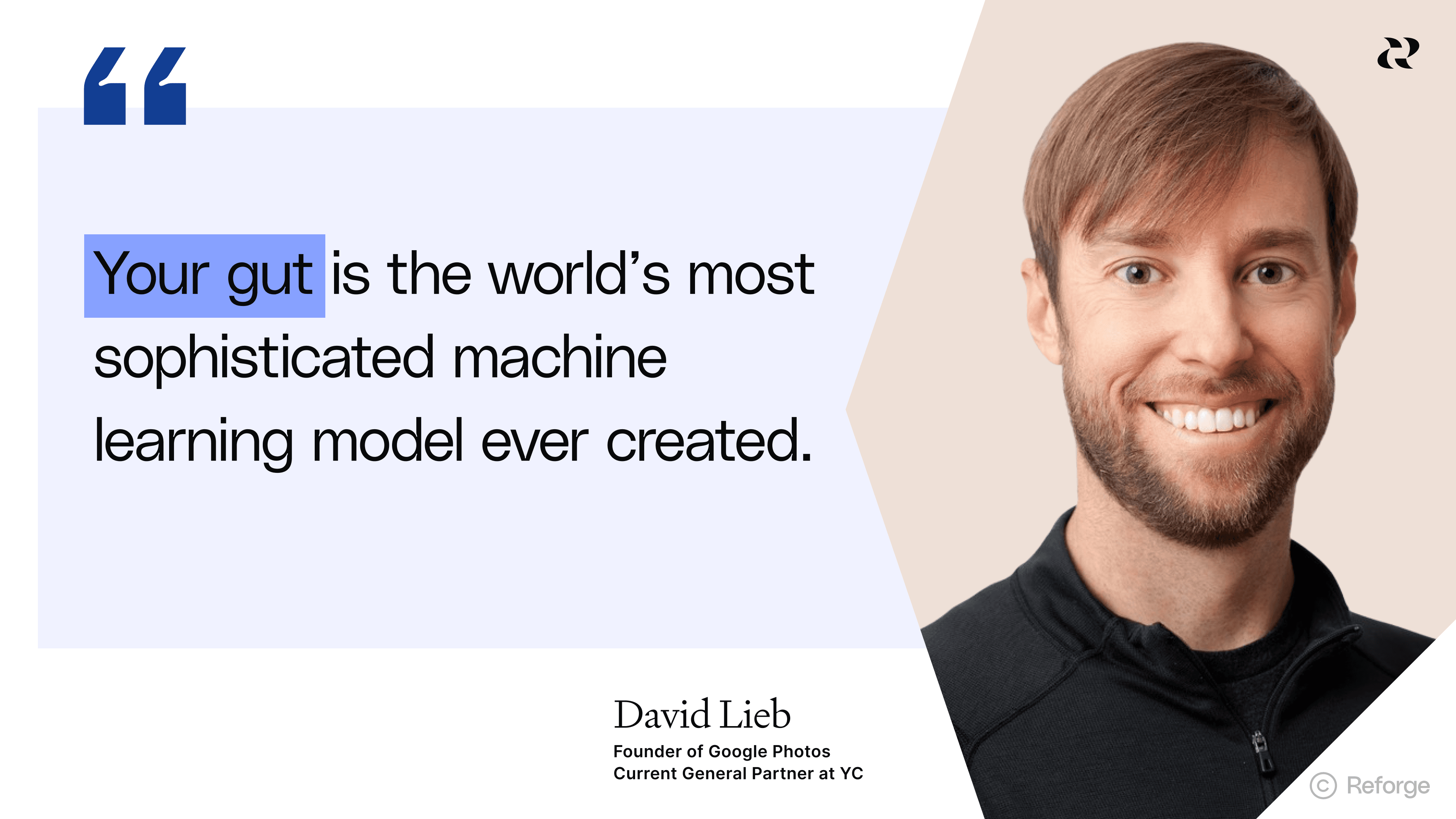
Sachin brings in one of my favorite quotes that is especially timely in AI from David Lieb, Founder of Google Photos and now General Partner at YC:
"Your gut is the world’s most sophisticated machine learning model ever created."
This isn't just a clever analogy – it's a profound insight into how product intuition actually develops. Like any machine learning model, product intuition requires:
High-Quality Training Data - Direct, unfiltered, raw customer feedback connected to product decisions and outcomes.
Lots of Cycles - Fast feedback loops and immediate outcome visibility to build pattern recognition.
As teams scale, instead of getting lots of these reps they tend to do two things to de-risk the chances of a failed product outcome.
The More Research Trap
First, is that they try to do more customer research. But this doesn’t work at scale because:
Painfully manual and high-friction
Slow to generate actionable insights
Quickly outdated in fast-moving markets
Prohibitively expensive to scale
The Dashboard Deluge
So the second thing product teams do is lean more on quantitative data analysis. While metrics are crucial, this approach creates critical blindspots. As I described in The Feedback Fragmentation Tax:
"For the past twenty years, quantitative data has dominated product development. We've built sophisticated dashboards, A/B testing frameworks, and metric-tracking systems. While quant data is important, there are three problems with this:
Metrics tell you the what, but have always struggled with the why.
Too many metrics dehumanize the customer.
An over-focus on quant data blinds teams to emerging opportunities that aren’t yet measurable."
From Process Driven → Intuition Driven
Interestingly, there is an environment that creates this machine learning algorithm for product intuition - early-stage startups. As I described in AI-Native Product Teams:
"In early stage startups, there is something special that happens that feels like magic. Teams tend to ship a lot more with a lot less people. As a company grows you try to maintain that magic but it eventually disappears. AI can potentially maintain the magic of early stage startups you lose over time. What feels like magic, isn’t magic at all.
Early-stage startups create the constraints and conditions for:
Super tight feedback loops between the builders and the customers.
These super tight feedback loops create “founder intuition.”
Everyone on the team does a little bit of everything because they have to.
But over time all those things get extracted away from the builders.
Tons of specialized roles (user researchers, data analysts, sales, success, etc) get introduced creating layers between the customers and the builders.
This slows down the feedback loops between the builders and customers which slows down the team building intuition
Intuition is replaced by documentation, product reviews, sync meetings in order to keep things “aligned” and headed in the right direction.
These things replace building time with time spent on the work behind the work."*
The Impossible Choice PM’s Face
So why not replicate this early-stage environment? A lot of teams try. They say there is an expectation for their product managers to spend time with support tickets, listen in on sales calls, sift through all the user research. But let’s get real for a second. Here is what really happens:
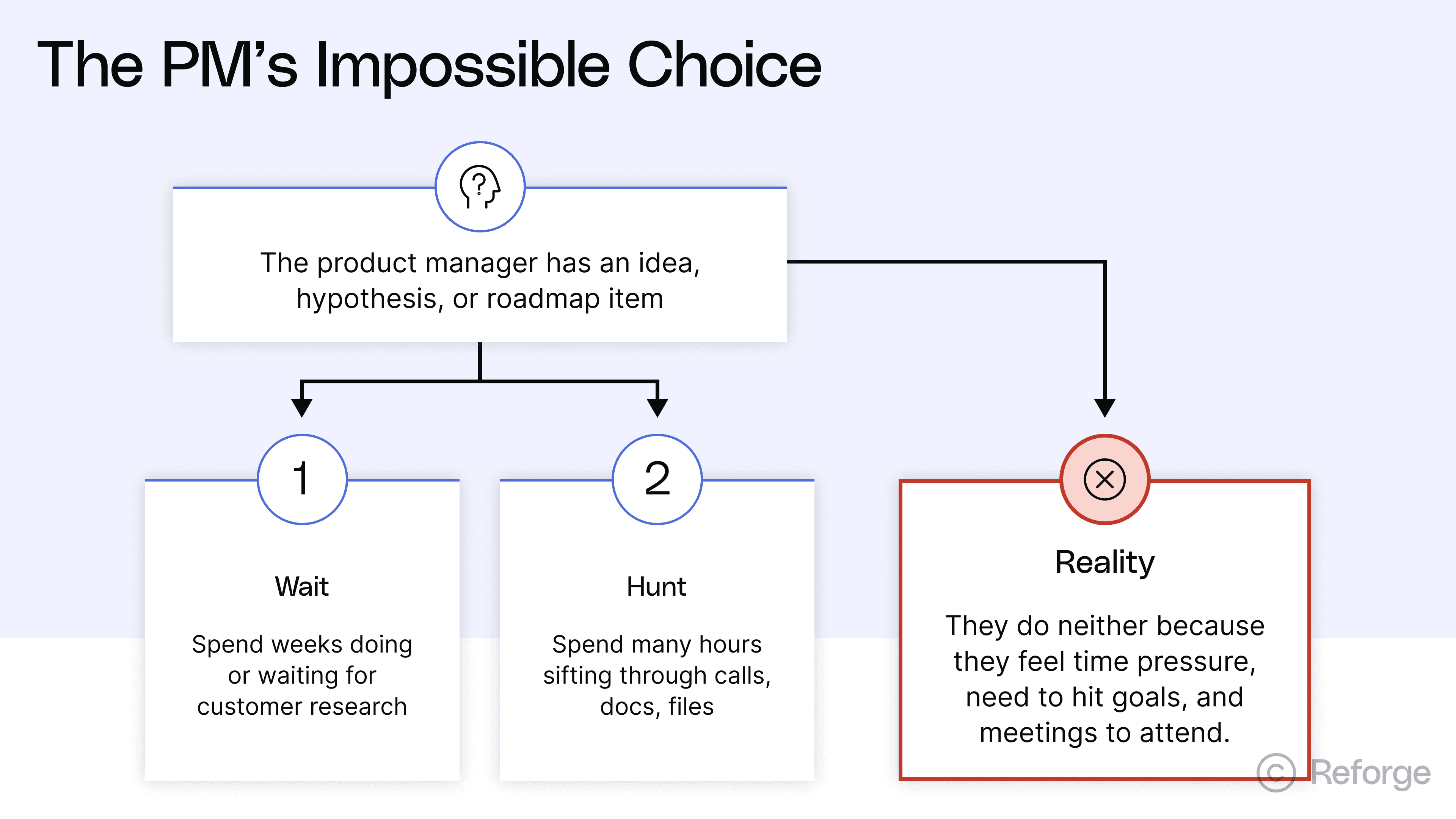
The product manager has an idea, hypothesis, or roadmap item.
They want it to be rooted in the customer. They have three options:
Option 1: Spend Weeks Waiting For Research
They can go do custom customer research. Which means finding the right customers to talk to, getting them to opt in, collecting the data, synthesizing, trying to quantify it, etc. Or put in a request to the user research team who has to go through the same things. It’s likely weeks until they get results.
Option 2: The Great Hunt
Spend many hours trying to sift through customer support tickets, Gong calls, the crm, past user research decks buried in a google drive folder, etc.
Option 3 - Reality
They actually choose Option 3. They do neither of those things because they feel tight time pressure, need to hit goals, have a million meetings to attend.
While this solves the immediate time pressure, it creates a compound interest problem:
Product intuition never develops
Decision quality deteriorates over time
Team becomes increasingly disconnected from customers
Innovation capacity diminishes
Product teams are caught in an impossible situation. You know your decisions should be rooted in customer insight, but every time you need to validate an idea or prioritize a feature, you face a crushing dilemma: spend weeks gathering research, or make a blind decision.
Building an Intuition Engine
The challenge is clear: we need to build and scale product intuition across entire organizations. But how do we systematically create the conditions that naturally exist in early-stage companies? The answer begins with reimagining how teams consume and process customer feedback.
The Feedback River: A First Step
Sachin Rekhi, while building LinkedIn Sales Navigator, pioneered an approach called the Feedback River – a continuous stream of real-time customer feedback flowing directly into teams' existing workflows. The concept was simple but powerful: pipe unfiltered customer voice from multiple sources directly into channels where product teams already work.
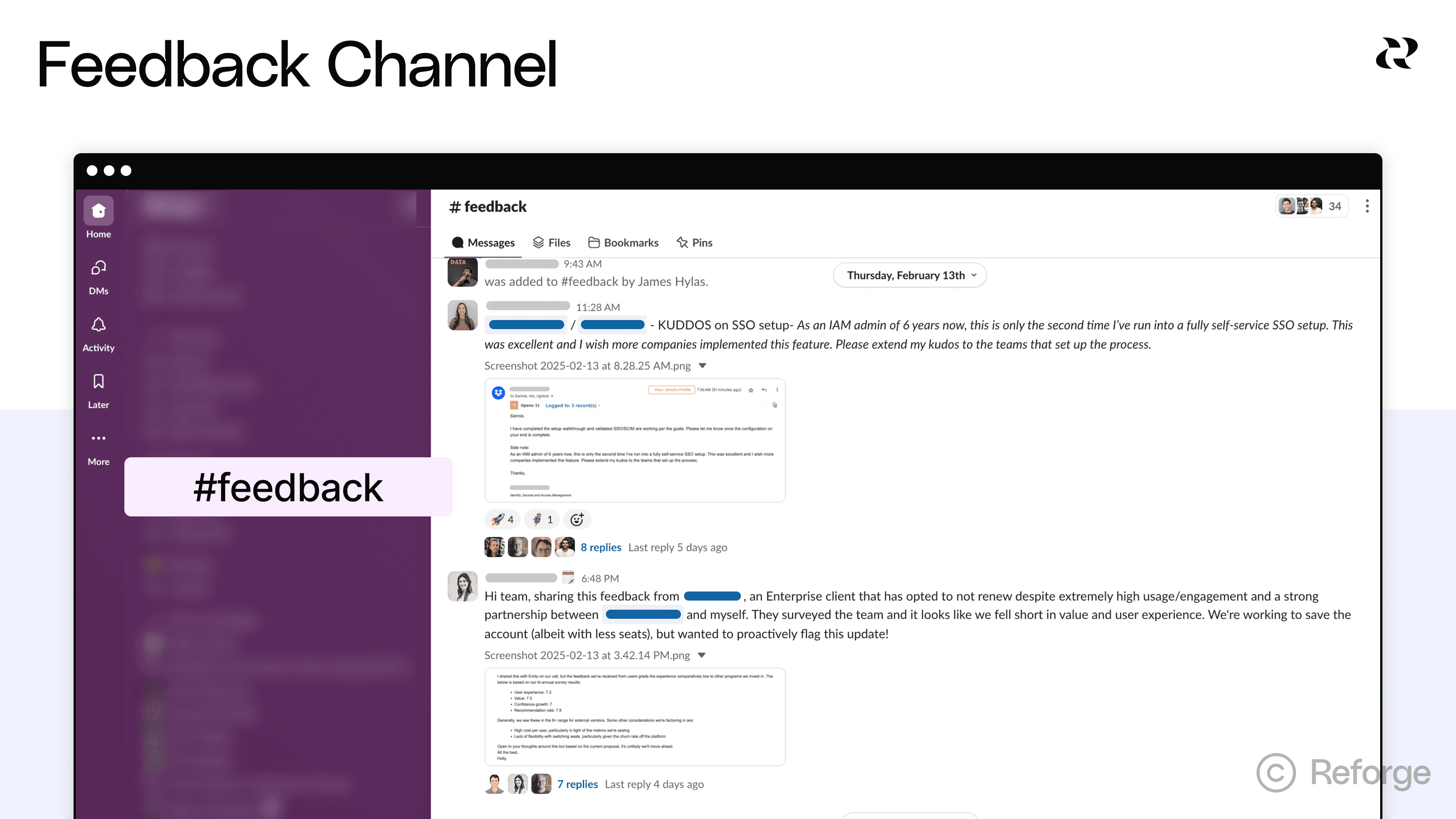
This approach aimed to recreate the natural advantages of early-stage companies through three key mechanisms:
Continuous Exposure: Teams receive real-time, unfiltered customer feedback throughout their day, maintaining constant connection to user needs and pain points.
Pattern Recognition: The steady stream of feedback enables teams to spot emerging trends and recurring issues before they become obvious in metrics.
Rapid Response: Teams can see immediate reactions to product changes, creating the tight feedback loops that drive intuition development.
Challenges With Feedback Rivers 1.0
The Feedback River 1.0 is a great tool. One I’ve used at Reforge and other companies. But there are some challenges with them as well caused by limitations of the software:
Volume - At meaningful customer scale, they ended up being a firehose of information. Too much to consume which meant some team members would just ignore.
Lack Of Personalization - As we had more product teams focused on different things, everyone trying to consume feedback about everything was too much. We wanted them personalized to a team and ideally individual.
Fuzzy Product Outcome Data - Connecting directly to product outcomes of what worked and didn’t work was fuzzy.
Reactive vs Proactive - Often times someone would have an independent feature idea they wanted to explore vs reacting to feedback coming in. They would need to search/sift through the continuous stream in order to find that info.
Experience with first-generation Feedback Rivers revealed three critical requirements for any system help accelerate scaling product intuition:
Intelligent Personalization: Teams need relevant feedback, automatically surfaced at the right time.
Bi-directional Flow: The system must support both passive monitoring and active exploration of specific questions, hypotheses, ideas.
Closed Loop Learning: Every piece of feedback must connect clearly to product outcomes, enabling teams to build pattern recognition over time.
This understanding led us to completely reimagine how Feedback Rivers could work in the AI era.
AI-Powered Feedback Rivers with Personalization, Customizable Reports, Product Outcomes
These challenges are why I’m excited to announce three new improvements to Reforge Insight Analytics that enables AI-Powered Feedback Rivers to accelerate building product intuition on your team.
The first step was enabling easy aggregation, analysis, and action on feedback. But in the past two months we’ve released a number of updates to take this another step.
Team and Individual Personalization
We've transformed the overwhelming feedback firehose into precise, personalized streams that adapt to both team and individual needs. Product teams can now:
Create organizational tags to route feedback to relevant teams
Track individual themes that matter to specific initiatives, goals, or OKRs
Configure personalization settings at both team and individual levels
Ensure every team member sees the feedback that matters most to their work
https://www.loom.com/embed/43eab8e948df46848322fd26ba5843f6?sid=d7ced85e-bb24-42fb-9f30-7b53f3cbd6dd
Create Reports w/ AI Chat
When valuable patterns emerge from the feedback, team members can instantly transform them into actionable insights:
Convert chat explorations into shareable reports with one click
Generate reports from existing themes or manual analysis
Share insights across teams while maintaining private views
https://www.loom.com/embed/80c85680fc1a4b26903b055d89380462?sid=d50fe02e-52b0-446b-a0f9-6cf6a227e9c2
Closing the Loop with Product Outcomes
We've eliminated the gap between feedback and outcomes by connecting directly with your development workflow:
Integrate with Linear, JIRA, and other ticketing systems
Track how feedback translates into shipped features
Measure the impact of changes on customer satisfaction
Create a continuous feedback loop between customers and product
https://www.loom.com/embed/1f875ec0b94e4677a8ed553852eb3ac1?sid=6e0b8e59-f369-45e5-af87-7b8d26b64651
The New Product Manager Workflow with AI
The shift to AI-Native Product Teams isn't just about tools – it's about reimagining how product teams work and the skills (intuition) they need to strengthen. The improvements to Insight Analytics enable your team to build and scale product intuition in ways previously impossible. Instead of hunting for insights, teams can now:
Automatically triage feedback to relevant product areas and initiatives
Instantly explore patterns and connections through natural language
Track the impact of product decisions in real-time
Build institutional knowledge that compounds over time
Remember that flow of a PM before? Let’s look at the flow with AI-powered feedback rivers.
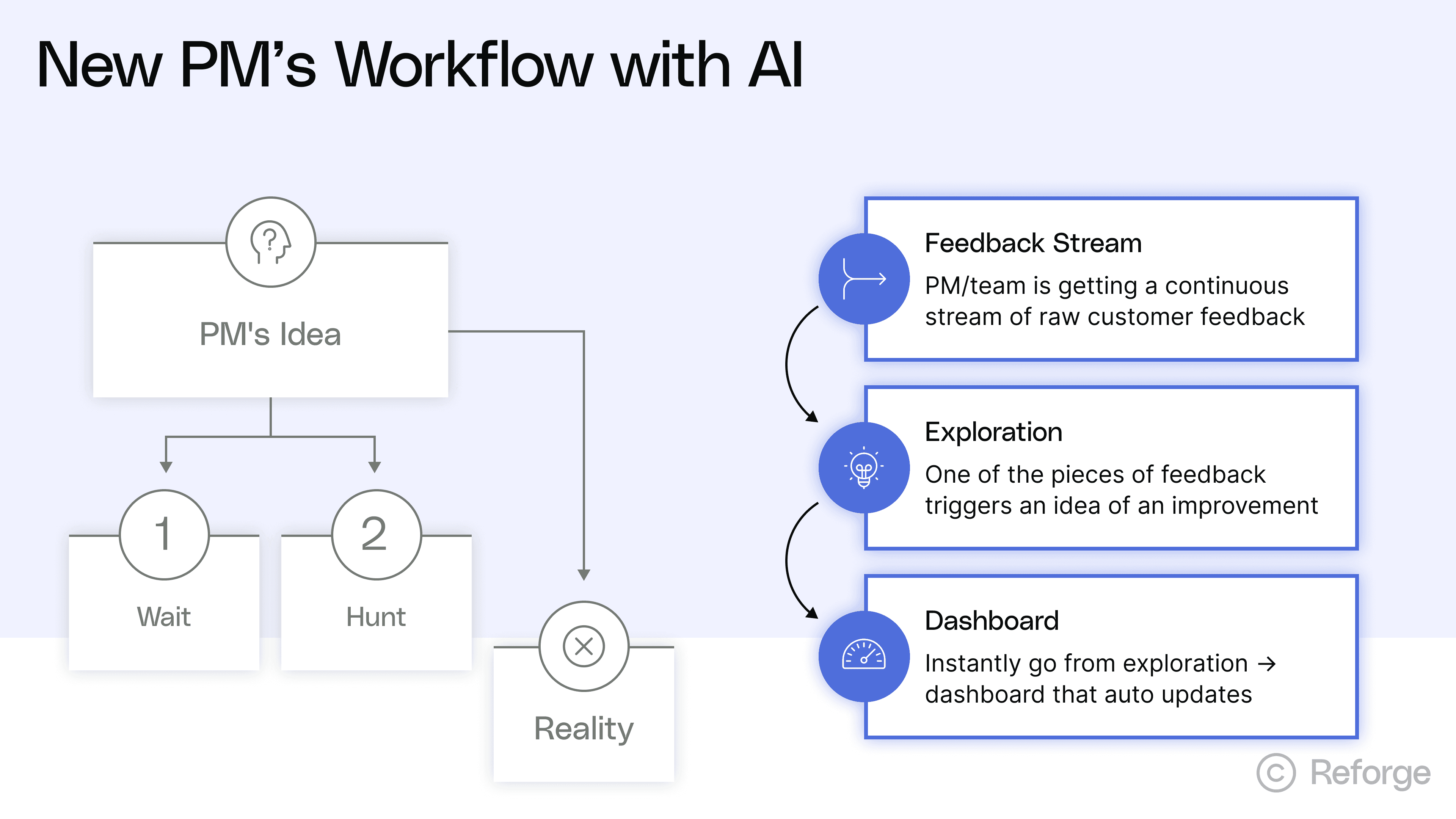
Product manager/team is getting a continuous stream of raw customer feedback personalized to their product area in Slack or other area.
One of the pieces of feedback triggers an idea of an improvement. They can do a number of things:
Pop into Insight Analytics, enter the idea/goal/roadmap item into the Chat and instantly pull all other relevant feedback to that item and get an instant analysis.
They can ask follow up questions, see volume of feedback, impact to key metrics, etc to immediately quantify the potential impact.
Get an instant list of highly relevant users to reach out to in order to get more information.
Instantly go from exploration → dashboard that auto updates. This allows them to:
Monitor and track the feedback over time.
Segment it by different metrics or types of customers.
Easily see the before/after effect closing the loop from feedback → product outcome.
Accelerate Your Product Intuition
All of this would have taken many manual hours before. It would have been too high friction and costly for the team to do. But can now be done in minutes. This new workflow creates a virtuous cycle:
Each product decision is based on deeper customer understanding
Every outcome generates clear learning for future decisions
Product intuition develops faster through rapid feedback loops
Teams build institutional knowledge that survives employee turnover
To go deeper on these concepts or others:
Setup Your AI-Enabled Feedback Rivers
We’ll show you a step by step on how to set up your AI-enabled feedback rivers (and more) to increase the product intuition of your team.
Mastering Product Management by Sachin Rekhi
Learn how to separate yourself from the crowd, with tools and frameworks for more effectively managing product work. Deepen your understanding of product strategy, Better identify work that will move the needle, articulate a vision around it, and get buy-in on that vision.
Mastering Customer Feedback by Behzod Sirjani
As a product leader, you will spend the rest of your career making decisions based on customer feedback. To make great decisions, just talking to users isn't enough. Master the skill of using customer feedback to make great product decisions.



AI is on a path to automate historical product management skills and tasks—from process workflows to data analysis and feature deployment. As a result, the competitive advantage is shifting away from conventional process skills and best practices. The new differentiator? Product intuition.
To Win In AI Era, You Can’t Just Follow Process
The product management landscape is undergoing its most significant transformation since the technology shift from on-premise to cloud. Many product leaders see AI as just another tool in their arsenal. This is a dangerous misconception. At Reforge, we believe the industry is underestimating AI's impact on product development over the next five years.
As I described in AI-Native Product Teams:
The shift from on-premise to cloud wasn't merely a hosting change; it revolutionized every aspect of how we build, ship, and grow software products. AI represents a similar inflection point.
Our belief at Reforge is that the technology shift to AI will completely redefine product teams and in a lot of ways I think the ecosystem is underestimating not overestimating the impact it will have over the next decade.
AI is shifting the constraints and possibilities around what products and features we build, how we build and grow those products, and the roles, teams, and org structures we use. The next generation of product teams will be trained as AI-native from day one. They will think, work, and build differently
As AI reshapes how we build and ship products, the fundamental skills that made product managers successful are being redefined. While process and best practices have been an important part historically, they're no longer enough to win in the AI era.
While process helps solve certain problems, it’s never enough. Sachin Rekhi, who led product on LinkedIn Sales Navigator and creator of Mastering Product Management tells this story in an excellent video on Building Your Product Intuition. In his presentation brings in an excellent quote from Jeff Bezos:
Leaders are right a lot. They have strong judgement and good instincts. They seek diverse perspectives, and work to disconfirm their beliefs.
What Bezos is talking about here is that you can’t just process in order to win. You ultimately have to take bets. Those bets are informed by instincts and judgement. Those bets ultimately have to be the right ones in order to win.
As AI Automates, Product Intuition Becomes King
The next great divide in product management won't be about skills or processes – it will be about intuition. AI is systematically automating some core functions that have been key parts of product management for decades.
Process Automation
Best practices are being encoded into AI systems
Standard workflows are becoming automated
Traditional PM tools are being AI-enhanced
Intelligence Automation
Data gathering and analysis is becoming easier/instant
Competitive intelligence is being automated
Market research is being transformed by AI
Execution Acceleration
Build times are compressing dramatically
Testing cycles are becoming near-instantaneous
Feature deployment is being streamlined
This automation wave creates an uncomfortable truth: many of the skills that made product managers or product teams gain an edge in the past are becoming commoditized. As that happens, we will witness a fundamental shift in what drives competitive advantage.
The New Scarce Resource
In this transformed landscape, something more fundamental emerges as the key differentiator: product intuition. Scott Belsky, former CPO of Adobe and Reforge investor, captures this shift perfectly:
"Until now, skills have been a major differentiator for humanity. However, in the age of AI, taste will become more important than skills as much of skill-based work and productivity is offloaded to compute. Taste seems more scarce these days, and increasingly differentiating in the age of AI."
This is a classic “the skills that got you here, won’t get you there” situation. Intuition and Taste can feel vague. So the question emerges - how do we build a sophisticated pattern recognition engine that can:
Identify emerging customer needs before they're obvious
Spot market opportunities that data alone can't reveal
Make confident bets in ambiguous situations
Synthesize disparate signals into coherent product vision
The Historical Problem With Building and Scaling Intuition
Given that product intuition and taste become the scarcity that leads to winning, product teams need to think about how they build, cultivate, and scale it across the team as the organization grows. Historically, this is has been incredibly difficult. Instead, organizations opt for installing more processes to create controls around the lack of scaled product intuition.
Part of those processes to try and be customer informed involve:
Lots of market research, user surveys, etc.
Scaling teams of specialists to do more of those things.
Presentations presenting summaries, averages, etc
Sachin in his presentation goes back to a Bezos quote on why this doesn’t build product intuition:
Market research and customer surveys can become proxies for customers - something that’s especially dangerous when you’re inventing and designing products. “Fifty-five percent of eta testers report being satisfied with this feature. That is up from 47% in the first survey.” That’s hard to interpret and could unintentionally mislead.
Good inventors and designers deeply understand their customer. They spend tremendous energy developing that intuition. They study and understand many anecdotes rather than the averages you find on surveys. They live with the design.
As Bezos points out - summaries, averages, and single numbers don’t build product intuition. They are too abstract. Getting lots of reps with the actual raw feedback and experience the customer had done.
Machine Learning Analogy For Product Intuition
Sachin brings in one of my favorite quotes that is especially timely in AI from David Lieb, Founder of Google Photos and now General Partner at YC:
"Your gut is the world’s most sophisticated machine learning model ever created."
This isn't just a clever analogy – it's a profound insight into how product intuition actually develops. Like any machine learning model, product intuition requires:
High-Quality Training Data - Direct, unfiltered, raw customer feedback connected to product decisions and outcomes.
Lots of Cycles - Fast feedback loops and immediate outcome visibility to build pattern recognition.
As teams scale, instead of getting lots of these reps they tend to do two things to de-risk the chances of a failed product outcome.
The More Research Trap
First, is that they try to do more customer research. But this doesn’t work at scale because:
Painfully manual and high-friction
Slow to generate actionable insights
Quickly outdated in fast-moving markets
Prohibitively expensive to scale
The Dashboard Deluge
So the second thing product teams do is lean more on quantitative data analysis. While metrics are crucial, this approach creates critical blindspots. As I described in The Feedback Fragmentation Tax:
"For the past twenty years, quantitative data has dominated product development. We've built sophisticated dashboards, A/B testing frameworks, and metric-tracking systems. While quant data is important, there are three problems with this:
Metrics tell you the what, but have always struggled with the why.
Too many metrics dehumanize the customer.
An over-focus on quant data blinds teams to emerging opportunities that aren’t yet measurable."
From Process Driven → Intuition Driven
Interestingly, there is an environment that creates this machine learning algorithm for product intuition - early-stage startups. As I described in AI-Native Product Teams:
"In early stage startups, there is something special that happens that feels like magic. Teams tend to ship a lot more with a lot less people. As a company grows you try to maintain that magic but it eventually disappears. AI can potentially maintain the magic of early stage startups you lose over time. What feels like magic, isn’t magic at all.
Early-stage startups create the constraints and conditions for:
Super tight feedback loops between the builders and the customers.
These super tight feedback loops create “founder intuition.”
Everyone on the team does a little bit of everything because they have to.
But over time all those things get extracted away from the builders.
Tons of specialized roles (user researchers, data analysts, sales, success, etc) get introduced creating layers between the customers and the builders.
This slows down the feedback loops between the builders and customers which slows down the team building intuition
Intuition is replaced by documentation, product reviews, sync meetings in order to keep things “aligned” and headed in the right direction.
These things replace building time with time spent on the work behind the work."*
The Impossible Choice PM’s Face
So why not replicate this early-stage environment? A lot of teams try. They say there is an expectation for their product managers to spend time with support tickets, listen in on sales calls, sift through all the user research. But let’s get real for a second. Here is what really happens:
The product manager has an idea, hypothesis, or roadmap item.
They want it to be rooted in the customer. They have three options:
Option 1: Spend Weeks Waiting For Research
They can go do custom customer research. Which means finding the right customers to talk to, getting them to opt in, collecting the data, synthesizing, trying to quantify it, etc. Or put in a request to the user research team who has to go through the same things. It’s likely weeks until they get results.
Option 2: The Great Hunt
Spend many hours trying to sift through customer support tickets, Gong calls, the crm, past user research decks buried in a google drive folder, etc.
Option 3 - Reality
They actually choose Option 3. They do neither of those things because they feel tight time pressure, need to hit goals, have a million meetings to attend.
While this solves the immediate time pressure, it creates a compound interest problem:
Product intuition never develops
Decision quality deteriorates over time
Team becomes increasingly disconnected from customers
Innovation capacity diminishes
Product teams are caught in an impossible situation. You know your decisions should be rooted in customer insight, but every time you need to validate an idea or prioritize a feature, you face a crushing dilemma: spend weeks gathering research, or make a blind decision.
Building an Intuition Engine
The challenge is clear: we need to build and scale product intuition across entire organizations. But how do we systematically create the conditions that naturally exist in early-stage companies? The answer begins with reimagining how teams consume and process customer feedback.
The Feedback River: A First Step
Sachin Rekhi, while building LinkedIn Sales Navigator, pioneered an approach called the Feedback River – a continuous stream of real-time customer feedback flowing directly into teams' existing workflows. The concept was simple but powerful: pipe unfiltered customer voice from multiple sources directly into channels where product teams already work.
This approach aimed to recreate the natural advantages of early-stage companies through three key mechanisms:
Continuous Exposure: Teams receive real-time, unfiltered customer feedback throughout their day, maintaining constant connection to user needs and pain points.
Pattern Recognition: The steady stream of feedback enables teams to spot emerging trends and recurring issues before they become obvious in metrics.
Rapid Response: Teams can see immediate reactions to product changes, creating the tight feedback loops that drive intuition development.
Challenges With Feedback Rivers 1.0
The Feedback River 1.0 is a great tool. One I’ve used at Reforge and other companies. But there are some challenges with them as well caused by limitations of the software:
Volume - At meaningful customer scale, they ended up being a firehose of information. Too much to consume which meant some team members would just ignore.
Lack Of Personalization - As we had more product teams focused on different things, everyone trying to consume feedback about everything was too much. We wanted them personalized to a team and ideally individual.
Fuzzy Product Outcome Data - Connecting directly to product outcomes of what worked and didn’t work was fuzzy.
Reactive vs Proactive - Often times someone would have an independent feature idea they wanted to explore vs reacting to feedback coming in. They would need to search/sift through the continuous stream in order to find that info.
Experience with first-generation Feedback Rivers revealed three critical requirements for any system help accelerate scaling product intuition:
Intelligent Personalization: Teams need relevant feedback, automatically surfaced at the right time.
Bi-directional Flow: The system must support both passive monitoring and active exploration of specific questions, hypotheses, ideas.
Closed Loop Learning: Every piece of feedback must connect clearly to product outcomes, enabling teams to build pattern recognition over time.
This understanding led us to completely reimagine how Feedback Rivers could work in the AI era.
AI-Powered Feedback Rivers with Personalization, Customizable Reports, Product Outcomes
These challenges are why I’m excited to announce three new improvements to Reforge Insight Analytics that enables AI-Powered Feedback Rivers to accelerate building product intuition on your team.
The first step was enabling easy aggregation, analysis, and action on feedback. But in the past two months we’ve released a number of updates to take this another step.
Team and Individual Personalization
We've transformed the overwhelming feedback firehose into precise, personalized streams that adapt to both team and individual needs. Product teams can now:
Create organizational tags to route feedback to relevant teams
Track individual themes that matter to specific initiatives, goals, or OKRs
Configure personalization settings at both team and individual levels
Ensure every team member sees the feedback that matters most to their work
https://www.loom.com/embed/43eab8e948df46848322fd26ba5843f6?sid=d7ced85e-bb24-42fb-9f30-7b53f3cbd6dd
Create Reports w/ AI Chat
When valuable patterns emerge from the feedback, team members can instantly transform them into actionable insights:
Convert chat explorations into shareable reports with one click
Generate reports from existing themes or manual analysis
Share insights across teams while maintaining private views
https://www.loom.com/embed/80c85680fc1a4b26903b055d89380462?sid=d50fe02e-52b0-446b-a0f9-6cf6a227e9c2
Closing the Loop with Product Outcomes
We've eliminated the gap between feedback and outcomes by connecting directly with your development workflow:
Integrate with Linear, JIRA, and other ticketing systems
Track how feedback translates into shipped features
Measure the impact of changes on customer satisfaction
Create a continuous feedback loop between customers and product
https://www.loom.com/embed/1f875ec0b94e4677a8ed553852eb3ac1?sid=6e0b8e59-f369-45e5-af87-7b8d26b64651
The New Product Manager Workflow with AI
The shift to AI-Native Product Teams isn't just about tools – it's about reimagining how product teams work and the skills (intuition) they need to strengthen. The improvements to Insight Analytics enable your team to build and scale product intuition in ways previously impossible. Instead of hunting for insights, teams can now:
Automatically triage feedback to relevant product areas and initiatives
Instantly explore patterns and connections through natural language
Track the impact of product decisions in real-time
Build institutional knowledge that compounds over time
Remember that flow of a PM before? Let’s look at the flow with AI-powered feedback rivers.
Product manager/team is getting a continuous stream of raw customer feedback personalized to their product area in Slack or other area.
One of the pieces of feedback triggers an idea of an improvement. They can do a number of things:
Pop into Insight Analytics, enter the idea/goal/roadmap item into the Chat and instantly pull all other relevant feedback to that item and get an instant analysis.
They can ask follow up questions, see volume of feedback, impact to key metrics, etc to immediately quantify the potential impact.
Get an instant list of highly relevant users to reach out to in order to get more information.
Instantly go from exploration → dashboard that auto updates. This allows them to:
Monitor and track the feedback over time.
Segment it by different metrics or types of customers.
Easily see the before/after effect closing the loop from feedback → product outcome.
Accelerate Your Product Intuition
All of this would have taken many manual hours before. It would have been too high friction and costly for the team to do. But can now be done in minutes. This new workflow creates a virtuous cycle:
Each product decision is based on deeper customer understanding
Every outcome generates clear learning for future decisions
Product intuition develops faster through rapid feedback loops
Teams build institutional knowledge that survives employee turnover
To go deeper on these concepts or others:
Setup Your AI-Enabled Feedback Rivers
We’ll show you a step by step on how to set up your AI-enabled feedback rivers (and more) to increase the product intuition of your team.
Mastering Product Management by Sachin Rekhi
Learn how to separate yourself from the crowd, with tools and frameworks for more effectively managing product work. Deepen your understanding of product strategy, Better identify work that will move the needle, articulate a vision around it, and get buy-in on that vision.
Mastering Customer Feedback by Behzod Sirjani
As a product leader, you will spend the rest of your career making decisions based on customer feedback. To make great decisions, just talking to users isn't enough. Master the skill of using customer feedback to make great product decisions.