Reforge has joined Miro ↗
Many product professionals are questioning their future as traditional PM workflows—documentation, basic prioritization, and coordination—become increasingly automated. Yet this technological shift isn't eliminating the product management function; rather, it's elevating what has always differentiated exceptional PMs from average ones. While low-value processes are being automated away, the core elements that create product success—strategic vision, judgment, taste, and leadership—are becoming dramatically more valuable.
I had zero intention of ever writing this post. I feel like many others have already covered the topic. But a few weeks ago I was doing an event on the topic of Product Market Fit Collapse. At the very end with less than a minute remaining on the scheduled time, one brave soul submitted a question:
“I feel like product management as a profession is going through product market fit collapse. What do we do?”
Immediately, others starting smashing the upvote button and the question rose to the top of the list. The question was hitting others like a ton of bricks. I was surprised. It was clear that most of the online conversation has been creating more anxiety and questions vs answering.
I ended up going on a 15 minute combo of rant and motivational speech. Not a single person dropped off the call even though we were over time. It was the most heart emojis and other reactions I have received for an event. Given that, I decided the topic still had value to cover. But I wanted to talk about it with others that I respected and knew would come with thoughts that were hype-free.
On the most recent episode of Unsolicited Feedback, Fareed Mosavat (Product Advisor and former Reforge, Slack, Instacart), Shaun Clowes (CPO at Confluent, former Mulesoft/Atlassian) and I decided to discuss. I appreciated the convo with them because I’ve found Fareed to always take a long term view to career topics and Shaun has always had deeply thoughtful but opinionated takes on product management as a profession.
Starting With The End
I’d like to start this post with our end conclusion:
It is extremely unlikely the product management function goes away.
AI automates/eliminates the low value parts of product management, and enhances the pieces that have always differentiated great from average product managers.
Trying to predict more than one year out is pointless. No one has a revealed map and there are no safer waters across other knowledge management roles. Everyone has one path forward - be curious and adaptable. Reveal the map one tile at a time.
Stop Wasting Your Energy On Pointless Questions
Many are looking for an answer - Is Product Management going to die? If yes, then what other type of job should I move to? Trying to answer these questions is a complete waste of time for a few reasons.
There Is No Crystal Ball Trying to answer those questions assumes the future can be predicted with high precision. We are in the exact opposite environment right now. Even the researchers on the front lines of AI are discovering new emergent abilities they weren’t aware of from the technology. The pace of change around AI is moving so fast that anyone making claims that some thing is going to definitively happen is likely just doing it for the clicks. Ignore.
There Are No Safer Waters Let’s just assume for a moment that we all agreed product management as a function was going to go away entirely. What do you do? What other knowledge work function do you move to that is a lot safer? Engineering? Design? Something else? There are no safer waters to move to. All knowledge work is going through a massive transformation. Trying to navigate new waters that are also highly risky is a way worse decision than navigating the one that you know.
Paralysis Is Your Enemy When the environment is changing fast, anything that creates analysis paralysis is your enemy. That is exactly what is happening to people trying to decide if product management is dead. Adaptability is at a premium. You need to keep moving forward.
Revealing The Map vs Searching For The Revealed Map

In high school I was big into real time and turn based strategy games. Civilization II, Command and Conquer, Heroes of Might and Magic, and the early Warcrafts. In those games you always started with a map that was mostly covered by fog with a little clear area around you. You didn’t win by trying to predict what the full revealed map might look like. Instead, you took a couple steps forward, which revealed a bit more, you’d then react with the info you had, then keep moving forward.
I’ve had this mental image stuck in my head for the past year because that’s what I feel like every day is. It’s moving forward one step at time revealing new things that I can do with AI, how it changes my day to day, then continuing to iterate. Sometimes I find a new chest of gold, or sometimes it’s a small barbarian hoard. Sitting and waiting for the full map to be revealed before you make any move means you’ll be ages behind the other players around you.
Asking The Right Questions
Many others who have posted about this topic have analyzed it from the perspective on a task by task basis.
What tasks do product managers do today?
What can AI replace?
Is what left over going to justify product managers?
This is incomplete and flawed thinking for a few reasons:
Not All Tasks Are Created Equal There are things that great product managers do vs good/bad product managers do. Certain things, when done well, create outsized leverage and value. AI might automate 50% of the tasks but does it automate 50% of the value? No.
Assumes Jobs Are Static The analysis also assumes jobs/roles are static. But the product manager role (like many others) has continued to evolve constantly over time. When we adopt new tools to automate some things, we tend to just find more things to fill that space with.
AI Enhances and Replaces Those analyses also focus on the things that AI replaces. It leaves out the things that AI enhances.
Instead, here are the questions we should ask:
What parts of product management get replaced? Are those low value or high value?
What parts of product management get enhanced? Are those low value or high value?
What might happen with the new space that we’ve created?
What Parts Of Product Management Get Replaced?
Knowledge Value Collapse
For the past couple of decades, product managers derived significant value from their accumulated factual knowledge—industry insights, competitive intelligence, customer feedback patterns, and market trends. This knowledge wasn't just valuable; it was a competitive advantage and a key differentiator for senior PMs. As Shaun Clowes notes in the podcast:
"Previously your knowledge of what customers had been saying, your knowledge of the market, your knowledge of the technology, your knowledge of your own product was valuable. Why? Because it was difficult to get, difficult to keep, and difficult to query."
That barrier is falling. Large language models have democratized access to information that once required years to accumulate and master. The specialized knowledge that previously took multiple quarters to develop can now be accessed, synthesized, and applied in minutes or hours.
From Information Scarcity to Abundance
We are moving from a world where lots of knowledge areas are moving from scarcity to abundance.
Competitive Analysis: Once requiring weeks of research, competitor deep-dives can now be generated in minutes. LLMs can quickly synthesize public information about competitors' features, pricing strategies, market positioning, and recent moves. Tools can now generate comprehensive competitive landscapes that would have previously required engaging expensive consulting firms or dedicating weeks of a PM's time.
Market Research: Market sizing, segmentation analysis, and industry trend identification that once demanded specialized skills and access to expensive reports can now be rapidly assembled through AI tools. While the quality varies based on the recency of the data, the ability to quickly generate directionally accurate market analyses has been fundamentally altered.
Customer Insights Synthesis: Perhaps most dramatically, the analysis of customer feedback—once a painstaking process of manual tagging, clustering, and pattern identification—has been transformed. As one PM recently told me: "I used to spend two days a month synthesizing our customer interviews. Now I upload the transcripts to an AI tool and get 90% of the value in 15 minutes."
Trend Analysis: Identifying emerging trends, understanding their potential impact, and placing them in context used to be a specialized skill developed over years. Now, AI can rapidly analyze patterns across industries, surface potential disruptions, and connect seemingly unrelated developments into coherent narratives.
From Shaun Clowes comparing this transformation to previous technological shifts:
"I started my career as an engineer early on... at the time I started, all of the world's programming knowledge was not on the internet. And there used to be these people they called wizards... They were often the people who had read all the manuals. They knew the magic incantations necessary to make the machine do things... And they used to hoard their knowledge. In many cases, they tried not to share it because they viewed it as a form of job protection... They quickly got stripped of their robes, right? You saw Stack Overflow, you saw the internet blow up, all of that knowledge suddenly became open."
Process Value Collapse
Product management has historically been defined as much by its processes as by its outcomes. The ability to create effective documentation, establish prioritization frameworks, manage stakeholder communication, and drive delivery through established workflows has been a core part of the PM toolkit. As Shaun explains:
"One of the other legs of the product management confidence stool is process value. In other words, I have a system by which I do the following things that bring my knowledge to bear to deliver a uniquely valuable product into the market. And you're seeing that collapse too. Why? Because those processes can either be executed by LLMs or agents, or anyone can design one of those processes using an LLM or an agent because it's a generic concept."
This shift is fundamentally altering the landscape of product management by commoditizing processes that were once differentiators.
The Commoditization of PM Workflows
Let's examine how AI is transforming key process areas:
Documentation (PRDs, Specs, Roadmaps): What once took days now takes minutes. AI tools can generate comprehensive product requirements documents, feature specifications, and even visual roadmaps based on minimal input. Fareed captured this transformation perfectly: The implication is clear: if document creation is no longer a time-intensive task, PMs must find other ways to add value.
"I can whip out a spec in like 12 minutes now. That would have taken me seven hours of procrastination and, you know, two hours of real work is now like zero minutes of procrastination to 12 minutes of actual work, right? At the same quality."
Basic Prioritization Frameworks: Frameworks like RICE, MoSCoW, and impact/effort matrices can now be automatically generated and populated. AI can analyze backlogs, apply standardized criteria, and produce prioritized lists that once required significant PM time and judgment. The mechanical aspects of prioritization have been largely automated, pushing PMs to focus more on the strategic "why" behind prioritization decisions.
Project Management Workflows: Tools augmented with AI can now automatically track progress, predict delays, and even suggest resource reallocations. The administrative aspects of project management—scheduling meetings, sending reminders, documenting decisions—are increasingly handled by intelligent assistants. This fundamentally changes how PMs allocate their time and attention.
Status Tracking and Reporting: Perhaps most dramatically, the creation of status reports, executive updates, and project summaries has been vastly simplified. AI can now review activity streams across multiple tools, synthesize key updates, and generate comprehensive reports with minimal human input.
This isn’t a bad thing in my opinion. I thought Nikunj Kothari who led product teams at Meter, Opendoor, and Atlassian put it well in this tweet:
It is sad that product management as a craft has mostly gone away from building hard things to simply being a conductor with largely no control. And it’s because at large companies you just simply learn the wrong lessons (process over agency, bureaucracy over shipping, talking internally vs talking to customers, optics over impact). People don’t like hearing this but this is the reason why startups don’t hire big tech folks.
What Parts Of Product Management Get Enhanced?
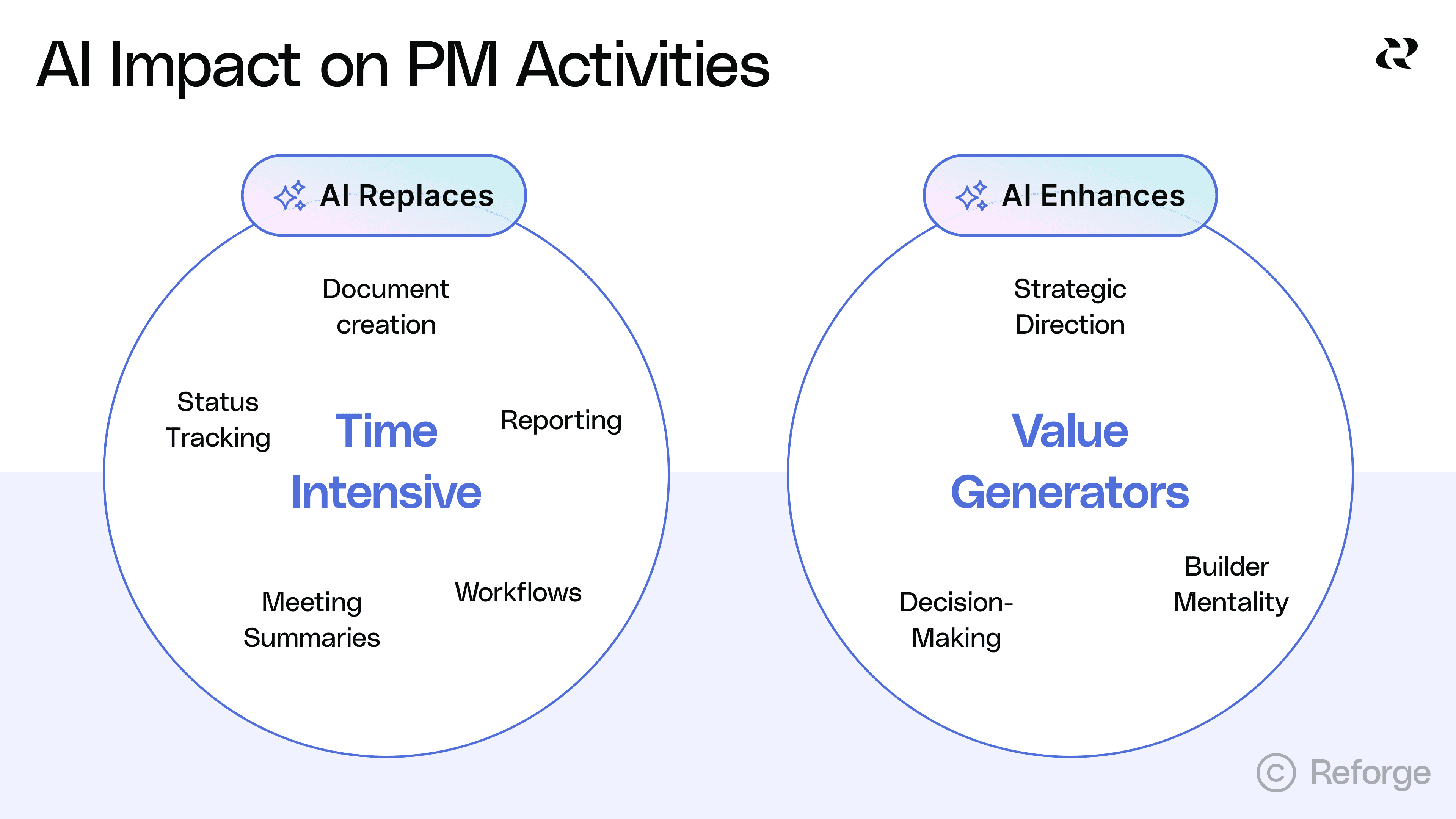
Here is the thing about factual knowledge and and process - even though they were a large part of a pm job by time, they were always the parts that created the lowest value. This gets to one of my core conclusions - AI replaces the low value parts of PM while it enhances the parts that were always the differentiators and value creators.
As Shaun Clowes suggests:
"I wonder whether or not this might lead to a return to kind of the core bits that matter, the bits like you don't need, not everybody needs to know everything, but they need to know enough to like really be dangerous. They need to know enough to understand what the real problem is, and the space which it can be solved in."
So what remains valuable in an AI-Era?
Strategic Direction
As knowledge becomes universally accessible and processes become commoditized, competitive advantage increasingly derives from unique perspectives and insights.
Shaun Clowes articulates this critical shift in how product managers must approach their work:
"You're constantly trying to get ahead. You're trying to find the angle, the question that has not yet been asked that gives you an insight that is not being actioned by other people. Remember, it doesn't just have to be an insight, has to be an insight that others are not actioning. Because if you find that insight and others are not actioning it, that's your competitive advantage."
This is the essence of strategic product leadership in the AI era—not merely having information, but identifying the non-obvious implications of that information that lead to differentiated product decisions. It's about asking better questions than your competitors, not just having better answers to the same questions.
Playing Chess When the Board Is Disappearing
The traditional product management environment was already dynamic, but AI has accelerated this changeability exponentially. Clowes borrows a concept often attributed to Sun Tzu that perfectly captures this challenge:
"The really interesting thing is to think about how to play chess when the board is disappearing... product management is about playing a game where the market will respond. Every person you're playing this game with will respond. So there are no three moves. There's no four moves, five moves, six moves. Everything you do is on shifting sand. All of it's moving all the time."
This metaphor captures the reality that product managers now face. You're not just making moves on a static board—you're making decisions in an environment where:
The rules are constantly changing
Your competitors are adapting their strategies in real-time
New possibilities emerge daily
Customer expectations evolve rapidly
The ability to navigate this complexity—to make smart decisions even as the context shifts—is what distinguishes strategic product leaders from those merely executing processes.
Seeing Below the Surface
Perhaps most critically, product managers must develop the ability to look beyond the literal, surface-level changes and understand the deeper forces at work. This means analyzing not just what is happening, but why it's happening and what might happen next.
Shaun Clowes emphasizes this dimension of strategic thinking:
"You're trying to know what are other people doing? Why are they doing it? What is the market doing? Why is it doing it? Where is technology going? What is driving those trends? You're trying to actually get below the literal sense of what's happening in the world to try and understand what's driving all of those changes and to see around a corner, to be ahead, to predict."
This ability to see beneath the surface—to understand not just the features a competitor is building but why they're building them, not just what customers are saying but what needs they're truly expressing—becomes the differentiating factor for strategic product leaders.
Fareed Mosavat reinforces this point with his poker analogy:
"I like the analogy of poker versus chess for product building because everything's a random chance and always changing dynamically."
Judgement and Taste
As AI accelerates both knowledge acquisition and process execution, the premium on good judgment and taste in product management has never been higher. When information is universally accessible and execution is increasingly automated, the ability to make the right decisions becomes a true differentiator.
Decision-Making in an Age of Infinite Options
AI doesn't reduce the complexity of product decisions—it multiplies it. With faster iteration cycles and more solution possibilities, the burden of choice becomes even greater. Fareed Mosavat captures this paradox perfectly:
"I can whip out a spec in like 12 minutes now. That would have taken me seven hours of procrastination and, you know, two hours of real work is now like zero minutes of procrastination to 12 minutes of actual work, right? At the same quality. But it is all the little micro decisions, things we always call things like product sense, taste, you know, prioritization. These things are actually harder now because the realm of possible solutions is even wider."
As Fareed suggests, while AI dramatically speeds up the execution and documentation parts of product management, it simultaneously makes the judgment part of the role more challenging. When prototyping, designing, and building become faster and cheaper, you face more decision points, not fewer.
This escalation of choices puts an even greater premium on what has always been at the heart of great product management: the ability to make good decisions consistently in conditions of uncertainty.
The Value of a Point of View
When everyone has access to the same knowledge base, having a clear point of view becomes increasingly valuable. Shaun Clowes explains this evolution:
"Judgment and taste are like two of the key attributes of a good leader or a good product manager. Judgment and taste. If there are unlimited problems to be solved, unlimited things to be thought about, unlimited data questions to ask or whatever, you have to know when to stop, right? You have to know when to start, where to stop. You have to know when near enough is good enough."
The paradox of abundant information is that it can lead to decision paralysis or endless exploration without meaningful progress. The product manager who can cut through this complexity—who knows not just what can be built but what should be built—provides immense value that AI enhances rather than replaces.
Experience as the Foundation of Intuition
Both Fareed and Shaun emphasize that real-world experience—what they call "at-bats"—remains irreplaceable in developing the judgment necessary for product leadership. Shaun explains:
"There's no real substitute for at-bats. Like you can read about someone else's experiences and what they did in X circumstance and Y circumstance, but unless you did it, like you were there, you were on the field, were playing the game, you were literally about to get sacked and then you did get sacked and you learned from that experience. It's not the same."
This is a critical insight about the limits of AI-assisted learning. AI can help you absorb information faster, but it cannot replace the wisdom that comes from direct experience—from making real decisions with real consequences in real markets. Shaun continues:
"The more at-bats you have, the better. You're still going to be more valuable if you have more experience, if you have made more real-world decisions."
Steering When Speed Increases
In a particularly apt metaphor, Ravi Mehta (Former product leader at Tinder, Facebook, Tripadvisor and creator of the AI Strategy and Product Leadership courses) compares the PM's role to steering a vehicle—where speed dramatically changes the impact of direction-setting:
"Think about driving a car. When you're going slowly, changes to the steering wheel don't do much. But, if you're going MKBHD speed, tiny nudges can send you shooting off in the wrong direction. As teams accelerate, the direction-setting that PMs do becomes even more important."
This perfectly captures why judgment becomes more crucial, not less, as AI accelerates execution. The faster your team can build, the more important it becomes that they're building the right things. One wrong turn at high speed can send you far off course before you have time to correct.
Ravi further explains:
"I've seen this anecdotally when there are too few PMs: Teams spend much more time firing and less time aiming. They may initially feel they're moving faster, but if it's in the wrong direction, it's ultimately slowing down the rate of progress."
Builder Mentality
Product management largely turned into a direction-setting role—identifying what to build, while leaving the actual building to designers and engineers. But there were always the rare few product managers that had engineering, SQL, or some design skills. They always seemed like superpowers - the exception, not the rule. However, this is changing. Fareed Mosavat describes this evolution:
"I think of this as like rise of the builder that like the person that has the idea and an idea of what needs to be done and can communicate or show the path the best individually removes a lot of the alignment job... I do think there's this builder mentality that will become more and more important. Can you prototype instead of spec? Can you write a little bit of code? Can you do complex data analysis?"
Democratization Of Builder Capabilities
AI tools are making this builder mentality more accessible than ever before. You no longer need years of coding experience to create a functional prototype, or extensive design training to produce a compelling mockup. AI-powered tools are democratizing these capabilities, allowing PMs to extend their reach into execution.
What was once an exception is becoming the rule. Brian emphasizes that this has actually been a differentiator for great PMs all along:
"I think that's what made great PMs. I've always had a bias towards people who have had some form of building background, whether that is from a little bit of the engineering side or the design side or some other aspects of creation. The pure process manager types never create the leverage you need."
Product Leadership
As execution speeds accelerate and teams become more distributed, the challenge of getting everyone rowing in the same direction becomes more complex. In the podcast episode, Fareed captures this:
"I do think leadership, and I mean this not as management, but leadership, which is how do you get a bunch of people excited about doing a thing? Which really is at least for great product management, a big part of the job is still important. Because I don't think people do things just because the robot told them to. I think for at least the next three to five years, humans are still going to follow humans."
While AI can help you build based on data, market analysis, and best practices, it cannot create the authentic human connection that inspires a team to give their best effort. It cannot radiate the conviction and passion that makes others want to follow.
Building Trust: Teams follow leaders whose actions align with their words over time—a relationship built on consistent delivery and honest communication.
Navigating Ambiguity: When faced with uncertainty, teams look to leaders who can acknowledge what isn't known while maintaining confidence in the path forward.
Emotional Intelligence: Understanding the unspoken concerns, motivations, and dynamics of your team is critical for effective leadership—and requires human empathy.
Ravi Mehta highlights this nuanced human element in his blog:
"Another point to mention when delegating roles to AI is accountability. As we discussed, steering is critical for fast moving teams. You'll want someone to put their credibility on the line to influence a team and ensure their ability to 'aim' improves over time. Again, it is hard for even humans to do this well."
This accountability—the willingness to stand behind decisions and their outcomes—creates the foundation for trust that makes leadership effective. AI can advise, but cannot assume accountability in the way a human leader does.
Crafting Narratives That Inspire Action
Perhaps the most powerful leadership tool is storytelling—crafting narratives that help teams understand not just what they're building, but why it matters. Shaun Clowes touches on this when discussing the erosion of traditional documentation:
"With a product requirements document or document like that, what you're trying to do is you're trying to communicate to another human brain what matters and why, what matters and why, why this, why us, right? And you're trying to do it because you want that other person, once they've read this document, to be autonomous and to make good decisions."
The most effective product leaders create a shared narrative that:
Connects daily work to meaningful customer outcomes
Places individual features within a larger strategic context
Helps team members see their personal impact and growth
Creates a sense of purpose that transcends transactional work
This narrative-building isn't a one-time activity—it's an ongoing process of reinforcing meaning and direction, especially as teams navigate ambiguity and change.
Moving To Higher Ground
One of the things I disagree with around most around the “AI Kills Product Management” narrative is that it assumes that the things AI automates/eliminates aren’t replaced with new activities. This is completely wrong. An example from Fareed:
"There's a lot of data analysis I would love to do that I didn't do because it was too hard. Like meaning the activation energy, the cost to get to any insight was high enough that even if the insight were valuable, it wasn't worth trying because it was just gonna be too much SQL, too much data, too hard to get to, especially around things like user research. And now, maybe the list of things I'll ask as a product leader is just going to be longer because it's easier to get at.”
His point is that as AI automates some things, it also lowers the cost and friction of other activities that historically we wish we could do, but couldn’t because of time, friction, or cost restraints. As humans, we tend to find ways to fill empty space with new activities.
So what do you do with the empty space that AI creates? You move to higher ground. As Shaun puts it:
"You know I'd be adapting as quickly as possible. Like, okay, how do I make it to higher ground? How do I get, you know, better, faster, you know, faster access to inbound data sources, better, you know, interrogation of the data to find angles that others can't see. Like you basically be thinking about how do I run faster than the next person next when the cheetah is chasing us.”
The pieces of product management that AI eliminates will create new opportunities. So what do you fill that space with? Look to all the adjacent areas that you usually delegate work. Something I mention on the podcast:
"I think a big trend over the past five years, six years has been product teams basically hire all of these adjacent roles whether that's like the product ops, the user research roles, the PMM roles. The triad all of a sudden became like an octopus with eight tentacles, like all over the place. This does not produce better products. It creates more coordination tax, more alignment, more translation between people, etc, etc. ”
I’ve always been a believer that small teams build better products. I think there is a large opportunity for product managers to reabsorb many of these adjacent activities across data, design, eng, research, ops, etc to become a more valuable partner as part of the core triad of Design ↔ Eng ↔ Product.
But this begs a question. Will design or eng just absorb all the product responsibilities? Shaun has a good point:
“The problem is that there's a circular logic eventually. You're like, okay, it may be true that the product management job would collapse into engineering, but you could just as easily say the engineering job collapses into product management. Or the design job.”
He continues with the key insight:
"Will things need to be built by more than one person? In other words, for the foreseeable future, will there be teams of people that build things? If that's true, then what Fareed was saying kicks home. It still matters. It doesn't matter whether your title is product manager or it's designer or it's engineer or grand high pubah. It doesn't much matter. There has to be somebody who's bringing that intuition, the leadership, that judgment, the taste, and also the one who gets to decide. In other words, there would still be that need that that role would still exist in some person."
PM Career Trajectory Evolves
The impact of AI on product management isn't uniform across career stages. The challenges and opportunities vary depending on where you sit in the career ladder. Let's examine how different career stages are being transformed.
Entry-Level Challenges and Opportunities
The hard truth is that associate product management roles will likely face the most headwinds from AI. As Fareed put it:
"I think of a associate PM as known problem, known solution, drive execution. That job kind of doesn't exist, right?"
Shaun agreed:
"I think that the impact on junior PMs is potentially catastrophic. If the job of a product manager is to prioritize, decide, make decisions, find competitive advantage... in the junior level usually that's feature work. It's the operational rather than the explorational work that they typically get tasked to do, and if that collapses to zero then that's a problem for those at that level."
But here’s the thing. APM roles are an incredibly small percentage of overall product management roles. Product Management has never worked like software engineering which is shaped more like a pyramid.
Opportunities For Those Early In Their Career
I also don’t think it’s all negative for those earlier in their career. Those early in your career have a few advantages:
Fewer ingrained habits: Those early in their careers don’t have ingrained habits and ways of doing things like those later in their careers. It is harder to rewire a well-established habit vs building a new one. Early career product folks have the advantage of approaching it in a fresh way with new tools.
Time advantage: Younger professionals tend to have more time. That is a big advantage right now. The biggest barrier to learning how to work with AI is time to experiment and try things. Those later in their career tend to be older, will less time.
First-mover advantage: Shaun emphasizes, "It's not often that you see an epoch change... if you're adaptable, curious, and the first in your cohort to start applying these tools, you're a god. Like you can stand out wildly."
More willingness to be wrong: As you go later in your career, you have a tendency to want to only do things that are “right.” This is counterproductive in an environment with lots of unknowns. It takes you longer to get moving. Earlier in your career there tends to be more willingness to be wrong.
The path forward for those entering product management may require unconventional approaches—developing hybrid skill sets, focusing on builder capabilities, and using AI to accelerate learning cycles.
Mid-Career Evolution
For mid-career product managers, AI presents less of a threat and more of an opportunity for reinvention and expanded impact. In Crossing The Canyon: From Product Manager to Product Leader we talk about how most product professionals get stuck at this stage of their career:
Let's think about the product career journey as a hike up a mountain. You go from APM → PM → SPM by strengthening a similar set of muscles and product management skills. You keep solving similar problems, but the problems just get harder. But all of a sudden you reach the transition to a Product Leader. It's not just a steeper part of the mountain — it's actually a wide canyon. To cross that canyon is not a more intense version of the same problem. It's a totally new set of problems that requires completely different muscles, skills, and tools to cross it.
Most product managers get stuck in this canyon because they are never able to get off the treadmill of low value process work required at lower levels of product manager to focus on building the new set of skills needed as a leader. AI if leveraged correctly has the opportunity to help solve that:
Focusing on high-value work: Automating the mechanical aspects of the role allows mid-career PMs to focus on the strategic and interpersonal elements that drive the most value.
Building broader expertise: As Shaun suggests, PMs can use AI to "become a really good designer. Or at least know enough to be a half decent designer. Or... get a little bit more dangerous with code."
Accelerating learning cycles: AI enables faster synthesis of information, allowing mid-career PMs to more quickly develop intuition in new domains.
The Shift from Process to Strategy
The most significant opportunity for mid-career PMs is to elevate their strategic thinking:
"Maybe instead of doing all these docs we pitch at each other, instead how can I very quickly, like right now, tell you what will matter to this customer?" - Shaun Clowes
This shift allows mid-career PMs to differentiate themselves through:
Customer insight synthesis: Going beyond raw data to identify patterns and opportunities others miss
Strategic hypothesis generation: Creating unique perspectives on market evolution and company positioning
Influencing without authority: Building alignment across functions through persuasion and clear vision-setting
Expanding Scope with AI Assistance
AI tools also enable mid-career PMs to handle larger scopes than previously possible:
Managing multiple products or features: Using AI to handle routine updates and coordination
Cross-functional orchestration: Streamlining communication across more stakeholders
Data-informed decision making: Leveraging AI to process more information and identify insights
The key for mid-career PMs is to embrace AI as an amplifier of capabilities rather than a threat. As Fareed notes, "The amount of stuff you can do on your own before you need to convince a single other person is so much higher."
Late Career
For product leaders, AI presents perhaps the most clear-cut advantages, enabling faster onboarding, deeper insights, and more effective strategy development.
Deeper Insights at Leadership Levels
AI enables product leaders to develop more nuanced and comprehensive insights:
Pattern recognition across industries: Identifying relevant trends from adjacent markets
Counterfactual analysis: Using AI to explore alternative strategic paths and perspectives more thoroughly and much quicker than before.
Comprehensive competitive analysis: Understanding the full landscape of competitors, not just the most visible ones.
The End Of Yearly Strategy Planning
The yearly strategy cycle makes no sense in this environment anymore, given how fast things are changing and speeding up. This acceleration challenges traditional notions about yearly strategic planning. More decisions, more bets, more calls will need to be made more frequently. Leaders will be steering ships moving at 10X the speed before.
Continuous strategy evolution: Replacing annual planning with ongoing adaptation
Real-time competitive response: Adjusting to market changes as they happen, not in quarterly cycles
Dynamic resource allocation: Shifting investments more fluidly based on emerging opportunities
The New Leadership Imperatives
For product leaders to thrive in this environment, several skills become increasingly crucial:
Comfort with ambiguity: Leading confidently despite rapid change and incomplete information
Strategic agility: Rapidly adapting strategies as new information emerges
Vision articulation: Creating compelling narratives that can absorb changes while maintaining direction
Building learning organizations: Creating teams that can adapt quickly to new information and capabilities
As Ravi Mehta observes in his analysis:
"I believe product management takes on an even more central role — and we'll see demand for what only the most senior and skilled PMs and product leaders can deliver today—deep product sense, rigorous strategic thinking, analytical decision-making, and the ability to build, lead, motivate, and align teams."
What You Should Do
To recap:
It is extremely unlikely the product management function goes away.
AI automates/eliminates the low value parts of product management, and enhances the pieces that have always differentiated great from average product managers.
Trying to predict more than one year out is pointless. No one has a revealed map and there are no safer waters across other knowledge management roles. Everyone has one path forward - be curious and adaptable. Reveal the map one tile at a time.
To be clear, I’m not saying you shouldn’t do anything. I’m saying the exact opposite. Every product manager and leader will be an AI product manager and leader. Over time AI is going to be part of every technology product. It will impact every type of product work. It will be used internally by every modern product team. There are four things that I think every person in product should be working on:
Learn To Automate The Process and Factual Knowledge Parts of PM
First thing is learn how to leverage aI to automate the process and factual knowledge parts of product management. If you don’t do this, you will never create the space for the next steps. You need to “move to higher ground.” There are other places to do this, but Reforge can help here as well:
The Reforge Mastering AI Productivity course helps PM’s leverage AI in their day to day.
The AI Foundations helps every product manager understand how the tech works so that you can build AI features and products.
The AI Strategy course helps methodically go through how AI is changing markets, customer problems, feature strategy, and technical strategy.
Focus On Getting Better At The Pieces AI Enhances
The next step is to get lots of reps at the pieces that AI doesn’t replace, but makes more valuable:
Expand Your Skillset Into Adjacent Areas
Instead of focusing on what AI is eliminating, flip the script. Focus on what AI now potentially enables for you that you couldn’t do before. Everyone now has the opportunity to expand themselves into adjacent areas. That might be data analysis, design, code, product marketing, or other areas. It doesn’t matter which one. They will be needs for all. The key is add skills to your arsenal to make you a more versatile builder.
Choose A Company That Accelerates vs Creates Friction
Last but not least, you need to get into an environment that supports the above things vs creates friction for it. We’ll write a longer post on how to choose a company in the AI-era. But if your in a company that is not embracing and encouraging the adoption of AI, then find a new company.
Get Excited
Lastly, get excited. We are living through an incredible technology shift that is enabling us to solve new problems and create new solutions that we never could before. Yes, change can be scary but if you embrace the above good things will follow.




Many product professionals are questioning their future as traditional PM workflows—documentation, basic prioritization, and coordination—become increasingly automated. Yet this technological shift isn't eliminating the product management function; rather, it's elevating what has always differentiated exceptional PMs from average ones. While low-value processes are being automated away, the core elements that create product success—strategic vision, judgment, taste, and leadership—are becoming dramatically more valuable.
I had zero intention of ever writing this post. I feel like many others have already covered the topic. But a few weeks ago I was doing an event on the topic of Product Market Fit Collapse. At the very end with less than a minute remaining on the scheduled time, one brave soul submitted a question:
“I feel like product management as a profession is going through product market fit collapse. What do we do?”
Immediately, others starting smashing the upvote button and the question rose to the top of the list. The question was hitting others like a ton of bricks. I was surprised. It was clear that most of the online conversation has been creating more anxiety and questions vs answering.
I ended up going on a 15 minute combo of rant and motivational speech. Not a single person dropped off the call even though we were over time. It was the most heart emojis and other reactions I have received for an event. Given that, I decided the topic still had value to cover. But I wanted to talk about it with others that I respected and knew would come with thoughts that were hype-free.
On the most recent episode of Unsolicited Feedback, Fareed Mosavat (Product Advisor and former Reforge, Slack, Instacart), Shaun Clowes (CPO at Confluent, former Mulesoft/Atlassian) and I decided to discuss. I appreciated the convo with them because I’ve found Fareed to always take a long term view to career topics and Shaun has always had deeply thoughtful but opinionated takes on product management as a profession.
Starting With The End
I’d like to start this post with our end conclusion:
It is extremely unlikely the product management function goes away.
AI automates/eliminates the low value parts of product management, and enhances the pieces that have always differentiated great from average product managers.
Trying to predict more than one year out is pointless. No one has a revealed map and there are no safer waters across other knowledge management roles. Everyone has one path forward - be curious and adaptable. Reveal the map one tile at a time.
Stop Wasting Your Energy On Pointless Questions
Many are looking for an answer - Is Product Management going to die? If yes, then what other type of job should I move to? Trying to answer these questions is a complete waste of time for a few reasons.
There Is No Crystal Ball Trying to answer those questions assumes the future can be predicted with high precision. We are in the exact opposite environment right now. Even the researchers on the front lines of AI are discovering new emergent abilities they weren’t aware of from the technology. The pace of change around AI is moving so fast that anyone making claims that some thing is going to definitively happen is likely just doing it for the clicks. Ignore.
There Are No Safer Waters Let’s just assume for a moment that we all agreed product management as a function was going to go away entirely. What do you do? What other knowledge work function do you move to that is a lot safer? Engineering? Design? Something else? There are no safer waters to move to. All knowledge work is going through a massive transformation. Trying to navigate new waters that are also highly risky is a way worse decision than navigating the one that you know.
Paralysis Is Your Enemy When the environment is changing fast, anything that creates analysis paralysis is your enemy. That is exactly what is happening to people trying to decide if product management is dead. Adaptability is at a premium. You need to keep moving forward.
Revealing The Map vs Searching For The Revealed Map
In high school I was big into real time and turn based strategy games. Civilization II, Command and Conquer, Heroes of Might and Magic, and the early Warcrafts. In those games you always started with a map that was mostly covered by fog with a little clear area around you. You didn’t win by trying to predict what the full revealed map might look like. Instead, you took a couple steps forward, which revealed a bit more, you’d then react with the info you had, then keep moving forward.
I’ve had this mental image stuck in my head for the past year because that’s what I feel like every day is. It’s moving forward one step at time revealing new things that I can do with AI, how it changes my day to day, then continuing to iterate. Sometimes I find a new chest of gold, or sometimes it’s a small barbarian hoard. Sitting and waiting for the full map to be revealed before you make any move means you’ll be ages behind the other players around you.
Asking The Right Questions
Many others who have posted about this topic have analyzed it from the perspective on a task by task basis.
What tasks do product managers do today?
What can AI replace?
Is what left over going to justify product managers?
This is incomplete and flawed thinking for a few reasons:
Not All Tasks Are Created Equal There are things that great product managers do vs good/bad product managers do. Certain things, when done well, create outsized leverage and value. AI might automate 50% of the tasks but does it automate 50% of the value? No.
Assumes Jobs Are Static The analysis also assumes jobs/roles are static. But the product manager role (like many others) has continued to evolve constantly over time. When we adopt new tools to automate some things, we tend to just find more things to fill that space with.
AI Enhances and Replaces Those analyses also focus on the things that AI replaces. It leaves out the things that AI enhances.
Instead, here are the questions we should ask:
What parts of product management get replaced? Are those low value or high value?
What parts of product management get enhanced? Are those low value or high value?
What might happen with the new space that we’ve created?
What Parts Of Product Management Get Replaced?
Knowledge Value Collapse
For the past couple of decades, product managers derived significant value from their accumulated factual knowledge—industry insights, competitive intelligence, customer feedback patterns, and market trends. This knowledge wasn't just valuable; it was a competitive advantage and a key differentiator for senior PMs. As Shaun Clowes notes in the podcast:
"Previously your knowledge of what customers had been saying, your knowledge of the market, your knowledge of the technology, your knowledge of your own product was valuable. Why? Because it was difficult to get, difficult to keep, and difficult to query."
That barrier is falling. Large language models have democratized access to information that once required years to accumulate and master. The specialized knowledge that previously took multiple quarters to develop can now be accessed, synthesized, and applied in minutes or hours.
From Information Scarcity to Abundance
We are moving from a world where lots of knowledge areas are moving from scarcity to abundance.
Competitive Analysis: Once requiring weeks of research, competitor deep-dives can now be generated in minutes. LLMs can quickly synthesize public information about competitors' features, pricing strategies, market positioning, and recent moves. Tools can now generate comprehensive competitive landscapes that would have previously required engaging expensive consulting firms or dedicating weeks of a PM's time.
Market Research: Market sizing, segmentation analysis, and industry trend identification that once demanded specialized skills and access to expensive reports can now be rapidly assembled through AI tools. While the quality varies based on the recency of the data, the ability to quickly generate directionally accurate market analyses has been fundamentally altered.
Customer Insights Synthesis: Perhaps most dramatically, the analysis of customer feedback—once a painstaking process of manual tagging, clustering, and pattern identification—has been transformed. As one PM recently told me: "I used to spend two days a month synthesizing our customer interviews. Now I upload the transcripts to an AI tool and get 90% of the value in 15 minutes."
Trend Analysis: Identifying emerging trends, understanding their potential impact, and placing them in context used to be a specialized skill developed over years. Now, AI can rapidly analyze patterns across industries, surface potential disruptions, and connect seemingly unrelated developments into coherent narratives.
From Shaun Clowes comparing this transformation to previous technological shifts:
"I started my career as an engineer early on... at the time I started, all of the world's programming knowledge was not on the internet. And there used to be these people they called wizards... They were often the people who had read all the manuals. They knew the magic incantations necessary to make the machine do things... And they used to hoard their knowledge. In many cases, they tried not to share it because they viewed it as a form of job protection... They quickly got stripped of their robes, right? You saw Stack Overflow, you saw the internet blow up, all of that knowledge suddenly became open."
Process Value Collapse
Product management has historically been defined as much by its processes as by its outcomes. The ability to create effective documentation, establish prioritization frameworks, manage stakeholder communication, and drive delivery through established workflows has been a core part of the PM toolkit. As Shaun explains:
"One of the other legs of the product management confidence stool is process value. In other words, I have a system by which I do the following things that bring my knowledge to bear to deliver a uniquely valuable product into the market. And you're seeing that collapse too. Why? Because those processes can either be executed by LLMs or agents, or anyone can design one of those processes using an LLM or an agent because it's a generic concept."
This shift is fundamentally altering the landscape of product management by commoditizing processes that were once differentiators.
The Commoditization of PM Workflows
Let's examine how AI is transforming key process areas:
Documentation (PRDs, Specs, Roadmaps): What once took days now takes minutes. AI tools can generate comprehensive product requirements documents, feature specifications, and even visual roadmaps based on minimal input. Fareed captured this transformation perfectly: The implication is clear: if document creation is no longer a time-intensive task, PMs must find other ways to add value.
"I can whip out a spec in like 12 minutes now. That would have taken me seven hours of procrastination and, you know, two hours of real work is now like zero minutes of procrastination to 12 minutes of actual work, right? At the same quality."
Basic Prioritization Frameworks: Frameworks like RICE, MoSCoW, and impact/effort matrices can now be automatically generated and populated. AI can analyze backlogs, apply standardized criteria, and produce prioritized lists that once required significant PM time and judgment. The mechanical aspects of prioritization have been largely automated, pushing PMs to focus more on the strategic "why" behind prioritization decisions.
Project Management Workflows: Tools augmented with AI can now automatically track progress, predict delays, and even suggest resource reallocations. The administrative aspects of project management—scheduling meetings, sending reminders, documenting decisions—are increasingly handled by intelligent assistants. This fundamentally changes how PMs allocate their time and attention.
Status Tracking and Reporting: Perhaps most dramatically, the creation of status reports, executive updates, and project summaries has been vastly simplified. AI can now review activity streams across multiple tools, synthesize key updates, and generate comprehensive reports with minimal human input.
This isn’t a bad thing in my opinion. I thought Nikunj Kothari who led product teams at Meter, Opendoor, and Atlassian put it well in this tweet:
It is sad that product management as a craft has mostly gone away from building hard things to simply being a conductor with largely no control. And it’s because at large companies you just simply learn the wrong lessons (process over agency, bureaucracy over shipping, talking internally vs talking to customers, optics over impact). People don’t like hearing this but this is the reason why startups don’t hire big tech folks.
What Parts Of Product Management Get Enhanced?
Here is the thing about factual knowledge and and process - even though they were a large part of a pm job by time, they were always the parts that created the lowest value. This gets to one of my core conclusions - AI replaces the low value parts of PM while it enhances the parts that were always the differentiators and value creators.
As Shaun Clowes suggests:
"I wonder whether or not this might lead to a return to kind of the core bits that matter, the bits like you don't need, not everybody needs to know everything, but they need to know enough to like really be dangerous. They need to know enough to understand what the real problem is, and the space which it can be solved in."
So what remains valuable in an AI-Era?
Strategic Direction
As knowledge becomes universally accessible and processes become commoditized, competitive advantage increasingly derives from unique perspectives and insights.
Shaun Clowes articulates this critical shift in how product managers must approach their work:
"You're constantly trying to get ahead. You're trying to find the angle, the question that has not yet been asked that gives you an insight that is not being actioned by other people. Remember, it doesn't just have to be an insight, has to be an insight that others are not actioning. Because if you find that insight and others are not actioning it, that's your competitive advantage."
This is the essence of strategic product leadership in the AI era—not merely having information, but identifying the non-obvious implications of that information that lead to differentiated product decisions. It's about asking better questions than your competitors, not just having better answers to the same questions.
Playing Chess When the Board Is Disappearing
The traditional product management environment was already dynamic, but AI has accelerated this changeability exponentially. Clowes borrows a concept often attributed to Sun Tzu that perfectly captures this challenge:
"The really interesting thing is to think about how to play chess when the board is disappearing... product management is about playing a game where the market will respond. Every person you're playing this game with will respond. So there are no three moves. There's no four moves, five moves, six moves. Everything you do is on shifting sand. All of it's moving all the time."
This metaphor captures the reality that product managers now face. You're not just making moves on a static board—you're making decisions in an environment where:
The rules are constantly changing
Your competitors are adapting their strategies in real-time
New possibilities emerge daily
Customer expectations evolve rapidly
The ability to navigate this complexity—to make smart decisions even as the context shifts—is what distinguishes strategic product leaders from those merely executing processes.
Seeing Below the Surface
Perhaps most critically, product managers must develop the ability to look beyond the literal, surface-level changes and understand the deeper forces at work. This means analyzing not just what is happening, but why it's happening and what might happen next.
Shaun Clowes emphasizes this dimension of strategic thinking:
"You're trying to know what are other people doing? Why are they doing it? What is the market doing? Why is it doing it? Where is technology going? What is driving those trends? You're trying to actually get below the literal sense of what's happening in the world to try and understand what's driving all of those changes and to see around a corner, to be ahead, to predict."
This ability to see beneath the surface—to understand not just the features a competitor is building but why they're building them, not just what customers are saying but what needs they're truly expressing—becomes the differentiating factor for strategic product leaders.
Fareed Mosavat reinforces this point with his poker analogy:
"I like the analogy of poker versus chess for product building because everything's a random chance and always changing dynamically."
Judgement and Taste
As AI accelerates both knowledge acquisition and process execution, the premium on good judgment and taste in product management has never been higher. When information is universally accessible and execution is increasingly automated, the ability to make the right decisions becomes a true differentiator.
Decision-Making in an Age of Infinite Options
AI doesn't reduce the complexity of product decisions—it multiplies it. With faster iteration cycles and more solution possibilities, the burden of choice becomes even greater. Fareed Mosavat captures this paradox perfectly:
"I can whip out a spec in like 12 minutes now. That would have taken me seven hours of procrastination and, you know, two hours of real work is now like zero minutes of procrastination to 12 minutes of actual work, right? At the same quality. But it is all the little micro decisions, things we always call things like product sense, taste, you know, prioritization. These things are actually harder now because the realm of possible solutions is even wider."
As Fareed suggests, while AI dramatically speeds up the execution and documentation parts of product management, it simultaneously makes the judgment part of the role more challenging. When prototyping, designing, and building become faster and cheaper, you face more decision points, not fewer.
This escalation of choices puts an even greater premium on what has always been at the heart of great product management: the ability to make good decisions consistently in conditions of uncertainty.
The Value of a Point of View
When everyone has access to the same knowledge base, having a clear point of view becomes increasingly valuable. Shaun Clowes explains this evolution:
"Judgment and taste are like two of the key attributes of a good leader or a good product manager. Judgment and taste. If there are unlimited problems to be solved, unlimited things to be thought about, unlimited data questions to ask or whatever, you have to know when to stop, right? You have to know when to start, where to stop. You have to know when near enough is good enough."
The paradox of abundant information is that it can lead to decision paralysis or endless exploration without meaningful progress. The product manager who can cut through this complexity—who knows not just what can be built but what should be built—provides immense value that AI enhances rather than replaces.
Experience as the Foundation of Intuition
Both Fareed and Shaun emphasize that real-world experience—what they call "at-bats"—remains irreplaceable in developing the judgment necessary for product leadership. Shaun explains:
"There's no real substitute for at-bats. Like you can read about someone else's experiences and what they did in X circumstance and Y circumstance, but unless you did it, like you were there, you were on the field, were playing the game, you were literally about to get sacked and then you did get sacked and you learned from that experience. It's not the same."
This is a critical insight about the limits of AI-assisted learning. AI can help you absorb information faster, but it cannot replace the wisdom that comes from direct experience—from making real decisions with real consequences in real markets. Shaun continues:
"The more at-bats you have, the better. You're still going to be more valuable if you have more experience, if you have made more real-world decisions."
Steering When Speed Increases
In a particularly apt metaphor, Ravi Mehta (Former product leader at Tinder, Facebook, Tripadvisor and creator of the AI Strategy and Product Leadership courses) compares the PM's role to steering a vehicle—where speed dramatically changes the impact of direction-setting:
"Think about driving a car. When you're going slowly, changes to the steering wheel don't do much. But, if you're going MKBHD speed, tiny nudges can send you shooting off in the wrong direction. As teams accelerate, the direction-setting that PMs do becomes even more important."
This perfectly captures why judgment becomes more crucial, not less, as AI accelerates execution. The faster your team can build, the more important it becomes that they're building the right things. One wrong turn at high speed can send you far off course before you have time to correct.
Ravi further explains:
"I've seen this anecdotally when there are too few PMs: Teams spend much more time firing and less time aiming. They may initially feel they're moving faster, but if it's in the wrong direction, it's ultimately slowing down the rate of progress."
Builder Mentality
Product management largely turned into a direction-setting role—identifying what to build, while leaving the actual building to designers and engineers. But there were always the rare few product managers that had engineering, SQL, or some design skills. They always seemed like superpowers - the exception, not the rule. However, this is changing. Fareed Mosavat describes this evolution:
"I think of this as like rise of the builder that like the person that has the idea and an idea of what needs to be done and can communicate or show the path the best individually removes a lot of the alignment job... I do think there's this builder mentality that will become more and more important. Can you prototype instead of spec? Can you write a little bit of code? Can you do complex data analysis?"
Democratization Of Builder Capabilities
AI tools are making this builder mentality more accessible than ever before. You no longer need years of coding experience to create a functional prototype, or extensive design training to produce a compelling mockup. AI-powered tools are democratizing these capabilities, allowing PMs to extend their reach into execution.
What was once an exception is becoming the rule. Brian emphasizes that this has actually been a differentiator for great PMs all along:
"I think that's what made great PMs. I've always had a bias towards people who have had some form of building background, whether that is from a little bit of the engineering side or the design side or some other aspects of creation. The pure process manager types never create the leverage you need."
Product Leadership
As execution speeds accelerate and teams become more distributed, the challenge of getting everyone rowing in the same direction becomes more complex. In the podcast episode, Fareed captures this:
"I do think leadership, and I mean this not as management, but leadership, which is how do you get a bunch of people excited about doing a thing? Which really is at least for great product management, a big part of the job is still important. Because I don't think people do things just because the robot told them to. I think for at least the next three to five years, humans are still going to follow humans."
While AI can help you build based on data, market analysis, and best practices, it cannot create the authentic human connection that inspires a team to give their best effort. It cannot radiate the conviction and passion that makes others want to follow.
Building Trust: Teams follow leaders whose actions align with their words over time—a relationship built on consistent delivery and honest communication.
Navigating Ambiguity: When faced with uncertainty, teams look to leaders who can acknowledge what isn't known while maintaining confidence in the path forward.
Emotional Intelligence: Understanding the unspoken concerns, motivations, and dynamics of your team is critical for effective leadership—and requires human empathy.
Ravi Mehta highlights this nuanced human element in his blog:
"Another point to mention when delegating roles to AI is accountability. As we discussed, steering is critical for fast moving teams. You'll want someone to put their credibility on the line to influence a team and ensure their ability to 'aim' improves over time. Again, it is hard for even humans to do this well."
This accountability—the willingness to stand behind decisions and their outcomes—creates the foundation for trust that makes leadership effective. AI can advise, but cannot assume accountability in the way a human leader does.
Crafting Narratives That Inspire Action
Perhaps the most powerful leadership tool is storytelling—crafting narratives that help teams understand not just what they're building, but why it matters. Shaun Clowes touches on this when discussing the erosion of traditional documentation:
"With a product requirements document or document like that, what you're trying to do is you're trying to communicate to another human brain what matters and why, what matters and why, why this, why us, right? And you're trying to do it because you want that other person, once they've read this document, to be autonomous and to make good decisions."
The most effective product leaders create a shared narrative that:
Connects daily work to meaningful customer outcomes
Places individual features within a larger strategic context
Helps team members see their personal impact and growth
Creates a sense of purpose that transcends transactional work
This narrative-building isn't a one-time activity—it's an ongoing process of reinforcing meaning and direction, especially as teams navigate ambiguity and change.
Moving To Higher Ground
One of the things I disagree with around most around the “AI Kills Product Management” narrative is that it assumes that the things AI automates/eliminates aren’t replaced with new activities. This is completely wrong. An example from Fareed:
"There's a lot of data analysis I would love to do that I didn't do because it was too hard. Like meaning the activation energy, the cost to get to any insight was high enough that even if the insight were valuable, it wasn't worth trying because it was just gonna be too much SQL, too much data, too hard to get to, especially around things like user research. And now, maybe the list of things I'll ask as a product leader is just going to be longer because it's easier to get at.”
His point is that as AI automates some things, it also lowers the cost and friction of other activities that historically we wish we could do, but couldn’t because of time, friction, or cost restraints. As humans, we tend to find ways to fill empty space with new activities.
So what do you do with the empty space that AI creates? You move to higher ground. As Shaun puts it:
"You know I'd be adapting as quickly as possible. Like, okay, how do I make it to higher ground? How do I get, you know, better, faster, you know, faster access to inbound data sources, better, you know, interrogation of the data to find angles that others can't see. Like you basically be thinking about how do I run faster than the next person next when the cheetah is chasing us.”
The pieces of product management that AI eliminates will create new opportunities. So what do you fill that space with? Look to all the adjacent areas that you usually delegate work. Something I mention on the podcast:
"I think a big trend over the past five years, six years has been product teams basically hire all of these adjacent roles whether that's like the product ops, the user research roles, the PMM roles. The triad all of a sudden became like an octopus with eight tentacles, like all over the place. This does not produce better products. It creates more coordination tax, more alignment, more translation between people, etc, etc. ”
I’ve always been a believer that small teams build better products. I think there is a large opportunity for product managers to reabsorb many of these adjacent activities across data, design, eng, research, ops, etc to become a more valuable partner as part of the core triad of Design ↔ Eng ↔ Product.
But this begs a question. Will design or eng just absorb all the product responsibilities? Shaun has a good point:
“The problem is that there's a circular logic eventually. You're like, okay, it may be true that the product management job would collapse into engineering, but you could just as easily say the engineering job collapses into product management. Or the design job.”
He continues with the key insight:
"Will things need to be built by more than one person? In other words, for the foreseeable future, will there be teams of people that build things? If that's true, then what Fareed was saying kicks home. It still matters. It doesn't matter whether your title is product manager or it's designer or it's engineer or grand high pubah. It doesn't much matter. There has to be somebody who's bringing that intuition, the leadership, that judgment, the taste, and also the one who gets to decide. In other words, there would still be that need that that role would still exist in some person."
PM Career Trajectory Evolves
The impact of AI on product management isn't uniform across career stages. The challenges and opportunities vary depending on where you sit in the career ladder. Let's examine how different career stages are being transformed.
Entry-Level Challenges and Opportunities
The hard truth is that associate product management roles will likely face the most headwinds from AI. As Fareed put it:
"I think of a associate PM as known problem, known solution, drive execution. That job kind of doesn't exist, right?"
Shaun agreed:
"I think that the impact on junior PMs is potentially catastrophic. If the job of a product manager is to prioritize, decide, make decisions, find competitive advantage... in the junior level usually that's feature work. It's the operational rather than the explorational work that they typically get tasked to do, and if that collapses to zero then that's a problem for those at that level."
But here’s the thing. APM roles are an incredibly small percentage of overall product management roles. Product Management has never worked like software engineering which is shaped more like a pyramid.
Opportunities For Those Early In Their Career
I also don’t think it’s all negative for those earlier in their career. Those early in your career have a few advantages:
Fewer ingrained habits: Those early in their careers don’t have ingrained habits and ways of doing things like those later in their careers. It is harder to rewire a well-established habit vs building a new one. Early career product folks have the advantage of approaching it in a fresh way with new tools.
Time advantage: Younger professionals tend to have more time. That is a big advantage right now. The biggest barrier to learning how to work with AI is time to experiment and try things. Those later in their career tend to be older, will less time.
First-mover advantage: Shaun emphasizes, "It's not often that you see an epoch change... if you're adaptable, curious, and the first in your cohort to start applying these tools, you're a god. Like you can stand out wildly."
More willingness to be wrong: As you go later in your career, you have a tendency to want to only do things that are “right.” This is counterproductive in an environment with lots of unknowns. It takes you longer to get moving. Earlier in your career there tends to be more willingness to be wrong.
The path forward for those entering product management may require unconventional approaches—developing hybrid skill sets, focusing on builder capabilities, and using AI to accelerate learning cycles.
Mid-Career Evolution
For mid-career product managers, AI presents less of a threat and more of an opportunity for reinvention and expanded impact. In Crossing The Canyon: From Product Manager to Product Leader we talk about how most product professionals get stuck at this stage of their career:
Let's think about the product career journey as a hike up a mountain. You go from APM → PM → SPM by strengthening a similar set of muscles and product management skills. You keep solving similar problems, but the problems just get harder. But all of a sudden you reach the transition to a Product Leader. It's not just a steeper part of the mountain — it's actually a wide canyon. To cross that canyon is not a more intense version of the same problem. It's a totally new set of problems that requires completely different muscles, skills, and tools to cross it.
Most product managers get stuck in this canyon because they are never able to get off the treadmill of low value process work required at lower levels of product manager to focus on building the new set of skills needed as a leader. AI if leveraged correctly has the opportunity to help solve that:
Focusing on high-value work: Automating the mechanical aspects of the role allows mid-career PMs to focus on the strategic and interpersonal elements that drive the most value.
Building broader expertise: As Shaun suggests, PMs can use AI to "become a really good designer. Or at least know enough to be a half decent designer. Or... get a little bit more dangerous with code."
Accelerating learning cycles: AI enables faster synthesis of information, allowing mid-career PMs to more quickly develop intuition in new domains.
The Shift from Process to Strategy
The most significant opportunity for mid-career PMs is to elevate their strategic thinking:
"Maybe instead of doing all these docs we pitch at each other, instead how can I very quickly, like right now, tell you what will matter to this customer?" - Shaun Clowes
This shift allows mid-career PMs to differentiate themselves through:
Customer insight synthesis: Going beyond raw data to identify patterns and opportunities others miss
Strategic hypothesis generation: Creating unique perspectives on market evolution and company positioning
Influencing without authority: Building alignment across functions through persuasion and clear vision-setting
Expanding Scope with AI Assistance
AI tools also enable mid-career PMs to handle larger scopes than previously possible:
Managing multiple products or features: Using AI to handle routine updates and coordination
Cross-functional orchestration: Streamlining communication across more stakeholders
Data-informed decision making: Leveraging AI to process more information and identify insights
The key for mid-career PMs is to embrace AI as an amplifier of capabilities rather than a threat. As Fareed notes, "The amount of stuff you can do on your own before you need to convince a single other person is so much higher."
Late Career
For product leaders, AI presents perhaps the most clear-cut advantages, enabling faster onboarding, deeper insights, and more effective strategy development.
Deeper Insights at Leadership Levels
AI enables product leaders to develop more nuanced and comprehensive insights:
Pattern recognition across industries: Identifying relevant trends from adjacent markets
Counterfactual analysis: Using AI to explore alternative strategic paths and perspectives more thoroughly and much quicker than before.
Comprehensive competitive analysis: Understanding the full landscape of competitors, not just the most visible ones.
The End Of Yearly Strategy Planning
The yearly strategy cycle makes no sense in this environment anymore, given how fast things are changing and speeding up. This acceleration challenges traditional notions about yearly strategic planning. More decisions, more bets, more calls will need to be made more frequently. Leaders will be steering ships moving at 10X the speed before.
Continuous strategy evolution: Replacing annual planning with ongoing adaptation
Real-time competitive response: Adjusting to market changes as they happen, not in quarterly cycles
Dynamic resource allocation: Shifting investments more fluidly based on emerging opportunities
The New Leadership Imperatives
For product leaders to thrive in this environment, several skills become increasingly crucial:
Comfort with ambiguity: Leading confidently despite rapid change and incomplete information
Strategic agility: Rapidly adapting strategies as new information emerges
Vision articulation: Creating compelling narratives that can absorb changes while maintaining direction
Building learning organizations: Creating teams that can adapt quickly to new information and capabilities
As Ravi Mehta observes in his analysis:
"I believe product management takes on an even more central role — and we'll see demand for what only the most senior and skilled PMs and product leaders can deliver today—deep product sense, rigorous strategic thinking, analytical decision-making, and the ability to build, lead, motivate, and align teams."
What You Should Do
To recap:
It is extremely unlikely the product management function goes away.
AI automates/eliminates the low value parts of product management, and enhances the pieces that have always differentiated great from average product managers.
Trying to predict more than one year out is pointless. No one has a revealed map and there are no safer waters across other knowledge management roles. Everyone has one path forward - be curious and adaptable. Reveal the map one tile at a time.
To be clear, I’m not saying you shouldn’t do anything. I’m saying the exact opposite. Every product manager and leader will be an AI product manager and leader. Over time AI is going to be part of every technology product. It will impact every type of product work. It will be used internally by every modern product team. There are four things that I think every person in product should be working on:
Learn To Automate The Process and Factual Knowledge Parts of PM
First thing is learn how to leverage aI to automate the process and factual knowledge parts of product management. If you don’t do this, you will never create the space for the next steps. You need to “move to higher ground.” There are other places to do this, but Reforge can help here as well:
The Reforge Mastering AI Productivity course helps PM’s leverage AI in their day to day.
The AI Foundations helps every product manager understand how the tech works so that you can build AI features and products.
The AI Strategy course helps methodically go through how AI is changing markets, customer problems, feature strategy, and technical strategy.
Focus On Getting Better At The Pieces AI Enhances
The next step is to get lots of reps at the pieces that AI doesn’t replace, but makes more valuable:
Expand Your Skillset Into Adjacent Areas
Instead of focusing on what AI is eliminating, flip the script. Focus on what AI now potentially enables for you that you couldn’t do before. Everyone now has the opportunity to expand themselves into adjacent areas. That might be data analysis, design, code, product marketing, or other areas. It doesn’t matter which one. They will be needs for all. The key is add skills to your arsenal to make you a more versatile builder.
Choose A Company That Accelerates vs Creates Friction
Last but not least, you need to get into an environment that supports the above things vs creates friction for it. We’ll write a longer post on how to choose a company in the AI-era. But if your in a company that is not embracing and encouraging the adoption of AI, then find a new company.
Get Excited
Lastly, get excited. We are living through an incredible technology shift that is enabling us to solve new problems and create new solutions that we never could before. Yes, change can be scary but if you embrace the above good things will follow.