Reforge has joined Miro ↗
“Much like how the telescope was an invention, but the moons of Jupiter were a discovery, Generative AI models are tools for uncovering new possibilities, not end solutions in themselves.” — Jeff Bezos
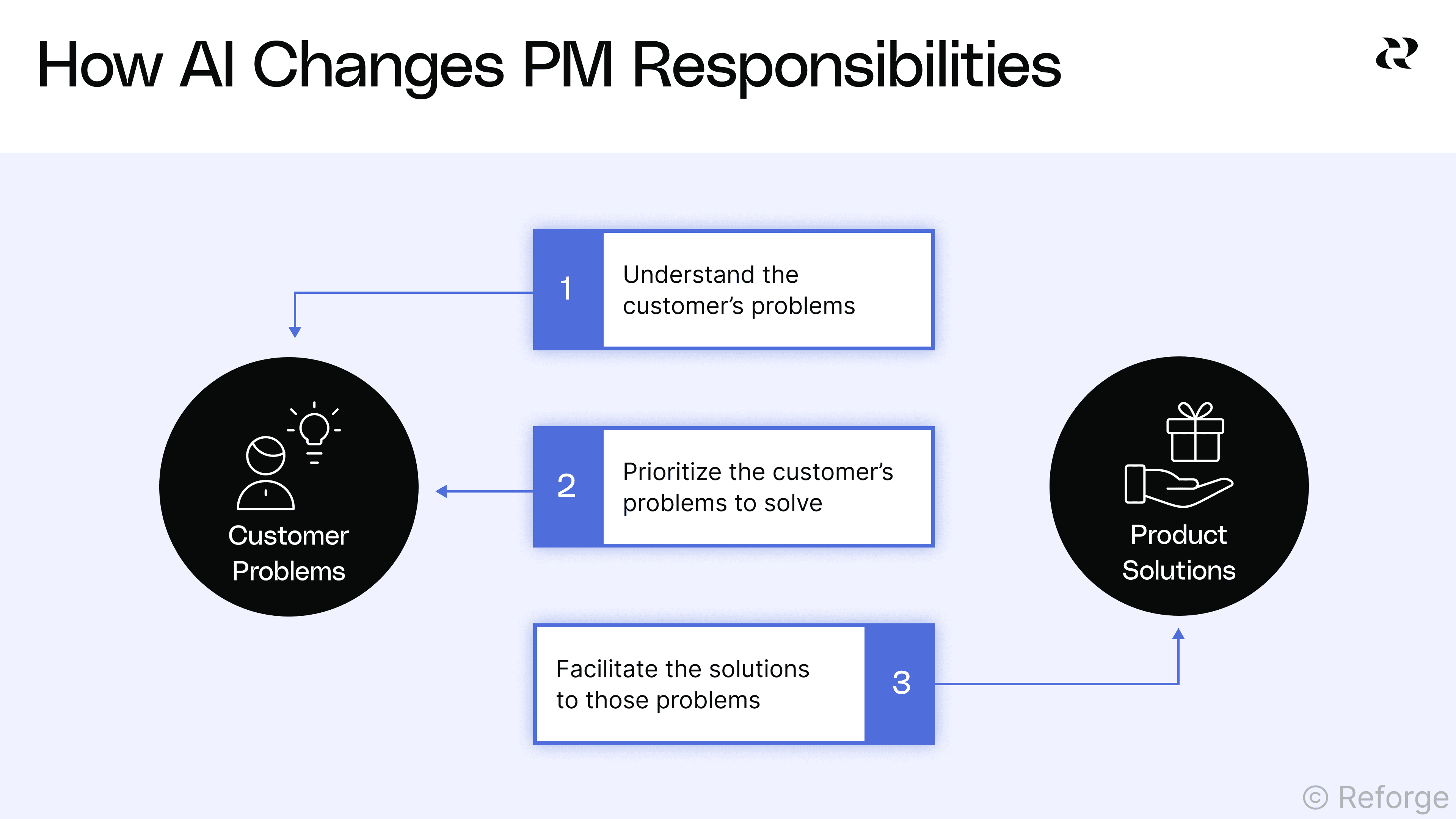
A product manager's job boils down to three essential responsibilities: understand customer problems, prioritize which problems to solve, and facilitate solutions. AI doesn't change these core responsibilities, but it does fundamentally change how you execute each one.
Tal Raviv, a PM who’s worked at Wix, Patreon and Riverside, wrote on LinkedIn that “the gap between not using AI and using it effectively is not about special knowledge that's out of reach, it's about building comfort with a few key habits.” The technology is the equivalent of rocket science, but the adoption process is not.
Here’s how we suggest thinking about this:
AI expands both your problem space and your solution space.
Problems that were previously unsolvable must be considered.
Solutions that were previously impossible become practical.
This means your approach to understanding, prioritizing, and facilitating must evolve. And the implications are massive. When AI products and features resonate with customers, they resonate big time.
Cursor grew from $1 million ARR to $100 million ARR in 12 months. That makes them the fastest growing SaaS company of all time. And while it may be an outlier, there’s a trend of AI SaaS companies absolutely exploding over the last year or so. Lovable went from $0 to $10 million ARR in 60 days and Bolt hit $40 million ARR in five months. These are brand-new companies, but existing companies that are launching AI features are riding the same tailwind. Figma, Canva and Descript stand out as companies growing quickly thanks to AI-powered features (per Ramp’s Economic Lab).
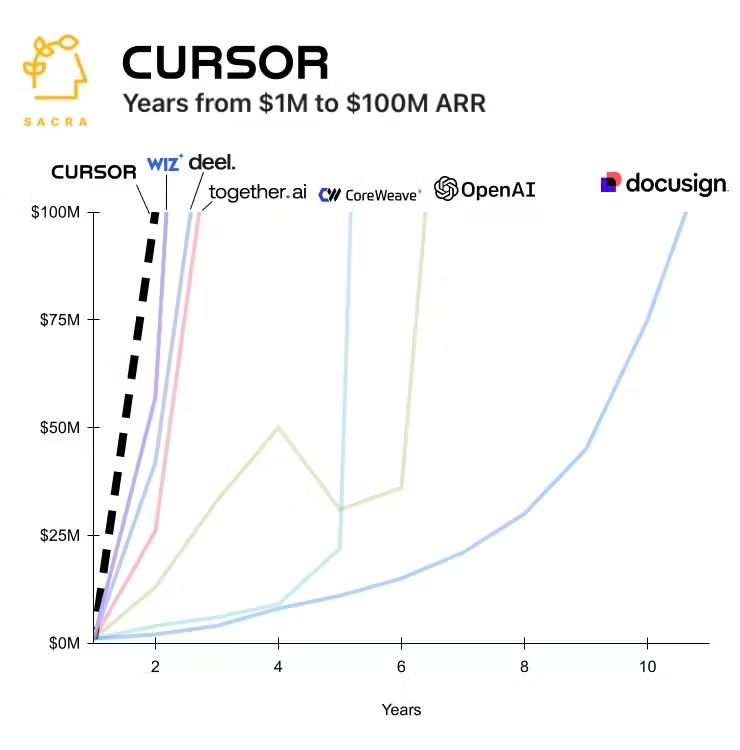
AI bets seem to be asymmetric: either massive results or none. Your role as PM is can make the difference.
How we got here: A quick technology history lesson
This is the right time to shore up our knowledge of exactly what AI is good at. This context is a good foundation for thinking through how AI is changing the PM role.
Ravi Mehta, former product leader at Tinder, Meta, Tripadvisor, and Xbox, led Reforge’s recent AI Strategy course. In it, he offers a brief history lesson which is very useful in understanding where we are today.
We can trace the evolution of computing through four distinct periods. Each era fundamentally changed how we interact with technology and created entirely new business opportunities.
The Computation Era (1940s) brought us the transistor. You provide an input, apply predefined rules, and get an output. This simple concept scaled exponentially. Today's computers run trillions of rules on trillions of inputs every second.
The Networking Era (1980s-90s) connected isolated personal computers through the Internet. This shift enabled Internet-native companies like Google, Facebook, and Amazon to challenge early PC winners like Microsoft and Intel. Connection became the new competitive advantage.
The Ubiquity Era (2000s) put always-connected, location-aware computers in everyone's pocket. Mobile devices enabled companies like Uber (riders and drivers always have devices nearby) and Netflix (streaming to pocket-sized screens) that couldn't exist before. Accessibility became universal.
The Learning Era (Present) marks the fundamental shift from computational problems to learning problems. AI generates rules from examples and data instead of following pre-programmed instructions. Tesla can’t possibly provide enough instructions to allow a self-driving car to operate safely but AI can learn from examples and write its own.
Computational problems involve tasks you can code rules for. Learning problems involve tasks you can't easily express in code but AI can learn from examples.
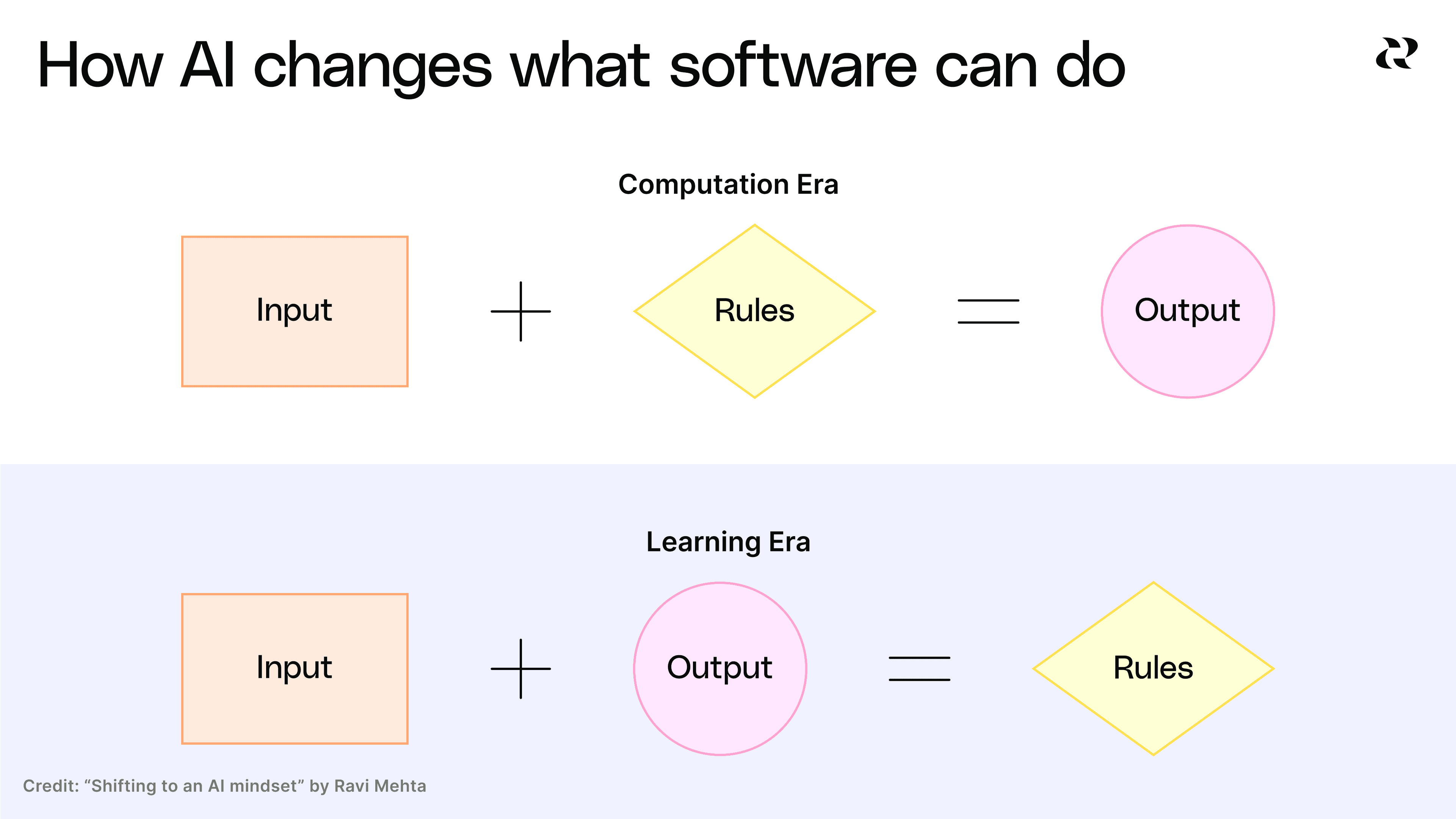
This evolution matters because each era changed what products were possible to build. We're now in an era where AI can solve problems that were previously impossible because you couldn't write explicit rules for them.
“There will be very few product features that aren’t possible — given enough time and data. We can truly solve our customer’s problems without limitations.” — Ravi Mehta
With this as context, let’s look at how the three core responsibilities—customer problems, prioritizing the ones to solve, and facilitating solutions to those problem—of PMs are changing.
Change #1: Understanding customer problems is both easier and harder
AI doesn't just help solve existing problems, it expands the realm of what problems are solvable. This means your problem space is no longer constrained by old limitations.
At the same time, AI is also enabling PMs to capture way more qualitative data about customers via call recordings, support tickets and chatbot conversations. This is a good, but does mean that you have tons of fragmented data to sift through. (This is one of the key problems that Reforge Insights solves. If you want a demo, I’ll give you one myself.)
Your customers don’t know what’s possible
Many customers won't know to ask for solutions they believe are impossible. Part of your job includes identifying problems they've accepted as unsolvable and determining whether AI makes them viable.
As an example, Canva’s AI features allow anyone to create professional-quality videos and graphics with simple prompts. The barrier to producing high-quality visual content didn't just get lower, it essentially disappeared for many use cases. Canva’s customers have always wanted easier and faster ways to create designs, but how many were actively asking for this before Canva launched it? Canva took a common problem and super-charged the solution.
Customer expectations are changing quickly
Your customers’ expectations are shaped by every consumer app they use, not just B2B enterprise tools. Their tolerance for clunky experiences is low, especially when they’re constantly exposed to great consumer software experiences. ChatGPT is a good example. It makes AI so easy and accessible and has widespread usage. It sets their bar for AI ease-of-use in every other product its customers use.
Additionally, customer expectations don't evolve gradually but rather spike dramatically when new technology capabilities emerge. As I wrote in The Expectation Reset: 7 Ways AI Is Redefining Customer Expectations, we're seeing clear patterns emerge in how customer expectations are evolving. Here are seven patterns we’ve identified:
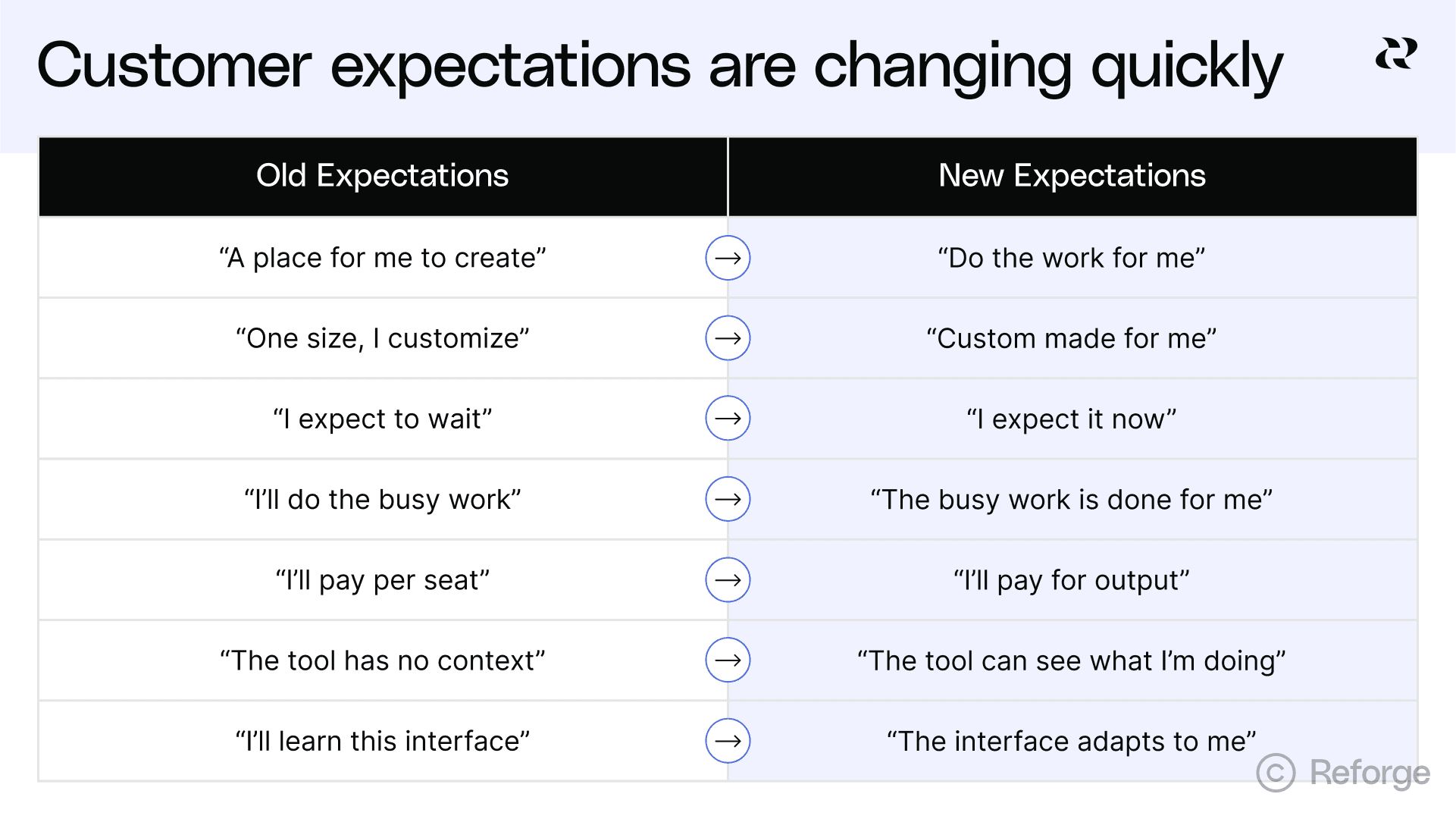
You must track expectation shifts across all software categories, not just your competitive set. For example, a customer who uses AI-powered writing assistance in a writing-specific tool like Lex will start to expect similar capabilities everywhere they write, even general purpose tools like Notion, Asana and ClickUp.
Takeaway: Turn customer research into real-time insights
Most companies still approach customer research like it's 2015. Your team manually synthesizes customer feedback from different sources on a monthly or quarterly basis. Someone reviews support tickets to identify themes. Someone else does the same with sales call transcripts. Each team finds opportunities but it takes a lot of manual work.
This approach creates four major problems:
Infrequent updates: Monthly or quarterly cycles mean you're always working with stale insights
Fragmented insights: Each source tells you different things, requiring additional manual work to connect patterns
Loss of nuance: Manual synthesis strips away specific quotes and details to create high-level themes
Big themes only: Human analysis naturally focuses on the most common issues, missing smaller but potentially impactful problems
The result is that product teams get sanitized, delayed insights that are difficult to act on. AI tools like Reforge Insights address each of these limitations directly:
Real-time analysis: AI plugs directly into conversation sources, updating themes and detecting new issues as they emerge
Connected sources: All feedback sources feed into a single analysis, creating a complete picture rather than fragmented reports
Preserved nuance: You can drill down into specific quotes and details while still seeing high-level patterns
Comprehensive coverage: AI identifies both major themes and smaller, nuanced issues that manual analysis typically misses
Business impact: AI connects qualitative insights to quantitative metrics, immediately showing potential business impact
AI is great at collecting and analyzing lots fragmented data so lean into it. This will make your life easier and will surface all kinds of opportunities to create more value for your users.
Change #2: Prioritizing customer problems when solutions are almost infinite
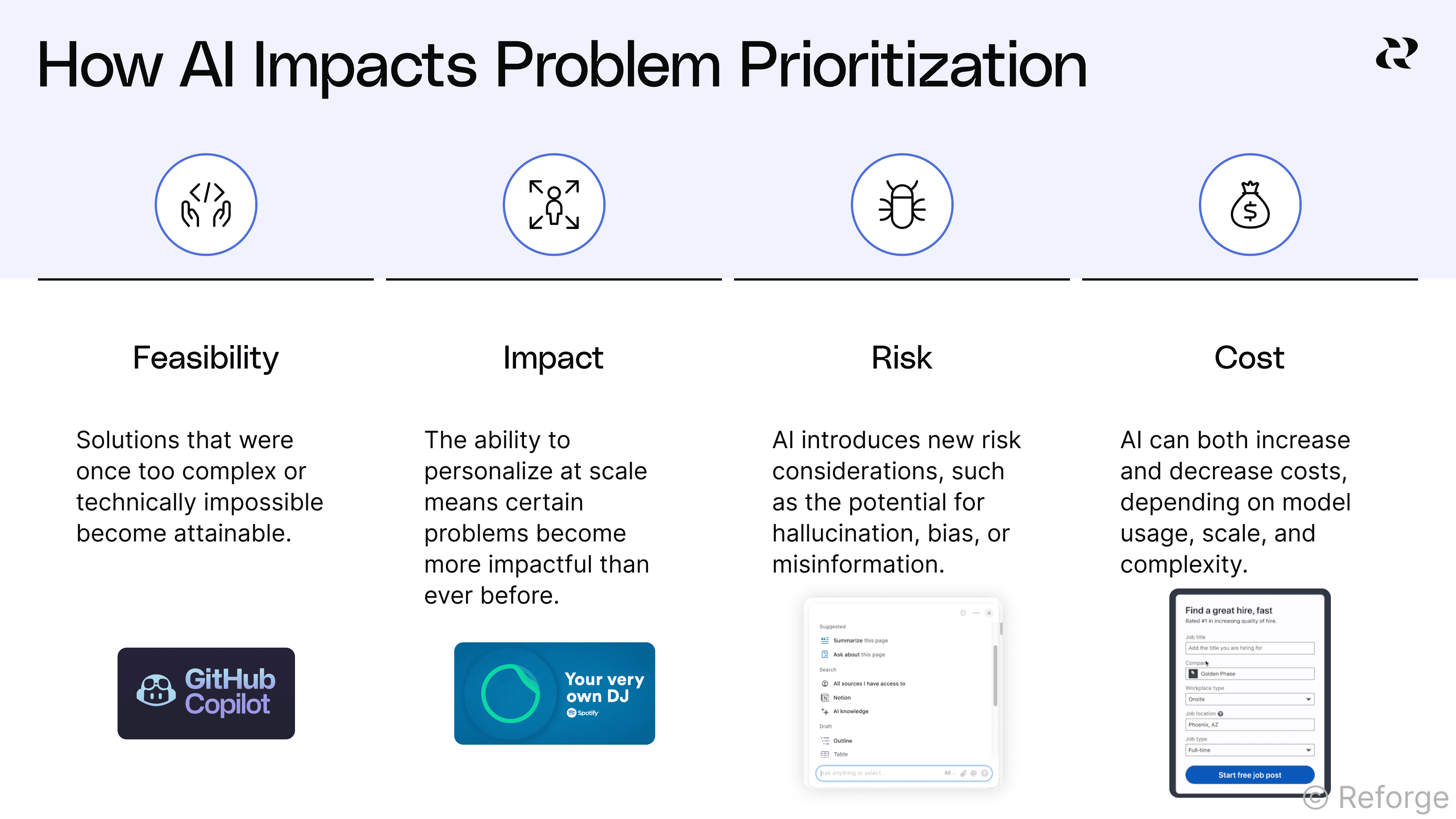
Most product prioritization frameworks consider four dimensions:
Feasibility
Impact
Risk
Cost
AI introduces new factors into each element of prioritization that fundamentally change how you evaluate what to build next.
Feasibility has expanded dramatically
Solutions that were once too complex or technically impossible become attainable. Tools like Cursor or Claude Code make complex code generation feasible, altering the calculus of what features to prioritize. Features that would have taken months now take weeks.
The traditional question "Can we build this?" becomes "Should we build this?" This shift means your prioritization process needs to account for a much larger set of possible solutions.
Your product can be deeply personalized
AI's ability to personalize at scale means certain problems become more impactful than ever before. Spotify's AI DJ tailors music selections to individual tastes in real-time, making personalization a strategic priority rather than a nice-to-have feature.
The same is true for Duolingo, which uses AI to grade the difficulty of courses for individual users in real-time. It can adjust lessons to be easier when a user is struggling or more difficult when they need to be challenged. Good customer research would reveal that some users struggle when lessons become too difficult. Duolingo’s PMs recognized that a common problem could finally be solved in a way that was impossible until very recently. In this case, customers won’t even realize that AI solved this problem. It just results in a better experience for them in the app.
New risk categories emerge
AI introduces risk considerations like hallucination, bias, and misinformation that didn't exist in traditional software development. What happens if the AI makes mistakes? How do you handle bias in AI outputs? What are the regulatory implications of AI-powered features? These risks require new evaluation criteria in your prioritization framework.
You should also consider where your customers actually want AI and where they don’t. Canva’s AI-generated images and Duolingo’s improved courses are obvious wins, but every single one of your users has had bad AI features forced on them in some products they use. A ZDNET/Aberdeen survey found that many users are tired of AI being bolted on to products they use:
The least desired use of an AI feature was "an AI assistant to manage tasks", with 64% saying they wouldn't use it, would turn off the capability if possible, or would stop using a product with this feature.
Adding random AI features that people don’t want is a risk. You don’t want to damage customer loyalty, especially if your competitors are finding ways to create new value or customers with AI, rather than just tacking it onto an existing experience.
Cost complexity increases
AI can both increase and decrease costs, depending on model usage, scale, and complexity. LinkedIn's free AI-generated job description feature is great for users but it’s so easy to use that it could cost LinkedIn a fortune if not monitored. Small optimizations in prompts or model selection can reduce annual expenses by millions.
Unlike traditional development where costs are relatively predictable, AI costs can scale unpredictably with usage. A feature that seems cost-effective at low volume might become prohibitively expensive at scale.
The bundling cycle changes competitive dynamics
Jim Barksdale famously said, "There are only two ways I know of to make money in business: bundling and unbundling." We're in a bundling phase, and AI capabilities enable companies to expand into adjacent functions.
Companies that never competed before now find themselves serving the same customer needs. As we’ve discussed on the Unsolicited Feedback podcast, it’s everyone vs. everyone. This changes how you evaluate competitive threats in your prioritization process. Business buyers increasingly prefer tools that consolidate multiple functions, reducing vendor relationships.
Takeaway: Update your prioritization framework
Your prioritization framework needs to include these new considerations:
What problems can we solve now that we couldn't solve before?
How do AI capabilities change the impact potential of existing problems?
What new risks do AI solutions introduce to our customers and business?
How do AI implementation costs compare to traditional development approaches?
Does this feature help us bundle more value or should we remain specialized?
Re-evaluate your current roadmap using these enhanced criteria this month. Update your prioritization framework to include AI-specific factors in feasibility, impact, risk, and cost calculations.
Change #3: What’s worth building?
Because technical constraints have been loosened so much, there are a new set of things you could build. Prohibitively technical or expensive solutions are sometimes just an API call away.
The new question is "what's worth building?" This is the most dramatic change that AI is having on the PM role, and the likely the hardest part to adapt to.
The developer bottleneck is widening
AI is really good at writing code, which means developer time isn’t quite as constrained as it used to be. Deciding what to build has always been important, but the idea of “wasting” your finite dev resources isn’t as pressing. You can be thinking about what new things are possible as the developer bottleneck eases.
Some customer problems were too hard to solve, so you never solved them. Some problems were prohibitively expensive, so you didn’t build them. Some problems were obvious, but the solutions were so complex and expensive that you didn’t really allow yourself to approach them.
AI assistants are already outdated
In the same way that many companies are “adopting” AI by finding 10% productivity gains, the first wave of AI product features was surface-level. It looked like a bunch of AI assistants with an unclear value proposition, not unlike Microsoft Office 97’s Clippy feature. Now that most folks see the transformational promise AI, some companies are using customer value as the lens through which to examine what to build.
Ramp automates expense categorization and policy compliance using AI, simplifying a traditionally tedious process that required extensive manual work. This solution fundamentally changes the user experience from active work to passive benefit. Users don't need to think about expense categories since the AI handles it automatically.
Grammarly evolved from basic grammar correction to providing contextual suggestions, rewriting sentences to match user intent, tone, or audience. This solution was technically impossible five years ago because you couldn't write rules for all the contextual variations in human communication.
Shopify leverages AI to automatically generate product descriptions, SEO content, and personalized email campaigns from just a product photo and basic details. This approach changes how merchants list and market their items, solving problems that required expensive copywriters or significant time investment.
In each case, the product isn’t asking the customer to use AI, it’s adding new value by leaning on the new solution surface available to them.
How does “everyone vs. everyone” change your strategy?
So many companies are rolling out new features that you likely have new competitors. Call recording and note-taking is a good example of a space that went from quaint to cutthroat almost overnight.
Fathom, Grain, Otter and a few other purpose-built tools have been helping people take notes for last the five years. In the meantime, tools like Gong popped up to layer context and analysis on top of a specific type of call (the sales call). And then every CRM released a call recording and note-taking feature. More recently, Granola rolled out a new take on this. And then ChatGPT and Notion launched similar tools.
The technology has been commoditized, but each of these companies sees call recording as a vital feature. Why? Because the data adds to each tools’ growing “memory” and this is one of the only ways to build a moat these days.
The market is a mess, with several types of companies competing for the same spot in your Zoom calls. This is happening in every category too. A project management tool adds AI-powered content creation, competing with content platforms. A CRM adds AI-driven financial analysis, competing with business intelligence tools. An e-commerce platform adds AI customer service, competing with support software.
For B2B buyers, this can create a preference for consolidated tools. For procurement teams, it definitely does (and especially for larger teams who are adopting tools with AI features with a careful on data privacy and security).
All of this creates strategic questions for your roadmap:
Should we build AI features that expand into adjacent markets?
Do we remain specialized or embrace bundling?
How do we compete when companies from other industries enter our space?
The answer depends on your market position. Established players with strong customer relationships may benefit from bundling AI features. Newer companies might succeed by remaining specialized and excelling at one thing with AI.
Takeaway: Audit your roadmap for value creation opportunities
Audit your current product roadmap this week. Identify features that were "impossible" 12 months ago but are now viable. Focus on value creation opportunities, not just efficiency improvements.
Study AI capabilities themselves, not just products built with AI. Look for unexplored applications of existing AI capabilities that could create new customer value. Set up a process to regularly review what became possible with new AI capabilities.
Do a fresh competitor analysis to see who might be creeping into your space, and who’s space you might be expanding into.
Avoid the product-market fit collapse (the worst-case scenario)
PMs are at the forefront of the new AI-powered economy. They are the ones steering the products, working with GTM teams and sorting out the new competitive landscape. A failure to adapt carries obvious career risk, but it also puts the companies’ employing them at risk too.
GitHub Copilot became publicly available in June 2022 and within three years had 15 million users according to its CEO Thomas Dohmke.
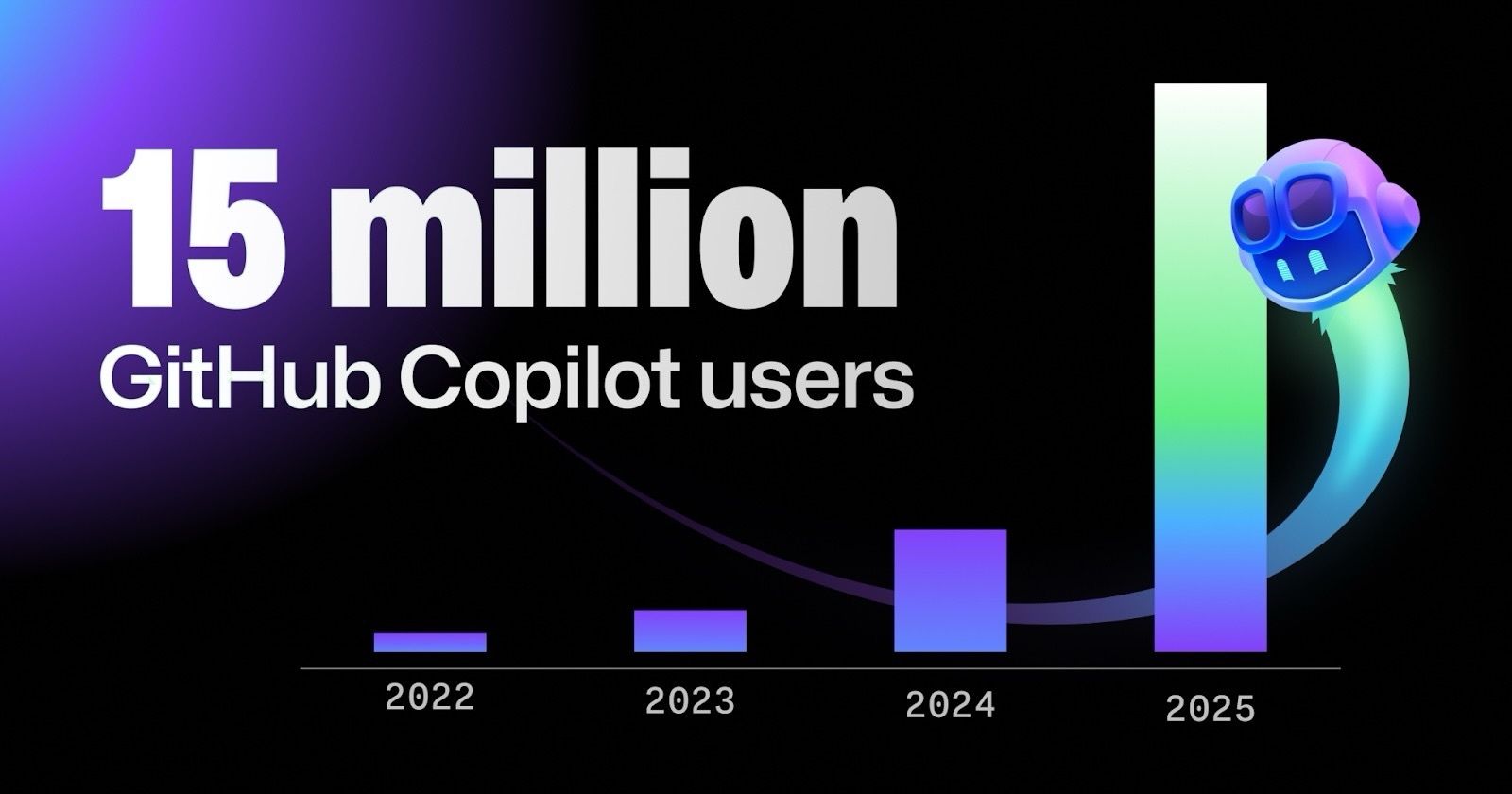
It felt like perfect product market fit. And then Cursor came along and became the fastest growing SaaS company of all time. Almost overnight, GitHub Copilot’s unquestioned market share was rattled. Cursor went hard on PLG and integrated easily into most devs existing stacks. Users adopted at unbelievable rates. We all watched Clay Christensen’s theory of disruptive innovation happen literally in front of our eyes.
In June 2025, Ara Kharazian, head of Ramp’s Economic Lab, posted on X that, “Last month, Cursor overtook GitHub Copilot in business spend, Ramp data shows. Both continue adding users + spend, more than enough to go around in this market. But goes to show that first movers != market dominance.”
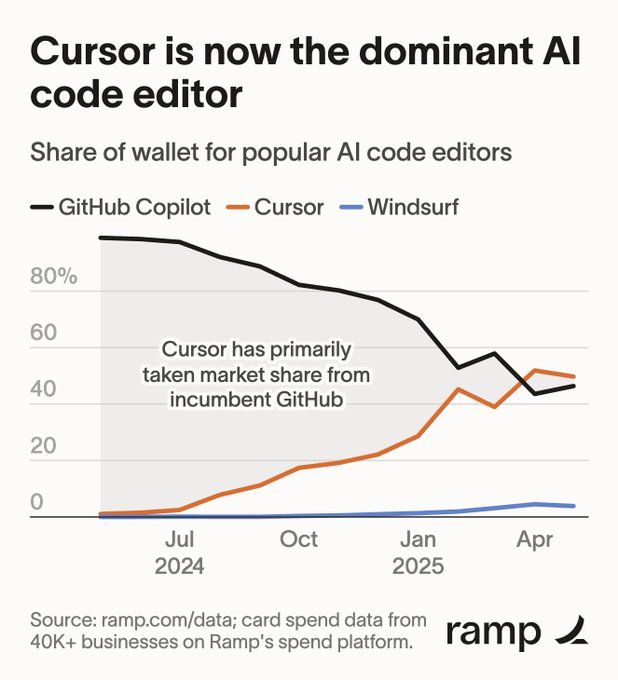
Not every business is at an immediate risk of product market fit collapse, but AI is making even the most rock-solid product market fit look a bit wobbly. This used to happen slowly enough that you could identify it and react. Now, technology changes and customer expectations change so quickly that some companies are stuck on their heels.
For companies rolling out innovative AI features, the risk is greater. As Ravi Mehta says, “The earlier your audience sits on the adoption curve, the faster Product Market Fit can crumble. These users willingly test new tools, drop old habits, and show little loyalty when a clear upgrade appears.”
Assess your own vulnerability
In our AI Strategy course, we have an AI risk assessment exercise, which Ravi Mehta summarized on in his post Is Your Product at Risk of AI Disruption? Ravi even vibe-coded an AI risk assessment tool which you can try here.
Some of the factors to assess include:
Is your product used to deliver “outlier” outputs of exceptional quality or will “commodity” quality suffice for your users?
Does your product/service rely on human judgement or can sophisticated pattern recognition take its place?
Do your customers value the people behind the product—therapists, trainers, account managers, etc.—or do they care only about the outcome?
Where do your customers fall on the technology adoption curve?
And watch for these early warning signs of product market fit collapse :
Customers asking for more automated solutions
Usage patterns showing preference for AI-assisted features
Competitive pressure from AI-native alternatives
Customer complaints about manual processes
Build AI capabilities that complement rather than replace your core value proposition. Focus on using AI to enhance customer outcomes, not just automate existing processes.
Conduct a vulnerability audit this month. Map your core features against the question: "What happens if users no longer want to do this work themselves?" Look for problems that became solvable in the past 12 months and prioritize opportunities that create new customer value rather than just improving efficiency.
AI is the telescope, not the stars
For a while, it was unclear exactly how the PM role would evolve. It’s become much more clear in 2025. It’s both harder and easier. It’s both exciting and sometimes daunting. AI is going to change your role entirely, if it hasn’t already.
But remember: AI is the telescope, not the star. You can use it observe your customers and collect data. But AI isn’t the end result. It’s the tool you use to understand your users, make better decisions and deliver huge value to your customers.


“Much like how the telescope was an invention, but the moons of Jupiter were a discovery, Generative AI models are tools for uncovering new possibilities, not end solutions in themselves.” — Jeff Bezos
A product manager's job boils down to three essential responsibilities: understand customer problems, prioritize which problems to solve, and facilitate solutions. AI doesn't change these core responsibilities, but it does fundamentally change how you execute each one.
Tal Raviv, a PM who’s worked at Wix, Patreon and Riverside, wrote on LinkedIn that “the gap between not using AI and using it effectively is not about special knowledge that's out of reach, it's about building comfort with a few key habits.” The technology is the equivalent of rocket science, but the adoption process is not.
Here’s how we suggest thinking about this:
AI expands both your problem space and your solution space.
Problems that were previously unsolvable must be considered.
Solutions that were previously impossible become practical.
This means your approach to understanding, prioritizing, and facilitating must evolve. And the implications are massive. When AI products and features resonate with customers, they resonate big time.
Cursor grew from $1 million ARR to $100 million ARR in 12 months. That makes them the fastest growing SaaS company of all time. And while it may be an outlier, there’s a trend of AI SaaS companies absolutely exploding over the last year or so. Lovable went from $0 to $10 million ARR in 60 days and Bolt hit $40 million ARR in five months. These are brand-new companies, but existing companies that are launching AI features are riding the same tailwind. Figma, Canva and Descript stand out as companies growing quickly thanks to AI-powered features (per Ramp’s Economic Lab).
AI bets seem to be asymmetric: either massive results or none. Your role as PM is can make the difference.
How we got here: A quick technology history lesson
This is the right time to shore up our knowledge of exactly what AI is good at. This context is a good foundation for thinking through how AI is changing the PM role.
Ravi Mehta, former product leader at Tinder, Meta, Tripadvisor, and Xbox, led Reforge’s recent AI Strategy course. In it, he offers a brief history lesson which is very useful in understanding where we are today.
We can trace the evolution of computing through four distinct periods. Each era fundamentally changed how we interact with technology and created entirely new business opportunities.
The Computation Era (1940s) brought us the transistor. You provide an input, apply predefined rules, and get an output. This simple concept scaled exponentially. Today's computers run trillions of rules on trillions of inputs every second.
The Networking Era (1980s-90s) connected isolated personal computers through the Internet. This shift enabled Internet-native companies like Google, Facebook, and Amazon to challenge early PC winners like Microsoft and Intel. Connection became the new competitive advantage.
The Ubiquity Era (2000s) put always-connected, location-aware computers in everyone's pocket. Mobile devices enabled companies like Uber (riders and drivers always have devices nearby) and Netflix (streaming to pocket-sized screens) that couldn't exist before. Accessibility became universal.
The Learning Era (Present) marks the fundamental shift from computational problems to learning problems. AI generates rules from examples and data instead of following pre-programmed instructions. Tesla can’t possibly provide enough instructions to allow a self-driving car to operate safely but AI can learn from examples and write its own.
Computational problems involve tasks you can code rules for. Learning problems involve tasks you can't easily express in code but AI can learn from examples.
This evolution matters because each era changed what products were possible to build. We're now in an era where AI can solve problems that were previously impossible because you couldn't write explicit rules for them.
“There will be very few product features that aren’t possible — given enough time and data. We can truly solve our customer’s problems without limitations.” — Ravi Mehta
With this as context, let’s look at how the three core responsibilities—customer problems, prioritizing the ones to solve, and facilitating solutions to those problem—of PMs are changing.
Change #1: Understanding customer problems is both easier and harder
AI doesn't just help solve existing problems, it expands the realm of what problems are solvable. This means your problem space is no longer constrained by old limitations.
At the same time, AI is also enabling PMs to capture way more qualitative data about customers via call recordings, support tickets and chatbot conversations. This is a good, but does mean that you have tons of fragmented data to sift through. (This is one of the key problems that Reforge Insights solves. If you want a demo, I’ll give you one myself.)
Your customers don’t know what’s possible
Many customers won't know to ask for solutions they believe are impossible. Part of your job includes identifying problems they've accepted as unsolvable and determining whether AI makes them viable.
As an example, Canva’s AI features allow anyone to create professional-quality videos and graphics with simple prompts. The barrier to producing high-quality visual content didn't just get lower, it essentially disappeared for many use cases. Canva’s customers have always wanted easier and faster ways to create designs, but how many were actively asking for this before Canva launched it? Canva took a common problem and super-charged the solution.
Customer expectations are changing quickly
Your customers’ expectations are shaped by every consumer app they use, not just B2B enterprise tools. Their tolerance for clunky experiences is low, especially when they’re constantly exposed to great consumer software experiences. ChatGPT is a good example. It makes AI so easy and accessible and has widespread usage. It sets their bar for AI ease-of-use in every other product its customers use.
Additionally, customer expectations don't evolve gradually but rather spike dramatically when new technology capabilities emerge. As I wrote in The Expectation Reset: 7 Ways AI Is Redefining Customer Expectations, we're seeing clear patterns emerge in how customer expectations are evolving. Here are seven patterns we’ve identified:
You must track expectation shifts across all software categories, not just your competitive set. For example, a customer who uses AI-powered writing assistance in a writing-specific tool like Lex will start to expect similar capabilities everywhere they write, even general purpose tools like Notion, Asana and ClickUp.
Takeaway: Turn customer research into real-time insights
Most companies still approach customer research like it's 2015. Your team manually synthesizes customer feedback from different sources on a monthly or quarterly basis. Someone reviews support tickets to identify themes. Someone else does the same with sales call transcripts. Each team finds opportunities but it takes a lot of manual work.
This approach creates four major problems:
Infrequent updates: Monthly or quarterly cycles mean you're always working with stale insights
Fragmented insights: Each source tells you different things, requiring additional manual work to connect patterns
Loss of nuance: Manual synthesis strips away specific quotes and details to create high-level themes
Big themes only: Human analysis naturally focuses on the most common issues, missing smaller but potentially impactful problems
The result is that product teams get sanitized, delayed insights that are difficult to act on. AI tools like Reforge Insights address each of these limitations directly:
Real-time analysis: AI plugs directly into conversation sources, updating themes and detecting new issues as they emerge
Connected sources: All feedback sources feed into a single analysis, creating a complete picture rather than fragmented reports
Preserved nuance: You can drill down into specific quotes and details while still seeing high-level patterns
Comprehensive coverage: AI identifies both major themes and smaller, nuanced issues that manual analysis typically misses
Business impact: AI connects qualitative insights to quantitative metrics, immediately showing potential business impact
AI is great at collecting and analyzing lots fragmented data so lean into it. This will make your life easier and will surface all kinds of opportunities to create more value for your users.
Change #2: Prioritizing customer problems when solutions are almost infinite
Most product prioritization frameworks consider four dimensions:
Feasibility
Impact
Risk
Cost
AI introduces new factors into each element of prioritization that fundamentally change how you evaluate what to build next.
Feasibility has expanded dramatically
Solutions that were once too complex or technically impossible become attainable. Tools like Cursor or Claude Code make complex code generation feasible, altering the calculus of what features to prioritize. Features that would have taken months now take weeks.
The traditional question "Can we build this?" becomes "Should we build this?" This shift means your prioritization process needs to account for a much larger set of possible solutions.
Your product can be deeply personalized
AI's ability to personalize at scale means certain problems become more impactful than ever before. Spotify's AI DJ tailors music selections to individual tastes in real-time, making personalization a strategic priority rather than a nice-to-have feature.
The same is true for Duolingo, which uses AI to grade the difficulty of courses for individual users in real-time. It can adjust lessons to be easier when a user is struggling or more difficult when they need to be challenged. Good customer research would reveal that some users struggle when lessons become too difficult. Duolingo’s PMs recognized that a common problem could finally be solved in a way that was impossible until very recently. In this case, customers won’t even realize that AI solved this problem. It just results in a better experience for them in the app.
New risk categories emerge
AI introduces risk considerations like hallucination, bias, and misinformation that didn't exist in traditional software development. What happens if the AI makes mistakes? How do you handle bias in AI outputs? What are the regulatory implications of AI-powered features? These risks require new evaluation criteria in your prioritization framework.
You should also consider where your customers actually want AI and where they don’t. Canva’s AI-generated images and Duolingo’s improved courses are obvious wins, but every single one of your users has had bad AI features forced on them in some products they use. A ZDNET/Aberdeen survey found that many users are tired of AI being bolted on to products they use:
The least desired use of an AI feature was "an AI assistant to manage tasks", with 64% saying they wouldn't use it, would turn off the capability if possible, or would stop using a product with this feature.
Adding random AI features that people don’t want is a risk. You don’t want to damage customer loyalty, especially if your competitors are finding ways to create new value or customers with AI, rather than just tacking it onto an existing experience.
Cost complexity increases
AI can both increase and decrease costs, depending on model usage, scale, and complexity. LinkedIn's free AI-generated job description feature is great for users but it’s so easy to use that it could cost LinkedIn a fortune if not monitored. Small optimizations in prompts or model selection can reduce annual expenses by millions.
Unlike traditional development where costs are relatively predictable, AI costs can scale unpredictably with usage. A feature that seems cost-effective at low volume might become prohibitively expensive at scale.
The bundling cycle changes competitive dynamics
Jim Barksdale famously said, "There are only two ways I know of to make money in business: bundling and unbundling." We're in a bundling phase, and AI capabilities enable companies to expand into adjacent functions.
Companies that never competed before now find themselves serving the same customer needs. As we’ve discussed on the Unsolicited Feedback podcast, it’s everyone vs. everyone. This changes how you evaluate competitive threats in your prioritization process. Business buyers increasingly prefer tools that consolidate multiple functions, reducing vendor relationships.
Takeaway: Update your prioritization framework
Your prioritization framework needs to include these new considerations:
What problems can we solve now that we couldn't solve before?
How do AI capabilities change the impact potential of existing problems?
What new risks do AI solutions introduce to our customers and business?
How do AI implementation costs compare to traditional development approaches?
Does this feature help us bundle more value or should we remain specialized?
Re-evaluate your current roadmap using these enhanced criteria this month. Update your prioritization framework to include AI-specific factors in feasibility, impact, risk, and cost calculations.
Change #3: What’s worth building?
Because technical constraints have been loosened so much, there are a new set of things you could build. Prohibitively technical or expensive solutions are sometimes just an API call away.
The new question is "what's worth building?" This is the most dramatic change that AI is having on the PM role, and the likely the hardest part to adapt to.
The developer bottleneck is widening
AI is really good at writing code, which means developer time isn’t quite as constrained as it used to be. Deciding what to build has always been important, but the idea of “wasting” your finite dev resources isn’t as pressing. You can be thinking about what new things are possible as the developer bottleneck eases.
Some customer problems were too hard to solve, so you never solved them. Some problems were prohibitively expensive, so you didn’t build them. Some problems were obvious, but the solutions were so complex and expensive that you didn’t really allow yourself to approach them.
AI assistants are already outdated
In the same way that many companies are “adopting” AI by finding 10% productivity gains, the first wave of AI product features was surface-level. It looked like a bunch of AI assistants with an unclear value proposition, not unlike Microsoft Office 97’s Clippy feature. Now that most folks see the transformational promise AI, some companies are using customer value as the lens through which to examine what to build.
Ramp automates expense categorization and policy compliance using AI, simplifying a traditionally tedious process that required extensive manual work. This solution fundamentally changes the user experience from active work to passive benefit. Users don't need to think about expense categories since the AI handles it automatically.
Grammarly evolved from basic grammar correction to providing contextual suggestions, rewriting sentences to match user intent, tone, or audience. This solution was technically impossible five years ago because you couldn't write rules for all the contextual variations in human communication.
Shopify leverages AI to automatically generate product descriptions, SEO content, and personalized email campaigns from just a product photo and basic details. This approach changes how merchants list and market their items, solving problems that required expensive copywriters or significant time investment.
In each case, the product isn’t asking the customer to use AI, it’s adding new value by leaning on the new solution surface available to them.
How does “everyone vs. everyone” change your strategy?
So many companies are rolling out new features that you likely have new competitors. Call recording and note-taking is a good example of a space that went from quaint to cutthroat almost overnight.
Fathom, Grain, Otter and a few other purpose-built tools have been helping people take notes for last the five years. In the meantime, tools like Gong popped up to layer context and analysis on top of a specific type of call (the sales call). And then every CRM released a call recording and note-taking feature. More recently, Granola rolled out a new take on this. And then ChatGPT and Notion launched similar tools.
The technology has been commoditized, but each of these companies sees call recording as a vital feature. Why? Because the data adds to each tools’ growing “memory” and this is one of the only ways to build a moat these days.
The market is a mess, with several types of companies competing for the same spot in your Zoom calls. This is happening in every category too. A project management tool adds AI-powered content creation, competing with content platforms. A CRM adds AI-driven financial analysis, competing with business intelligence tools. An e-commerce platform adds AI customer service, competing with support software.
For B2B buyers, this can create a preference for consolidated tools. For procurement teams, it definitely does (and especially for larger teams who are adopting tools with AI features with a careful on data privacy and security).
All of this creates strategic questions for your roadmap:
Should we build AI features that expand into adjacent markets?
Do we remain specialized or embrace bundling?
How do we compete when companies from other industries enter our space?
The answer depends on your market position. Established players with strong customer relationships may benefit from bundling AI features. Newer companies might succeed by remaining specialized and excelling at one thing with AI.
Takeaway: Audit your roadmap for value creation opportunities
Audit your current product roadmap this week. Identify features that were "impossible" 12 months ago but are now viable. Focus on value creation opportunities, not just efficiency improvements.
Study AI capabilities themselves, not just products built with AI. Look for unexplored applications of existing AI capabilities that could create new customer value. Set up a process to regularly review what became possible with new AI capabilities.
Do a fresh competitor analysis to see who might be creeping into your space, and who’s space you might be expanding into.
Avoid the product-market fit collapse (the worst-case scenario)
PMs are at the forefront of the new AI-powered economy. They are the ones steering the products, working with GTM teams and sorting out the new competitive landscape. A failure to adapt carries obvious career risk, but it also puts the companies’ employing them at risk too.
GitHub Copilot became publicly available in June 2022 and within three years had 15 million users according to its CEO Thomas Dohmke.
It felt like perfect product market fit. And then Cursor came along and became the fastest growing SaaS company of all time. Almost overnight, GitHub Copilot’s unquestioned market share was rattled. Cursor went hard on PLG and integrated easily into most devs existing stacks. Users adopted at unbelievable rates. We all watched Clay Christensen’s theory of disruptive innovation happen literally in front of our eyes.
In June 2025, Ara Kharazian, head of Ramp’s Economic Lab, posted on X that, “Last month, Cursor overtook GitHub Copilot in business spend, Ramp data shows. Both continue adding users + spend, more than enough to go around in this market. But goes to show that first movers != market dominance.”
Not every business is at an immediate risk of product market fit collapse, but AI is making even the most rock-solid product market fit look a bit wobbly. This used to happen slowly enough that you could identify it and react. Now, technology changes and customer expectations change so quickly that some companies are stuck on their heels.
For companies rolling out innovative AI features, the risk is greater. As Ravi Mehta says, “The earlier your audience sits on the adoption curve, the faster Product Market Fit can crumble. These users willingly test new tools, drop old habits, and show little loyalty when a clear upgrade appears.”
Assess your own vulnerability
In our AI Strategy course, we have an AI risk assessment exercise, which Ravi Mehta summarized on in his post Is Your Product at Risk of AI Disruption? Ravi even vibe-coded an AI risk assessment tool which you can try here.
Some of the factors to assess include:
Is your product used to deliver “outlier” outputs of exceptional quality or will “commodity” quality suffice for your users?
Does your product/service rely on human judgement or can sophisticated pattern recognition take its place?
Do your customers value the people behind the product—therapists, trainers, account managers, etc.—or do they care only about the outcome?
Where do your customers fall on the technology adoption curve?
And watch for these early warning signs of product market fit collapse :
Customers asking for more automated solutions
Usage patterns showing preference for AI-assisted features
Competitive pressure from AI-native alternatives
Customer complaints about manual processes
Build AI capabilities that complement rather than replace your core value proposition. Focus on using AI to enhance customer outcomes, not just automate existing processes.
Conduct a vulnerability audit this month. Map your core features against the question: "What happens if users no longer want to do this work themselves?" Look for problems that became solvable in the past 12 months and prioritize opportunities that create new customer value rather than just improving efficiency.
AI is the telescope, not the stars
For a while, it was unclear exactly how the PM role would evolve. It’s become much more clear in 2025. It’s both harder and easier. It’s both exciting and sometimes daunting. AI is going to change your role entirely, if it hasn’t already.
But remember: AI is the telescope, not the star. You can use it observe your customers and collect data. But AI isn’t the end result. It’s the tool you use to understand your users, make better decisions and deliver huge value to your customers.