Reforge has joined Miro ↗
Discovery Agent is the newest feature in Reforge Build. To learn more about how product teams are exploring better solutions and collecting feedback from human and synthetic users, book a demo or sign up today.
Product managers know their products and customers. They know what problems need solving, which bets are worth taking, and roughly what direction to head. What they don't always have at the start of a new prototype is a fully refined spec, and they shouldn't need one. Good product thinking happens through exploration, not just documentation.
Our new Discovery Agent is built for that reality. It takes your idea, however formed, and helps you think it through before committing to a prototype. It asks the right questions, surfaces the assumptions worth examining, and builds a shared plan before anything gets generated. The result is a prototype that reflects what you actually meant, not just what you first typed.
Closing the gap between building fast and building right
AI gave engineering teams a massive boost. Tools like Cursor, Claude Code, and Codex mean a team can now execute in days what used to take quarters. That's a genuine shift.
But product discovery didn't get the same boost. PMs still gather context manually, schedule customer calls weeks out, and explore one solution when they should be exploring ten. The result is a capacity mismatch. You can build 10 things in the time it takes to properly vet one. That mismatch is what creates product debt: features shipped with low adoption that you carry forever in the form of maintenance, complexity, and support surface.
Discovery Agent gets you one step closer to closing that gap.
How Discovery Agent works
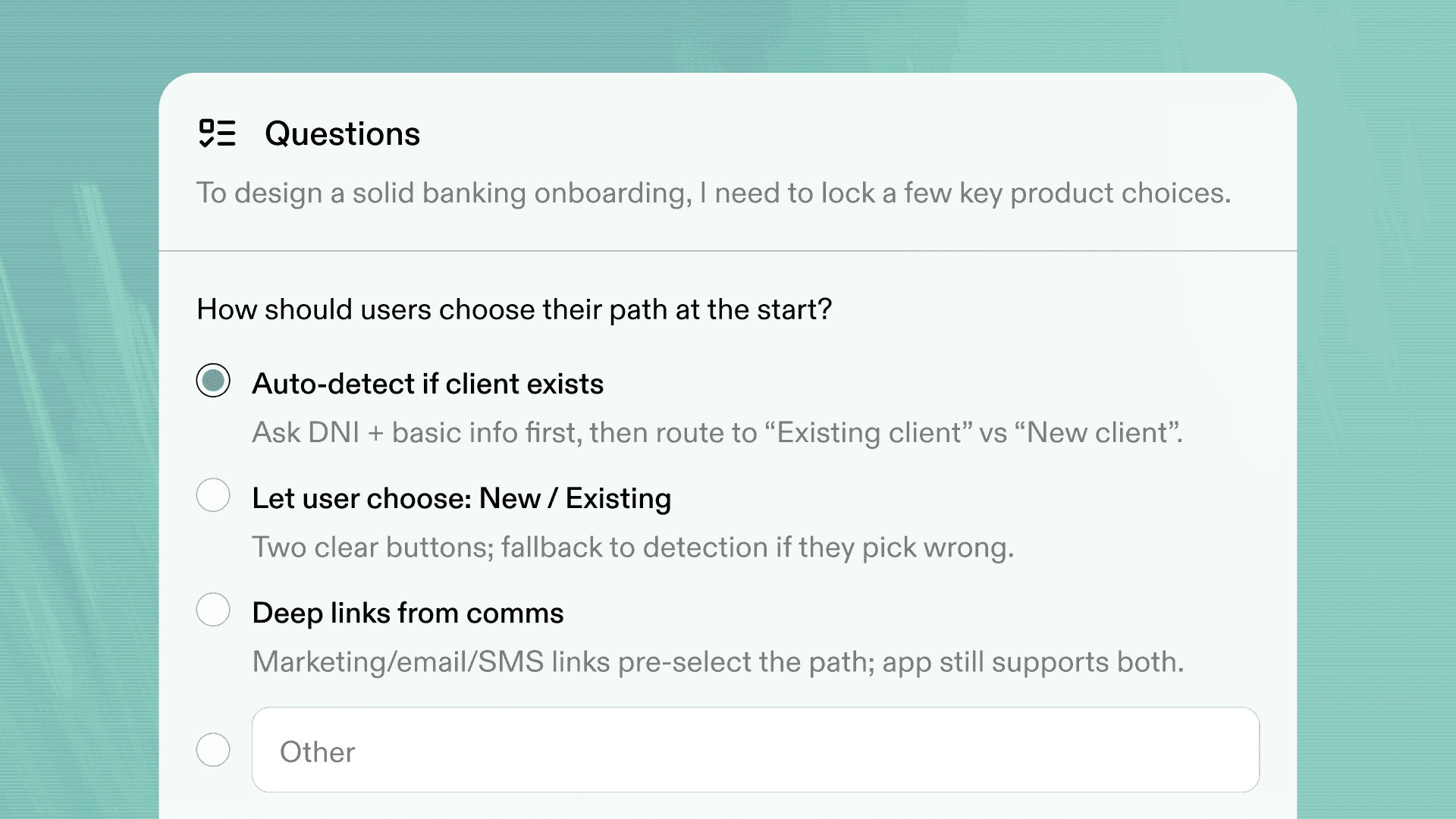
When you open a new Build chat, Discovery Agent leads by default. It reads your input—a vague problem, a detailed PRD, a competitor you want to beat—and instead of immediately generating something, it asks clarifying questions. It surfaces the assumptions buried in your prompt and helps you build a plan.
That plan is product-focused. You see what's being built and why, not how. You can approve it, tweak it, or redirect it before a single line of code is generated. Then, if you want to see a structure before you commit to a full prototype, the agent can generate a low-fi wireframe for you to react to first.
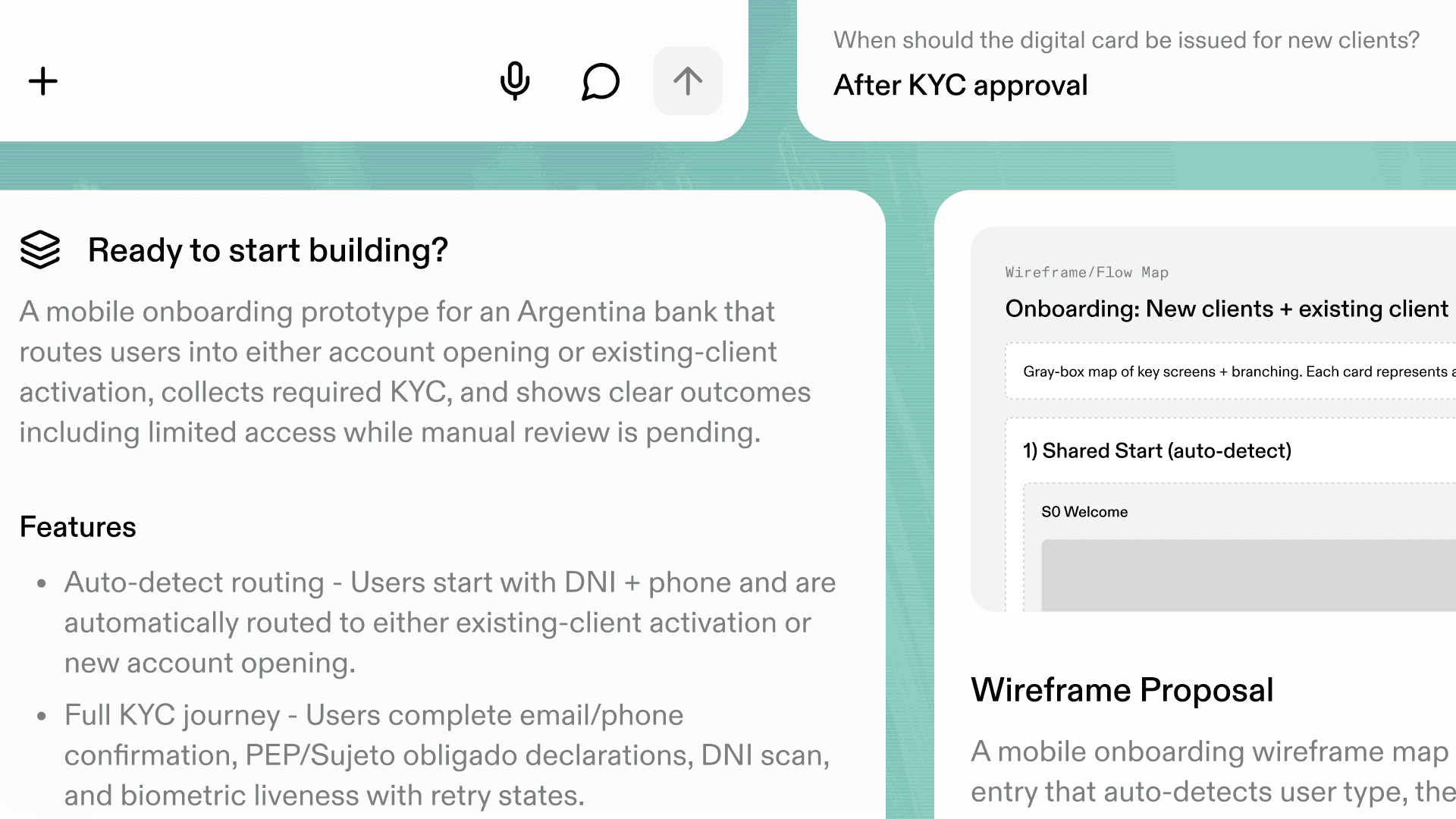
And that's not all. Here's everything included in Discovery Agent:
Inline clarifying questions. The agent asks smart, contextual questions through a guided UI that includes radio buttons and checkboxes with brief descriptions to make it easy to think through your options, not just pick one.
Plan approval before building. Before anything is generated, you get a clear summary of what the agent understood: features it will build, data it will use, what's out of scope, and how you'd know if the prototype succeeded. Approve it, modify it, or start over.
Wireframe tool. A low-fi wireframe gives you something to react to before you see the full prototype. It's faster to redirect a sketch than a finished build, and it keeps you from anchoring too early on implementation details.
URL-based context. Paste a competitor URL, a design doc, or any reference link. The agent pulls in that context to inform the exploration. You're not starting from scratch.
Voice input. Product ideas don't always arrive at a keyboard. Speak your idea instead of typing it. Especially useful for brain dumps.
Ask mode. A toggle that prevents code generation while you're still thinking. For the moments when you want to explore out loud without accidentally triggering a build. Available in the builder view too.
This is how good product decisions get made
The best product decisions have always started with a question. What are we actually trying to do? Who is this for? What does success look like? Those questions used to live in a doc, or a meeting, or a Slack thread — somewhere upstream from the build process.
Discovery Agent brings them into the build process itself. Before the wireframe, before the prototype, before any code. It meets you where most product ideas actually begin and helps you get to clarity faster.
Build has always been fast. Now it starts smarter.


Product managers know their products and customers. They know what problems need solving, which bets are worth taking, and roughly what direction to head. What they don't always have at the start of a new prototype is a fully refined spec, and they shouldn't need one. Good product thinking happens through exploration, not just documentation.
Our new Discovery Agent is built for that reality. It takes your idea, however formed, and helps you think it through before committing to a prototype. It asks the right questions, surfaces the assumptions worth examining, and builds a shared plan before anything gets generated. The result is a prototype that reflects what you actually meant, not just what you first typed.
Closing the gap between building fast and building right
AI gave engineering teams a massive boost. Tools like Cursor, Claude Code, and Codex mean a team can now execute in days what used to take quarters. That's a genuine shift.
But product discovery didn't get the same boost. PMs still gather context manually, schedule customer calls weeks out, and explore one solution when they should be exploring ten. The result is a capacity mismatch. You can build 10 things in the time it takes to properly vet one. That mismatch is what creates product debt: features shipped with low adoption that you carry forever in the form of maintenance, complexity, and support surface.
Discovery Agent gets you one step closer to closing that gap.
How Discovery Agent works
When you open a new Build chat, Discovery Agent leads by default. It reads your input—a vague problem, a detailed PRD, a competitor you want to beat—and instead of immediately generating something, it asks clarifying questions. It surfaces the assumptions buried in your prompt and helps you build a plan.
That plan is product-focused. You see what's being built and why, not how. You can approve it, tweak it, or redirect it before a single line of code is generated. Then, if you want to see a structure before you commit to a full prototype, the agent can generate a low-fi wireframe for you to react to first.
And that's not all. Here's everything included in Discovery Agent:
Inline clarifying questions. The agent asks smart, contextual questions through a guided UI that includes radio buttons and checkboxes with brief descriptions to make it easy to think through your options, not just pick one.
Plan approval before building. Before anything is generated, you get a clear summary of what the agent understood: features it will build, data it will use, what's out of scope, and how you'd know if the prototype succeeded. Approve it, modify it, or start over.
Wireframe tool. A low-fi wireframe gives you something to react to before you see the full prototype. It's faster to redirect a sketch than a finished build, and it keeps you from anchoring too early on implementation details.
URL-based context. Paste a competitor URL, a design doc, or any reference link. The agent pulls in that context to inform the exploration. You're not starting from scratch.
Voice input. Product ideas don't always arrive at a keyboard. Speak your idea instead of typing it. Especially useful for brain dumps.
Ask mode. A toggle that prevents code generation while you're still thinking. For the moments when you want to explore out loud without accidentally triggering a build. Available in the builder view too.
This is how good product decisions get made
The best product decisions have always started with a question. What are we actually trying to do? Who is this for? What does success look like? Those questions used to live in a doc, or a meeting, or a Slack thread — somewhere upstream from the build process.
Discovery Agent brings them into the build process itself. Before the wireframe, before the prototype, before any code. It meets you where most product ideas actually begin and helps you get to clarity faster.
Build has always been fast. Now it starts smarter.