Reforge has joined Miro ↗
When we have an idea for a product or feature, we usually frame it as a benefit to the people who will eventually use it. For example, “what if we created an app so people could have their food delivered to them, even if the restaurant itself doesn’t do delivery?”
However, when teams move from idea generation to product development, it can be easy to lose sight of what the real value is to the customer. That’s where an official value proposition takes on a meaningful role.
A value proposition is a perfect distillation of what your product is and how customers find unique value in it. Sitting at a crossroads between strategy and brand, it serves as a short-hand definition of what the product offers the customer.
Let’s dive into how we can create a comprehensive and unique value proposition. We’ll also dive deep into a few of the most important B2B disruptors with some of the most compelling value propositions anywhere.
What Is A Comprehensive Value Proposition?
Most people think that a unique value proposition is an attention-getting phrase, but that’s just the tip of the iceberg.
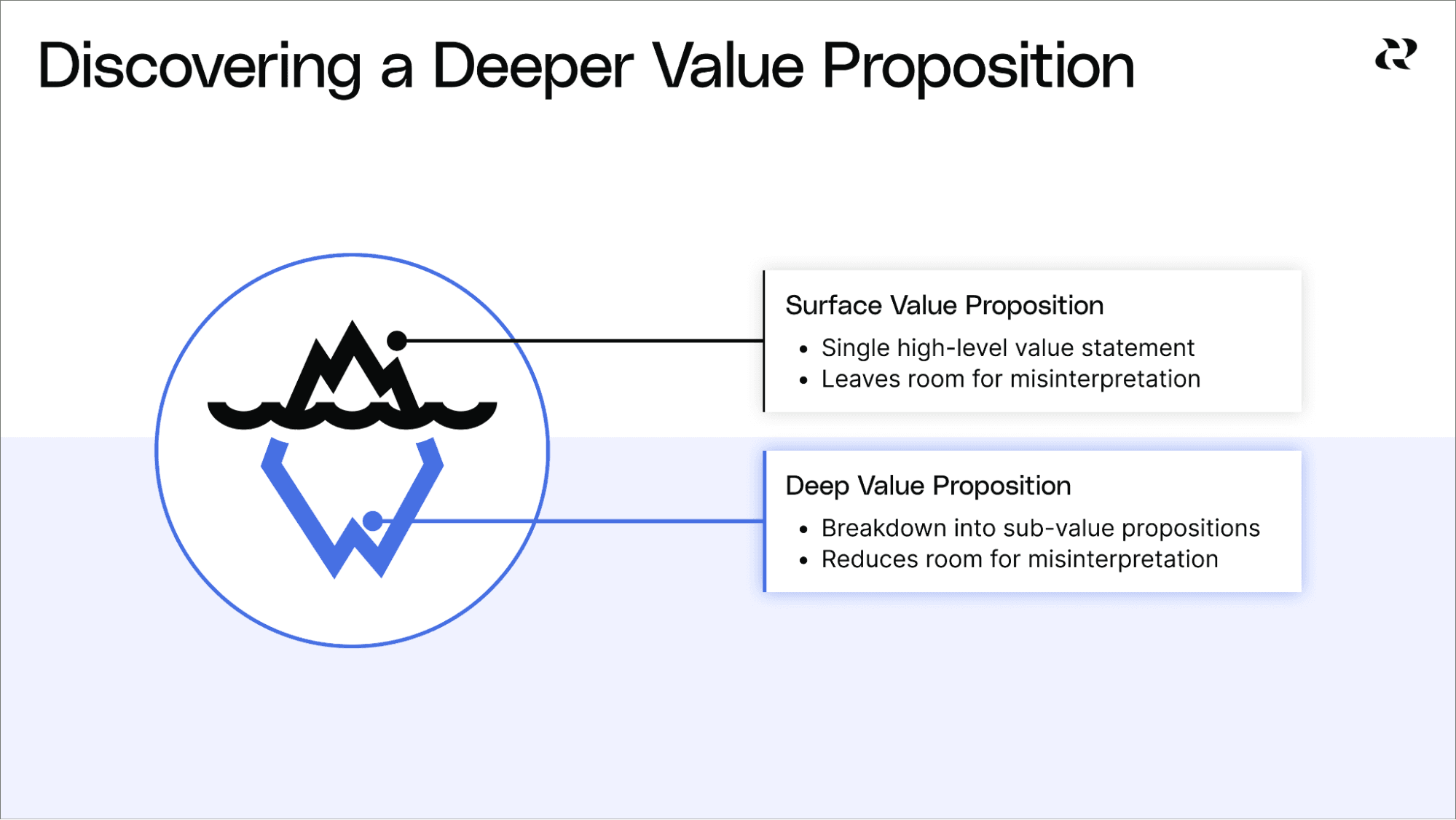
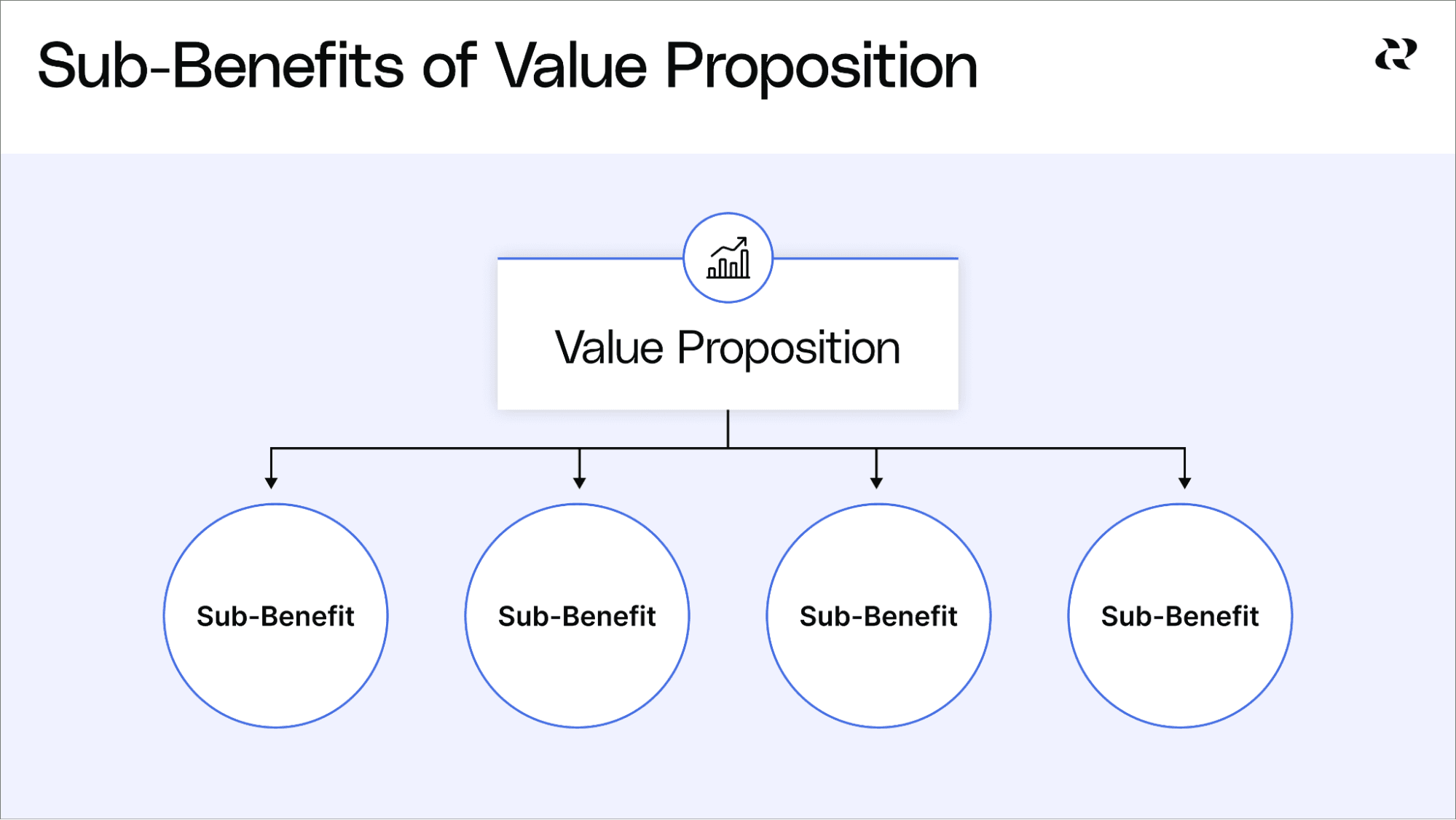
While a company’s fully-formed value proposition is its overarching, differentiating tagline, it also includes three to five specific benefits that detail how the product would solve key customer challenges.** The top-line value proposition is bolstered by sub-benefits that distinctly identify what the customer will get by using the product.**
How Do You Write A Value Proposition?
Now, if you want to create a unique value proposition from scratch, start by capturing the unique benefits your product will bring the customer. It’s important to remember that a value proposition is not a neutral description of what the product is or what it does.
Sachin Rekhi, former Head of Product at LinkedIn Sales Navigator, partnered with Reforge to define how to create a comprehensive value proposition with sub-benefits. He says, “you need to keep asking yourself, what is the ‘so, what?’ for the customer?”
Now, let’s briefly walk through how you might go about developing the first version of your value proposition.
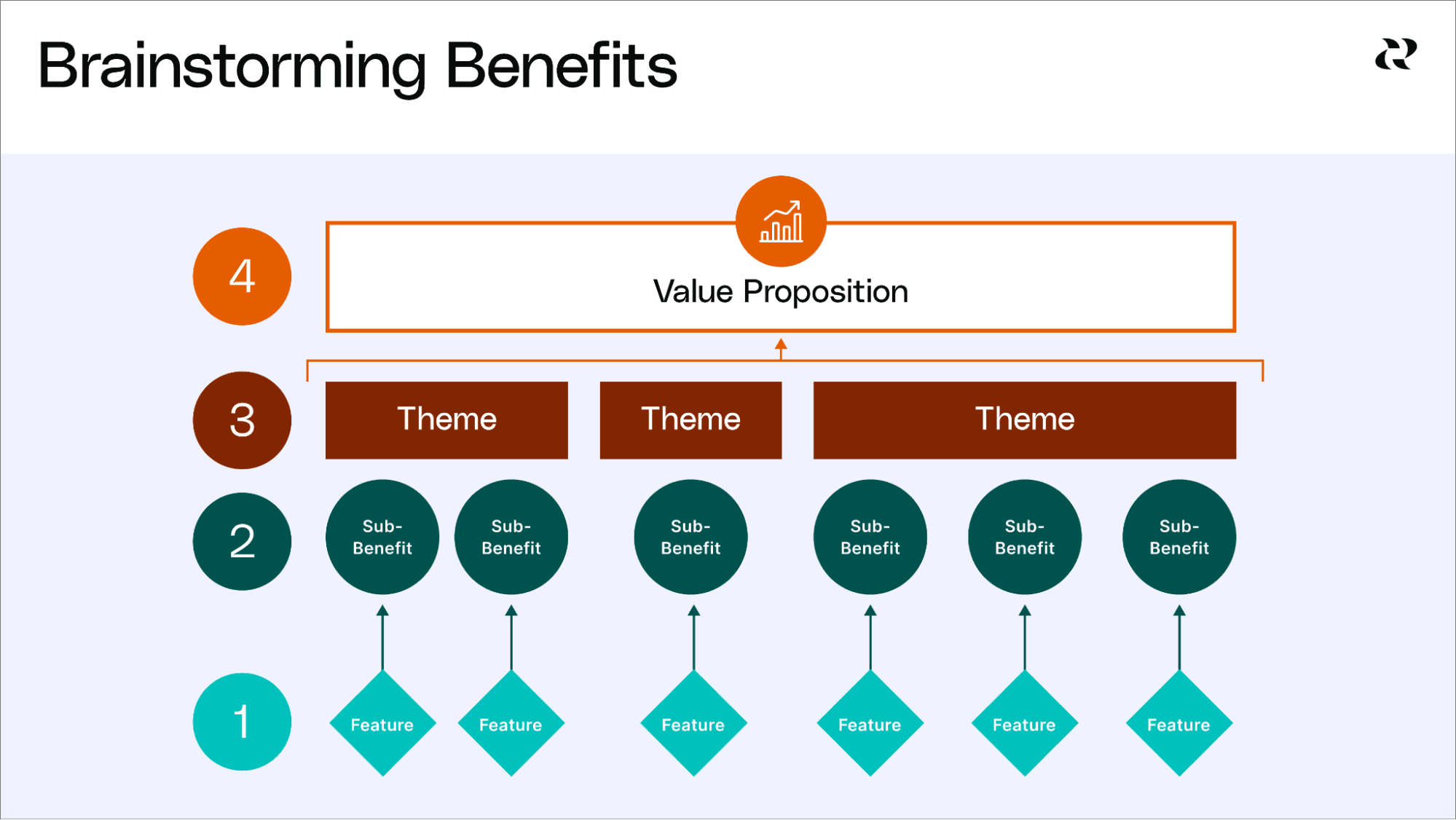
If you want to write a unique value proposition for your product from scratch, first list the features of your product.
Next, convert those features into benefits for the customer. Sachin says, “you want to place yourself in the mind of the customer and clearly answer the question, ‘why should I care?’” Sachin believes that the most difficult part of creating a value proposition is to be able to think entirely in terms of benefits statements.
**Then, take the benefits and cluster them by theme. **This will help you delineate the real breadth your product has by creating delineated lanes of value that speak to how dynamic the product is.
Finally, consider how your themes relate to one another and begin to craft the overarching proclamation to your prospective customer about how it will meaningfully improve their lives.
Now let’s take a look at an example of how LinkedIn Sales Navigator used the varied benefits and features of their tool to hone in on the right value proposition.
Value Proposition Example 1: LinkedIn Sales Navigator
Let’s use the core value proposition and sub-benefits from LinkedIn Sales Navigator to think about how they both provide a clear narrative about what Sales Navigator can do for organizations.
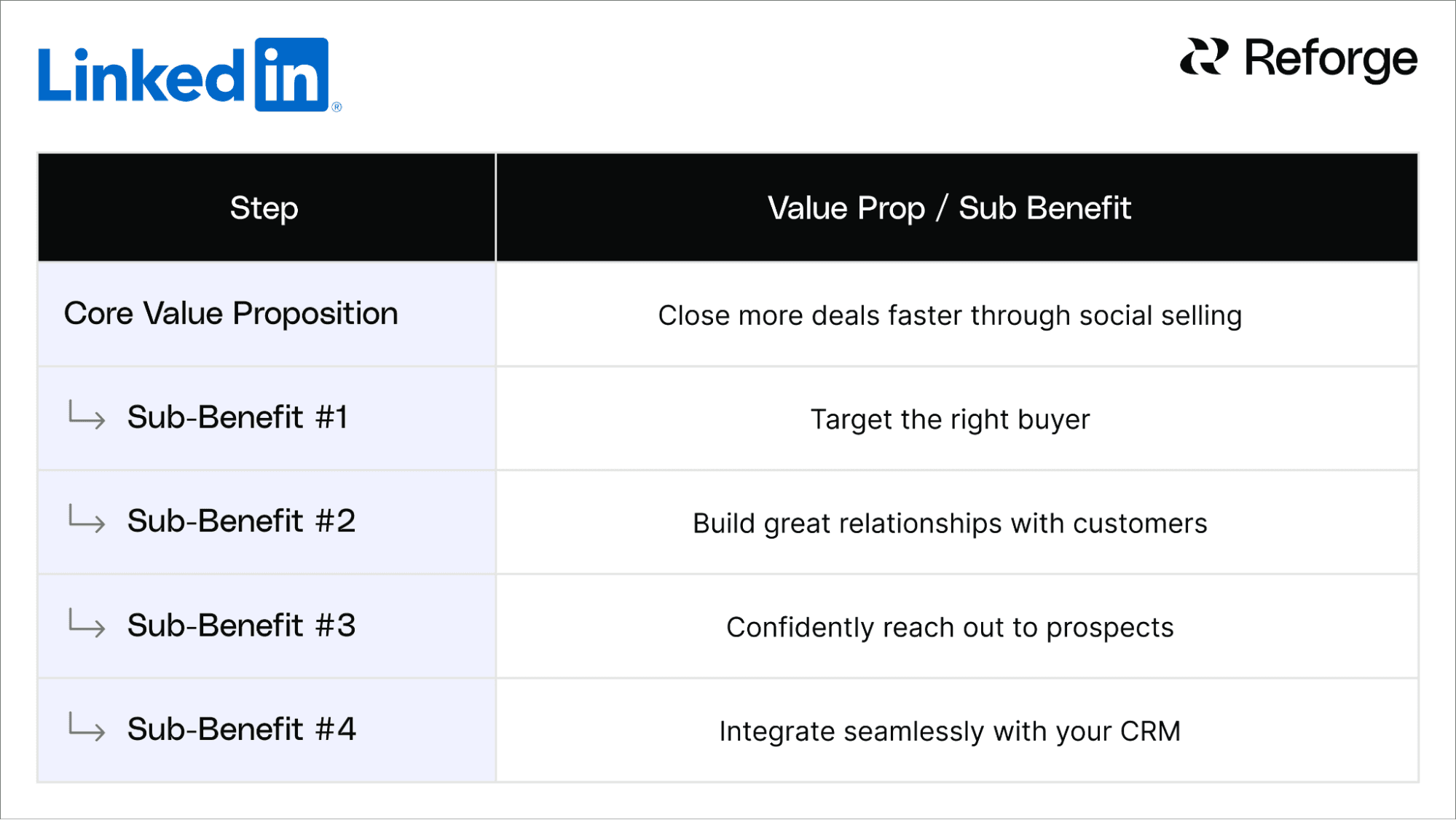
When Sachin was Head of Product, Sales Solutions at LinkedIn building the Sales Navigator tool, they considered the varied benefits of the tool to the customer as they developed the value proposition.
First, they identified the primary features of the new product. Then, they reframed them as sub-benefits which directly address why the customer should care. Next, they clustered them into the following four themes. These themes address the four most important ways the customer benefits from the product. They include:
Target the right buyer
Build great relationships with customers
Confidently reach out to prospects
Integrate seamlessly with your CRM
The LinkedIn Sales Navigator team then elaborated on the four key sub-benefits to give clear details about why they are going to help their customers. Here’s what that looks like:
**Target the right buyer: **Find the right people and companies with a search experience that delivers the most relevant prospects, built on top of LinkedIn’s 100s of millions of always up-to-date profiles. Supplement your search with personalized lead recommendations for your target accounts.
**Build great relationships with customers:**Sales Navigator will help you discover relevant insights. For example, promotions, role changes, and company news to build rapport with your prospects.
**Confidently reach out to prospects: **Sales Navigator will help you find out how you can get warmly introduced to target buyers as well as enable you to message them directly with inMails.
Integrate seamlessly with your CRM: Automatically save the leads and accounts you are selling to log Sales Navigator activity to CRM in a single click.
When they considered the varied ways LinkedIn Sales Navigator would meaningfully impact their potential customers’ lives, they were able to arrive at a core value proposition, which was: Close more deals faster with social selling.
The first version of this value proposition helped propel LinkedIn Sales Navigator to $200 million in annual sales, and has since grown to now over $1 billion in annual sales.
Now, let’s look at another company’s comprehensive value proposition and consider how they were able to fully communicate the value of the product to their customers.
Value Proposition Example 2: Substack
Now let’s look at how Substack clearly defines what their product can do via the core value proposition and sub-benefits laid out cleanly on their homepage.
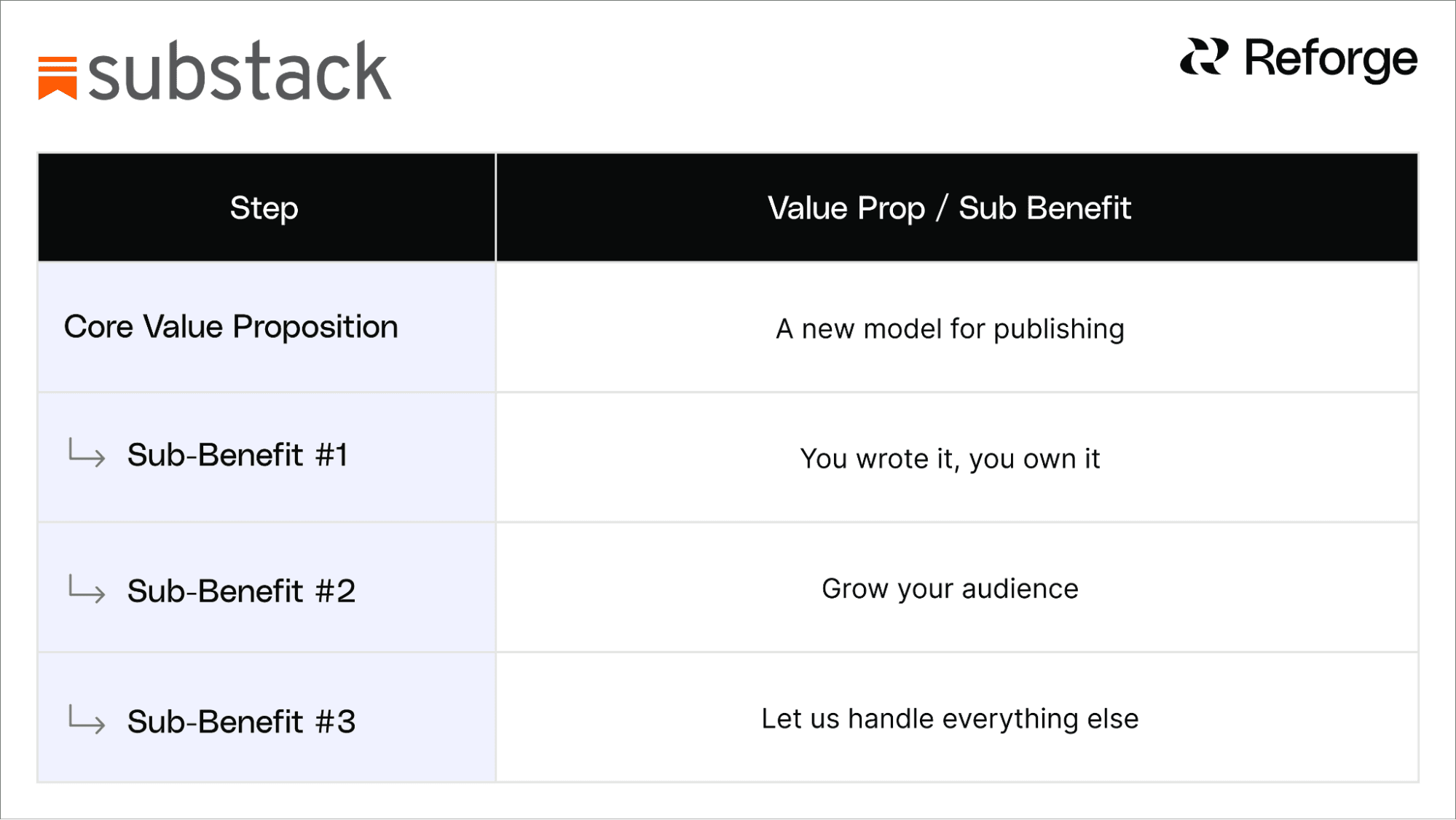
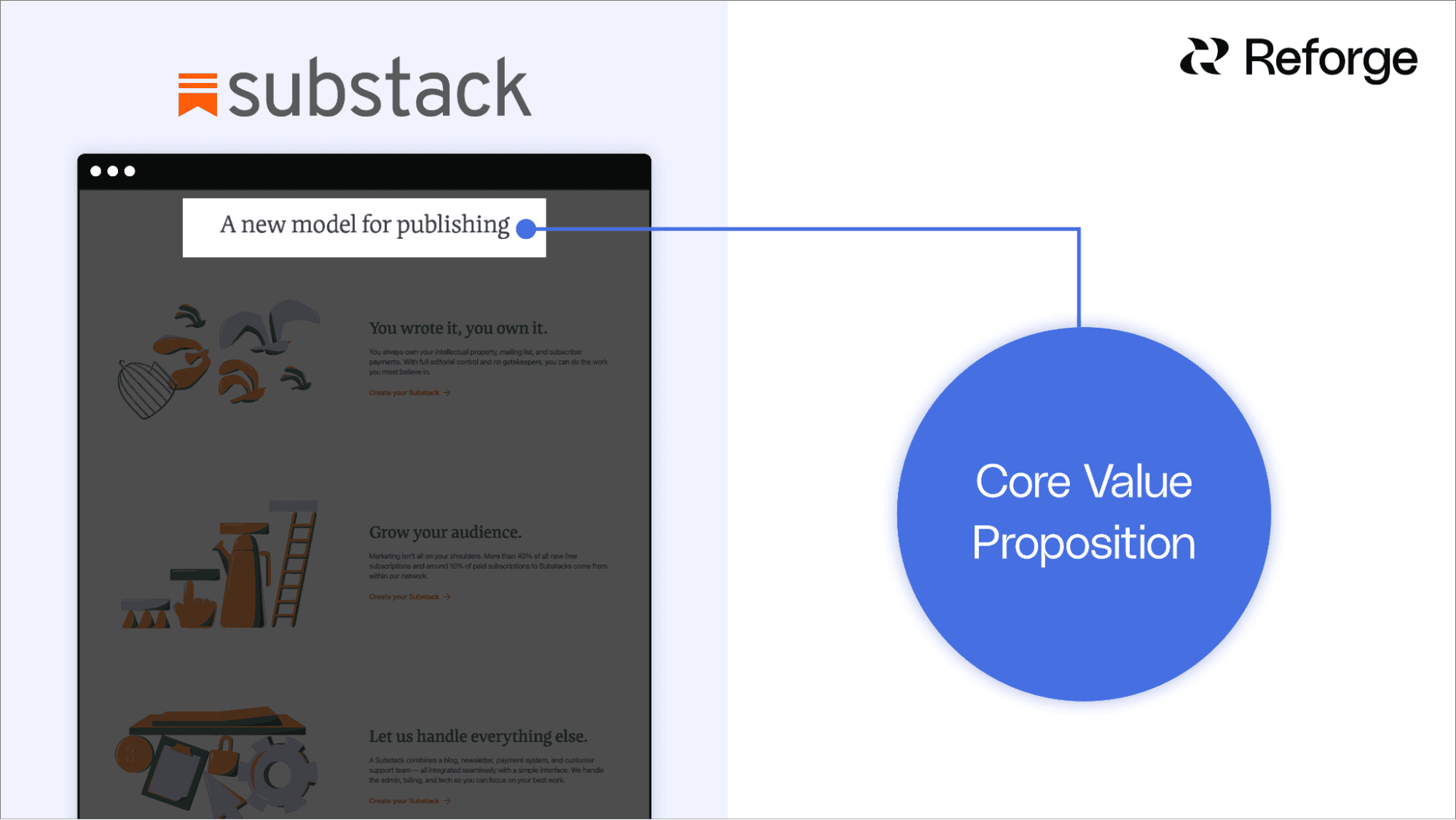
The core value proposition captured on their current homepage is: **A new model for publishing. **From this tagline, we understand that Substack is an innovation in self-publishing.
As we scroll, we can see what looks like a second value proposition, followed by the first of three sub-benefits: You wrote it, you own it.
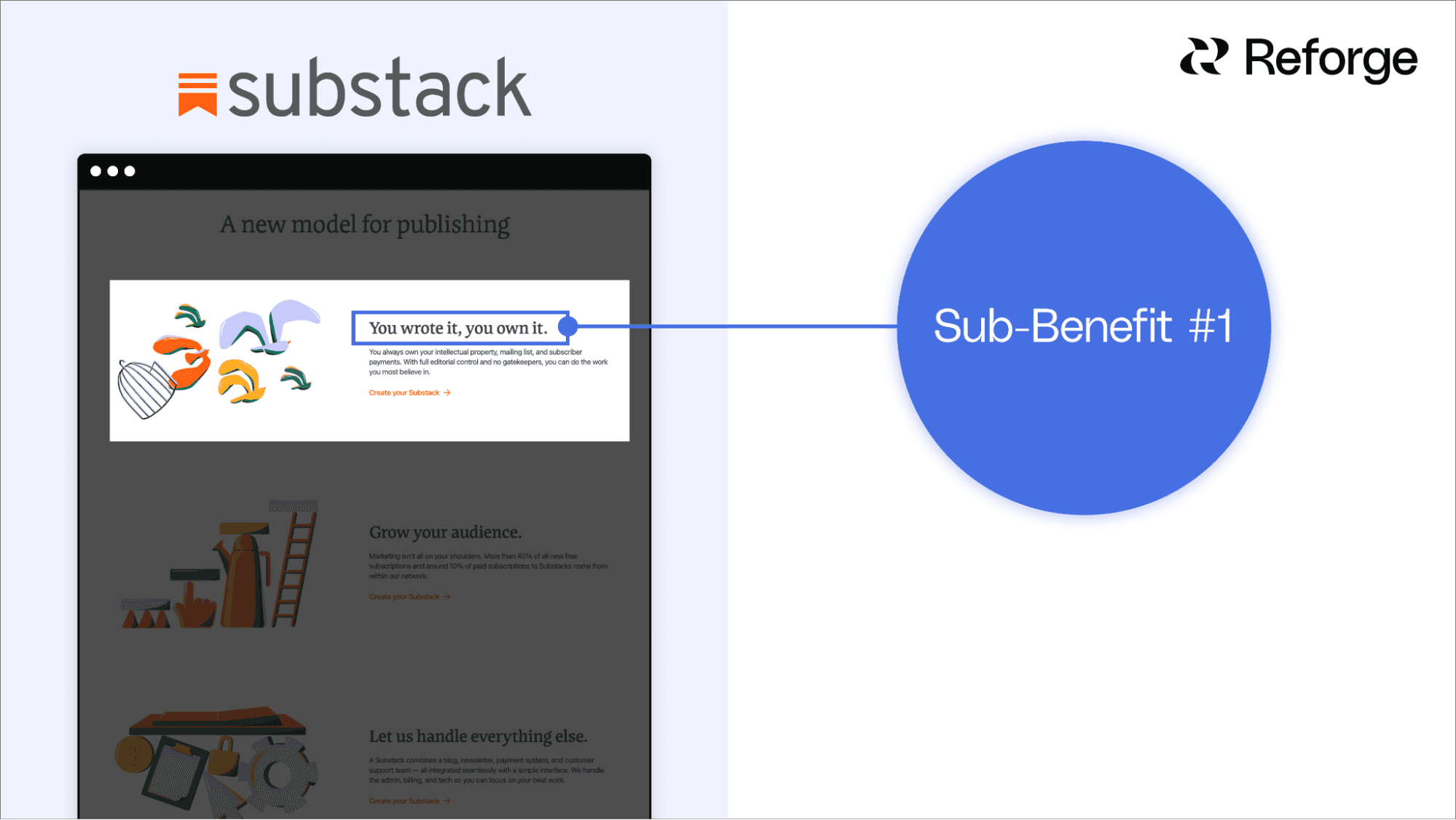
The description of the first sub-benefit is:
“You always own your intellectual property, mailing list, and subscriber payments. With full editorial control and no gatekeepers, you can do the work you most believe in.”
From this sub-benefit and its accompanying description, we gain context that is especially important to writers: the platform does not own the content; the writer does. We also learn some specific tools Substack provides, including mail and payment systems.
Let’s move on to the second sub-benefit, which is: Grow your audience.
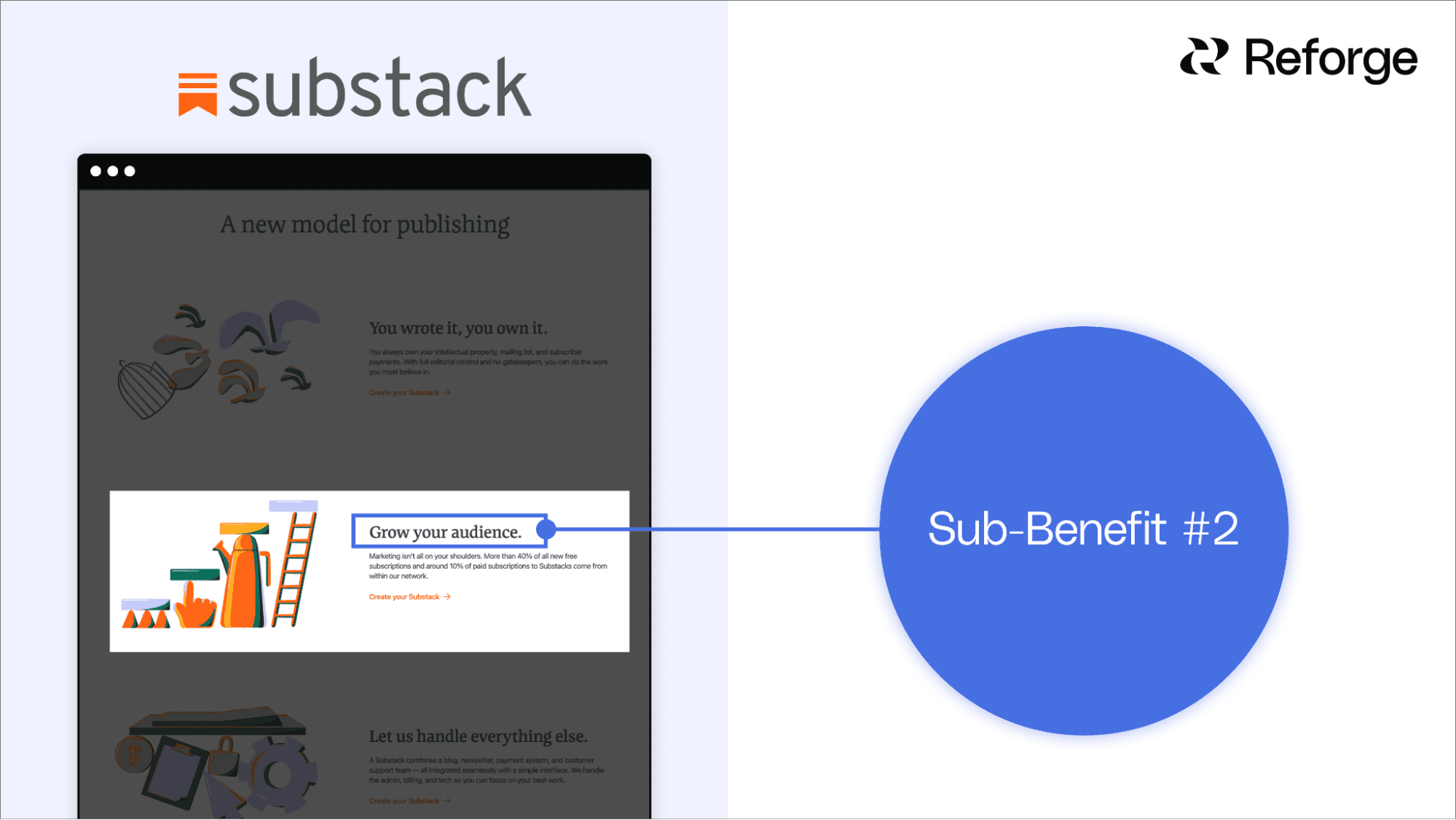
The description of this sub-benefit is:
“Marketing isn’t all on your shoulders. More than 40% of all new free subscriptions and around 10% of paid subscriptions to Substacks come from within our network.”
Here, we learn that Substack is an important marketing channel in and of itself, especially for free subscriptions. While the first sub-benefit emphasizes the agency the writer has, the second benefit suggests that writers are better off if they let Substack’s platform help them with amplified visibility.
The third and final sub-benefit Substack offers is: Let us handle everything else.
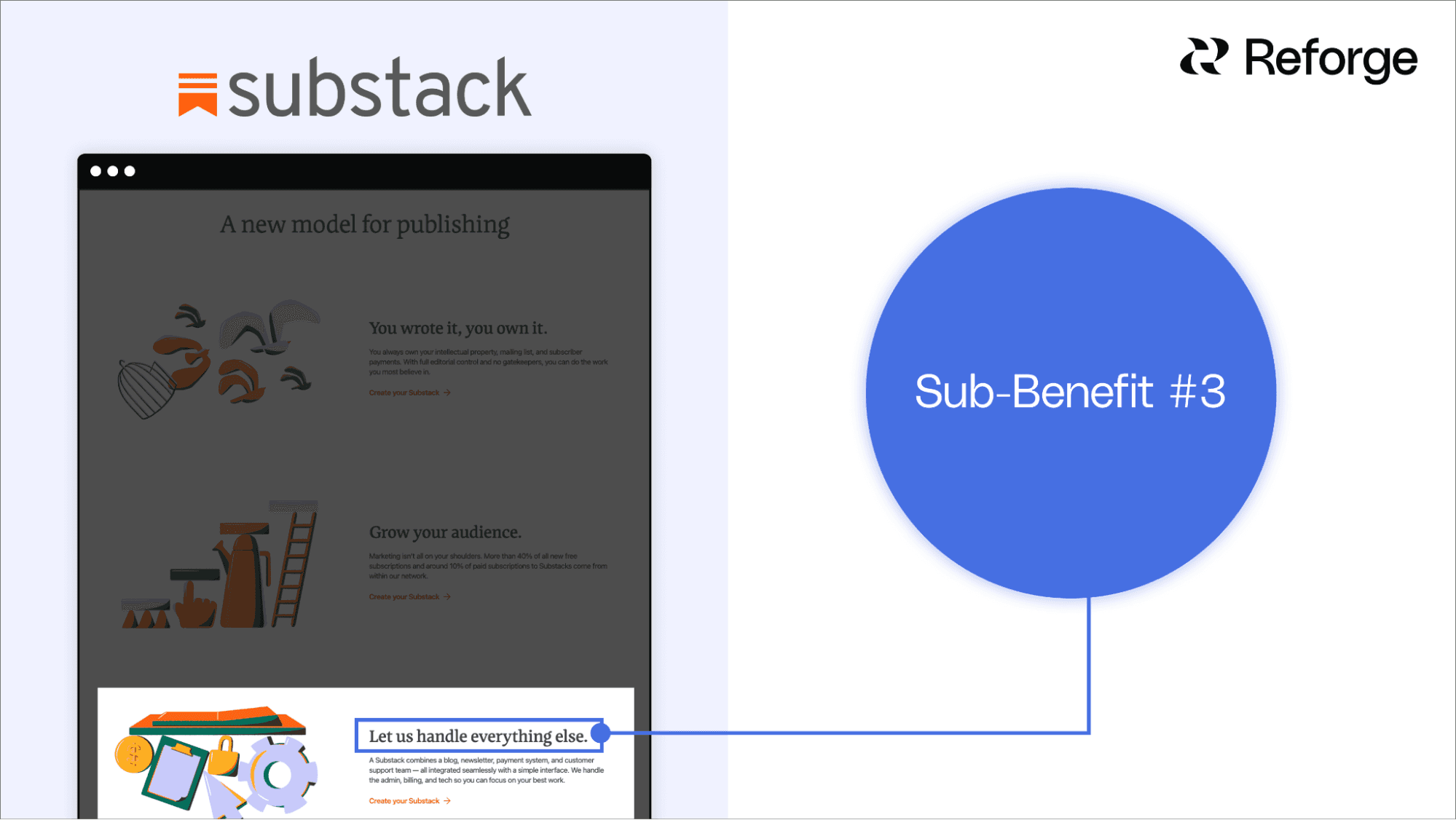
The description of the third sub-benefit is:
“A Substack combines a blog, newsletter, payment system, and customer support team — all integrated seamlessly with a simple interface. We handle the admin, billing, and tech so you can focus on your best work.”
The final sub-benefit is a catchall to describe all the levers writers can pull to make freelancing easier when they use Substack as their publishing platform. Interestingly, while this last benefit may seem just like a list of features, it may have the effect of sparking the imagination of a freelancer who hadn’t tangibly envisioned the vast possibilities of self-publishing.
The comprehensive Substack value proposition is a great example of a product that really benefits from providing rich and thoughtful sub-benefits on its homepage, below its visionary core value proposition.
Now, let’s take a look at our final example of a successful value proposition, arguably the gold standard for value propositions and new products in the last few years: Slack!
Value Proposition Example 3: Slack
Slack, and its accompanying value proposition, is broadly viewed as a game changer in the messaging space. As of 2020, Slack had more than 18 million users, and it’s widely believed that it has more than 20 million today.
Here is a preview of the various parts of their comprehensive value proposition:
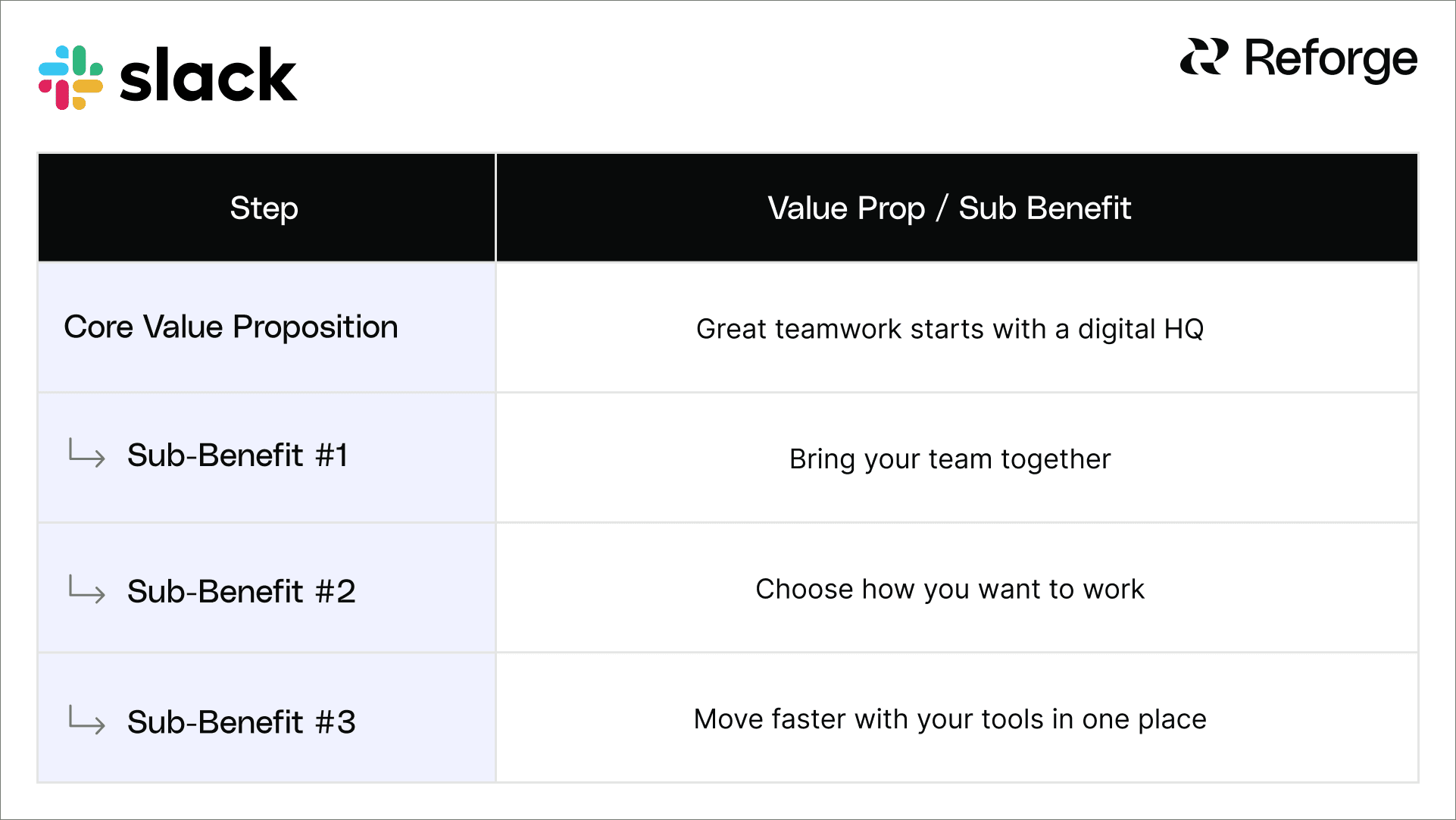
Let’s look at each part of that value proposition now. First, Slack’s homepage neatly calls out its core value proposition: Great teamwork starts with a digital HQ.
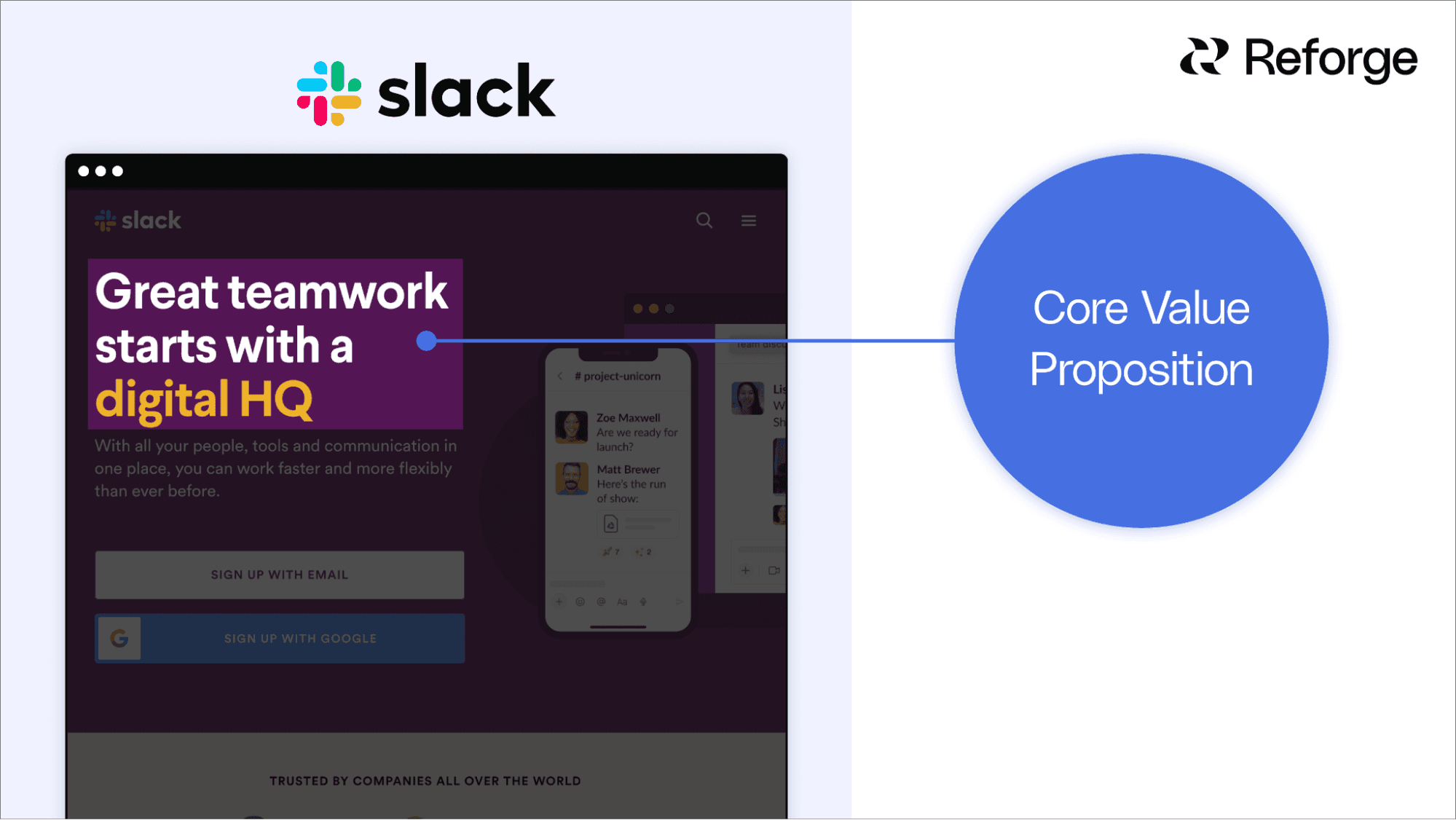
From the brief, pithy tagline alone, we understand that the product is going to foster a closer working environment for our team. The highlighted “digital HQ” emphasizes that we’re broadly working in a remote-first world and that our primary communications happen online.
Let’s have a look at the sentence-long subheading beneath the core value proposition:
“With all your people, tools, and communication in one place, you can work faster and more flexibly than ever before.”
Here, we learn that companies will have a central location that they can use to easily communicate with all personnel, be able to integrate the tools they use to further streamline their communication, and be able to communicate via chat, video, and audio huddle. The visuals also quickly show that Slack works on multiple devices.
As we scroll, we begin to see the three key sub-benefits of the product. The first of three sub-benefits is: Bring your team together.
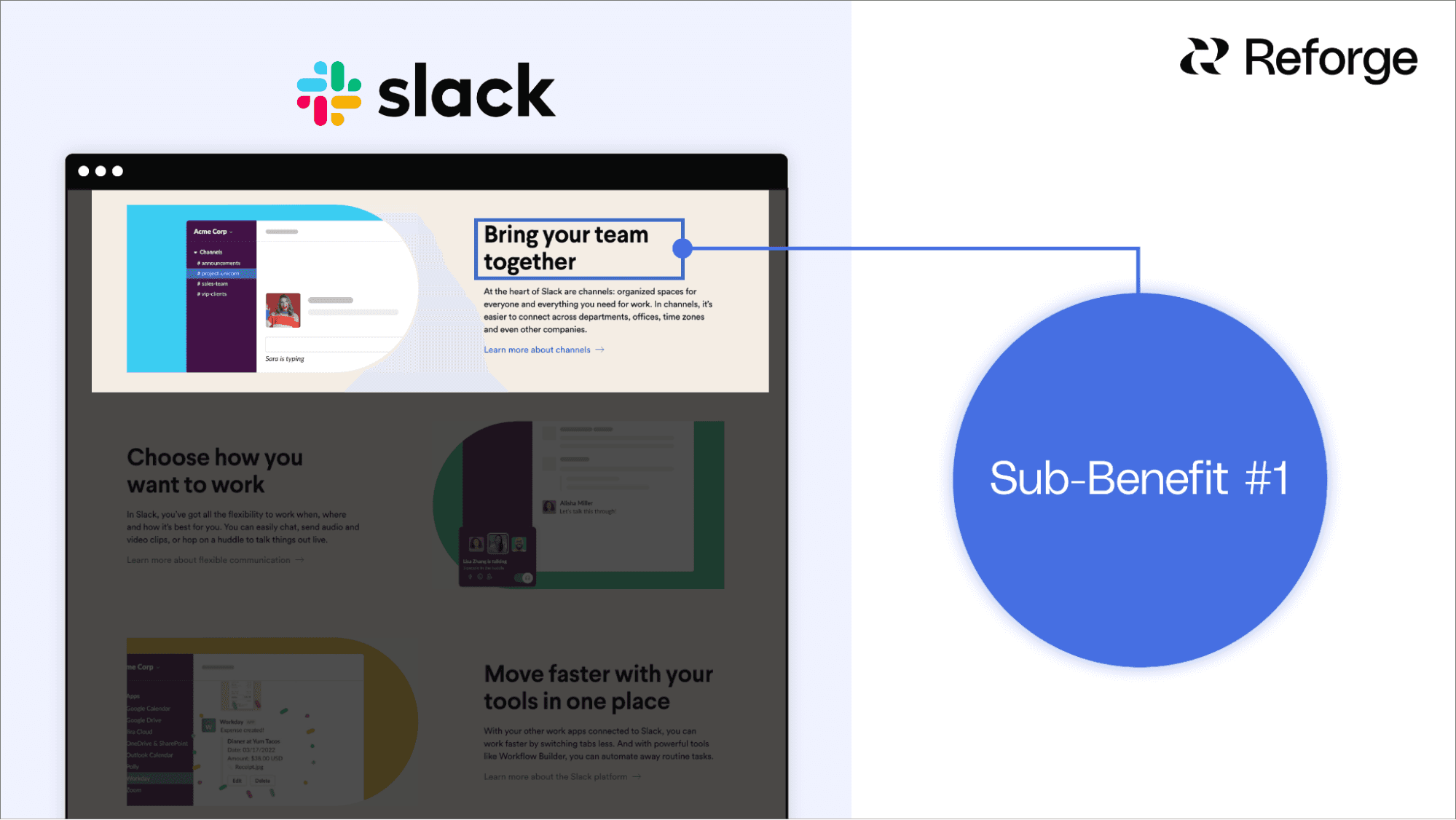
The description of sub-benefit one is:
“At the heart of Slack are channels: organized spaces for everyone and everything you need for work. In channels, it’s easier to connect across departments, offices, time zones, and even companies.”
Here, Slack introduces prospective customers to organizing messages via channels. Intuitively, we understand that the “#announcements” channel is where we’ll go to find or create anything that falls into that category. The #sales team channel will likely only have members of the sales team on it, and so on.
Let’s move on to the second benefit: Choose how you want to work.
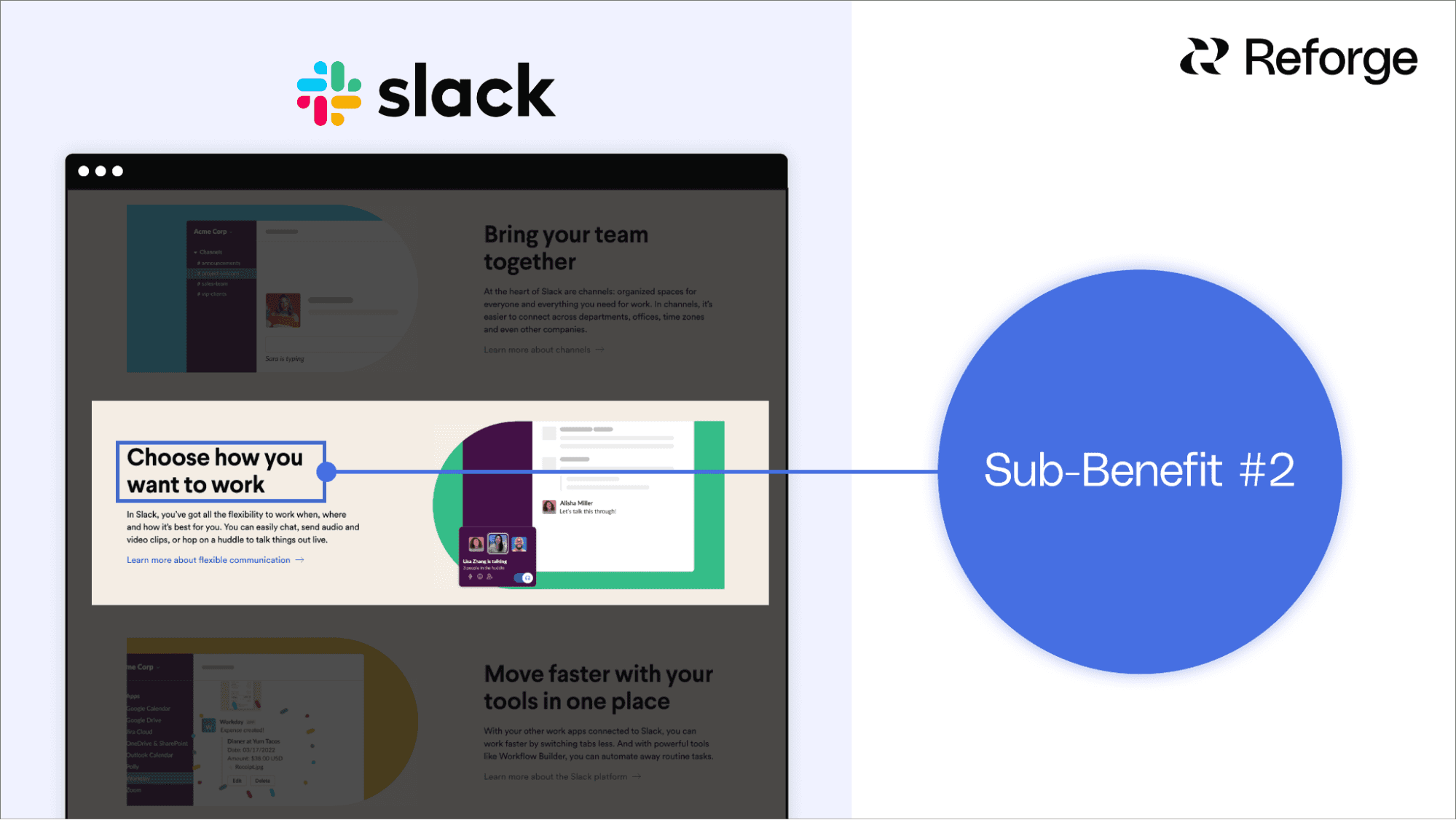
The description of this sub-benefit is:
“In Slack you’ve got all the flexibility to work when, where, and how it’s best for you. You can easily chat, send audio and video clips, or hop on a huddle to talk things out live.”
The first benefit introduces their prospective customers to channels, which are a unique feature of the product. The second benefit communicates essentially that any tool you previously used to message or video chat, you can now use Slack instead.
Here, Slack drives home the idea that its superior product can replace other tools your company is currently paying for.
Finally, we can look at Slack’s third sub-benefit: Move faster with your tools in one place.
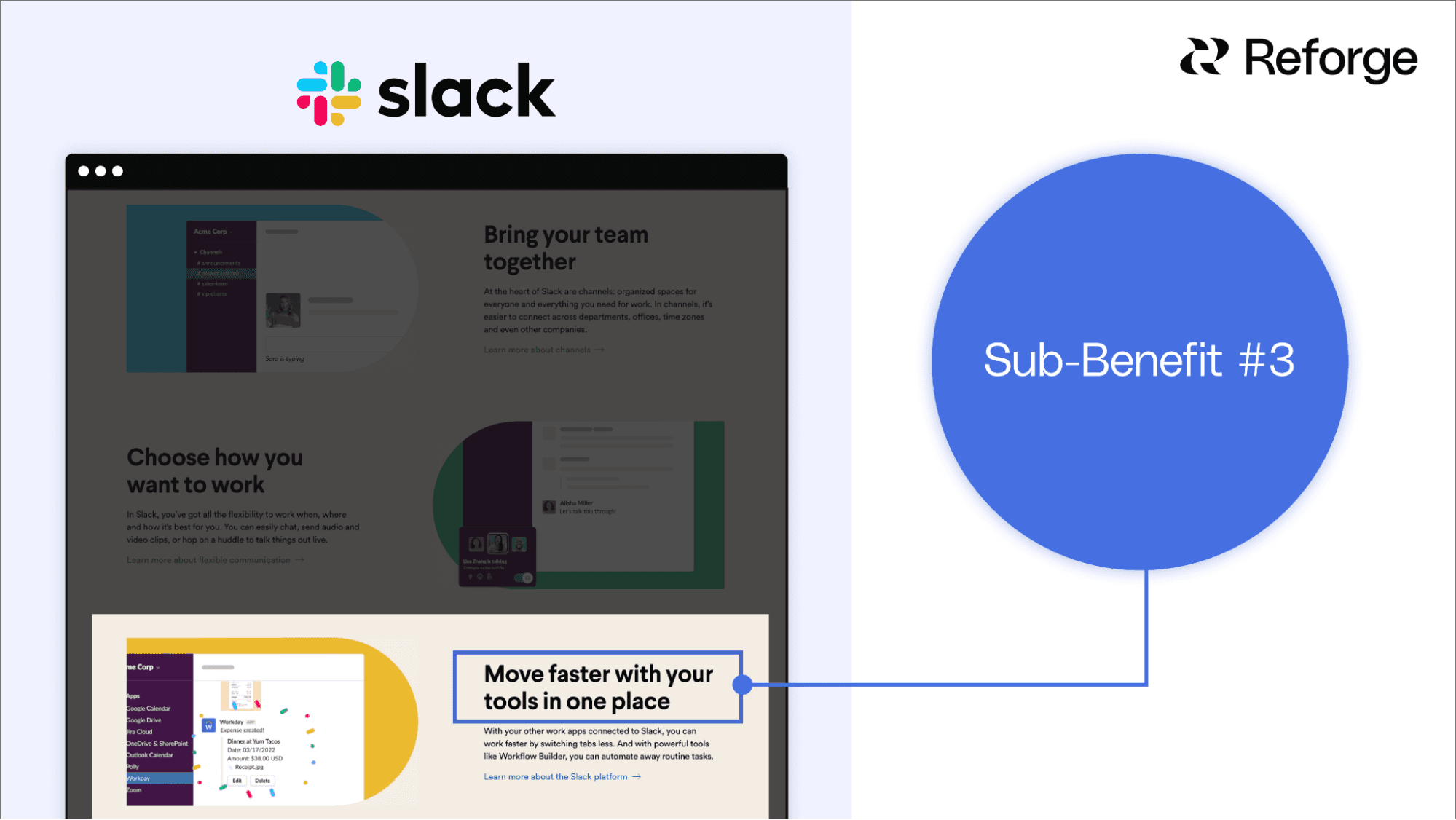
The description of the third sub-benefit is:
“With your other work apps connected to Slack, you can work faster by switching tabs less. And with powerful tools like Workflow Builder, you can automate away routine tasks.”
The third value proposition benefit puts a fine point on the idea that Slack is not only a powerful communication tool, it can also streamline your workday and even help eliminate some of the tasks you’d have to complete if you didn’t have the product.
By the time we reach the end of the page, we’re primed to take the next steps as an organization. The calls to action make that a seamless move for the prospective customer, so we can really view this comprehensive value proposition as a customer-forward, well-rounded pitch with actionable next steps.
A Comprehensive Value Proposition Can Help Illuminate Customer Benefits
Now you know how to start from a list of product features and build a comprehensive value proposition that specifically targets what the customer will value. You understand that a truly complete value proposition goes far beyond a catchy umbrella phrase that somewhat vaguely nods to what your product is and how it will impact your customers’ lives.
Moreover, you know, based on a number of great examples of organizations that continue to experience exponential growth that a well-built value proposition is a powerful tool. By deeply investing in the process, you too can give people a sense of how their lives will be meaningfully improved if they buy your product — and not just give them a pithy tagline to read on your homepage.
If you’re interested in learning more about how to create a value proposition and how to build a product more broadly, we recommend Reforge’s Mastering Product Management or Product Marketing programs!


When we have an idea for a product or feature, we usually frame it as a benefit to the people who will eventually use it. For example, “what if we created an app so people could have their food delivered to them, even if the restaurant itself doesn’t do delivery?”
However, when teams move from idea generation to product development, it can be easy to lose sight of what the real value is to the customer. That’s where an official value proposition takes on a meaningful role.
A value proposition is a perfect distillation of what your product is and how customers find unique value in it. Sitting at a crossroads between strategy and brand, it serves as a short-hand definition of what the product offers the customer.
Let’s dive into how we can create a comprehensive and unique value proposition. We’ll also dive deep into a few of the most important B2B disruptors with some of the most compelling value propositions anywhere.
What Is A Comprehensive Value Proposition?
Most people think that a unique value proposition is an attention-getting phrase, but that’s just the tip of the iceberg.
While a company’s fully-formed value proposition is its overarching, differentiating tagline, it also includes three to five specific benefits that detail how the product would solve key customer challenges.** The top-line value proposition is bolstered by sub-benefits that distinctly identify what the customer will get by using the product.**
How Do You Write A Value Proposition?
Now, if you want to create a unique value proposition from scratch, start by capturing the unique benefits your product will bring the customer. It’s important to remember that a value proposition is not a neutral description of what the product is or what it does.
Sachin Rekhi, former Head of Product at LinkedIn Sales Navigator, partnered with Reforge to define how to create a comprehensive value proposition with sub-benefits. He says, “you need to keep asking yourself, what is the ‘so, what?’ for the customer?”
Now, let’s briefly walk through how you might go about developing the first version of your value proposition.
If you want to write a unique value proposition for your product from scratch, first list the features of your product.
Next, convert those features into benefits for the customer. Sachin says, “you want to place yourself in the mind of the customer and clearly answer the question, ‘why should I care?’” Sachin believes that the most difficult part of creating a value proposition is to be able to think entirely in terms of benefits statements.
**Then, take the benefits and cluster them by theme. **This will help you delineate the real breadth your product has by creating delineated lanes of value that speak to how dynamic the product is.
Finally, consider how your themes relate to one another and begin to craft the overarching proclamation to your prospective customer about how it will meaningfully improve their lives.
Now let’s take a look at an example of how LinkedIn Sales Navigator used the varied benefits and features of their tool to hone in on the right value proposition.
Value Proposition Example 1: LinkedIn Sales Navigator
Let’s use the core value proposition and sub-benefits from LinkedIn Sales Navigator to think about how they both provide a clear narrative about what Sales Navigator can do for organizations.
When Sachin was Head of Product, Sales Solutions at LinkedIn building the Sales Navigator tool, they considered the varied benefits of the tool to the customer as they developed the value proposition.
First, they identified the primary features of the new product. Then, they reframed them as sub-benefits which directly address why the customer should care. Next, they clustered them into the following four themes. These themes address the four most important ways the customer benefits from the product. They include:
Target the right buyer
Build great relationships with customers
Confidently reach out to prospects
Integrate seamlessly with your CRM
The LinkedIn Sales Navigator team then elaborated on the four key sub-benefits to give clear details about why they are going to help their customers. Here’s what that looks like:
**Target the right buyer: **Find the right people and companies with a search experience that delivers the most relevant prospects, built on top of LinkedIn’s 100s of millions of always up-to-date profiles. Supplement your search with personalized lead recommendations for your target accounts.
**Build great relationships with customers:**Sales Navigator will help you discover relevant insights. For example, promotions, role changes, and company news to build rapport with your prospects.
**Confidently reach out to prospects: **Sales Navigator will help you find out how you can get warmly introduced to target buyers as well as enable you to message them directly with inMails.
Integrate seamlessly with your CRM: Automatically save the leads and accounts you are selling to log Sales Navigator activity to CRM in a single click.
When they considered the varied ways LinkedIn Sales Navigator would meaningfully impact their potential customers’ lives, they were able to arrive at a core value proposition, which was: Close more deals faster with social selling.
The first version of this value proposition helped propel LinkedIn Sales Navigator to $200 million in annual sales, and has since grown to now over $1 billion in annual sales.
Now, let’s look at another company’s comprehensive value proposition and consider how they were able to fully communicate the value of the product to their customers.
Value Proposition Example 2: Substack
Now let’s look at how Substack clearly defines what their product can do via the core value proposition and sub-benefits laid out cleanly on their homepage.
The core value proposition captured on their current homepage is: **A new model for publishing. **From this tagline, we understand that Substack is an innovation in self-publishing.
As we scroll, we can see what looks like a second value proposition, followed by the first of three sub-benefits: You wrote it, you own it.
The description of the first sub-benefit is:
“You always own your intellectual property, mailing list, and subscriber payments. With full editorial control and no gatekeepers, you can do the work you most believe in.”
From this sub-benefit and its accompanying description, we gain context that is especially important to writers: the platform does not own the content; the writer does. We also learn some specific tools Substack provides, including mail and payment systems.
Let’s move on to the second sub-benefit, which is: Grow your audience.
The description of this sub-benefit is:
“Marketing isn’t all on your shoulders. More than 40% of all new free subscriptions and around 10% of paid subscriptions to Substacks come from within our network.”
Here, we learn that Substack is an important marketing channel in and of itself, especially for free subscriptions. While the first sub-benefit emphasizes the agency the writer has, the second benefit suggests that writers are better off if they let Substack’s platform help them with amplified visibility.
The third and final sub-benefit Substack offers is: Let us handle everything else.
The description of the third sub-benefit is:
“A Substack combines a blog, newsletter, payment system, and customer support team — all integrated seamlessly with a simple interface. We handle the admin, billing, and tech so you can focus on your best work.”
The final sub-benefit is a catchall to describe all the levers writers can pull to make freelancing easier when they use Substack as their publishing platform. Interestingly, while this last benefit may seem just like a list of features, it may have the effect of sparking the imagination of a freelancer who hadn’t tangibly envisioned the vast possibilities of self-publishing.
The comprehensive Substack value proposition is a great example of a product that really benefits from providing rich and thoughtful sub-benefits on its homepage, below its visionary core value proposition.
Now, let’s take a look at our final example of a successful value proposition, arguably the gold standard for value propositions and new products in the last few years: Slack!
Value Proposition Example 3: Slack
Slack, and its accompanying value proposition, is broadly viewed as a game changer in the messaging space. As of 2020, Slack had more than 18 million users, and it’s widely believed that it has more than 20 million today.
Here is a preview of the various parts of their comprehensive value proposition:
Let’s look at each part of that value proposition now. First, Slack’s homepage neatly calls out its core value proposition: Great teamwork starts with a digital HQ.
From the brief, pithy tagline alone, we understand that the product is going to foster a closer working environment for our team. The highlighted “digital HQ” emphasizes that we’re broadly working in a remote-first world and that our primary communications happen online.
Let’s have a look at the sentence-long subheading beneath the core value proposition:
“With all your people, tools, and communication in one place, you can work faster and more flexibly than ever before.”
Here, we learn that companies will have a central location that they can use to easily communicate with all personnel, be able to integrate the tools they use to further streamline their communication, and be able to communicate via chat, video, and audio huddle. The visuals also quickly show that Slack works on multiple devices.
As we scroll, we begin to see the three key sub-benefits of the product. The first of three sub-benefits is: Bring your team together.
The description of sub-benefit one is:
“At the heart of Slack are channels: organized spaces for everyone and everything you need for work. In channels, it’s easier to connect across departments, offices, time zones, and even companies.”
Here, Slack introduces prospective customers to organizing messages via channels. Intuitively, we understand that the “#announcements” channel is where we’ll go to find or create anything that falls into that category. The #sales team channel will likely only have members of the sales team on it, and so on.
Let’s move on to the second benefit: Choose how you want to work.
The description of this sub-benefit is:
“In Slack you’ve got all the flexibility to work when, where, and how it’s best for you. You can easily chat, send audio and video clips, or hop on a huddle to talk things out live.”
The first benefit introduces their prospective customers to channels, which are a unique feature of the product. The second benefit communicates essentially that any tool you previously used to message or video chat, you can now use Slack instead.
Here, Slack drives home the idea that its superior product can replace other tools your company is currently paying for.
Finally, we can look at Slack’s third sub-benefit: Move faster with your tools in one place.
The description of the third sub-benefit is:
“With your other work apps connected to Slack, you can work faster by switching tabs less. And with powerful tools like Workflow Builder, you can automate away routine tasks.”
The third value proposition benefit puts a fine point on the idea that Slack is not only a powerful communication tool, it can also streamline your workday and even help eliminate some of the tasks you’d have to complete if you didn’t have the product.
By the time we reach the end of the page, we’re primed to take the next steps as an organization. The calls to action make that a seamless move for the prospective customer, so we can really view this comprehensive value proposition as a customer-forward, well-rounded pitch with actionable next steps.
A Comprehensive Value Proposition Can Help Illuminate Customer Benefits
Now you know how to start from a list of product features and build a comprehensive value proposition that specifically targets what the customer will value. You understand that a truly complete value proposition goes far beyond a catchy umbrella phrase that somewhat vaguely nods to what your product is and how it will impact your customers’ lives.
Moreover, you know, based on a number of great examples of organizations that continue to experience exponential growth that a well-built value proposition is a powerful tool. By deeply investing in the process, you too can give people a sense of how their lives will be meaningfully improved if they buy your product — and not just give them a pithy tagline to read on your homepage.
If you’re interested in learning more about how to create a value proposition and how to build a product more broadly, we recommend Reforge’s Mastering Product Management or Product Marketing programs!