Reforge has joined Miro ↗
The strongest product teams are united and working toward something they all agree on — but how do you inspire that type of unity? It’s all about the product goals that you and your team are pursuing.
Strong product goals guide product work because they enable your team to understand how far they’ve gone and in which direction. You can use these goals as a method to give feedback and adjust the team’s direction if it veers off course.
But it’s challenging to know where to start with goal setting strategies, especially in the product space. A few simple searches online show you just how many ways you can set product goals and monitor progress – and they all look to be wonderful. But how do you decide which to use? In this post, we’re going to walk through some of our favorite goal setting frameworks.
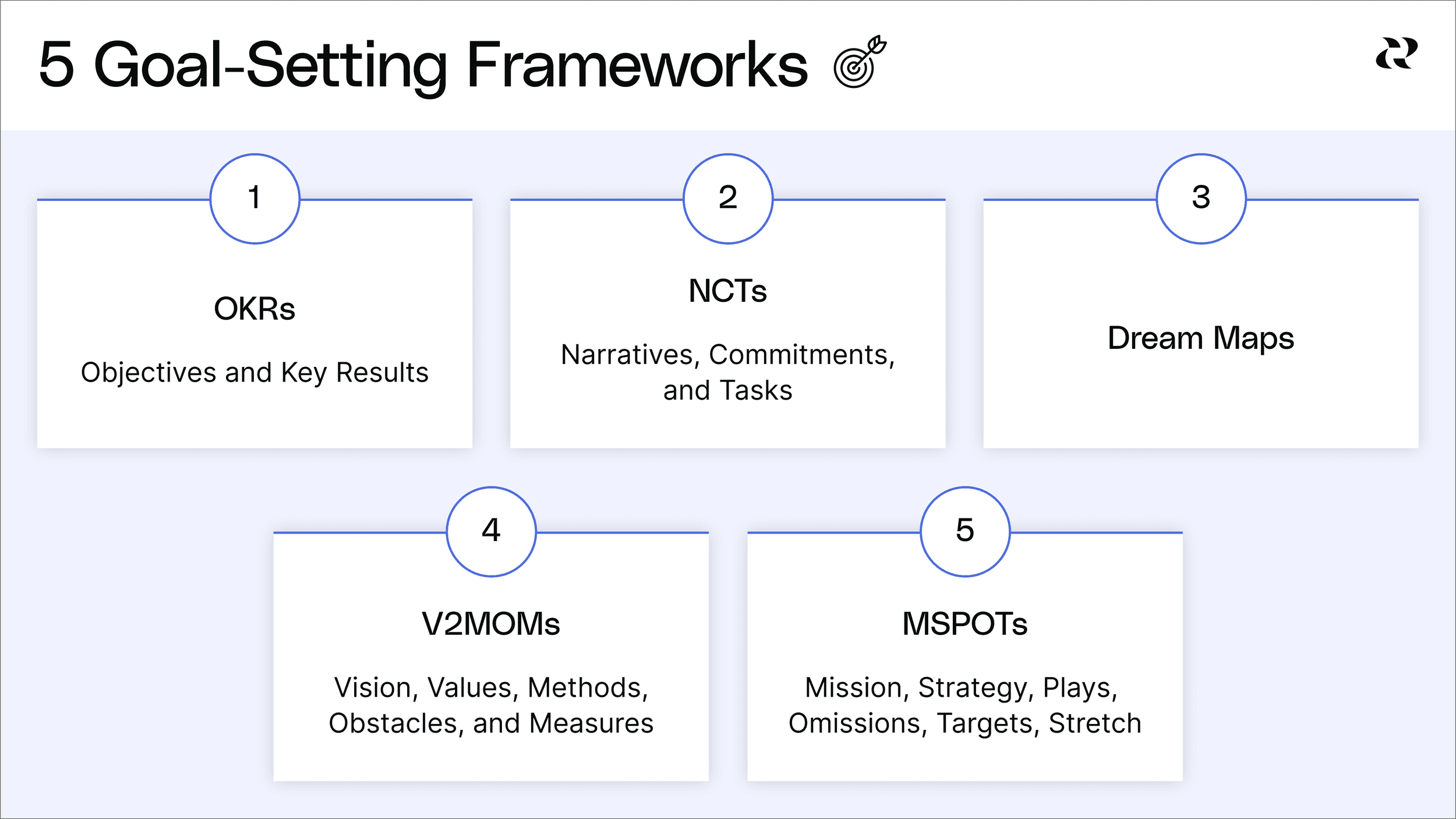
We know that every team and company is different. That’s why these five frameworks for setting better product goals come directly from our experts like Sachin Rekhi, Ravi Mehta, Tatyana Mamut, Jonatan Littke and Michael Pici and their experiences at companies such as Hubspot, LinkedIn, and Tripadvisor
But depending on the scope, resources, and even leadership style, the right framework for setting product goals will vary. Maybe you want an approach that’s better for small, remote teams. Or maybe you need to streamline differing goals from various teams, which requires a framework to communicate a top-down strategy.
Each of these five frameworks excels at different things, which is why we took the time to cover all of them.
Click on any below to learn more or scroll along to understand each goal setting framework.
OKRs****: Ideal for when you’re trying to push a large, established team to stretch themselves
NCTs****: For when you find the team seems to be consistently missing context
Dream Maps****: When you are trying to keep a remote team connected
MSPOTs: When you need to unite your team around a strategic vision but don’t want to be prescriptive
V2MOMs****: When you need really strong top-down alignment
Meet The Contributors
Goal Setting Framework #1: OKRs
We’ll start with OKRs. You’ve probably heard of this goal setting framework and may have even used them before. However, using something because it was assigned to you at a previous company is not the same as choosing to use a framework because it fits your needs. Let’s break down what is an OKR, who should use OKRs, and some OKR examples.
What Is An OKR?
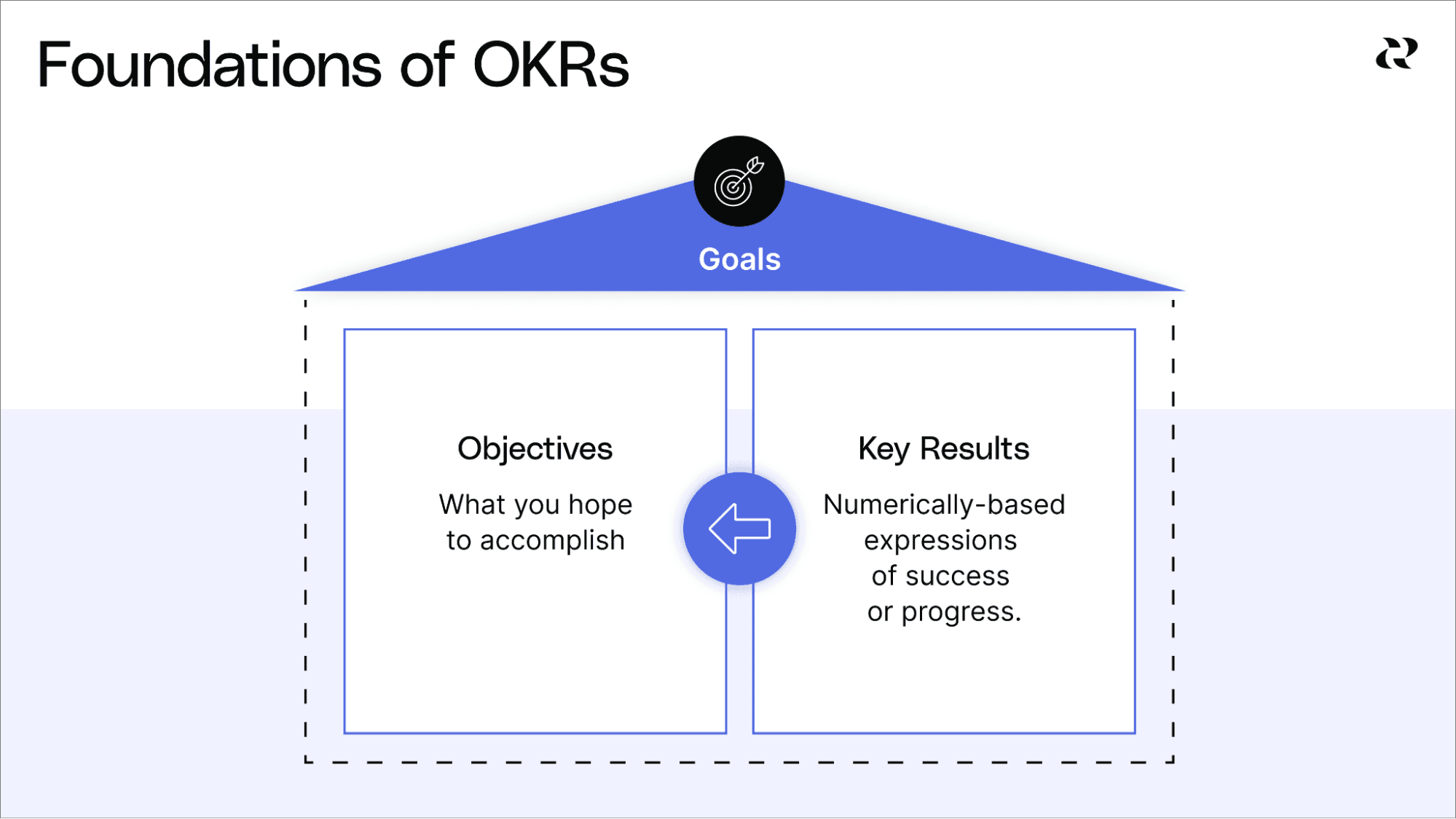
Simply put, there are two parts of OKRs: the Objective and the Key Results:
The objective: what you hope to accomplish with a given set of initiatives
Key results: numerically-based expressions of success or progress towards an objective
When To Use OKRs?
OKRs are the best way to set product goals when you’re trying to push a large, established team to stretch itself to reach new heights.
That’s because OKRs do four things really well:
They create focused effort. By focusing on the top objectives and associated key results, product teams have to make hard prioritization trade-offs upfront. This also helps teams align on business and product outcomes, rather than outputs. Additionally, focus effort helps to prioritize the most needle-moving work.
They drive team empowerment. OKRs can help you scale beyond your own efforts by aligning the entire product team on top priorities. This alignment empowers the team to make tradeoffs with less top-down involvement. That way, when cross-functional peers approach the team with product requests, your teammates will be able to make decisions quickly and with more confidence.
They create product intuition. By adopting an outcome-oriented approach to OKRs and implementing a regular review process, a team's learning loop can be improved and accelerated.
**They create leadership buy-in. **If product managers in the organization are all using OKRs, it’s easier to socialize your team’s objectives and key results with executives. When leadership is familiar with the product team’s OKRs, product pods, and product managers can get support from key decision-makers in the company.
“OKRs are one of the best goal setting frameworks I've found for driving focus, alignment, accountability, and an outcome orientation.”
— Sachin Rekhi, Founder & CEO of Notejoy
Example Of OKRs In Practice
In 2014, LinkedIn wanted to expand product market fit by launching a product aimed at sales professionals. At the time, the professional networking company’s biggest user demographic were sales professionals, so they wanted to leverage this audience to expand into the new product.
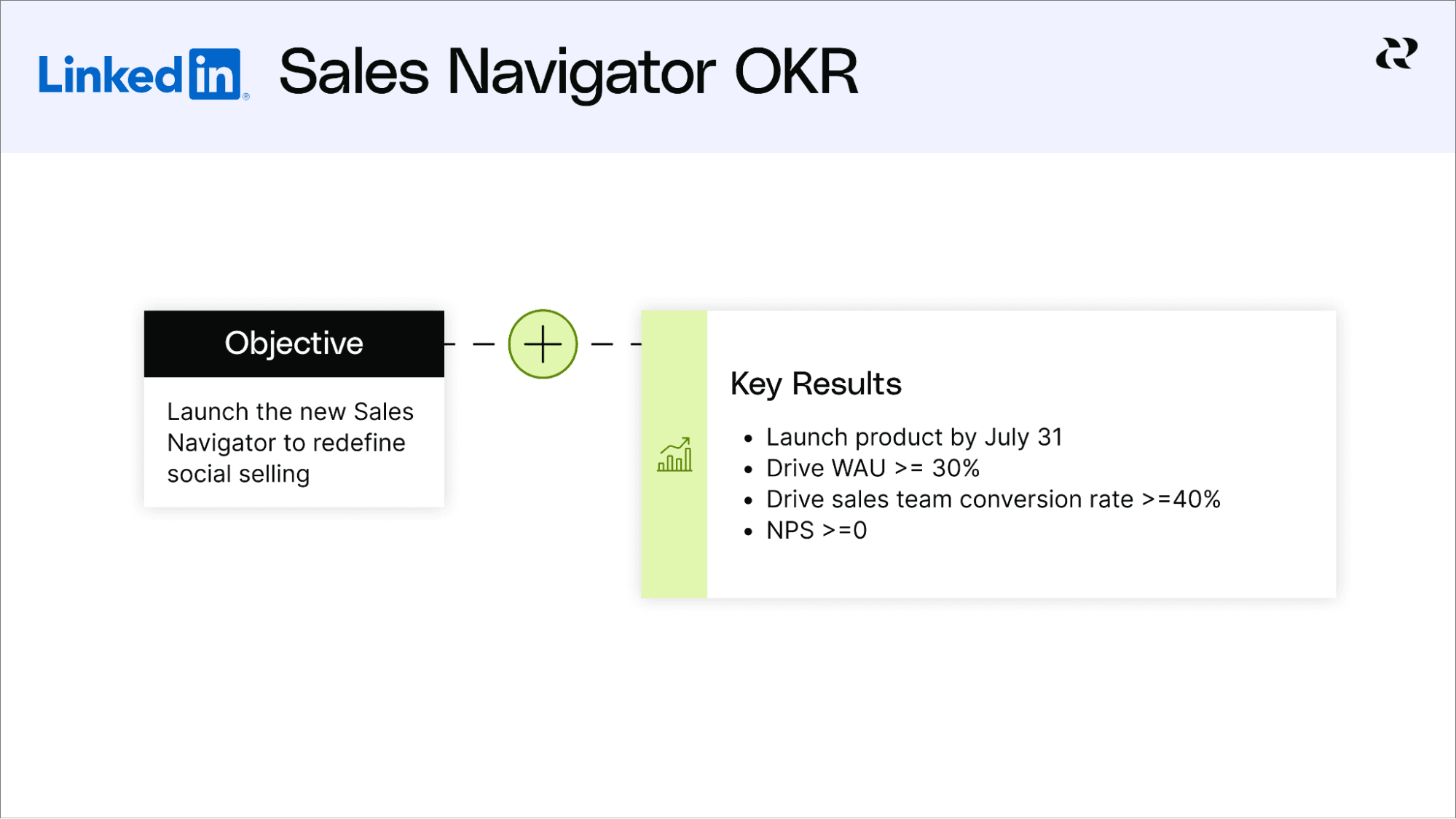
LinkedIn started with an objective in mind: to launch the Sales Navigator product and define “social selling.” While many of the features that Sales Navigator offered already existed in the core networking product, building out a standalone product transformed the sales world. It enabled social selling, which is the process of people finding, engaging with, and building trust with others on a social network.
To reach this objective, the product team’s key results focused first on an output-oriented metric to launch the product by July 31 of that year. Their outcome-oriented key results included increasing weekly active users, increasing the sales team’s conversion rate, and achieving a high NPS with the product.
LinkedIn launched the Sales Navigator product in July 2014 and saw company revenue increase by 45% that year, compared to the year before. It helped that their product team used OKRs to stay focused and push toward their goal.
For a detailed walkthrough on how to use OKRs to set product goals, check out the Mastering Product Management program.
Goal Setting Framework #2: NCTs
Although OKRs have become the most widely used framework in tech for goal setting, product teams working on ambiguous initiatives find that OKRs don’t provide enough context or guidance to accomplish end goals. NCTs, on the other hand, guide product teams from a place of uncertainty toward real results. Let’s take a look at NCTs now.
What is an NCT?
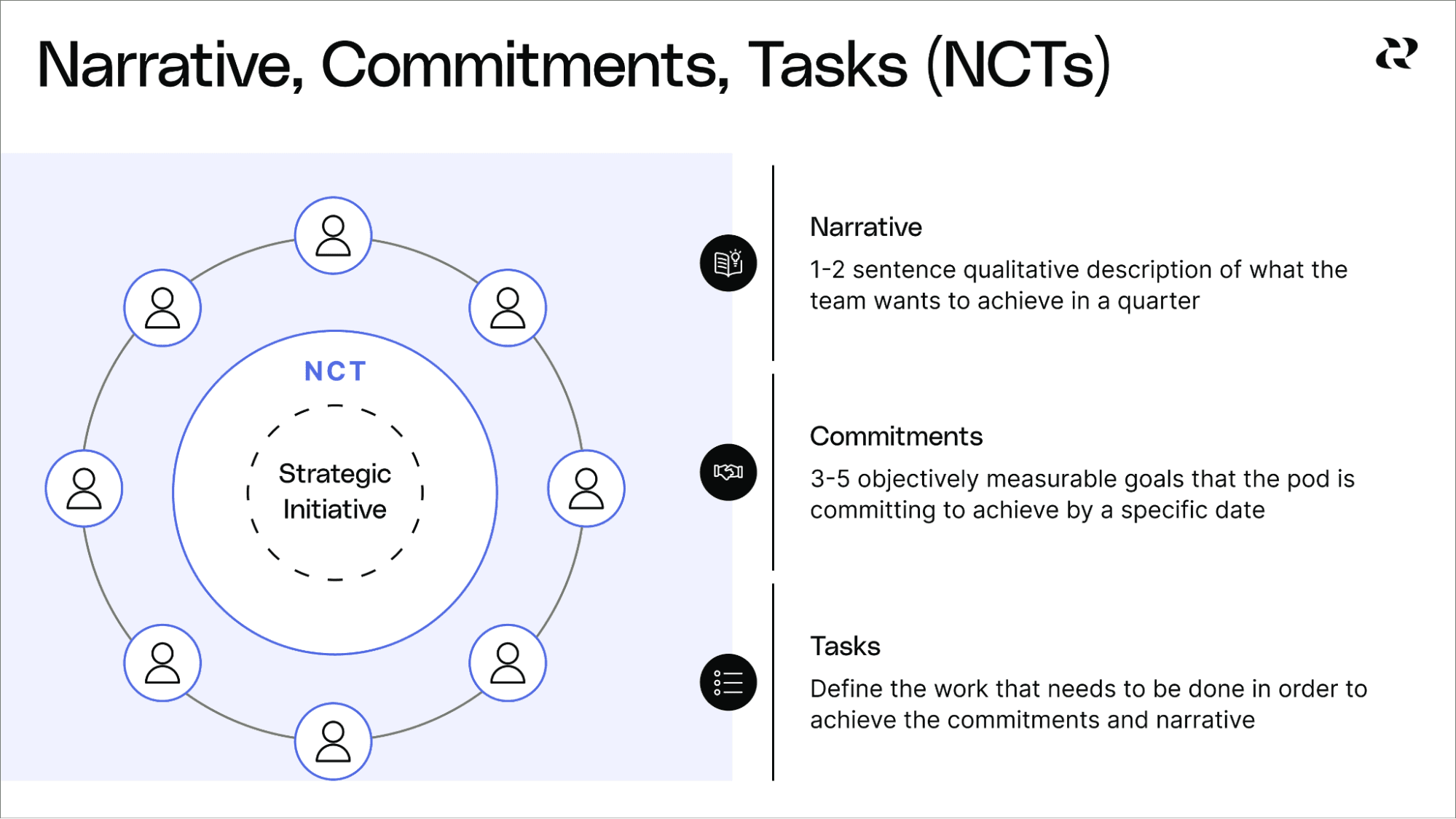
NCT stands for Narrative, Commitment, and Task. As a goal setting framework, NCTs identify key strategic initiatives for specific teams or pods through those three components.
Narrative
Let’s start by breaking down the Narrative part of NCTs. This is a 1-2 sentence qualitative description of what the product team or pod wants to achieve in a quarter. A narrative describes the outcome they want to achieve, and why it is important to the business.
Commitments
Then there are specific Commitments that need to be met. These tend to be 3-5 objectively-measurable goals that the team is committing to achieve by the end of the quarter. Commitments are evidence that the team has made progress on the narrative.
The best teams leverage two types of commitments:
Qualitative metrics. For example, “increase onboarding completion rate by 10%”
Deliverables: For example, “launch new onboarding flow by September 2019”
Tasks
Lastly, there are Tasks. Tasks identify the work that needs to be done to complete the commitments and achieve the narrative. Tasks are more fluid than commitments. They are mainly a recommendation or a plan for work, helping teams think through what work should be done to accomplish a commitment.
When To Use NCTs
NCTs are the best way to set product goals when you find the team seems to be consistently missing context.
Ravi Mehta created the NCT goal setting framework after observing that many product teams lacked a clear path forward when working on ambiguous projects. While OKRs are commonly used amongst product teams, small teams or teams working on brand new features or products need a more flexible framework than OKRs. If your team is developing a new product or exploring new market opportunities, NCTs may be the right fit.
Where OKRs don’t provide enough context, NCTs offer teams and leaders the opportunity to add important information that does not treat launches or product goals in isolation.
While OKRs don’t guide product builders on what they must work on over what they should do eventually, NCTs help teams prioritize which commitments are critical versus aspirational.
And when OKRs fail to define a path to delivery, NCTs guide teams with intermediary milestones that bring them closer to achieving their commitments.
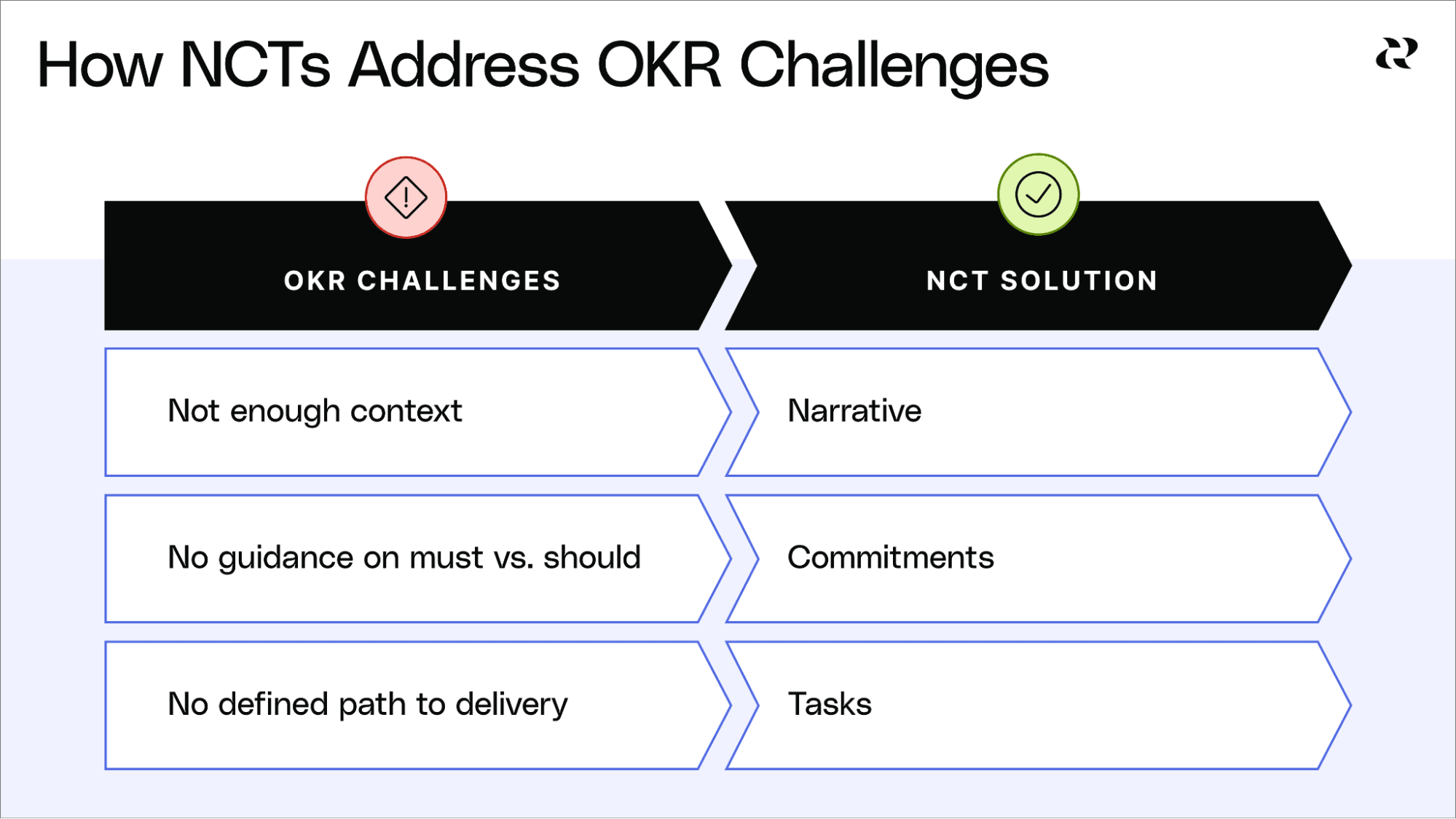
If you find that your team is struggling with context, prioritization, or clarity on a path forward, NCTs might be the best way to set your product goals.
Example Of NCTs In Practice
Let’s look at how NCTs play out in the real world example of Tripadvisor, the online booking platform for hotels, flights, car rentals, and more.
We’ll look at an initiative from a couple of years back. At the time, the company’s narrative was to increase the share of traffic coming directly to the product, rather than SEO and SEM. Recent learnings showed that travelers who save hotels and other places for a trip are more likely to return directly to the platform.
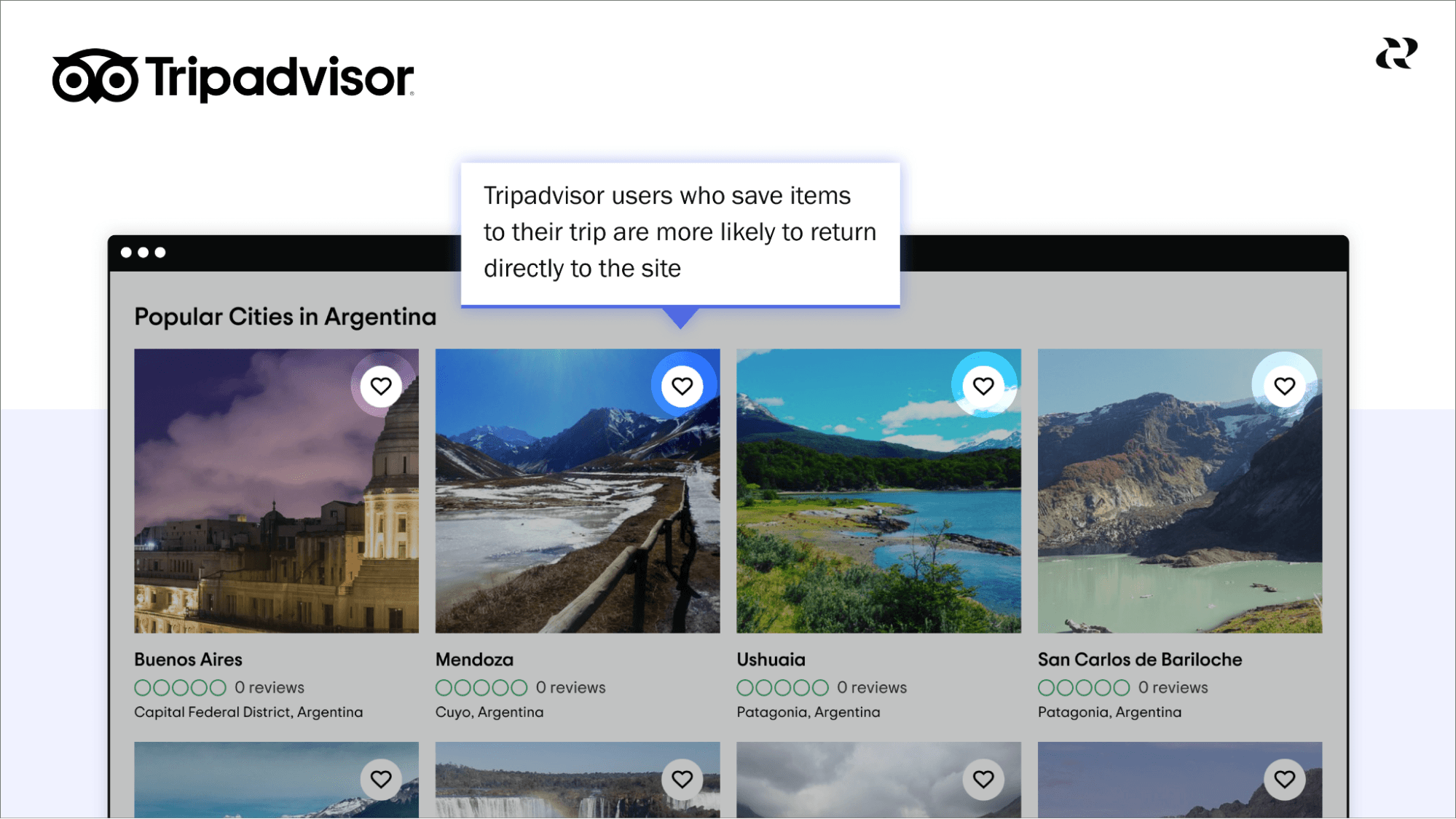
From this information, the product team planned to increase direct visits by increasing awareness and usage of the "Save to Trip*"* feature.
The team used both types of commitments, quantitative and deliverable. Their quantitative commitment was to increase the number of unique savers by 10% by the end of the year’s first quarter. Their deliverable commitment was to launch the enhanced "Save to Trip" feature and CTAs to 25% of traffic by mid-February of that year.
The team’s tasks broke down work that needed to be done to accomplish their commitments. This led to several tasks including:
Add a modal to announce the "Saves to Trip" feature to returning users.
Send an email announcing the new feature to users in the test group.
Add a prominent save CTA to the hotels list page and the hotel detail page.
Add a tooltip to the more prominent save CTAs for users who have not previously used the feature.
Send price update notifications for places in the person's saves list.
The product team worked through each of these tasks, which indicated when they were meeting their commitments, and eventually increased direct site visits through the “Save to Trip” feature.
*Want to learn more about using NCTs? **Check out our breakdown of NCTs *and learn how your brand can shift to this new goal setting framework.
Goal Setting Framework #3: Dream Mapping
Moving on now to another way to set strong product goals: Dream Maps. Perhaps the most unique goal setting framework we’re covering, this one is a highly visual way to see your goals and your journey toward them. It comes to us courtesy of Jonatan Littke, CEO of Squadformers.
What is a Dream Map?
A Dream Map helps teams choose a goal that they really care about achieving, find the fastest path to get there, and tell a story about the journey along the way.
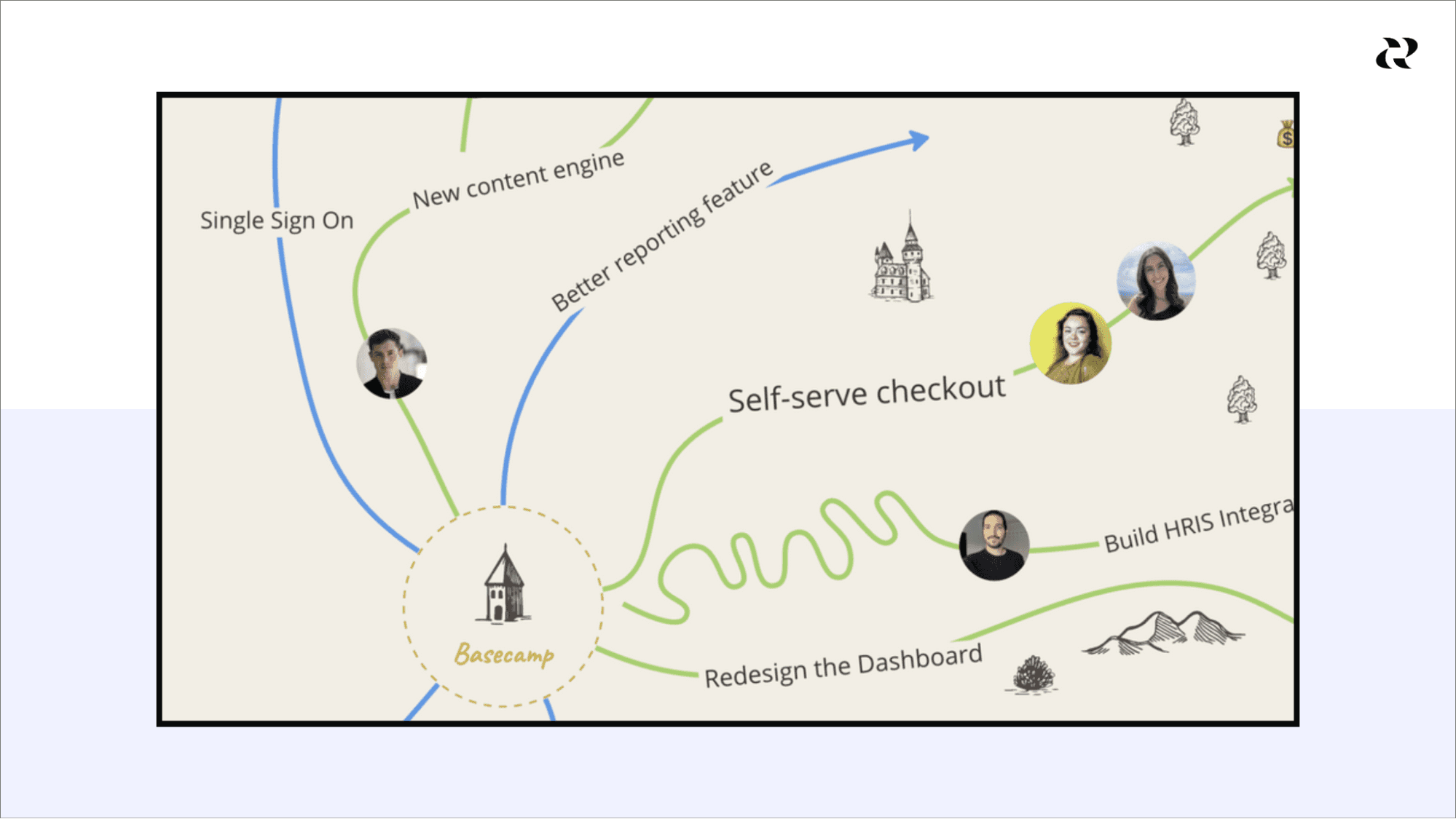
The team doesn’t necessarily need to know the best path forward – that’s the whole point. The map is flexible and can be changed as you learn new things along the way. As you can see in the goal setting framework example below, there are a few different paths to get to the main goal.
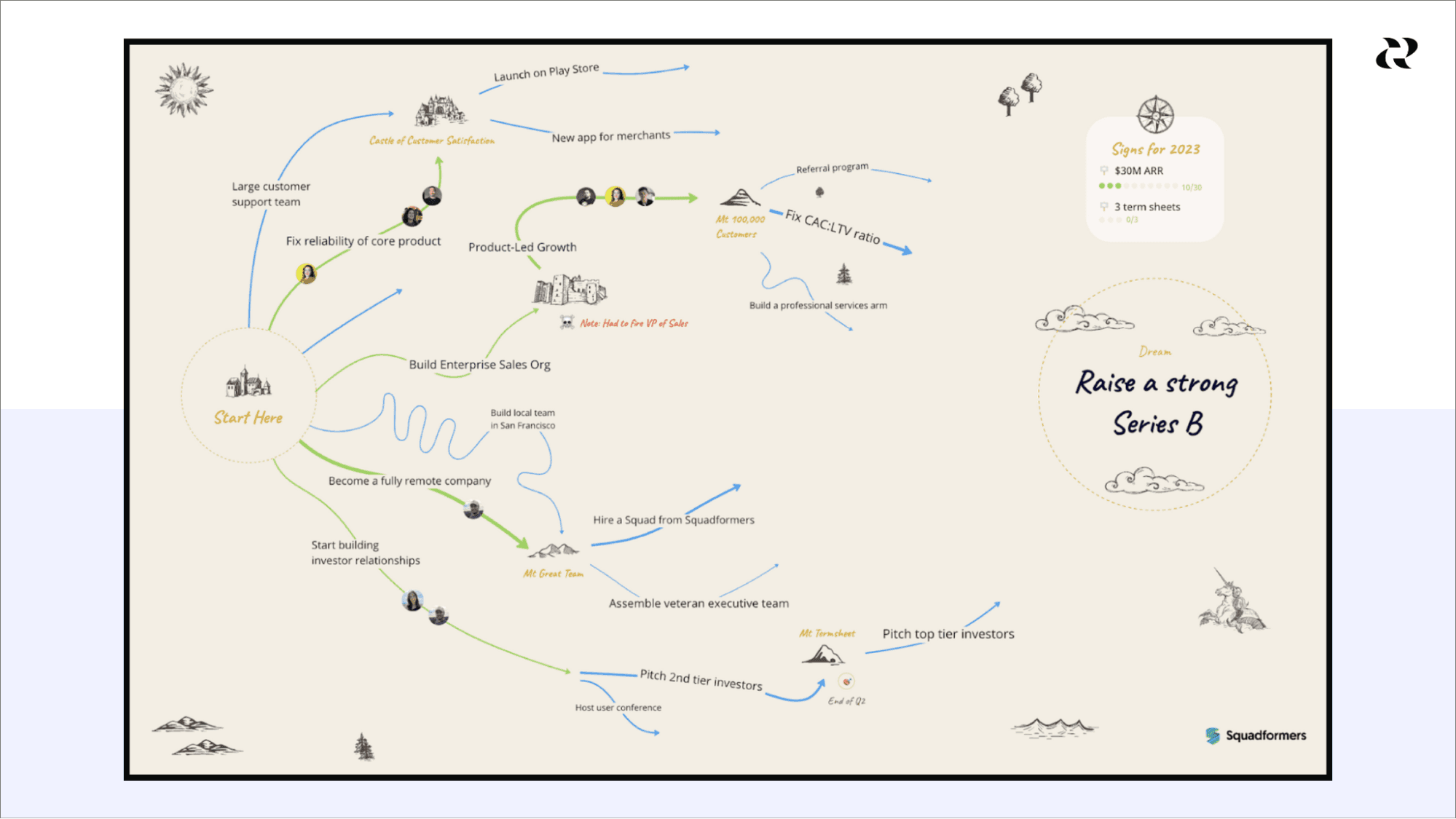
A Dream Map consists of several components: the Dream, Milestones, Signs, and Paths.
The Dream
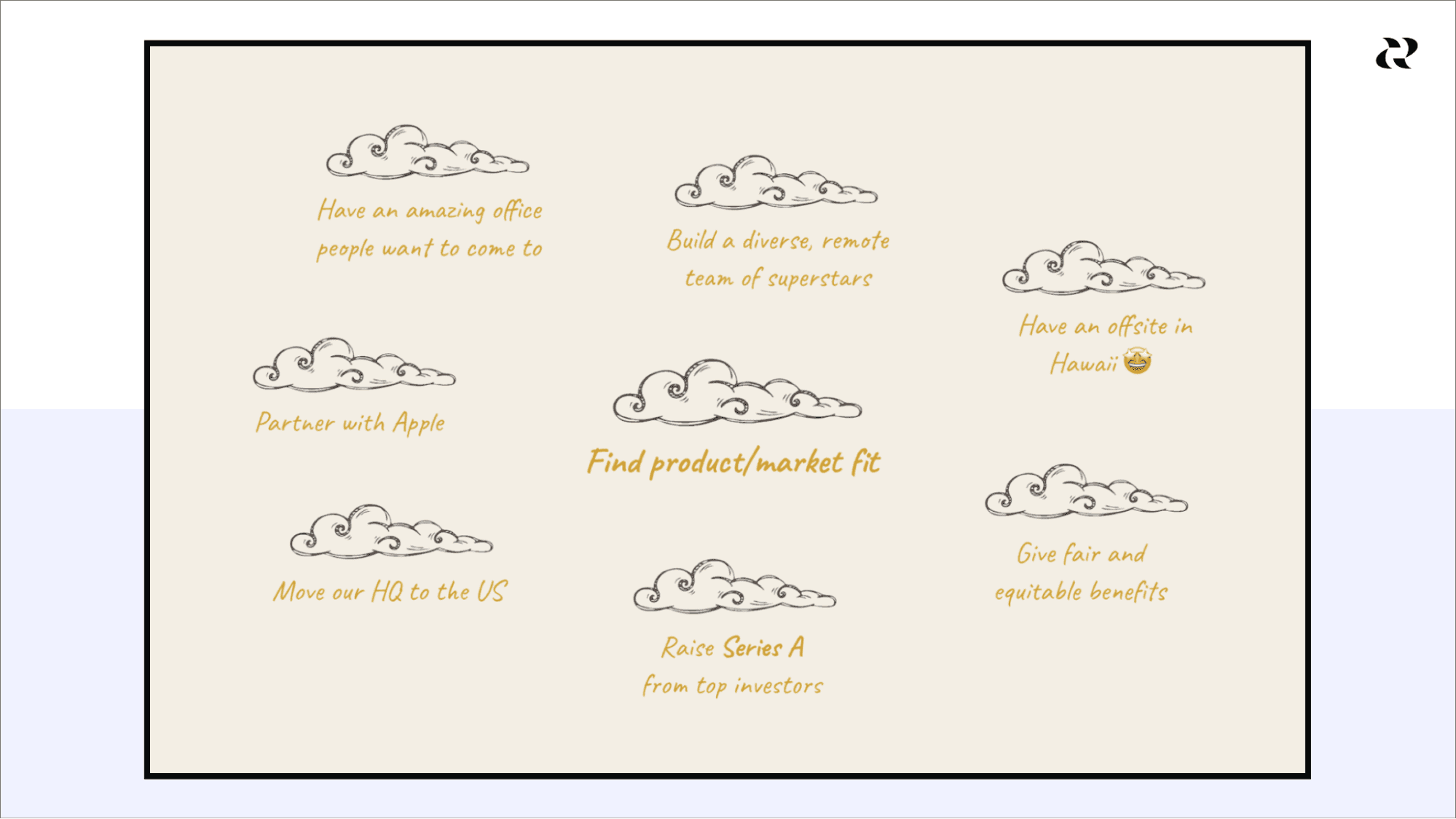
This is a big goal that everyone on the team truly dreams of achieving. As the name suggests, the Dream is something that inspires people to do their best work.
“Other goal setting approaches, like OKRs, are corporate and full of jargon. OKRs don’t really matter to people like dreams matter to them.”
*— *Jonatan Littke, CEO of Squadformers
Dreams might be something like achieving a strategic partnership, finding product-market fit, raising Series A from investors, or anything else that the team agrees is important to do.
Milestones
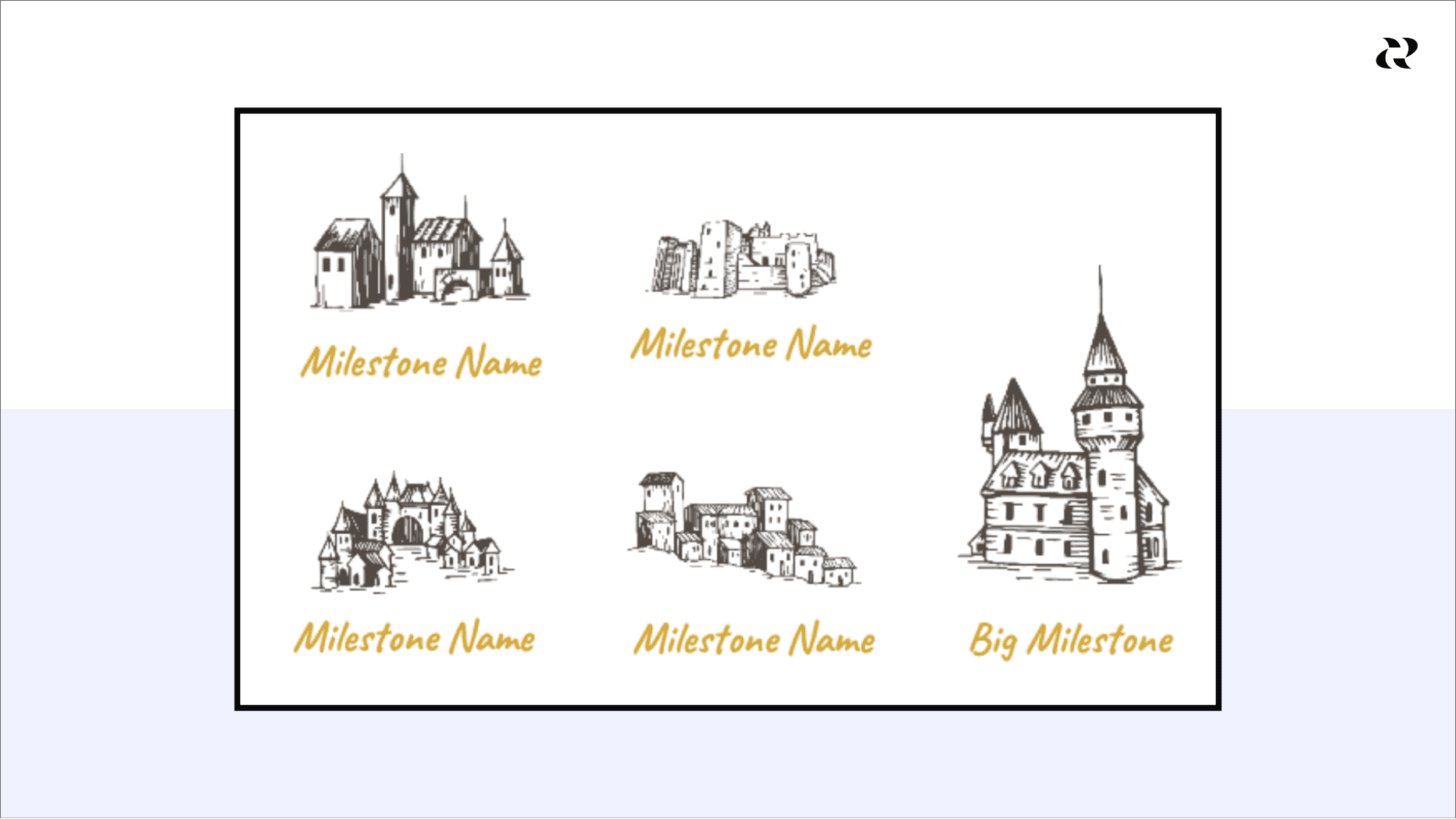
Then, there are Milestones. These are intermediary steps the team will accomplish on their way to accomplishing the dream goal. Most milestones will be significant outcomes.
Signs
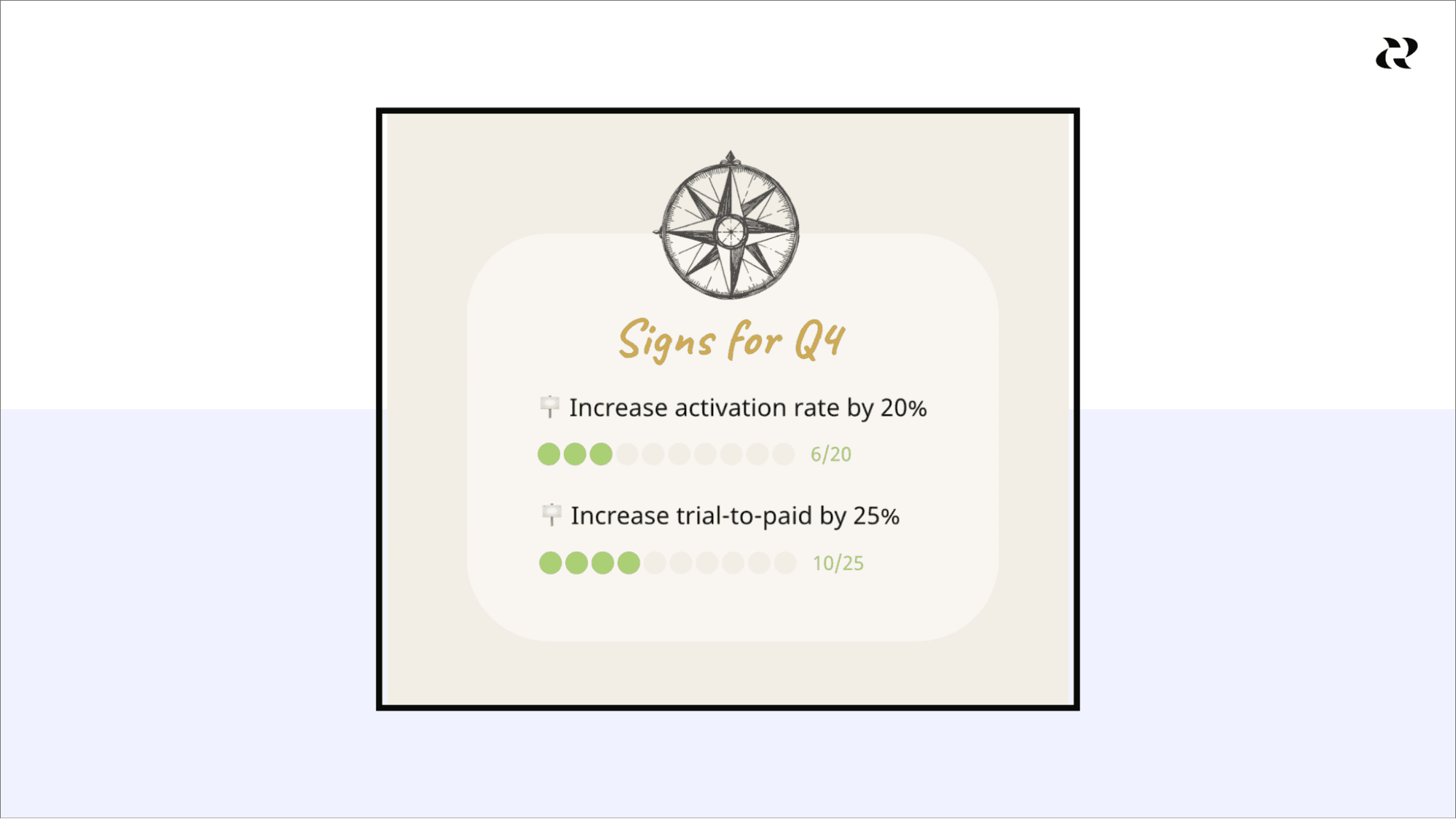
Each Dream will have a few key Signs. These indicate progress toward reaching the Dream. If the Dream is something like “Raise Series A” then it’s pretty clear when it’s been raised, but if the Dream is something like “Find Product Market Fit” then it’s less clear, and regularly updated Signs will be necessary to monitor progress.
Notably, Signs are outcome-based only. They don’t demonstrate how a team will reach a goal, but show how close a team is to reaching the product goal. Leaders and functional managers responsible for updating the Signs can note if current paths to the Dream are working well or need to be revised based on the Signs. If Signs aren’t changing, it might be time to explore new Paths.
Paths
That brings us to the final component of a Dream Map: Paths. These are lines plotted on the map that represent various initiatives, like experiments, features, or projects. Paths have different shapes depending on the level of uncertainty or level of effort that it requires for a team or individual to travel down.
Typically, a completed Dream Map will have multiple paths going from the current position, or starting point, to the Dream, or end goal. Some of these Paths will point directly toward the Dream, passing through Milestones, and other Paths will meander or fizzle out. All Paths demonstrate what the team or individual has tried to do in an effort to reach the Dream goal.
When to Use Dream Maps
Dream Maps are the best way to set product goals when you are trying to keep a remote team connected.
“*In a remote team, it’s easy to get lost. It’s like, ‘where are we and where are we going?’ and ‘where am I?’ Dream Maps help teams maintain a sense of momentum by answering these questions and giving everyone on the team clear paths forward that connect to their goals. And, you literally can’t get lost on a Dream Map. Your avatar is right there, on a certain Path.” — *Jonatan Littke, CEO of Squadformers
Dream Maps can help product teams work smarter, not harder. Signs and Paths will demonstrate when teams are not heading toward their goal – unmistakably, right on the screen.
Additionally, companies can create a Dream Map at the executive level and connect it to those at functional or individual levels. Jonatan says that “this is an advanced use of Dream Maps, where you link a team or individual’s Dream Map from a Path on a higher-level dream map.” The entire organization can look at where teams are going with their work and how it’s moving them toward the bigger-picture goal.
Example Of Dream Mapping In Practice
Chris Zacharias, founder and CEO of Imgix, uses Dream Maps at an executive level to pick the right goals for the company and work toward them. Imgix is a SaaS company that offers visual asset optimization and management solutions.
“The original Dream for Imgix was to be the processor of images – sort of similar to Kodak back in the 1980s, where all of human history was recorded on Kodak film.”
— Chris Zacharias, CEO of Imgix
Imgix is a remote-first company, so the Dream Map has helped their team stay united even though they’re distributed across the world. Chris pulls up the Dream Map during team syncs and they debate four or five paths toward the milestones that they’re pursuing.
“Using Dream Maps has helped us see where we’re going globally as a company. We have a high-level mission and high-level goals we’re trying to accomplish, and then we have boots-on-the-ground tasks that we’re doing. It’s been challenging for our team to connect these things. So Dream Maps help us draw a picture of how everyone is contributing along the way toward those high-level goals.”
— Chris Zacharias, CEO of Imgix
At the executive level, Chris has created a Dream Map with the goal to achieve the Rule of 40. In other words, he wants to ensure that the company’s growth rate plus profit margin is 40% or above. Because this is a high-level, complicated Dream to pursue, he’s broken it down into Milestones and tracks progress toward them. The Milestones are revenue targets for each part of the business, and team members from different teams are on Paths working toward those outcomes.
Chris plans to expand Dream Maps across the company in the future but has already noticed that his teammates enjoy the clear, visual nature of the approach.
Goal Setting Framework #4: MSPOTs
Now, let’s talk about another goal setting framework you can use to set product goals called MSPOTs. Unlike many of the frameworks we’ve looked at, this approach is geared more toward company executives.
What is an MSPOT?
The MSPOT is a framework that distills the company’s mission down to measurable targets that functional teams can work toward. It consists of five items that cascade down from broad to more narrow, each informing the next one below it:
Mission: This is the company’s big-picture vision, and it rarely changes.
Strategy: This explains how the company plans to achieve the mission.
Plays: These are four or five big annual initiatives that are part of the strategy.
Omissions: These are the projects that won’t be worked on according to the strategy.
Targets: These measurable and realistic means to hold everyone accountable.
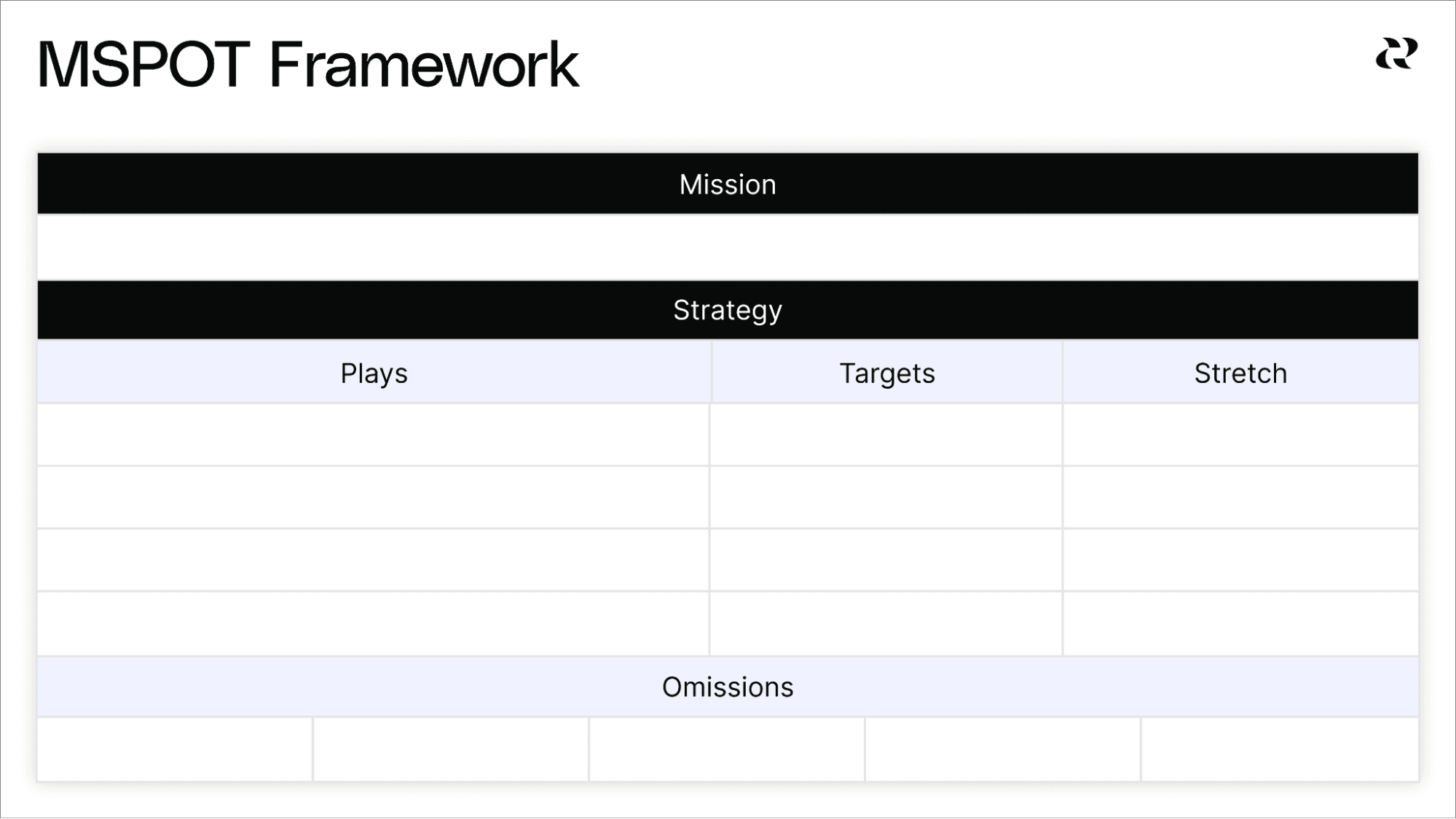
The MSPOT is less of a goal setting framework and more of a method to communicate goals. As Michael Pici, Reforge COO and former HubSpot VP of Product says, “You don’t really use it to decide your goals, you use it to communicate the goals that you’ve set.” It’s more useful as a communication tool than it is a goal setting or goal-tracking tool.
When To Use MSPOTs
MSPOTs are the best way to set product goals when you need to unite your team around a strategic vision but don’t want to be prescriptive.
MSPOTs are a goal setting framework that ladders down, from executives to individual contributors. Typically, leadership teams develop MSPOTs during planning sessions, then share them with functional managers in a top-down way.
From there, functional managers disseminate the information to their teams if leadership didn’t already do so. MSPOTs enable leadership to share high-level company goals with product managers and builders without being prescriptive about how those goals are accomplished.
Because strategy trickles down from the top with MSPOTs, most organizational layers will just receive their goals from this framework – they won’t write their own. Michael believes that MSPOTs are valuable for leaders who want to disseminate strategic goals without spending tons of time on how teams and individuals tactically progress toward those goals.
In fact, he recalls a time at HubSpot when MSPOTs were used at every organizational level – and it isn’t a fond recollection. He remembers that people spent more time documenting their goals and their progress than they did actually executing on them.
“What we’re trying to do is not waste time filling out papers. Leaders give teams a set of guardrails that they want people to follow spiritually, and then go do their best work.”
— Michael Pici, Interim Reforge COO
While most goal setting frameworks include a top-down vision, this one focuses heavily on it and gives functional managers autonomy on how to track team progress.
Example Of MSPOTs In Practice
Let’s take a look at how HubSpot invented and used the MSPOT. They started with the V2MOM, another goal setting framework that we will cover next. The company renamed the five components and reframed the approach to be more top-down. This gave functional domains, such as product, a lot of autonomy on how to execute the Plays and hit the Targets.
That said, HubSpot has roughly 140 product teams. While autonomy is good, the company understood there needed to be additional structure to help every product builder understand their product goals, roles, and responsibilities.
Company leaders then designed and implemented two frameworks to guide the day-to-day execution of the MSPOT.
First, they created the Product Compass. Michael says, “The company never had a feature-level product roadmap, but the Product Compass took its place.”
It was a collection of stories, roughly ten stories each issue, published annually. The stories represented the high-level product progress that teams were making toward the company Plays and Targets. Every story had a DRI on the product team who owned and updated the rest of the company on the initiative.
The second framework was the Product Mainsail. This was a guideline for team prioritization. Similar to the psychological framework of Maslow’s Hierarchy of Needs, individuals start at the bottom level and advance upwards through levels only when all conditions are satisfied in the one below. Within the Product Mainsail, there are seven levels – the first five are categorized as Guardrails and the last two are Goals.
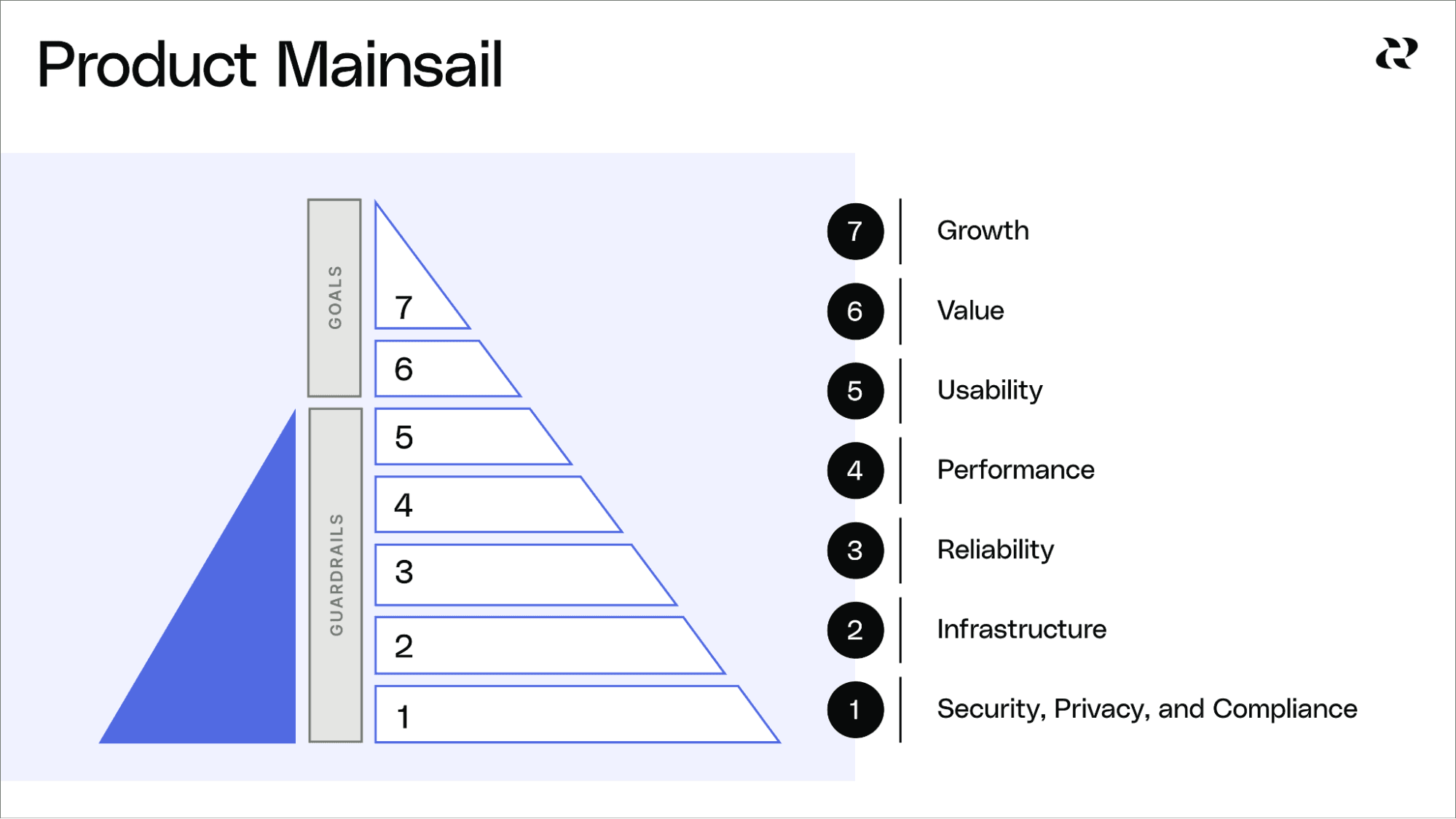
Guardrails are each tied to a metric that product teams can use to track their health. In order from top to bottom:
Security, Privacy, and Compliance: At this level, product teams can use security tickets, such as compliance or customer privacy, to determine if they should work here or move one level up.
Infrastructure: Here, product teams use infrastructure tickets, such as critical infrastructure updates or migrations, to know if they should work here or move up.
Reliability: At this point, product teams use support tickets, incident follow-ups, and service availability SLAs to determine if they work here or move a level higher.
Performance: Product teams use service latency SLAs, such as response time, or time until successful page load, to know if they should work here or move up.
Usability: Here, UX tickets, such as usability or interface issues related to customer research or support tickets indicate whether the product team stays on this area or moves up a level.
Goals relate to new features and the metrics vary by team. But examples of product goals might include:
Value: Signups, activation, usage data
Growth: Signup and retention data
Let’s walk through an example so that we can break down the Product Mainsail. In this example, a HubSpot product pod that encounters a security bug that puts customer data at risk needs to prioritize fixing that before they can take on any infrastructure-related work, or anything else. This is because that security bug falls into the Security, Privacy, and Compliance category, which is below the Infrastructure category and other categories.
It follows that Guardrails need to be healthy before a product team addresses Goals. This framework enabled product teams to operate efficiently on things that mattered most to the company without stopping to report on how the work relates to certain product goals or the company vision.
With the addition of Product Compass and Product Mainsail to Hubspot’s MSPOT framework, product teams could operate with autonomy and still be guided by the right principles. Instead of just focusing on rigorous goal setting and goal tracking.
Goal Setting Framework #5: V2MOMs
The last, but certainly not least, product goal setting framework we’re going to look at is V2MOMs. Similar to the MSPOT, this framework works well for product leaders to communicate strategy. But unlike the MSPOT, this goal setting approach cascades down throughout every level of the organization.
What is a V2MOM?
V2MOM stands for Vision, Values, Methods, Obstacles, and Measures.
Vision: This is a big-picture goal.
Values: These are things that are important to you.
Methods: These are actions needed to achieve the goal.
Obstacles: These are challenges you need to overcome to achieve the goal.
Measures: These are measurable results indicating progress toward the goal.
Notably, everyone in an organization will write a V2MOM for themselves. At the top, this means the leadership team produces a V2MOM for the company. Then, functional leaders take that V2MOM and create their own V2MOMs for their respective teams.
The product team, for example, would have its own V2MOM building off of that from the executive level. Then, every individual contributor on each team will craft a V2MOM based on the one their manager has shared with them. At each step of the way, a team member looks at their boss’ methods, picks out the ones they’ll own, and then writes their own V2MOM.
“This framework comes to life in a set of documents which clearly communicate the goals for every team and every employee across the organization. V2MOMs documents form a coherent whole, like the pieces of a puzzle, to communicate and align everyone on organizational priorities.”
— Tatyana Mamut, Former Product Leader at Amazon and Nextdoor
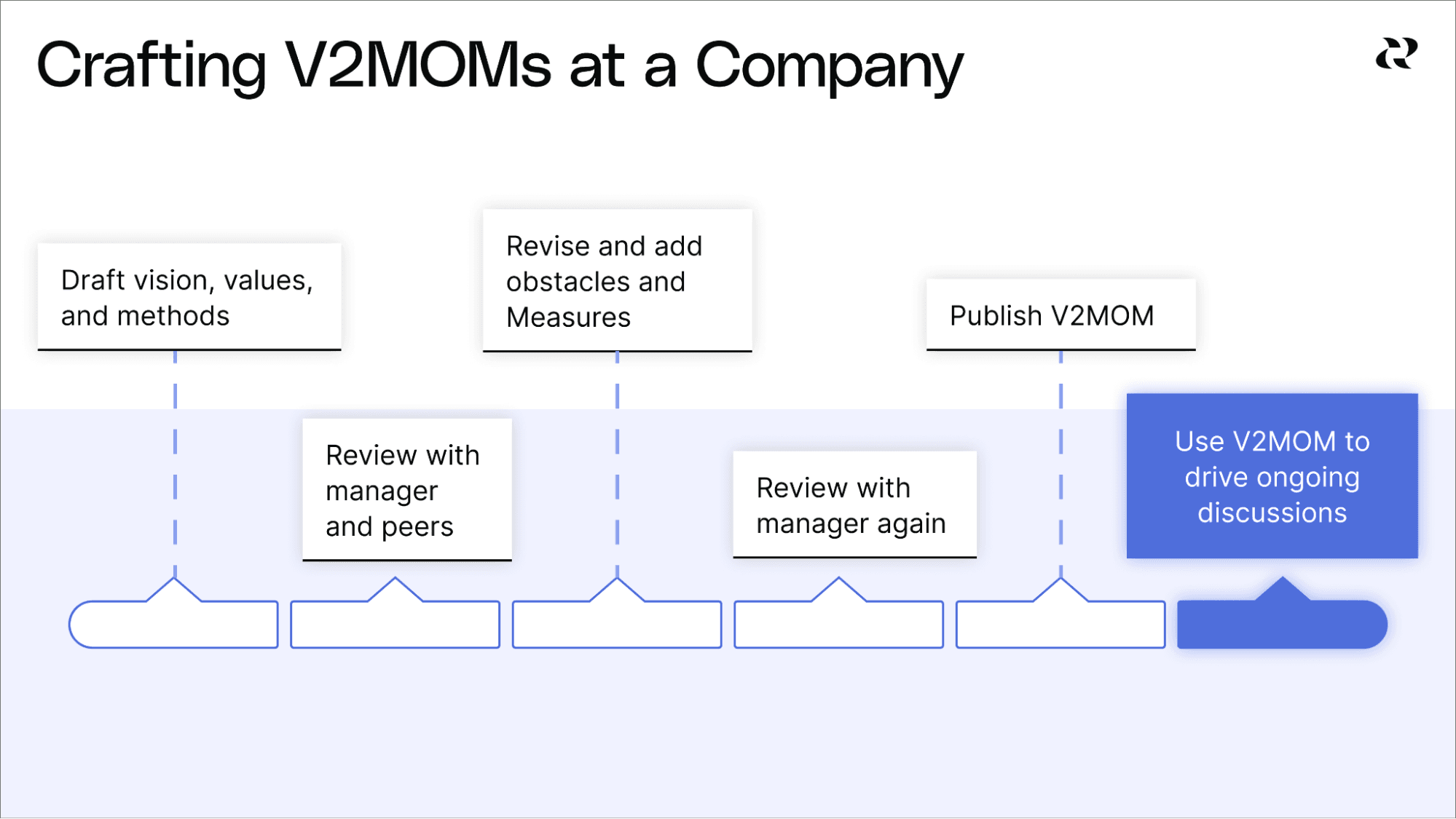
V2MOMs are open to change as teams move forward throughout the year. Methods are listed in priority order, so the ones at the bottom of the list can be sacrificed as needed so that the ones at the top of the list can be achieved. Then, at the end of the quarter, Methods and Measures are reviewed to make sure they’re still the right ones to accomplish the Vision.
When To Use V2MOMs
V2MOMs are the best way to set product goals when you need really strong top-down alignment.
Put simply, this is a top-down approach to goals, but it requires the entire organization to be bought in. When there are discrepancies between what product leader or cross-functional leader wants to prioritize, V2MOMs can help sort it out.
For example, if cross-functional leaders recognize that design resources are spread too thin across their multiple teams, then the design, product, and engineering teams can write V2MOMs together to balance resourcing. The framework encourages this alignment in a couple of ways.
First, in this example, it ensures that the design team’s Methods are listed in the same order as the company’s product priorities. Then, it encourages the engineering and product teams to consider the design team’s priorities when listing their own Methods – so that design capacity won’t be an issue for delivering product work.
“I’ve seen collaboration between functions break down and people start saying things like ‘we are blocked by design’ while design is working off their list of stated priorities, which they thought top leadership had agreed to. Aligning with a V2MOM and Methods listed in priority order for each team and function can really help alleviate these organizational frictions and frustrations.”
— Tatyana Mamut, Former Product Leader at Amazon and Nextdoor
Example Of V2MOMs In Practice
Tatyana recently advised a startup that used V2MOMs to align around a shared vision and strategies for the company. After raising a series A, the team wanted to expand – and they did so quickly. Several high-caliber C-suite executives were hired, including a new CRO, a new CMO, and several new VPs.
As all of these new leaders were onboarded, it became clear that everyone was bringing their own perspectives on what was important. So the CEO ran a 2-day V2MOM offsite with the senior leadership team. During an intense first day of the offsite, leaders aligned around a shared vision and values, and prioritized all the activities the company had to execute on in the next 18 months. On the second day of the offsite, each leader wrote their own V2MOM.
After the offsite, each functional leader returned to their respective team and shared their V2MOM. Team members then wrote their individual V2MOMs based on those from their managers. In this way, the V2MOM drove alignment for strategic product goals quickly, even though much of the company’s leadership team was new.
If we were to create a hypothetical V2MOM for a bigger company, the process would look the same. Similar to the startup Tatyana advised, the company would create an executive-level V2MOM, then each organizational level would do the same, with team members choosing the Methods that they’ll own and building out their goals from there.
We’ll create a hypothetical company-level V2MOM for language edtech company Duolingo
Vision: To create a world where everyone has access to high-quality, affordable language education.
Values: Quality education, inclusivity, affordability, access, and innovation.
Methods: Leveraging technology to make language learning more fun and engaging, expanding course offerings, and partnering with schools and universities to create pathways for students to access language learning opportunities.
Obstacles: Developing language courses that are both engaging and effective while keeping costs low, as well as creating pathways for students to gain access to educational opportunities.
Measures: Increase in language course enrollment, ratings and reviews of courses, student retention and completion rates, and partnerships with schools and universities
We can imagine that this V2MOM came from executives at Duolingo and was passed down to functional leaders, who then created versions of their own as it pertained to their respective teams. Then, those versions were passed to individual contributors, who created their own V2MOM based on that of their manager.
Picking The Right Framework
There’s a lot to consider when you’re selecting a goal setting framework. As a quick reminder, let's take a look at when each of the five product goal setting frameworks should generally be used:
OKRs - When you are trying to push a large, established team to stretch themselves
NCTs - When you find the team seems to be consistently missing context
**Dream Maps **- When you are trying to keep a remote team connected
MSPOTs - When you need to unite your team around a strategic vision but don’t want to be prescriptive
V2MOMs - When you need re


The strongest product teams are united and working toward something they all agree on — but how do you inspire that type of unity? It’s all about the product goals that you and your team are pursuing.
Strong product goals guide product work because they enable your team to understand how far they’ve gone and in which direction. You can use these goals as a method to give feedback and adjust the team’s direction if it veers off course.
But it’s challenging to know where to start with goal setting strategies, especially in the product space. A few simple searches online show you just how many ways you can set product goals and monitor progress – and they all look to be wonderful. But how do you decide which to use? In this post, we’re going to walk through some of our favorite goal setting frameworks.
We know that every team and company is different. That’s why these five frameworks for setting better product goals come directly from our experts like Sachin Rekhi, Ravi Mehta, Tatyana Mamut, Jonatan Littke and Michael Pici and their experiences at companies such as Hubspot, LinkedIn, and Tripadvisor
But depending on the scope, resources, and even leadership style, the right framework for setting product goals will vary. Maybe you want an approach that’s better for small, remote teams. Or maybe you need to streamline differing goals from various teams, which requires a framework to communicate a top-down strategy.
Each of these five frameworks excels at different things, which is why we took the time to cover all of them.
Click on any below to learn more or scroll along to understand each goal setting framework.
OKRs****: Ideal for when you’re trying to push a large, established team to stretch themselves
NCTs****: For when you find the team seems to be consistently missing context
Dream Maps****: When you are trying to keep a remote team connected
MSPOTs: When you need to unite your team around a strategic vision but don’t want to be prescriptive
V2MOMs****: When you need really strong top-down alignment
Meet The Contributors
Goal Setting Framework #1: OKRs
We’ll start with OKRs. You’ve probably heard of this goal setting framework and may have even used them before. However, using something because it was assigned to you at a previous company is not the same as choosing to use a framework because it fits your needs. Let’s break down what is an OKR, who should use OKRs, and some OKR examples.
What Is An OKR?
Simply put, there are two parts of OKRs: the Objective and the Key Results:
The objective: what you hope to accomplish with a given set of initiatives
Key results: numerically-based expressions of success or progress towards an objective
When To Use OKRs?
OKRs are the best way to set product goals when you’re trying to push a large, established team to stretch itself to reach new heights.
That’s because OKRs do four things really well:
They create focused effort. By focusing on the top objectives and associated key results, product teams have to make hard prioritization trade-offs upfront. This also helps teams align on business and product outcomes, rather than outputs. Additionally, focus effort helps to prioritize the most needle-moving work.
They drive team empowerment. OKRs can help you scale beyond your own efforts by aligning the entire product team on top priorities. This alignment empowers the team to make tradeoffs with less top-down involvement. That way, when cross-functional peers approach the team with product requests, your teammates will be able to make decisions quickly and with more confidence.
They create product intuition. By adopting an outcome-oriented approach to OKRs and implementing a regular review process, a team's learning loop can be improved and accelerated.
**They create leadership buy-in. **If product managers in the organization are all using OKRs, it’s easier to socialize your team’s objectives and key results with executives. When leadership is familiar with the product team’s OKRs, product pods, and product managers can get support from key decision-makers in the company.
“OKRs are one of the best goal setting frameworks I've found for driving focus, alignment, accountability, and an outcome orientation.”
— Sachin Rekhi, Founder & CEO of Notejoy
Example Of OKRs In Practice
In 2014, LinkedIn wanted to expand product market fit by launching a product aimed at sales professionals. At the time, the professional networking company’s biggest user demographic were sales professionals, so they wanted to leverage this audience to expand into the new product.
LinkedIn started with an objective in mind: to launch the Sales Navigator product and define “social selling.” While many of the features that Sales Navigator offered already existed in the core networking product, building out a standalone product transformed the sales world. It enabled social selling, which is the process of people finding, engaging with, and building trust with others on a social network.
To reach this objective, the product team’s key results focused first on an output-oriented metric to launch the product by July 31 of that year. Their outcome-oriented key results included increasing weekly active users, increasing the sales team’s conversion rate, and achieving a high NPS with the product.
LinkedIn launched the Sales Navigator product in July 2014 and saw company revenue increase by 45% that year, compared to the year before. It helped that their product team used OKRs to stay focused and push toward their goal.
For a detailed walkthrough on how to use OKRs to set product goals, check out the Mastering Product Management program.
Goal Setting Framework #2: NCTs
Although OKRs have become the most widely used framework in tech for goal setting, product teams working on ambiguous initiatives find that OKRs don’t provide enough context or guidance to accomplish end goals. NCTs, on the other hand, guide product teams from a place of uncertainty toward real results. Let’s take a look at NCTs now.
What is an NCT?
NCT stands for Narrative, Commitment, and Task. As a goal setting framework, NCTs identify key strategic initiatives for specific teams or pods through those three components.
Narrative
Let’s start by breaking down the Narrative part of NCTs. This is a 1-2 sentence qualitative description of what the product team or pod wants to achieve in a quarter. A narrative describes the outcome they want to achieve, and why it is important to the business.
Commitments
Then there are specific Commitments that need to be met. These tend to be 3-5 objectively-measurable goals that the team is committing to achieve by the end of the quarter. Commitments are evidence that the team has made progress on the narrative.
The best teams leverage two types of commitments:
Qualitative metrics. For example, “increase onboarding completion rate by 10%”
Deliverables: For example, “launch new onboarding flow by September 2019”
Tasks
Lastly, there are Tasks. Tasks identify the work that needs to be done to complete the commitments and achieve the narrative. Tasks are more fluid than commitments. They are mainly a recommendation or a plan for work, helping teams think through what work should be done to accomplish a commitment.
When To Use NCTs
NCTs are the best way to set product goals when you find the team seems to be consistently missing context.
Ravi Mehta created the NCT goal setting framework after observing that many product teams lacked a clear path forward when working on ambiguous projects. While OKRs are commonly used amongst product teams, small teams or teams working on brand new features or products need a more flexible framework than OKRs. If your team is developing a new product or exploring new market opportunities, NCTs may be the right fit.
Where OKRs don’t provide enough context, NCTs offer teams and leaders the opportunity to add important information that does not treat launches or product goals in isolation.
While OKRs don’t guide product builders on what they must work on over what they should do eventually, NCTs help teams prioritize which commitments are critical versus aspirational.
And when OKRs fail to define a path to delivery, NCTs guide teams with intermediary milestones that bring them closer to achieving their commitments.
If you find that your team is struggling with context, prioritization, or clarity on a path forward, NCTs might be the best way to set your product goals.
Example Of NCTs In Practice
Let’s look at how NCTs play out in the real world example of Tripadvisor, the online booking platform for hotels, flights, car rentals, and more.
We’ll look at an initiative from a couple of years back. At the time, the company’s narrative was to increase the share of traffic coming directly to the product, rather than SEO and SEM. Recent learnings showed that travelers who save hotels and other places for a trip are more likely to return directly to the platform.
From this information, the product team planned to increase direct visits by increasing awareness and usage of the "Save to Trip*"* feature.
The team used both types of commitments, quantitative and deliverable. Their quantitative commitment was to increase the number of unique savers by 10% by the end of the year’s first quarter. Their deliverable commitment was to launch the enhanced "Save to Trip" feature and CTAs to 25% of traffic by mid-February of that year.
The team’s tasks broke down work that needed to be done to accomplish their commitments. This led to several tasks including:
Add a modal to announce the "Saves to Trip" feature to returning users.
Send an email announcing the new feature to users in the test group.
Add a prominent save CTA to the hotels list page and the hotel detail page.
Add a tooltip to the more prominent save CTAs for users who have not previously used the feature.
Send price update notifications for places in the person's saves list.
The product team worked through each of these tasks, which indicated when they were meeting their commitments, and eventually increased direct site visits through the “Save to Trip” feature.
*Want to learn more about using NCTs? **Check out our breakdown of NCTs *and learn how your brand can shift to this new goal setting framework.
Goal Setting Framework #3: Dream Mapping
Moving on now to another way to set strong product goals: Dream Maps. Perhaps the most unique goal setting framework we’re covering, this one is a highly visual way to see your goals and your journey toward them. It comes to us courtesy of Jonatan Littke, CEO of Squadformers.
What is a Dream Map?
A Dream Map helps teams choose a goal that they really care about achieving, find the fastest path to get there, and tell a story about the journey along the way.
The team doesn’t necessarily need to know the best path forward – that’s the whole point. The map is flexible and can be changed as you learn new things along the way. As you can see in the goal setting framework example below, there are a few different paths to get to the main goal.
A Dream Map consists of several components: the Dream, Milestones, Signs, and Paths.
The Dream
This is a big goal that everyone on the team truly dreams of achieving. As the name suggests, the Dream is something that inspires people to do their best work.
“Other goal setting approaches, like OKRs, are corporate and full of jargon. OKRs don’t really matter to people like dreams matter to them.”
*— *Jonatan Littke, CEO of Squadformers
Dreams might be something like achieving a strategic partnership, finding product-market fit, raising Series A from investors, or anything else that the team agrees is important to do.
Milestones
Then, there are Milestones. These are intermediary steps the team will accomplish on their way to accomplishing the dream goal. Most milestones will be significant outcomes.
Signs
Each Dream will have a few key Signs. These indicate progress toward reaching the Dream. If the Dream is something like “Raise Series A” then it’s pretty clear when it’s been raised, but if the Dream is something like “Find Product Market Fit” then it’s less clear, and regularly updated Signs will be necessary to monitor progress.
Notably, Signs are outcome-based only. They don’t demonstrate how a team will reach a goal, but show how close a team is to reaching the product goal. Leaders and functional managers responsible for updating the Signs can note if current paths to the Dream are working well or need to be revised based on the Signs. If Signs aren’t changing, it might be time to explore new Paths.
Paths
That brings us to the final component of a Dream Map: Paths. These are lines plotted on the map that represent various initiatives, like experiments, features, or projects. Paths have different shapes depending on the level of uncertainty or level of effort that it requires for a team or individual to travel down.
Typically, a completed Dream Map will have multiple paths going from the current position, or starting point, to the Dream, or end goal. Some of these Paths will point directly toward the Dream, passing through Milestones, and other Paths will meander or fizzle out. All Paths demonstrate what the team or individual has tried to do in an effort to reach the Dream goal.
When to Use Dream Maps
Dream Maps are the best way to set product goals when you are trying to keep a remote team connected.
“*In a remote team, it’s easy to get lost. It’s like, ‘where are we and where are we going?’ and ‘where am I?’ Dream Maps help teams maintain a sense of momentum by answering these questions and giving everyone on the team clear paths forward that connect to their goals. And, you literally can’t get lost on a Dream Map. Your avatar is right there, on a certain Path.” — *Jonatan Littke, CEO of Squadformers
Dream Maps can help product teams work smarter, not harder. Signs and Paths will demonstrate when teams are not heading toward their goal – unmistakably, right on the screen.
Additionally, companies can create a Dream Map at the executive level and connect it to those at functional or individual levels. Jonatan says that “this is an advanced use of Dream Maps, where you link a team or individual’s Dream Map from a Path on a higher-level dream map.” The entire organization can look at where teams are going with their work and how it’s moving them toward the bigger-picture goal.
Example Of Dream Mapping In Practice
Chris Zacharias, founder and CEO of Imgix, uses Dream Maps at an executive level to pick the right goals for the company and work toward them. Imgix is a SaaS company that offers visual asset optimization and management solutions.
“The original Dream for Imgix was to be the processor of images – sort of similar to Kodak back in the 1980s, where all of human history was recorded on Kodak film.”
— Chris Zacharias, CEO of Imgix
Imgix is a remote-first company, so the Dream Map has helped their team stay united even though they’re distributed across the world. Chris pulls up the Dream Map during team syncs and they debate four or five paths toward the milestones that they’re pursuing.
“Using Dream Maps has helped us see where we’re going globally as a company. We have a high-level mission and high-level goals we’re trying to accomplish, and then we have boots-on-the-ground tasks that we’re doing. It’s been challenging for our team to connect these things. So Dream Maps help us draw a picture of how everyone is contributing along the way toward those high-level goals.”
— Chris Zacharias, CEO of Imgix
At the executive level, Chris has created a Dream Map with the goal to achieve the Rule of 40. In other words, he wants to ensure that the company’s growth rate plus profit margin is 40% or above. Because this is a high-level, complicated Dream to pursue, he’s broken it down into Milestones and tracks progress toward them. The Milestones are revenue targets for each part of the business, and team members from different teams are on Paths working toward those outcomes.
Chris plans to expand Dream Maps across the company in the future but has already noticed that his teammates enjoy the clear, visual nature of the approach.
Goal Setting Framework #4: MSPOTs
Now, let’s talk about another goal setting framework you can use to set product goals called MSPOTs. Unlike many of the frameworks we’ve looked at, this approach is geared more toward company executives.
What is an MSPOT?
The MSPOT is a framework that distills the company’s mission down to measurable targets that functional teams can work toward. It consists of five items that cascade down from broad to more narrow, each informing the next one below it:
Mission: This is the company’s big-picture vision, and it rarely changes.
Strategy: This explains how the company plans to achieve the mission.
Plays: These are four or five big annual initiatives that are part of the strategy.
Omissions: These are the projects that won’t be worked on according to the strategy.
Targets: These measurable and realistic means to hold everyone accountable.
The MSPOT is less of a goal setting framework and more of a method to communicate goals. As Michael Pici, Reforge COO and former HubSpot VP of Product says, “You don’t really use it to decide your goals, you use it to communicate the goals that you’ve set.” It’s more useful as a communication tool than it is a goal setting or goal-tracking tool.
When To Use MSPOTs
MSPOTs are the best way to set product goals when you need to unite your team around a strategic vision but don’t want to be prescriptive.
MSPOTs are a goal setting framework that ladders down, from executives to individual contributors. Typically, leadership teams develop MSPOTs during planning sessions, then share them with functional managers in a top-down way.
From there, functional managers disseminate the information to their teams if leadership didn’t already do so. MSPOTs enable leadership to share high-level company goals with product managers and builders without being prescriptive about how those goals are accomplished.
Because strategy trickles down from the top with MSPOTs, most organizational layers will just receive their goals from this framework – they won’t write their own. Michael believes that MSPOTs are valuable for leaders who want to disseminate strategic goals without spending tons of time on how teams and individuals tactically progress toward those goals.
In fact, he recalls a time at HubSpot when MSPOTs were used at every organizational level – and it isn’t a fond recollection. He remembers that people spent more time documenting their goals and their progress than they did actually executing on them.
“What we’re trying to do is not waste time filling out papers. Leaders give teams a set of guardrails that they want people to follow spiritually, and then go do their best work.”
— Michael Pici, Interim Reforge COO
While most goal setting frameworks include a top-down vision, this one focuses heavily on it and gives functional managers autonomy on how to track team progress.
Example Of MSPOTs In Practice
Let’s take a look at how HubSpot invented and used the MSPOT. They started with the V2MOM, another goal setting framework that we will cover next. The company renamed the five components and reframed the approach to be more top-down. This gave functional domains, such as product, a lot of autonomy on how to execute the Plays and hit the Targets.
That said, HubSpot has roughly 140 product teams. While autonomy is good, the company understood there needed to be additional structure to help every product builder understand their product goals, roles, and responsibilities.
Company leaders then designed and implemented two frameworks to guide the day-to-day execution of the MSPOT.
First, they created the Product Compass. Michael says, “The company never had a feature-level product roadmap, but the Product Compass took its place.”
It was a collection of stories, roughly ten stories each issue, published annually. The stories represented the high-level product progress that teams were making toward the company Plays and Targets. Every story had a DRI on the product team who owned and updated the rest of the company on the initiative.
The second framework was the Product Mainsail. This was a guideline for team prioritization. Similar to the psychological framework of Maslow’s Hierarchy of Needs, individuals start at the bottom level and advance upwards through levels only when all conditions are satisfied in the one below. Within the Product Mainsail, there are seven levels – the first five are categorized as Guardrails and the last two are Goals.
Guardrails are each tied to a metric that product teams can use to track their health. In order from top to bottom:
Security, Privacy, and Compliance: At this level, product teams can use security tickets, such as compliance or customer privacy, to determine if they should work here or move one level up.
Infrastructure: Here, product teams use infrastructure tickets, such as critical infrastructure updates or migrations, to know if they should work here or move up.
Reliability: At this point, product teams use support tickets, incident follow-ups, and service availability SLAs to determine if they work here or move a level higher.
Performance: Product teams use service latency SLAs, such as response time, or time until successful page load, to know if they should work here or move up.
Usability: Here, UX tickets, such as usability or interface issues related to customer research or support tickets indicate whether the product team stays on this area or moves up a level.
Goals relate to new features and the metrics vary by team. But examples of product goals might include:
Value: Signups, activation, usage data
Growth: Signup and retention data
Let’s walk through an example so that we can break down the Product Mainsail. In this example, a HubSpot product pod that encounters a security bug that puts customer data at risk needs to prioritize fixing that before they can take on any infrastructure-related work, or anything else. This is because that security bug falls into the Security, Privacy, and Compliance category, which is below the Infrastructure category and other categories.
It follows that Guardrails need to be healthy before a product team addresses Goals. This framework enabled product teams to operate efficiently on things that mattered most to the company without stopping to report on how the work relates to certain product goals or the company vision.
With the addition of Product Compass and Product Mainsail to Hubspot’s MSPOT framework, product teams could operate with autonomy and still be guided by the right principles. Instead of just focusing on rigorous goal setting and goal tracking.
Goal Setting Framework #5: V2MOMs
The last, but certainly not least, product goal setting framework we’re going to look at is V2MOMs. Similar to the MSPOT, this framework works well for product leaders to communicate strategy. But unlike the MSPOT, this goal setting approach cascades down throughout every level of the organization.
What is a V2MOM?
V2MOM stands for Vision, Values, Methods, Obstacles, and Measures.
Vision: This is a big-picture goal.
Values: These are things that are important to you.
Methods: These are actions needed to achieve the goal.
Obstacles: These are challenges you need to overcome to achieve the goal.
Measures: These are measurable results indicating progress toward the goal.
Notably, everyone in an organization will write a V2MOM for themselves. At the top, this means the leadership team produces a V2MOM for the company. Then, functional leaders take that V2MOM and create their own V2MOMs for their respective teams.
The product team, for example, would have its own V2MOM building off of that from the executive level. Then, every individual contributor on each team will craft a V2MOM based on the one their manager has shared with them. At each step of the way, a team member looks at their boss’ methods, picks out the ones they’ll own, and then writes their own V2MOM.
“This framework comes to life in a set of documents which clearly communicate the goals for every team and every employee across the organization. V2MOMs documents form a coherent whole, like the pieces of a puzzle, to communicate and align everyone on organizational priorities.”
— Tatyana Mamut, Former Product Leader at Amazon and Nextdoor
V2MOMs are open to change as teams move forward throughout the year. Methods are listed in priority order, so the ones at the bottom of the list can be sacrificed as needed so that the ones at the top of the list can be achieved. Then, at the end of the quarter, Methods and Measures are reviewed to make sure they’re still the right ones to accomplish the Vision.
When To Use V2MOMs
V2MOMs are the best way to set product goals when you need really strong top-down alignment.
Put simply, this is a top-down approach to goals, but it requires the entire organization to be bought in. When there are discrepancies between what product leader or cross-functional leader wants to prioritize, V2MOMs can help sort it out.
For example, if cross-functional leaders recognize that design resources are spread too thin across their multiple teams, then the design, product, and engineering teams can write V2MOMs together to balance resourcing. The framework encourages this alignment in a couple of ways.
First, in this example, it ensures that the design team’s Methods are listed in the same order as the company’s product priorities. Then, it encourages the engineering and product teams to consider the design team’s priorities when listing their own Methods – so that design capacity won’t be an issue for delivering product work.
“I’ve seen collaboration between functions break down and people start saying things like ‘we are blocked by design’ while design is working off their list of stated priorities, which they thought top leadership had agreed to. Aligning with a V2MOM and Methods listed in priority order for each team and function can really help alleviate these organizational frictions and frustrations.”
— Tatyana Mamut, Former Product Leader at Amazon and Nextdoor
Example Of V2MOMs In Practice
Tatyana recently advised a startup that used V2MOMs to align around a shared vision and strategies for the company. After raising a series A, the team wanted to expand – and they did so quickly. Several high-caliber C-suite executives were hired, including a new CRO, a new CMO, and several new VPs.
As all of these new leaders were onboarded, it became clear that everyone was bringing their own perspectives on what was important. So the CEO ran a 2-day V2MOM offsite with the senior leadership team. During an intense first day of the offsite, leaders aligned around a shared vision and values, and prioritized all the activities the company had to execute on in the next 18 months. On the second day of the offsite, each leader wrote their own V2MOM.
After the offsite, each functional leader returned to their respective team and shared their V2MOM. Team members then wrote their individual V2MOMs based on those from their managers. In this way, the V2MOM drove alignment for strategic product goals quickly, even though much of the company’s leadership team was new.
If we were to create a hypothetical V2MOM for a bigger company, the process would look the same. Similar to the startup Tatyana advised, the company would create an executive-level V2MOM, then each organizational level would do the same, with team members choosing the Methods that they’ll own and building out their goals from there.
We’ll create a hypothetical company-level V2MOM for language edtech company Duolingo
Vision: To create a world where everyone has access to high-quality, affordable language education.
Values: Quality education, inclusivity, affordability, access, and innovation.
Methods: Leveraging technology to make language learning more fun and engaging, expanding course offerings, and partnering with schools and universities to create pathways for students to access language learning opportunities.
Obstacles: Developing language courses that are both engaging and effective while keeping costs low, as well as creating pathways for students to gain access to educational opportunities.
Measures: Increase in language course enrollment, ratings and reviews of courses, student retention and completion rates, and partnerships with schools and universities
We can imagine that this V2MOM came from executives at Duolingo and was passed down to functional leaders, who then created versions of their own as it pertained to their respective teams. Then, those versions were passed to individual contributors, who created their own V2MOM based on that of their manager.
Picking The Right Framework
There’s a lot to consider when you’re selecting a goal setting framework. As a quick reminder, let's take a look at when each of the five product goal setting frameworks should generally be used:
OKRs - When you are trying to push a large, established team to stretch themselves
NCTs - When you find the team seems to be consistently missing context
**Dream Maps **- When you are trying to keep a remote team connected
MSPOTs - When you need to unite your team around a strategic vision but don’t want to be prescriptive
V2MOMs - When you need re