Reforge has joined Miro ↗
Explore the Subscription Value Loop, a proprietary framework for scaling consumer subscription businesses. The framework focuses on a strong cover value promise and a three-step loop to drive sustainable growth.
Build an Enduring Core Value Promise
The foundation of any successful consumer subscription app is its core value promise. It needs to be more than just compelling; it must be enduring. With fierce competition and numerous alternatives, it's crucial that your product provides lasting value.
“You need a value promise that isn't just compelling, but also enduring. If you deliver a lot of value in your first month or two, but then subscribers see diminishing returns, you're going to see many of them churn.”
Consider these examples:
Spotify: Listen to music you love, build playlists, and find new artists who match your taste.
Duolingo: Enjoy gamified study experiences that make language learning fun.
Strava: Record and share your workouts with a supportive community of athletes.
Each of these apps has a clear and unique value promise that stands the test of time. Your app’s promise should not only attract users but also keep them coming back month after month.
Create a Compounding Subscription Value Loop
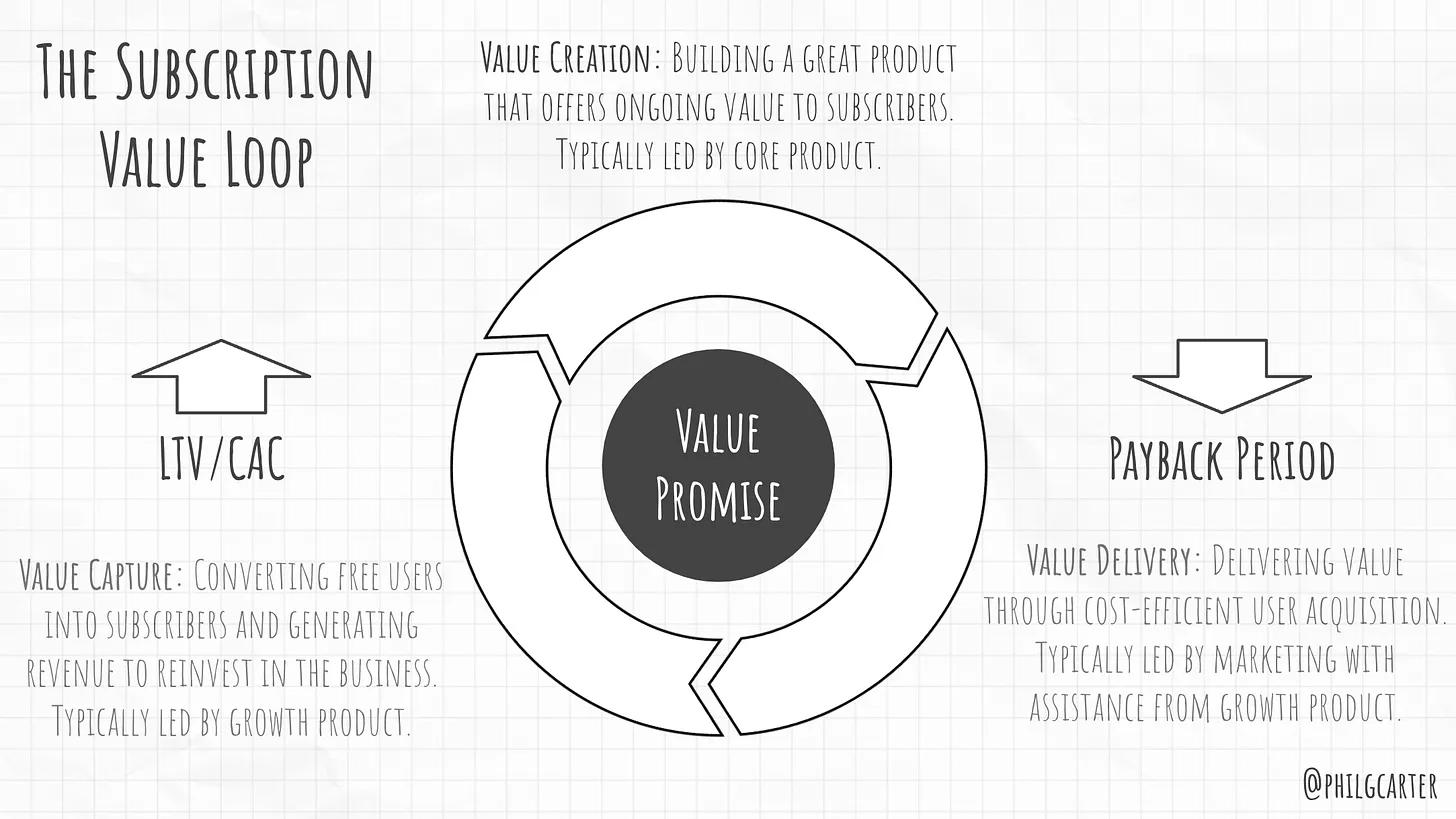
At the heart of scaling a consumer subscription business is the Subscription Value Loop. This loop harnesses the power of a company’s core value promise to drive growth in three interconnected steps:
Value Creation: Developing a product that offers ongoing value and connects users quickly to the core value promise. This work is typically driven by core product teams who build features enhancing both the free user and subscriber experiences. For instance, Duolingo has leveraged its core promise of making language learning engaging by incorporating gamification elements like streaks, achievements, and leaderboards, as well as highly-personalized lesson plans. This combination keeps users engaged and coming back for more.
Value Delivery: Distributing this value in a cost-efficient manner to acquire more users. This step goes beyond just building a great app, it requires thoughtful distribution strategies that usually go beyond paid advertising to include organic user acquisition as well. For example, Strava, delivers value organically by leveraging its highly-engaged community of athletes. These athletes are encouraged to share workouts both in the app and on social media to receive “kudos” from other athletes, which not only reinforces the company’s core value promise but also brings existing Strava users back into the product and spreads awareness of Strava to new users.
Value Capture: Converting free users to paying subscribers and reinvesting subscription revenue back into the business. This step is crucial, as effective value capture generates the resources needed for further product innovation and paid marketing campaigns. Tinder exemplifies effective value capture by offering multiple subscription tiers and in-app purchases that allow it to efficiently monetize users with different levels of intent and willingness to pay. By offering multiple premium value promises, and using contextual upsells and other merchandising strategies to make users aware of its premium features, Tinder has been able to continuously improve the monetization of its user base, resulting in hundreds of millions of dollars in incremental revenue growth.
“Each step in the loop feeds the others, creating a compounding effect. The more value you create, the easier it is to deliver that value and capture more revenue, which can be reinvested to accelerate growth.”
Quantify and Prioritize Growth Opportunities
To apply the Subscription Value Loop effectively, it's essential to quantify your app’s performance using key metrics across Value Creation, Value Delivery, and Value Capture. Phil introduces a tool—the Subscription Value Loop Calculator—that provides benchmarks for the most important consumer subscription metrics across a dozen different mobile app categories including Education, Productivity, Health & Fitness, and Media & Entertainment, as well as different tiers of consumer subscription apps including those performing at the 25th, 50th, 75th, and 95th percentiles.
This calculator, powered by RevenueCat’s proprietary data from over 30,000 consumer subscription apps, offers a detailed analysis of your app’s performance. By comparing your key metrics—including LTV/CAC, Payback Period, Cost per Install (CPI), Cost per Trial (CPT), Subscription Prices, Trial Start Rate, Trial Conversion Rate, Install to Paid Conversion Rate, and Subscriber Retention Rates—against industry benchmarks, you can pinpoint the specific areas within the Subscription Value Loop where your app is underperforming, and use this information to identify your biggest growth opportunities and prioritize specific product and marketing initiatives that will unlock these opportunities.
For example, if your app has low signup rates and subscriber retention rates, the calculator might highlight Value Creation as the most important step to focus on, whereas if your app has high subscriber acquisition costs, it might be more important to focus on Value Delivery. From there, you can prioritize initiatives like improving onboarding flows to boost signup and subscriber retention rates, or measuring and increasing word of mouth to reduce your blended subscriber acquisition costs.
“My hope is that the Subscription Value Loop, and now this calculator, provide leaders with additional tools to accelerate the growth of their consumer subscription businesses so they can reach their full potential.”
Ready to Deep Dive into Consumer Subscription Growth?
If you're looking to take your consumer subscription business to the next level, check out Phil Carter's course with Reforge, "Consumer Subscription Growth." The course covers the Subscription Value Loop in-depth, along with dozens of plug-and-play templates, detailed case studies, actionable strategies and tactics, and expert insights to help you accelerate the growth of your consumer subscription business. For more from Phil, you can also check out his website and follow him on Substack, LinkedIn, and X.


Explore the Subscription Value Loop, a proprietary framework for scaling consumer subscription businesses. The framework focuses on a strong cover value promise and a three-step loop to drive sustainable growth.
Build an Enduring Core Value Promise
The foundation of any successful consumer subscription app is its core value promise. It needs to be more than just compelling; it must be enduring. With fierce competition and numerous alternatives, it's crucial that your product provides lasting value.
“You need a value promise that isn't just compelling, but also enduring. If you deliver a lot of value in your first month or two, but then subscribers see diminishing returns, you're going to see many of them churn.”
Consider these examples:
Spotify: Listen to music you love, build playlists, and find new artists who match your taste.
Duolingo: Enjoy gamified study experiences that make language learning fun.
Strava: Record and share your workouts with a supportive community of athletes.
Each of these apps has a clear and unique value promise that stands the test of time. Your app’s promise should not only attract users but also keep them coming back month after month.
Create a Compounding Subscription Value Loop
At the heart of scaling a consumer subscription business is the Subscription Value Loop. This loop harnesses the power of a company’s core value promise to drive growth in three interconnected steps:
Value Creation: Developing a product that offers ongoing value and connects users quickly to the core value promise. This work is typically driven by core product teams who build features enhancing both the free user and subscriber experiences. For instance, Duolingo has leveraged its core promise of making language learning engaging by incorporating gamification elements like streaks, achievements, and leaderboards, as well as highly-personalized lesson plans. This combination keeps users engaged and coming back for more.
Value Delivery: Distributing this value in a cost-efficient manner to acquire more users. This step goes beyond just building a great app, it requires thoughtful distribution strategies that usually go beyond paid advertising to include organic user acquisition as well. For example, Strava, delivers value organically by leveraging its highly-engaged community of athletes. These athletes are encouraged to share workouts both in the app and on social media to receive “kudos” from other athletes, which not only reinforces the company’s core value promise but also brings existing Strava users back into the product and spreads awareness of Strava to new users.
Value Capture: Converting free users to paying subscribers and reinvesting subscription revenue back into the business. This step is crucial, as effective value capture generates the resources needed for further product innovation and paid marketing campaigns. Tinder exemplifies effective value capture by offering multiple subscription tiers and in-app purchases that allow it to efficiently monetize users with different levels of intent and willingness to pay. By offering multiple premium value promises, and using contextual upsells and other merchandising strategies to make users aware of its premium features, Tinder has been able to continuously improve the monetization of its user base, resulting in hundreds of millions of dollars in incremental revenue growth.
“Each step in the loop feeds the others, creating a compounding effect. The more value you create, the easier it is to deliver that value and capture more revenue, which can be reinvested to accelerate growth.”
Quantify and Prioritize Growth Opportunities
To apply the Subscription Value Loop effectively, it's essential to quantify your app’s performance using key metrics across Value Creation, Value Delivery, and Value Capture. Phil introduces a tool—the Subscription Value Loop Calculator—that provides benchmarks for the most important consumer subscription metrics across a dozen different mobile app categories including Education, Productivity, Health & Fitness, and Media & Entertainment, as well as different tiers of consumer subscription apps including those performing at the 25th, 50th, 75th, and 95th percentiles.
This calculator, powered by RevenueCat’s proprietary data from over 30,000 consumer subscription apps, offers a detailed analysis of your app’s performance. By comparing your key metrics—including LTV/CAC, Payback Period, Cost per Install (CPI), Cost per Trial (CPT), Subscription Prices, Trial Start Rate, Trial Conversion Rate, Install to Paid Conversion Rate, and Subscriber Retention Rates—against industry benchmarks, you can pinpoint the specific areas within the Subscription Value Loop where your app is underperforming, and use this information to identify your biggest growth opportunities and prioritize specific product and marketing initiatives that will unlock these opportunities.
For example, if your app has low signup rates and subscriber retention rates, the calculator might highlight Value Creation as the most important step to focus on, whereas if your app has high subscriber acquisition costs, it might be more important to focus on Value Delivery. From there, you can prioritize initiatives like improving onboarding flows to boost signup and subscriber retention rates, or measuring and increasing word of mouth to reduce your blended subscriber acquisition costs.
“My hope is that the Subscription Value Loop, and now this calculator, provide leaders with additional tools to accelerate the growth of their consumer subscription businesses so they can reach their full potential.”
Ready to Deep Dive into Consumer Subscription Growth?
If you're looking to take your consumer subscription business to the next level, check out Phil Carter's course with Reforge, "Consumer Subscription Growth." The course covers the Subscription Value Loop in-depth, along with dozens of plug-and-play templates, detailed case studies, actionable strategies and tactics, and expert insights to help you accelerate the growth of your consumer subscription business. For more from Phil, you can also check out his website and follow him on Substack, LinkedIn, and X.