Reforge has joined Miro ↗
Lovable hit $100 million ARR just eight months from launch. There’s no better example of a company that found escape velocity. And still, there’s no guarantee they’ve found long-term defensibility or can turn this wave of interest into a sustainable business.
A flood of competitors, both big and small, has entered the market. There are other startups selling general-purpose vibe coding tools like Bolt, v0, and Replit. Claude allows users to create hosted apps called Artifacts in its chat experience.
But Lovable also has a long list of incumbents it’s going to have to battle with too. Any existing company who sees prototyping a direct or adjacent use case is rushing to roll out a similar product. Figma recently launched Figma Make to keep its 450,000 paying customers on the platform. Google’s new Firebase Studio is aiming to do the same with the millions of developers who use Firebase. GitHub launched GitHub Spark just as I was about to publish this article.
Escape velocity elevated Lovable from obscurity to household name. And now the company has a real chance to build a large and successful business. Lovable is a perfect example of a company who has so far navigated the convergence of three distinct market trends:
Massive AI Interest: AI has sparked massive adoption of new tools, allowing companies like Lovable to hit escape velocity in record time.
Incumbent Mirroring: AI both allows startups to launch and scale faster, but also makes it easier for incumbents to copy their innovations.
Distribution Scarcity: We’re in the midst of a distribution shift that’s causing a decline in organic channels, creating more competition for fewer opportunities.
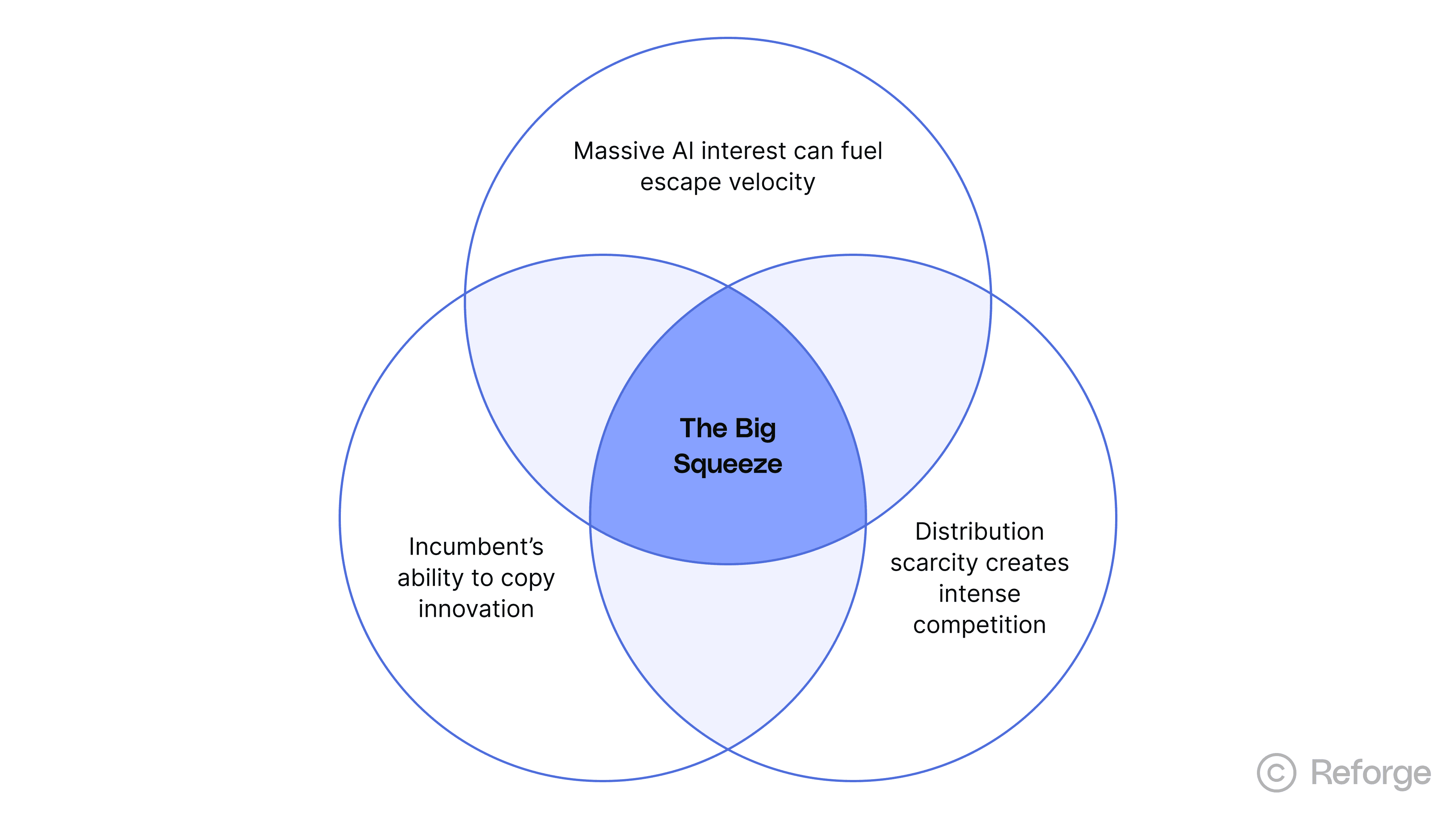
The result is the Big Squeeze. Startups must get massive distribution quickly, but it’s harder to get and easier for their innovations to be ripped off once they do. And as the spark of interest in new AI tools starts to wane (and it will eventually), the squeeze could strangle new startups before they have a chance.
This was best captured in 2015 by Alex Rampell in his blog post “Distribution vs Innovation” where he said:
“The battle between every startup and incumbent comes down to whether the startup gets distribution before the incumbent gets innovation.”
So, if you’re a startup, you need distribution now and you need it fast.
Distribution is the seed that leads to harvest
Distribution creates momentum that can lead to all kinds of good things. Distribution isn’t success in itself, but an opportunity to capture it. It’s the very first step in building a moat. The question is if you can sequence the distribution to a real moat.
Momentum gives you users and customers, of course, but also the chance to become ingrained in those customers’ workflows, add adjacent features, earn brand recognition, buy time to get a sales motion rolling, build a platform that incentivizes usage, create an ecosystem to power integrations, raise more funding and a host of other opportunities.
We could list off dozens of startups that have gained near-instant escape velocity in the last few years. Glean to $100m ARR, Cursor to $500m ARR, Codium to $100m ARR and the list goes on. The wave of interest in these tools is obvious and unprecedented. This creates a ton of buzz in the media, but the current market is volatile and these companies are shifting their attention from virality to moat building.
Here are a few recent moves Lovable has made:
It’s rolled out a number of integrations with GitHub, Supabase, Stripe, Figma, Twilio and other apps.
It’s created a partner program to help users find consultants and agencies to support advanced use-cases.
It’s launched an enterprise plan with custom integrations and enhanced security.
It’s raised a $200m Series A.
There is still enough AI interest to drive more distribution for Lovable, but it is making strategic moves to build an ecosystem and more defensibility.
Speed cuts both ways—incumbents are ready to copy you
AI has decreased code generation as a bottleneck. And while that’s great for startups looking to ship fast, it cuts both ways. Startups feel pressure to launch, but incumbents are feeling pressure too. Every incumbent is sorting out how to build AI out into existing products before their users seek out other solutions.
Lovable gained distribution, in part, because it’s a general-purpose vibe coding tool. There are thousands of possible use cases, including a handful of valuable business applications that incumbents are working to copy. Prosumers may want to vibe code, but designers want to prototype. It’s the same idea in different applications.
Figma obviously recognizes prototyping as an important part of its customers’ job to be done and quickly rolled out Figma Make. It has two very significant advantages over Lovable:
A vertical use-case that will allow it to more deeply integrate with its customers’ workflows.
13 million monthly active users and 450,000 paying customers to sell to.
Even with its massive base of customers, Figma is likely dealing with slow adoption of AI tools in the enterprise, due to both procurement and habits. It also has to integrate Figma Make into the rest of its product suite to make it useful. It has to train sales and success, write support documentation and nail its GTM motion. And even with all the speed advantages AI offers, Figma is working with a massive codebase and technical challenges that startups just don’t have.
This battle is still shaking out and is representative of what’s happening across nearly every category in tech right now. There will be room for a general-purpose tool like Lovable and vertical use cases like Figma Make, but only because Lovable got distribution early and fast.
How are you going to beat the squeeze?
For the last few years, the answer to this has been easy. If you build an AI product, people will show up because the interest in these new tools is so intense. This is fading, but that’s not even the biggest problem with distribution right now.
Organic channels always decay over time. It’s part of the cycle I wrote about in The Next Great Distribution Shift:
Every major new platform follows the same playbook: They start open and generous, practically begging developers to build on their platform. They need you to help solidify their moat. But once that moat has escape velocity? The walls go up. The taxes increase. The rules change. What was once free becomes paid. What was once permitted becomes forbidden.
So there’s nothing new here, but at the moment, it seems like every channel is decaying. Search traffic is declining because of AI Overviews, social channels don’t prioritize links to external sites and are insanely competitive, and paid distribution is getting more and more expensive. AI has made it faster than ever to create and ship products, but we’re stuck distributing them like it’s 2015. At some point, new distribution opportunities will arrive, but the window to launch new AI products will likely be closed by then.
In his post, “Levered beta is all you need,” TextQL CEO Ethan Ding makes the case that, right now, distribution is more important than a great product. LLMs are improving so rapidly they effectively act as product improvements. And so while Lovable can (and should) improve their product, nothing is more than distribution in the short-term:
If you're Replit: every dollar spent achieving that 30% (product improvement) could have bought distribution. Lovable gets this. While Replit makes their product 5% better, Lovable makes sure 5% more people know they exist. When the next model drops and erases that difference anyway... The real game is distribution. Be there when the wave hits, and make sure everyone knows your name when it does.
The technology will keep improving so quickly that you can ship now and know LLM updates will make your own product significantly better every few months. Go to market today with the confidence of where your product will be a year from now.
Capture the moment
The Big Squeeze creates a unique strategic moment. History suggests these periods of intense change create disproportionate opportunities for companies that recognize the patterns and jump on them.
The convergent factors driving this change are temporary. The window for leveraging AI novelty and finding rapid distribution is already narrowing because the market is learning to respond faster to these patterns. The companies that will dominate over the next decade are working as hard as they can towards escape velocity right now.
So, how will you beat the squeeze? How will you hit escape velocity in a short window? How will you sequence that escape velocity into long-term defensibility?
You do still need a great product and you still need product-market fit. But this market is a harsh reminder that a great product is necessary, but not sufficient.


Lovable hit $100 million ARR just eight months from launch. There’s no better example of a company that found escape velocity. And still, there’s no guarantee they’ve found long-term defensibility or can turn this wave of interest into a sustainable business.
A flood of competitors, both big and small, has entered the market. There are other startups selling general-purpose vibe coding tools like Bolt, v0, and Replit. Claude allows users to create hosted apps called Artifacts in its chat experience.
But Lovable also has a long list of incumbents it’s going to have to battle with too. Any existing company who sees prototyping a direct or adjacent use case is rushing to roll out a similar product. Figma recently launched Figma Make to keep its 450,000 paying customers on the platform. Google’s new Firebase Studio is aiming to do the same with the millions of developers who use Firebase. GitHub launched GitHub Spark just as I was about to publish this article.
Escape velocity elevated Lovable from obscurity to household name. And now the company has a real chance to build a large and successful business. Lovable is a perfect example of a company who has so far navigated the convergence of three distinct market trends:
Massive AI Interest: AI has sparked massive adoption of new tools, allowing companies like Lovable to hit escape velocity in record time.
Incumbent Mirroring: AI both allows startups to launch and scale faster, but also makes it easier for incumbents to copy their innovations.
Distribution Scarcity: We’re in the midst of a distribution shift that’s causing a decline in organic channels, creating more competition for fewer opportunities.
The result is the Big Squeeze. Startups must get massive distribution quickly, but it’s harder to get and easier for their innovations to be ripped off once they do. And as the spark of interest in new AI tools starts to wane (and it will eventually), the squeeze could strangle new startups before they have a chance.
This was best captured in 2015 by Alex Rampell in his blog post “Distribution vs Innovation” where he said:
“The battle between every startup and incumbent comes down to whether the startup gets distribution before the incumbent gets innovation.”
So, if you’re a startup, you need distribution now and you need it fast.
Distribution is the seed that leads to harvest
Distribution creates momentum that can lead to all kinds of good things. Distribution isn’t success in itself, but an opportunity to capture it. It’s the very first step in building a moat. The question is if you can sequence the distribution to a real moat.
Momentum gives you users and customers, of course, but also the chance to become ingrained in those customers’ workflows, add adjacent features, earn brand recognition, buy time to get a sales motion rolling, build a platform that incentivizes usage, create an ecosystem to power integrations, raise more funding and a host of other opportunities.
We could list off dozens of startups that have gained near-instant escape velocity in the last few years. Glean to $100m ARR, Cursor to $500m ARR, Codium to $100m ARR and the list goes on. The wave of interest in these tools is obvious and unprecedented. This creates a ton of buzz in the media, but the current market is volatile and these companies are shifting their attention from virality to moat building.
Here are a few recent moves Lovable has made:
It’s rolled out a number of integrations with GitHub, Supabase, Stripe, Figma, Twilio and other apps.
It’s created a partner program to help users find consultants and agencies to support advanced use-cases.
It’s launched an enterprise plan with custom integrations and enhanced security.
It’s raised a $200m Series A.
There is still enough AI interest to drive more distribution for Lovable, but it is making strategic moves to build an ecosystem and more defensibility.
Speed cuts both ways—incumbents are ready to copy you
AI has decreased code generation as a bottleneck. And while that’s great for startups looking to ship fast, it cuts both ways. Startups feel pressure to launch, but incumbents are feeling pressure too. Every incumbent is sorting out how to build AI out into existing products before their users seek out other solutions.
Lovable gained distribution, in part, because it’s a general-purpose vibe coding tool. There are thousands of possible use cases, including a handful of valuable business applications that incumbents are working to copy. Prosumers may want to vibe code, but designers want to prototype. It’s the same idea in different applications.
Figma obviously recognizes prototyping as an important part of its customers’ job to be done and quickly rolled out Figma Make. It has two very significant advantages over Lovable:
A vertical use-case that will allow it to more deeply integrate with its customers’ workflows.
13 million monthly active users and 450,000 paying customers to sell to.
Even with its massive base of customers, Figma is likely dealing with slow adoption of AI tools in the enterprise, due to both procurement and habits. It also has to integrate Figma Make into the rest of its product suite to make it useful. It has to train sales and success, write support documentation and nail its GTM motion. And even with all the speed advantages AI offers, Figma is working with a massive codebase and technical challenges that startups just don’t have.
This battle is still shaking out and is representative of what’s happening across nearly every category in tech right now. There will be room for a general-purpose tool like Lovable and vertical use cases like Figma Make, but only because Lovable got distribution early and fast.
How are you going to beat the squeeze?
For the last few years, the answer to this has been easy. If you build an AI product, people will show up because the interest in these new tools is so intense. This is fading, but that’s not even the biggest problem with distribution right now.
Organic channels always decay over time. It’s part of the cycle I wrote about in The Next Great Distribution Shift:
Every major new platform follows the same playbook: They start open and generous, practically begging developers to build on their platform. They need you to help solidify their moat. But once that moat has escape velocity? The walls go up. The taxes increase. The rules change. What was once free becomes paid. What was once permitted becomes forbidden.
So there’s nothing new here, but at the moment, it seems like every channel is decaying. Search traffic is declining because of AI Overviews, social channels don’t prioritize links to external sites and are insanely competitive, and paid distribution is getting more and more expensive. AI has made it faster than ever to create and ship products, but we’re stuck distributing them like it’s 2015. At some point, new distribution opportunities will arrive, but the window to launch new AI products will likely be closed by then.
In his post, “Levered beta is all you need,” TextQL CEO Ethan Ding makes the case that, right now, distribution is more important than a great product. LLMs are improving so rapidly they effectively act as product improvements. And so while Lovable can (and should) improve their product, nothing is more than distribution in the short-term:
If you're Replit: every dollar spent achieving that 30% (product improvement) could have bought distribution. Lovable gets this. While Replit makes their product 5% better, Lovable makes sure 5% more people know they exist. When the next model drops and erases that difference anyway... The real game is distribution. Be there when the wave hits, and make sure everyone knows your name when it does.
The technology will keep improving so quickly that you can ship now and know LLM updates will make your own product significantly better every few months. Go to market today with the confidence of where your product will be a year from now.
Capture the moment
The Big Squeeze creates a unique strategic moment. History suggests these periods of intense change create disproportionate opportunities for companies that recognize the patterns and jump on them.
The convergent factors driving this change are temporary. The window for leveraging AI novelty and finding rapid distribution is already narrowing because the market is learning to respond faster to these patterns. The companies that will dominate over the next decade are working as hard as they can towards escape velocity right now.
So, how will you beat the squeeze? How will you hit escape velocity in a short window? How will you sequence that escape velocity into long-term defensibility?
You do still need a great product and you still need product-market fit. But this market is a harsh reminder that a great product is necessary, but not sufficient.