Reforge has joined Miro ↗
During Reforge’s ref:AI event, host Brian Balfour, CEO and founder of Reforge, and guest Kieran Flanagan, SVP of Marketing at HubSpot, dove deep into the evolving landscape of AI marketing, exploring the challenges and opportunities presented by AI integration in marketing strategies. Here’s a breakdown of key insights and actionable takeaways from their discussion.
If you enjoy this conversation, please check out Kieran as a guest on Unsolicited Feedback or his podcast with Kipp Bodnar, Marketing Against the Grain.
What is Changing?
Before we can get into the playbook itself, it’s important to understand the two major changes underpinning this AI Marketing revolution.
From Open Web to Closed Web: Adapting to Platform Changes
Inbound marketing has long been a cornerstone for driving organic traffic and securing customer engagements. Traditionally, this approach relied heavily on SEO to create compounding returns by ranking content that generates sustained value over time. However, the landscape is evolving.
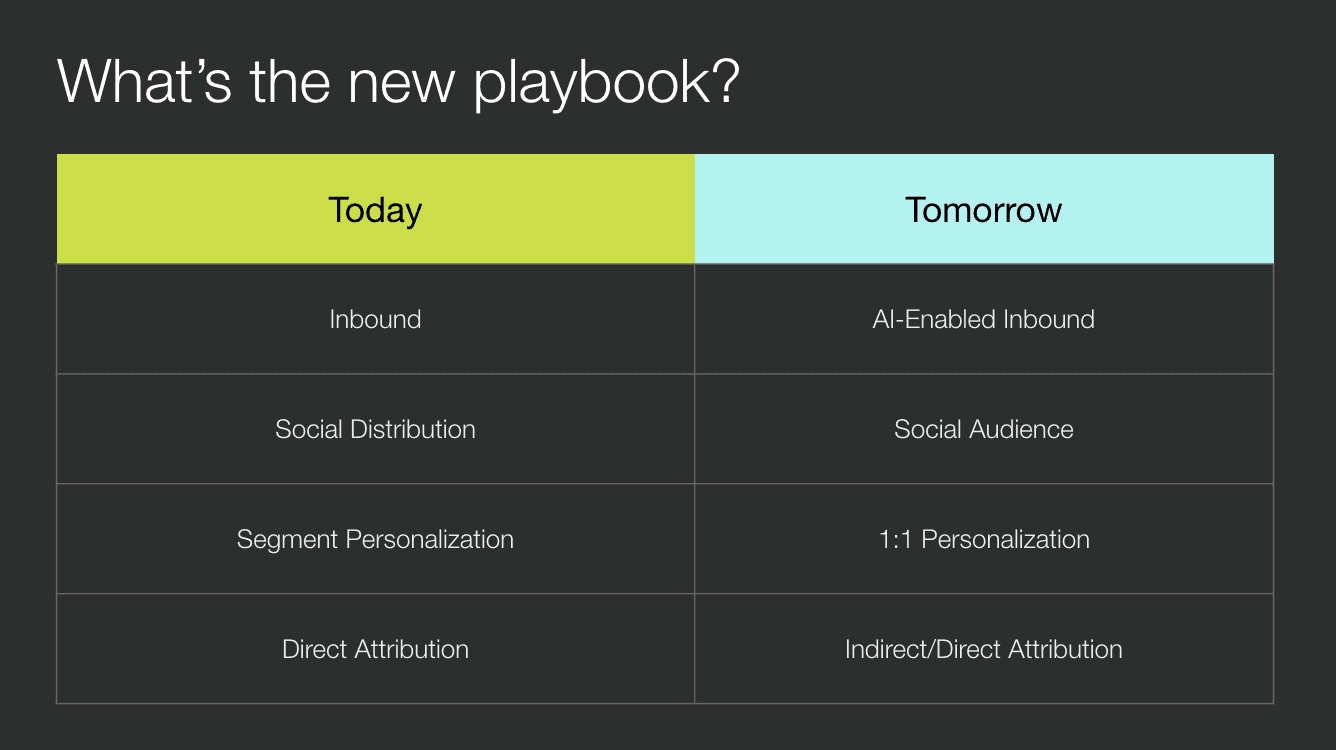
The internet is moving from an open web to a closed web, impacting how marketers distribute content. Social platforms are increasingly reluctant to promote external links, preferring to keep users on their sites. Google is following suit, with feature snippets and AI overviews reducing the need for users to click through to websites. This shift demands marketers to rethink their strategies, focusing more on building and monetizing social audiences directly within these platforms.
Google searches, while still increasing, no longer translate directly into traffic as Google and other platforms aim to keep users within their environments. Consequently, it's vital for startups and established companies to pivot their strategies towards AI-enabled inbound marketing, focusing on leveraging AI to create high-quality, personalized content that stands out.
Kieran illustrates this concept perfectly. HubSpot, with its vast content engine, is already seeing changes due to the introduction of AI overviews. Still, it continues to grow organic traffic by differentiating valuable, defensible content from generic, easily replicable information.
From Measurable Paid Spend to Unmeasurable Marketing Activities
A significant shift in the marketing landscape is the move from direct, clear-cut attribution to more complex, indirect ones. Traditionally, marketers could forecast returns on investment with high certainty. The integration of social and community-driven search behaviors, however, complicates this picture.
The New AI Marketing Playbook
With these changes, Marketers are forced and empowered to change how they operate. Kieran has identified four major impacts of AI on marketing, which are detailed below.
Embrace AI-Enabled Inbound Marketing
Optimize for Transactional Searches and Informational Codes
Kieran differentiates between different types of search, which will be impacted by AI differently.
Transactional Search: Users are searching with the intent of taking an action, such as signing up for a course or purchasing a product. Transactional search has not been impacted by AI. Optimizing for these types of searches remains crucial.
Informational Search: Users are searching with the intent to learn something. This can be broken into two categories:
Non-Defensible Search includes informational searches that aren’t unique. AI can create these, and this category will be most impacted by AI.
Defensible Search describes searches with with complexity in the questions and what people are seeking, which AI is not able to recreate. Marketers should work to understand what is defensible and invest in differentiation.
However, it's equally essential to create and leverage "informational codes." Instead of purely informational posts, consider developing tools or apps that solve specific use cases. This shift can transform one-time content consumptions into ongoing user engagements, proving especially valuable in an increasingly crowded digital space.
Kieran also highlights the challenge of optimizing for LLMs, given their complexity. Instead of traditional optimization techniques, brands should focus on becoming synonymous with their target keywords across the web, via brand and positioning efforts.
Any great marketer will use AI to help multiply the impact of their actions.
Master Prompt Engineering for Effective AI Utilization
One of the most actionable takeaways from Kieran’s insights is the critical role of prompt engineering. Prompts need to be highly contextual to elicit meaningful and relevant responses from AI models. Generic prompts may yield subpar results, whereas well-crafted ones can significantly enhance content quality and effectiveness.
Marketers should invest time in learning prompt engineering to maximize their AI tools' potentials. As Flanagan aptly puts it, if your prompts are generic and uninspired, your AI outputs will be too.
Learn From Creators: Building Social Media Audiences
Historically, brands have used social media platforms for distribution, ultimately bringing the traffic back to their sites. Kieran urges marketers to learn from creators, building genuine audience connections on these platforms. With younger generations favoring social and community-led searches over traditional search engines, building a strong social presence is more critical than ever.
As audiences gravitate towards content created by individuals rather than brands, integrating creators into your marketing strategy becomes crucial. Brands can opt to create an environment where creators want to work with you in-house, or partnering with industry influencers and creators can amplify your reach and build authentic connections with your audience. Kieran discusses HubSpot’s approach to partnering with creators through their creator program, which operates like a venture firm. This allows HubSpot to tap into the authentic engagement that creators bring, aligning with the trend of people following people, not just brands.
Personalization Across the Funnel: Elevate Customer Interactions
Across the funnel, AI can tailor customer journeys in real-time, enhancing engagement and conversion rates. AI can enhance customer support by creating personalized interactions based on user data, improving the overall customer experience. In sales, AI can help by providing reps with detailed information about prospects, making initial calls more productive and personalized. By using AI to gather and analyze customer data, marketers can create highly personalized experiences that drive engagement and conversion. Kieran notes that while AI may negatively impact volume at top of funnel, it may also create leverage with stronger conversion at bottom of funnel.
Less Measurable Marketing: Navigating Indirect and Direct Attribution
As marketing becomes less measurable due to privacy laws and the closed web, Kieran emphasizes the importance of balancing direct attribution and return on spend with indirect attribution. Conversion lift studies are one path to quantifying outcomes and determining investments, but marketers will have to increasingly lean into bigger bets with conviction. Investing in brand and social media initiatives might not provide immediate, direct returns but can drive long-term growth.
Kieran also notes that earlier stage companies are especially challenged by this shift in measurement, as they need to rely on an engine with predictable returns on marketing investment. However, declines are happening in the channels with predictable and forecastable models, while newer channels are growing.
How Marketers Can Leverage AI
While Kieran notes the impacts of AI on marketing, he also believes that AI can provide leverage to marketers to strengthen their efforts.
High Quality Output at Scale with AI-Enabled Tools
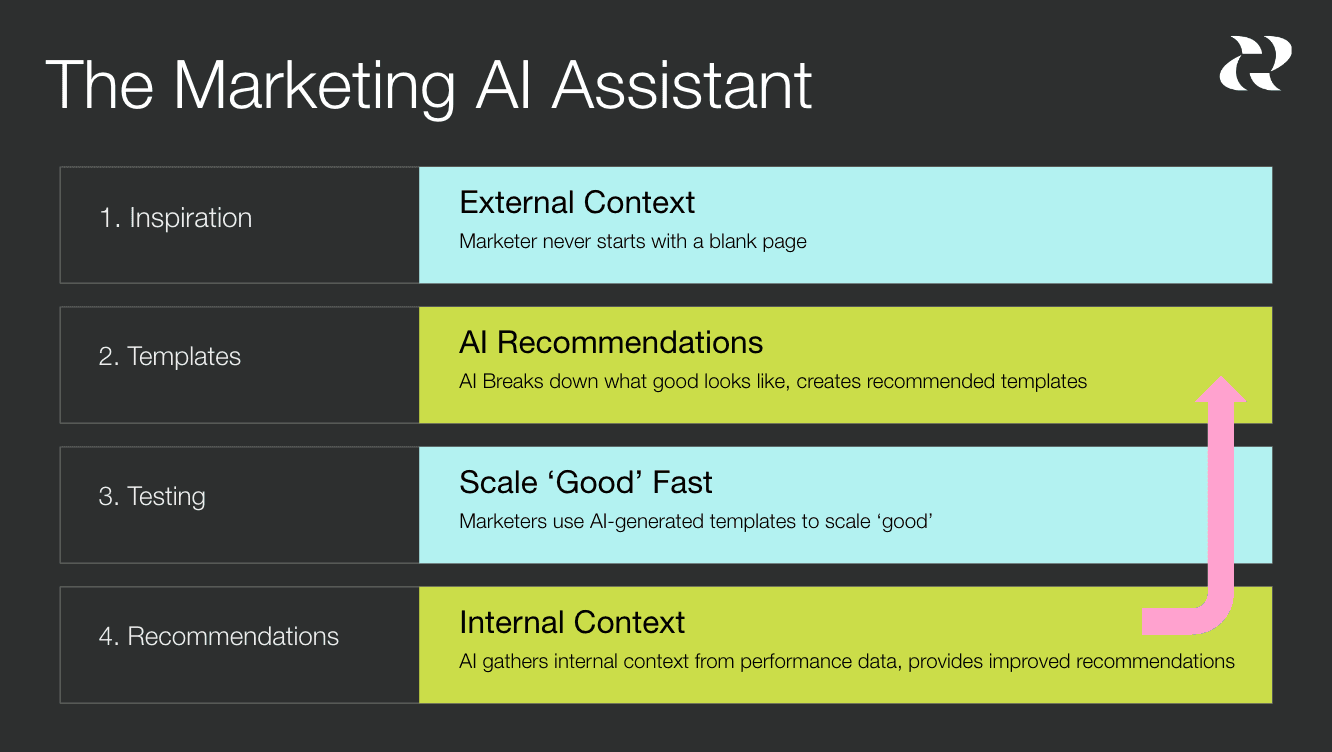
AI tools can significantly enhance marketing efforts by providing inspiration and creating templates for high-performing content. Specifically, these tools are increasingly able to templatize what good looks like, allowing marketers to create high-quality, scalable content quickly. For example, AI can analyze top-performing ads or social media posts and generate similar templates for new campaigns, enabling fast rounds of testing, analysis, and iteration.
Continuous Learning and Curiosity
Kieran highlights the importance of individual ownership and continuous learning in the age of AI. Providing access to AI tools is just the first step; marketers should be curious and proactive in experimenting with AI tools to improve their workflows. Mastering prompt engineering and understanding how to leverage AI effectively can set individuals apart in this rapidly changing landscape.
Invest in AI and Prepare for the Future
AI’s capabilities are rapidly advancing. Marketers should invest in AI now, even if the current tools aren’t perfect. By building the necessary infrastructure and processes, companies can be ready to leverage improved AI models as they become available. The key is to start experimenting and integrating AI into your workflows today.
Conclusion: Stay Ahead of the Curve
The future of marketing is intertwined with AI, and those who adapt and innovate will thrive. By understanding the shifts in the digital landscape, embracing indirect attribution, and leveraging AI for personalization and content creation, marketers can stay ahead of the curve. Stay curious, embrace change, and leverage AI to its fullest potential.
Related Resources:
Artifacts: Free, real-world work products from leading experts
Customer research and ad creation with ChatGPT
Automating marketing performance analysis with AI at SimplyPut
AI content generation guide at WeMoms
Prompt Engineering Template
Guides: 🔒 Members-only, step by step instruction
Evolution from search engine to answer engine
Prepare & optimize your content for Google SGE and AI overviews
Audit brand visibility on LLMs
Boost brand visibility with LLM optimization
Podcast: Reforge’s Unsolicited Feedback is available on the platform of your choice
Learn how Kieran Flanagan (SVP Marketing at HubSpot) formulated the AI Marketing Playbook, initially on Unsolicited Feedback.
Listen to Brian Balfour, Ravi Mehta, Fareed Mosavat, and Joff Redfern discuss key takeaways from H1 2024 - Part 1 & Part 2.
Listen to Sachin Rekhi react to the shrinking S-Curve’s impact on Product and Marketing Strategy and learn how to quickly find product-market fit in an AI world.


During Reforge’s ref:AI event, host Brian Balfour, CEO and founder of Reforge, and guest Kieran Flanagan, SVP of Marketing at HubSpot, dove deep into the evolving landscape of AI marketing, exploring the challenges and opportunities presented by AI integration in marketing strategies. Here’s a breakdown of key insights and actionable takeaways from their discussion.
If you enjoy this conversation, please check out Kieran as a guest on Unsolicited Feedback or his podcast with Kipp Bodnar, Marketing Against the Grain.
What is Changing?
Before we can get into the playbook itself, it’s important to understand the two major changes underpinning this AI Marketing revolution.
From Open Web to Closed Web: Adapting to Platform Changes
Inbound marketing has long been a cornerstone for driving organic traffic and securing customer engagements. Traditionally, this approach relied heavily on SEO to create compounding returns by ranking content that generates sustained value over time. However, the landscape is evolving.
The internet is moving from an open web to a closed web, impacting how marketers distribute content. Social platforms are increasingly reluctant to promote external links, preferring to keep users on their sites. Google is following suit, with feature snippets and AI overviews reducing the need for users to click through to websites. This shift demands marketers to rethink their strategies, focusing more on building and monetizing social audiences directly within these platforms.
Google searches, while still increasing, no longer translate directly into traffic as Google and other platforms aim to keep users within their environments. Consequently, it's vital for startups and established companies to pivot their strategies towards AI-enabled inbound marketing, focusing on leveraging AI to create high-quality, personalized content that stands out.
Kieran illustrates this concept perfectly. HubSpot, with its vast content engine, is already seeing changes due to the introduction of AI overviews. Still, it continues to grow organic traffic by differentiating valuable, defensible content from generic, easily replicable information.
From Measurable Paid Spend to Unmeasurable Marketing Activities
A significant shift in the marketing landscape is the move from direct, clear-cut attribution to more complex, indirect ones. Traditionally, marketers could forecast returns on investment with high certainty. The integration of social and community-driven search behaviors, however, complicates this picture.
The New AI Marketing Playbook
With these changes, Marketers are forced and empowered to change how they operate. Kieran has identified four major impacts of AI on marketing, which are detailed below.
Embrace AI-Enabled Inbound Marketing
Optimize for Transactional Searches and Informational Codes
Kieran differentiates between different types of search, which will be impacted by AI differently.
Transactional Search: Users are searching with the intent of taking an action, such as signing up for a course or purchasing a product. Transactional search has not been impacted by AI. Optimizing for these types of searches remains crucial.
Informational Search: Users are searching with the intent to learn something. This can be broken into two categories:
Non-Defensible Search includes informational searches that aren’t unique. AI can create these, and this category will be most impacted by AI.
Defensible Search describes searches with with complexity in the questions and what people are seeking, which AI is not able to recreate. Marketers should work to understand what is defensible and invest in differentiation.
However, it's equally essential to create and leverage "informational codes." Instead of purely informational posts, consider developing tools or apps that solve specific use cases. This shift can transform one-time content consumptions into ongoing user engagements, proving especially valuable in an increasingly crowded digital space.
Kieran also highlights the challenge of optimizing for LLMs, given their complexity. Instead of traditional optimization techniques, brands should focus on becoming synonymous with their target keywords across the web, via brand and positioning efforts.
Any great marketer will use AI to help multiply the impact of their actions.
Master Prompt Engineering for Effective AI Utilization
One of the most actionable takeaways from Kieran’s insights is the critical role of prompt engineering. Prompts need to be highly contextual to elicit meaningful and relevant responses from AI models. Generic prompts may yield subpar results, whereas well-crafted ones can significantly enhance content quality and effectiveness.
Marketers should invest time in learning prompt engineering to maximize their AI tools' potentials. As Flanagan aptly puts it, if your prompts are generic and uninspired, your AI outputs will be too.
Learn From Creators: Building Social Media Audiences
Historically, brands have used social media platforms for distribution, ultimately bringing the traffic back to their sites. Kieran urges marketers to learn from creators, building genuine audience connections on these platforms. With younger generations favoring social and community-led searches over traditional search engines, building a strong social presence is more critical than ever.
As audiences gravitate towards content created by individuals rather than brands, integrating creators into your marketing strategy becomes crucial. Brands can opt to create an environment where creators want to work with you in-house, or partnering with industry influencers and creators can amplify your reach and build authentic connections with your audience. Kieran discusses HubSpot’s approach to partnering with creators through their creator program, which operates like a venture firm. This allows HubSpot to tap into the authentic engagement that creators bring, aligning with the trend of people following people, not just brands.
Personalization Across the Funnel: Elevate Customer Interactions
Across the funnel, AI can tailor customer journeys in real-time, enhancing engagement and conversion rates. AI can enhance customer support by creating personalized interactions based on user data, improving the overall customer experience. In sales, AI can help by providing reps with detailed information about prospects, making initial calls more productive and personalized. By using AI to gather and analyze customer data, marketers can create highly personalized experiences that drive engagement and conversion. Kieran notes that while AI may negatively impact volume at top of funnel, it may also create leverage with stronger conversion at bottom of funnel.
Less Measurable Marketing: Navigating Indirect and Direct Attribution
As marketing becomes less measurable due to privacy laws and the closed web, Kieran emphasizes the importance of balancing direct attribution and return on spend with indirect attribution. Conversion lift studies are one path to quantifying outcomes and determining investments, but marketers will have to increasingly lean into bigger bets with conviction. Investing in brand and social media initiatives might not provide immediate, direct returns but can drive long-term growth.
Kieran also notes that earlier stage companies are especially challenged by this shift in measurement, as they need to rely on an engine with predictable returns on marketing investment. However, declines are happening in the channels with predictable and forecastable models, while newer channels are growing.
How Marketers Can Leverage AI
While Kieran notes the impacts of AI on marketing, he also believes that AI can provide leverage to marketers to strengthen their efforts.
High Quality Output at Scale with AI-Enabled Tools
AI tools can significantly enhance marketing efforts by providing inspiration and creating templates for high-performing content. Specifically, these tools are increasingly able to templatize what good looks like, allowing marketers to create high-quality, scalable content quickly. For example, AI can analyze top-performing ads or social media posts and generate similar templates for new campaigns, enabling fast rounds of testing, analysis, and iteration.
Continuous Learning and Curiosity
Kieran highlights the importance of individual ownership and continuous learning in the age of AI. Providing access to AI tools is just the first step; marketers should be curious and proactive in experimenting with AI tools to improve their workflows. Mastering prompt engineering and understanding how to leverage AI effectively can set individuals apart in this rapidly changing landscape.
Invest in AI and Prepare for the Future
AI’s capabilities are rapidly advancing. Marketers should invest in AI now, even if the current tools aren’t perfect. By building the necessary infrastructure and processes, companies can be ready to leverage improved AI models as they become available. The key is to start experimenting and integrating AI into your workflows today.
Conclusion: Stay Ahead of the Curve
The future of marketing is intertwined with AI, and those who adapt and innovate will thrive. By understanding the shifts in the digital landscape, embracing indirect attribution, and leveraging AI for personalization and content creation, marketers can stay ahead of the curve. Stay curious, embrace change, and leverage AI to its fullest potential.
Related Resources:
Artifacts: Free, real-world work products from leading experts
Customer research and ad creation with ChatGPT
Automating marketing performance analysis with AI at SimplyPut
AI content generation guide at WeMoms
Prompt Engineering Template
Guides: 🔒 Members-only, step by step instruction
Evolution from search engine to answer engine
Prepare & optimize your content for Google SGE and AI overviews
Audit brand visibility on LLMs
Boost brand visibility with LLM optimization
Podcast: Reforge’s Unsolicited Feedback is available on the platform of your choice
Learn how Kieran Flanagan (SVP Marketing at HubSpot) formulated the AI Marketing Playbook, initially on Unsolicited Feedback.
Listen to Brian Balfour, Ravi Mehta, Fareed Mosavat, and Joff Redfern discuss key takeaways from H1 2024 - Part 1 & Part 2.
Listen to Sachin Rekhi react to the shrinking S-Curve’s impact on Product and Marketing Strategy and learn how to quickly find product-market fit in an AI world.