Reforge has joined Miro ↗
All articles
When Speed Becomes Table Stakes: 5 Improvements to Accelerate Insight to Action
Jun 10, 2025
In a world where traditional moats can evaporate in weeks rather than years, speed has transformed from competitive advantage to baseline requirement. The New Bottleneck: Teams possess unprecedented ability to build and ship, yet lack the velocity to understand what deserves to be built. The bottleneck has shifted from execution to comprehension—from shipping code to shipping the right code.
The Erosion of Traditional Competitive Advantages
Jamin Ball of Altimeter Capital recently articulated what many product leaders are experiencing but struggling to name:
“A lot has been written about moats in software. Network effects. Switching costs. Proprietary data. Everyone wants to believe they’re building one. But I’ve come to believe the idea of a “long term moat” is mostly a myth, especially in this market. Moats aren’t permanent. They’re time-bound. At best, they function as a bridge. And companies either use that bridge to reach the next defensible position, or watch their moat get breached.
The real “long-term moat” is just a sequence of smaller moats stacked together. Each one buys time. And what you do with that time, how fast you execute, how quickly you evolve, determines whether you stay ahead. In the Age of AI, this is more true than ever. If the moat time window used to be 6–12 months, today it’s 2–3 weeks. “
James Currier of NFX recently stated:
“The AI revolution just ratcheted up the speed bar. You think you’re moving fast enough. You’re not. Now that generative AI is here, your definition of speed has to increase 10x.”
This isn’t merely investor philosophy, it’s operational reality. Windsurf grew to $50M ARR in a matter of months from launch and then got bought by OpenAI for $3B. In a recent podcast episode Varun Mohan (Founder + CEO of Windsurf) emphasized:
“The only moat in our category is speed. It’s learning where the dead bodies are, learning how to compound an advantage.”
The Speed Paradox in Product Development
In a world where traditional moats can evaporate in weeks rather than years, speed has transformed from competitive advantage to baseline requirement. Yet here lies the paradox: while building and shipping have never been faster (and accelerating), the insights to fuel that building remain trapped in 6-week archaeological expeditions through disconnected tools.
The New Bottleneck: Teams possess unprecedented ability to build and ship, yet lack the velocity to understand what deserves to be built. The bottleneck has shifted from execution to comprehension—from shipping code to shipping the right code.
Critical Questions for Product Leaders:
If competitors can replicate your features in weeks, how fast must you learn to maintain advantage?
When customer needs "rewrite themselves in real time," can you afford multi-week analysis backlog?
What's the true cost of perfect insights delivered too late versus good insights delivered immediately?
The answer isn't to abandon rigor for speed—it's to redesign the entire insight-to-action pipeline for a world where the only sustainable moat is learning faster than your competition compounds their advantages.
The Insight → Act → Learn Bottleneck
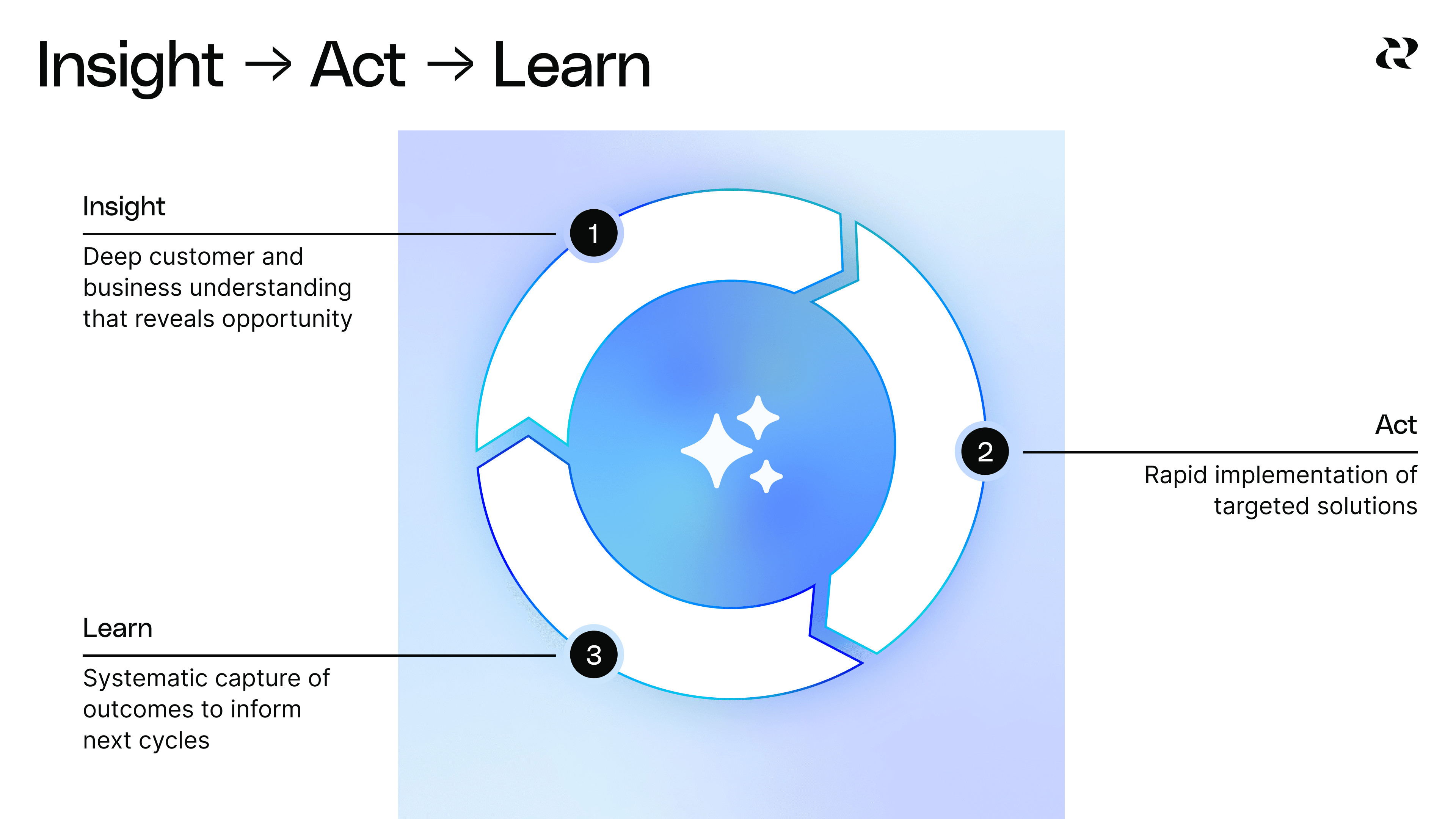
Speed isn't just about shipping faster, it's about accelerating your entire learning metabolism. The critical metric isn't feature velocity but rather your speed through the complete Insight → Act → Learn loop. This distinction separates products that compound advantages from those that compound technical debt.
As Morgan Brown, VP Product and Growth - AI Products at Dropbox said in a recent LinkedIn Post:
The right metric is insight per unit time. It’s the derivative of execution velocity, and it’s what actually drives compounding advantage.
The Fundamentals:
Insight: Deep customer and business understanding that reveals opportunity
Act: Rapid implementation of targeted solutions
Learn: Systematic capture of outcomes to inform next cycles
A core bottleneck to the Insight and Learn step is the Feedback Fragmentation Tax. This isn't merely an operational inconvenience, it's a vulnerability that compounds daily.
The core problem is that we collect more feedback from our customers than ever before, but it's scattered across many tools each with a different owner. This sets up the team for an impossible decision every time they want to be customer informed. Either:
Spend weeks gathering manual feedback from customers.
Go on a hunt through all the systems where this feedback already lives.
The reality is that this is so high friction, most teams just go with their gut or whatever is in motion resulting in speed without direction.
Reforge Insight Analytics: More Speed, Less Friction
Today we're shipping five targeted improvements to Reforge Insight Analytics that systematically compress the time between customer signal and product action. Each addresses a specific friction point where teams can spend hours that should be spent shipping.
The goal is simple: make good decisions as fast as you can build. Because when your only moat is learning faster than the competition, every minute matters.
1. Themes → Sub-themes: Find Root Causes in Seconds
"Customers are complaining about performance" tells you nothing actionable. Is it load times? Search speed? Video playback? You need specifics to act, but getting there could mean hours of manual analysis or exploration.
What's Shipping: Click any theme to instantly decompose it into subthemes. Then click those subthemes to go deeper. And deeper. Until you hit the exact root cause that needs fixing. Visualize the entire hierarchy to see how issues interconnect
Impact: What took 3-4 hours of manual exploration now takes 3-4 clicks. Your team get specific things to work on, not vague complaints to investigate.
2. Save → Customize → Organize: Turn One-Time Analysis into Reusable Intelligence
Every week, someone on your team recreates the same analysis. Every sprint planning, you hunt for that insight from three weeks ago. Every executive review, you rebuild the same reports from scratch.
What's Shipping:
Save a theme / subtheme into a report.
Customize the charts and other data for your exact needs.
Organize the reports into folders by team (”Growth Team,” “Platform,” etc), quarters (”Q2 OKR’s) , customer segments (”Enterprise” vs “SMB”), or however your team thinks.
Impact: Stop recreating the wheel. Start building a compound library of intelligence that makes every subsequent decision faster and more informed.
3. Contact, Account, & Segment Intelligence
Your biggest customer just escalated to the CEO. Now you're scrambling through Zendesk, Gong calls, support tickets, and feature requests trying to piece together what went wrong. By the time you understand the full picture, it's often too late.
What’s Shipping
Instant, unified intelligence for any contact, account, or custom segment—all feedback sources in one view.
Create a segment using natural language (no complex filters). Just type:
"Enterprise customers with low NPS"
“Users who mentioned ‘slow’ in the last 30 days”
“Customers that aren’t happy in the last quarter”
Impact
Account Managers: Prep for QBRs in minutes, not hours
Product Teams: Understand impact on specific segments and customers instantly
Sales Engineering: Walk into demos knowing exact customer pain points
4. Notifications 2.0: Intelligence That Finds You
More alerts don't create more action—they create alert fatigue that kills momentum.
What’s Shipping
Opportunity-Focused Alerts: Get notified about fastest-growing themes and significant positive trends only
Monday intelligence reports - Weekend insights aggregated into actionable weekly briefings
Reduced noise, increased signal - Fewer notifications, higher accuracy thresholds, weekday-only delivery
Impact
Start Monday with clarity, not chaos. Know exactly what matters without sifting through what doesn't.
5. Custom Integration Control: Your Data, Your Rules
Every team needs different data from Intercom, Zendesk, and other tools, but rigid integrations force you to accept everything or nothing. You need complete control over what data flows into your insight engine.
What’s Shipping
Field selection control - Choose which attributes to import (subscription tier, NPS score, renewal date, etc.)
Smart filtering rules - Define which records sync based on your criteria
Noise reduction - Bring in only the data that drives decisions
Impact
More control over data quality means faster insights and less noise. Built to scale to future integrations.
The Choice Is Binary
In the new world, you have two options:
Accept the status quo: Continue with the months long insight cycles while competitors compound advantages daily
Accelerate decisively: Compress weeks into hours and turn learning velocity into your only sustainable moat
The math is unforgiving. Every day you operate at legacy speeds, competitors pull further ahead. The gap compounds.
Let us help you make speed your moat
See how leading product teams are compressing their insight-to-action cycles from weeks to hours. Because in a world where advantages evaporate in weeks, the only question that matters is: How fast can you learn?


In a world where traditional moats can evaporate in weeks rather than years, speed has transformed from competitive advantage to baseline requirement. The New Bottleneck: Teams possess unprecedented ability to build and ship, yet lack the velocity to understand what deserves to be built. The bottleneck has shifted from execution to comprehension—from shipping code to shipping the right code.
The Erosion of Traditional Competitive Advantages
Jamin Ball of Altimeter Capital recently articulated what many product leaders are experiencing but struggling to name:
“A lot has been written about moats in software. Network effects. Switching costs. Proprietary data. Everyone wants to believe they’re building one. But I’ve come to believe the idea of a “long term moat” is mostly a myth, especially in this market. Moats aren’t permanent. They’re time-bound. At best, they function as a bridge. And companies either use that bridge to reach the next defensible position, or watch their moat get breached.
The real “long-term moat” is just a sequence of smaller moats stacked together. Each one buys time. And what you do with that time, how fast you execute, how quickly you evolve, determines whether you stay ahead. In the Age of AI, this is more true than ever. If the moat time window used to be 6–12 months, today it’s 2–3 weeks. “
James Currier of NFX recently stated:
“The AI revolution just ratcheted up the speed bar. You think you’re moving fast enough. You’re not. Now that generative AI is here, your definition of speed has to increase 10x.”
This isn’t merely investor philosophy, it’s operational reality. Windsurf grew to $50M ARR in a matter of months from launch and then got bought by OpenAI for $3B. In a recent podcast episode Varun Mohan (Founder + CEO of Windsurf) emphasized:
“The only moat in our category is speed. It’s learning where the dead bodies are, learning how to compound an advantage.”
The Speed Paradox in Product Development
In a world where traditional moats can evaporate in weeks rather than years, speed has transformed from competitive advantage to baseline requirement. Yet here lies the paradox: while building and shipping have never been faster (and accelerating), the insights to fuel that building remain trapped in 6-week archaeological expeditions through disconnected tools.
The New Bottleneck: Teams possess unprecedented ability to build and ship, yet lack the velocity to understand what deserves to be built. The bottleneck has shifted from execution to comprehension—from shipping code to shipping the right code.
Critical Questions for Product Leaders:
If competitors can replicate your features in weeks, how fast must you learn to maintain advantage?
When customer needs "rewrite themselves in real time," can you afford multi-week analysis backlog?
What's the true cost of perfect insights delivered too late versus good insights delivered immediately?
The answer isn't to abandon rigor for speed—it's to redesign the entire insight-to-action pipeline for a world where the only sustainable moat is learning faster than your competition compounds their advantages.
The Insight → Act → Learn Bottleneck
Speed isn't just about shipping faster, it's about accelerating your entire learning metabolism. The critical metric isn't feature velocity but rather your speed through the complete Insight → Act → Learn loop. This distinction separates products that compound advantages from those that compound technical debt.
As Morgan Brown, VP Product and Growth - AI Products at Dropbox said in a recent LinkedIn Post:
The right metric is insight per unit time. It’s the derivative of execution velocity, and it’s what actually drives compounding advantage.
The Fundamentals:
Insight: Deep customer and business understanding that reveals opportunity
Act: Rapid implementation of targeted solutions
Learn: Systematic capture of outcomes to inform next cycles
A core bottleneck to the Insight and Learn step is the Feedback Fragmentation Tax. This isn't merely an operational inconvenience, it's a vulnerability that compounds daily.
The core problem is that we collect more feedback from our customers than ever before, but it's scattered across many tools each with a different owner. This sets up the team for an impossible decision every time they want to be customer informed. Either:
Spend weeks gathering manual feedback from customers.
Go on a hunt through all the systems where this feedback already lives.
The reality is that this is so high friction, most teams just go with their gut or whatever is in motion resulting in speed without direction.
Reforge Insight Analytics: More Speed, Less Friction
Today we're shipping five targeted improvements to Reforge Insight Analytics that systematically compress the time between customer signal and product action. Each addresses a specific friction point where teams can spend hours that should be spent shipping.
The goal is simple: make good decisions as fast as you can build. Because when your only moat is learning faster than the competition, every minute matters.
1. Themes → Sub-themes: Find Root Causes in Seconds
"Customers are complaining about performance" tells you nothing actionable. Is it load times? Search speed? Video playback? You need specifics to act, but getting there could mean hours of manual analysis or exploration.
What's Shipping: Click any theme to instantly decompose it into subthemes. Then click those subthemes to go deeper. And deeper. Until you hit the exact root cause that needs fixing. Visualize the entire hierarchy to see how issues interconnect
Impact: What took 3-4 hours of manual exploration now takes 3-4 clicks. Your team get specific things to work on, not vague complaints to investigate.
2. Save → Customize → Organize: Turn One-Time Analysis into Reusable Intelligence
Every week, someone on your team recreates the same analysis. Every sprint planning, you hunt for that insight from three weeks ago. Every executive review, you rebuild the same reports from scratch.
What's Shipping:
Save a theme / subtheme into a report.
Customize the charts and other data for your exact needs.
Organize the reports into folders by team (”Growth Team,” “Platform,” etc), quarters (”Q2 OKR’s) , customer segments (”Enterprise” vs “SMB”), or however your team thinks.
Impact: Stop recreating the wheel. Start building a compound library of intelligence that makes every subsequent decision faster and more informed.
3. Contact, Account, & Segment Intelligence
Your biggest customer just escalated to the CEO. Now you're scrambling through Zendesk, Gong calls, support tickets, and feature requests trying to piece together what went wrong. By the time you understand the full picture, it's often too late.
What’s Shipping
Instant, unified intelligence for any contact, account, or custom segment—all feedback sources in one view.
Create a segment using natural language (no complex filters). Just type:
"Enterprise customers with low NPS"
“Users who mentioned ‘slow’ in the last 30 days”
“Customers that aren’t happy in the last quarter”
Impact
Account Managers: Prep for QBRs in minutes, not hours
Product Teams: Understand impact on specific segments and customers instantly
Sales Engineering: Walk into demos knowing exact customer pain points
4. Notifications 2.0: Intelligence That Finds You
More alerts don't create more action—they create alert fatigue that kills momentum.
What’s Shipping
Opportunity-Focused Alerts: Get notified about fastest-growing themes and significant positive trends only
Monday intelligence reports - Weekend insights aggregated into actionable weekly briefings
Reduced noise, increased signal - Fewer notifications, higher accuracy thresholds, weekday-only delivery
Impact
Start Monday with clarity, not chaos. Know exactly what matters without sifting through what doesn't.
5. Custom Integration Control: Your Data, Your Rules
Every team needs different data from Intercom, Zendesk, and other tools, but rigid integrations force you to accept everything or nothing. You need complete control over what data flows into your insight engine.
What’s Shipping
Field selection control - Choose which attributes to import (subscription tier, NPS score, renewal date, etc.)
Smart filtering rules - Define which records sync based on your criteria
Noise reduction - Bring in only the data that drives decisions
Impact
More control over data quality means faster insights and less noise. Built to scale to future integrations.
The Choice Is Binary
In the new world, you have two options:
Accept the status quo: Continue with the months long insight cycles while competitors compound advantages daily
Accelerate decisively: Compress weeks into hours and turn learning velocity into your only sustainable moat
The math is unforgiving. Every day you operate at legacy speeds, competitors pull further ahead. The gap compounds.
Let us help you make speed your moat
See how leading product teams are compressing their insight-to-action cycles from weeks to hours. Because in a world where advantages evaporate in weeks, the only question that matters is: How fast can you learn?