Reforge has joined Miro ↗
Launching a marketplace can be a tricky game. When it works, your users should have a frictionless experience: enough cars for a low wait time to go out to dinner, enough Airbnb hosts to meet your budget and location constraints, and enough profiles to swipe left or right on. But, it’s obvious when the marketplace is unbalanced. Suddenly your users are looking up taxi numbers, searching for hotels, or changing location settings just to solve their problem.
Established brands and marketplaces might have enough consumer loyalty to get away with a sub-par experience every now and then. But if you are looking to launch a new marketplace or in a new market, a sub-par user experience creates headwinds.
After you have confirmed there is demand for the marketplace idea, you likely will reach one of the most challenging parts of launching a marketplace: figuring out how to acquire enough supply for a positive marketplace experience.
While some product managers jump straight into different ways of acquiring a certain quantity of supply, there is an alternative option as well. Simply, restrict who or when folks can participate in a marketplace so that a good initial experience can happen with less supply.
“I repeatedly see people launching aspects of their marketplace where there’s not yet liquidity. They’re creating a really bad experience for people that hurts your brand and hurts your ability to re-engage consumers later.”
– Gemmy Tsai, former VP of Product at Solv Health
In this post, Gemmy Tsai will dive deep into exactly why you should restrict marketplace activity, and how to do it effectively.
Meet The Contributor
Why restricting marketplace activity can help find liquidity
In the early stages of a marketplace, you need to be very focused on figuring out how to get to liquidity. Liquidity is the measurement of the marketplace working: demand matched to supply.
To truly understand liquidity, marketplace product managers want to be able to understand who is successful in the marketplace and why they are successful. That gives you insight into the type of additional demand and supply you want to expand with. However, what most do not understand is it is equally as important to identify who is unsuccessful in a marketplace and define why.
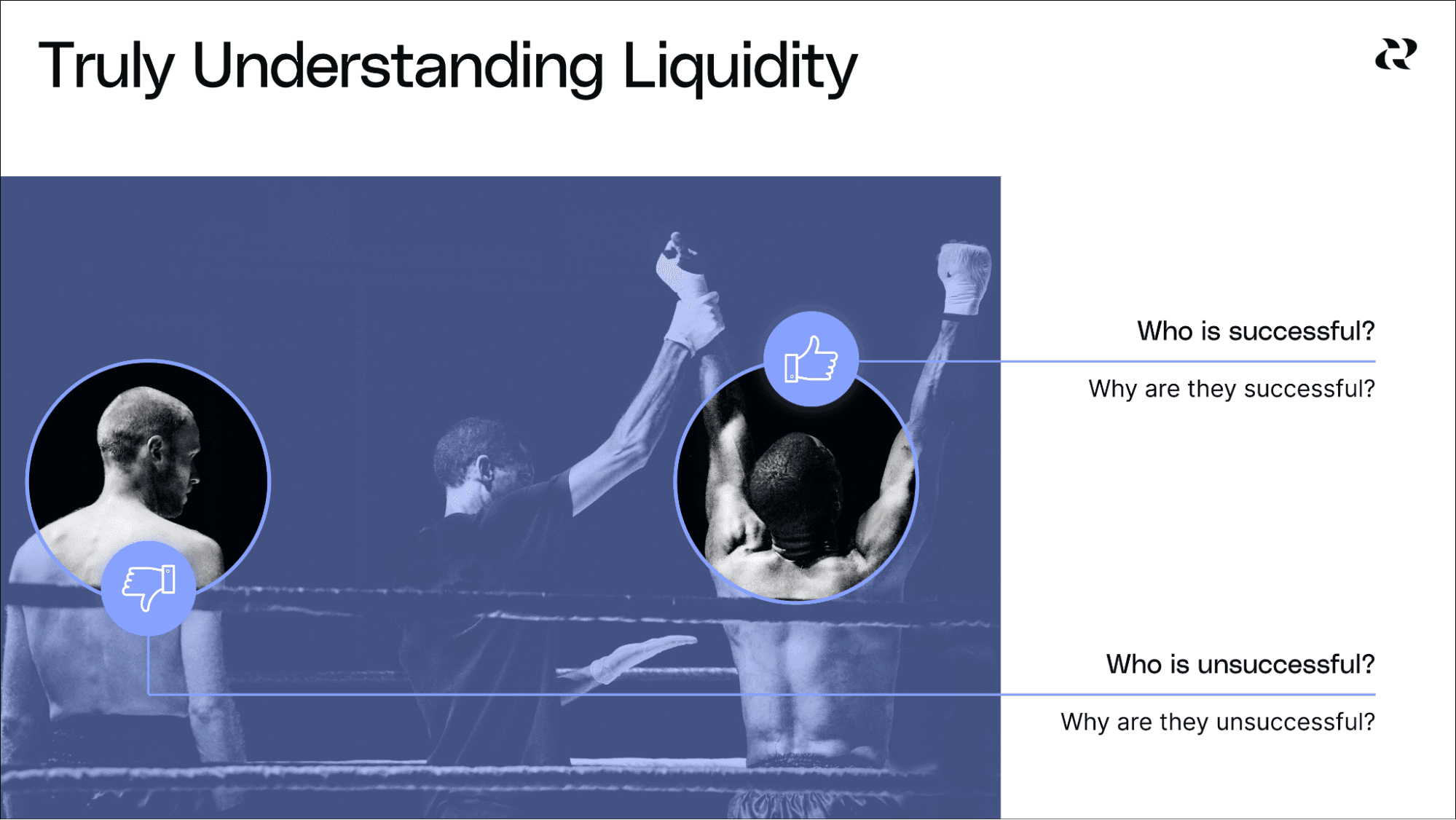
Negative experiences in the marketplace, especially early on, can be detrimental.
“Users - on either side - who aren’t seeing activity are effectively detractors of your marketplace. They aren’t having a good experience, they will churn, and it will be nearly impossible to resurrect them.”
— Gemmy Tsai
This search for liquidity is very hard, but restricting a marketplace can actually make it easier. Restricted marketplaces make it easier for supply and demand to find each other, enabling marketplace teams to focus on acquiring the right supply and demand rather than simply on the quantity of supply and demand. Tighter signals of liquidity also have far less noise - enabling faster iteration and more confidence in your path forward.
There are two methods to restrict marketplace activity:
Tightly define the definition of supply and demand
Time-restrict the marketplace activity
Method 1: Tightly define the definition of supply and demand
At the beginning of a marketplace business, most are not rigorous enough in narrowing the definition of the marketplace in the beginning. Instead, they are hyper-focused on growth on the demand and the supply side assuming that more on each side will lead to more liquidity.
“It’s a mistake I see marketplaces do all the time. They create a general purpose platform, have some users and some suppliers, and there’s just not much activity happening because it’s too broad.”
— Gemmy Tsai
Gemmy has found time and time again that assumptions, pre-launch, of what core characteristics lead to liquidity are just the first layer of characteristics and don’t lead to a differentiated, valuable experience. Once you launch with those assumptions, the marketplace has to be rigorous with holding itself to an incredibly high bar of activity to ensure users, on both sides, are getting a ton of value from the product.
For newer marketplaces, he recommends launching, figuring out where you’re getting liquidity, narrowing the definition, and focusing on that narrow definition before expanding further.
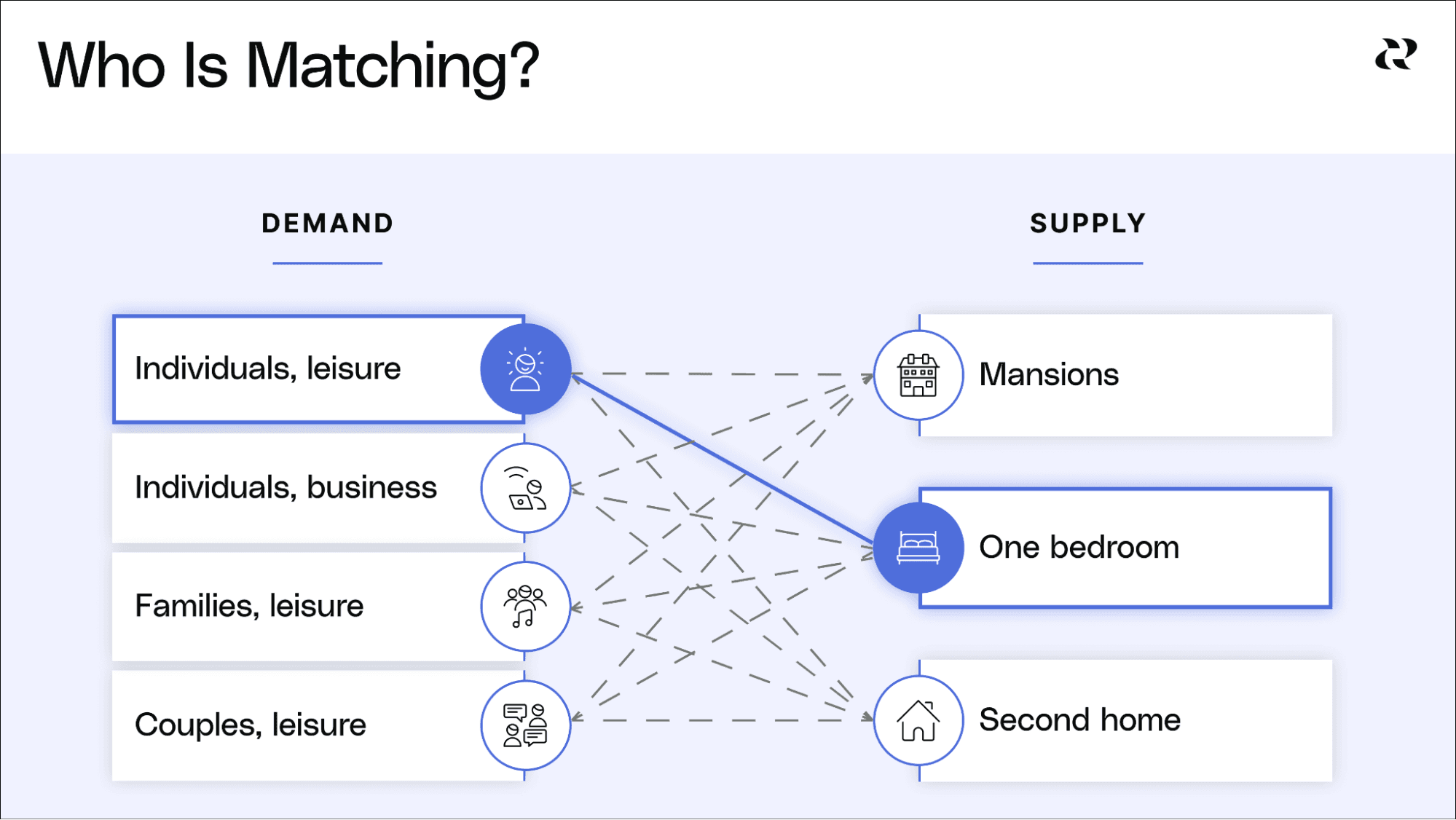
For example, if you are launching a house-sharing platform in San Francisco, it is not enough to just onboard supply and demand in San Francisco with the assumption that location is enough of a characteristic to inform a match. Once launched, you want to analyze marketplace activity to understand who is matching.
On the demand side, are they individuals, couples, or families? Are they traveling for leisure or business? On the supply side, are they mansions or only one bedrooms? Is it second homes or primary residences when a person is out of town? If individuals are looking for one-bedroom homes for leisure, then increasing the number of mansions on the platform won’t actually be making a more liquid experience.
“I think the benchmark for matching should be really high, like 90% of users. Ultimately, you’re wasting money to acquire the users who aren’t seeing activity and that is not the best return on investment, especially early on.”
—Gemmy Tsai
At Hired, Gemmy’s team strived to get 95% of job seekers to have at least one company reach out to them and to have an average of 5 companies per week reaching per user. They absolutely did not hit this target on the first try.
It took multiple rounds for the product team to realize they needed to really narrow their supply and demand to build positive momentum in their marketplace. They narrowed in on Ruby engineers at series A/B companies, not just software engineers. This narrowing created so much positive marketplace activity that Hired truly had a differentiated value proposition, and could consider growth from that position of strength.
The great part about this method is that all marketplaces can leverage it. You might also be able to leverage this method in conjunction with time restrictions.
Method 2: Time-restrict the marketplace activity
A time-restricted marketplace is when you wait to make the marketplace available to specific groups during set windows. The goal is to reach a critical mass of demand and supply at the same time. You can think of a time-restricted marketplace like a networking event. Instead of having a few people show up at different times, the planning team selects a specific time and place and then works to get people to show up.
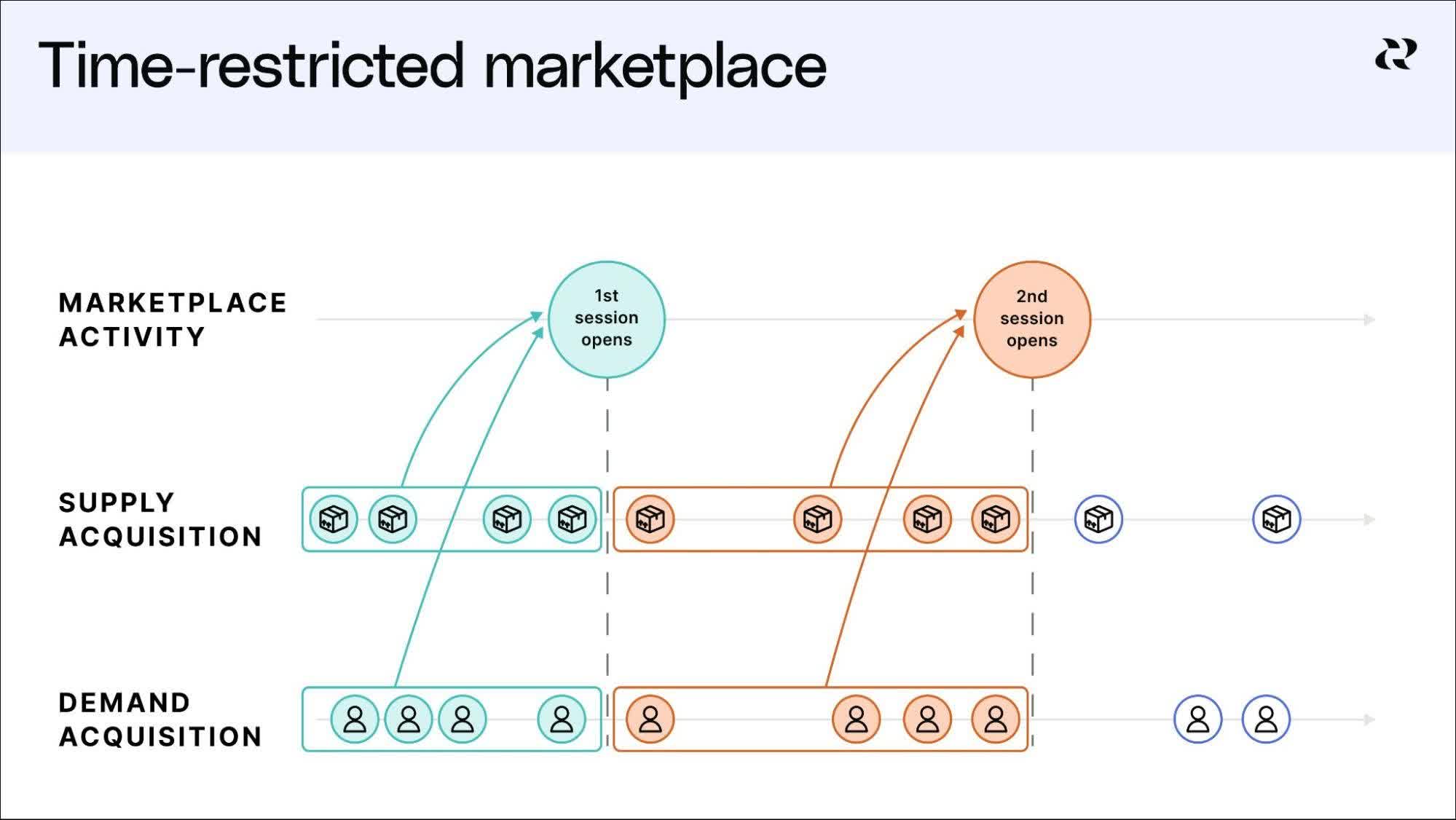
Time-restriction is a way to mitigate against a poor marketplace experience. If you showed up to a networking event and only a few people were there, you probably wouldn’t go back. Similarly, if a user is in a sub-liquid marketplace, there is a sizable risk of dissatisfaction and churn. While it can be tough to turn away the idea of constant activity, sometimes it’s better to optimize for quality and quantity of activity. The time in between the “open” marketplace allows the supply and demand teams to work on acquisition.
For example, Gemmy and his team were building a marketplace for job seekers and hiring companies at Hired. The marketplace experience would not have been interesting if a bunch of job seekers only had a couple companies to choose from. On the other side of the marketplace, companies would not have been happy if they only had a few applicants to consider. And it’s hard to get more of one side without the other!
In order to solve this problem, they decided to time-restrict the marketplace so job seekers could sign up in advance but could not interact with companies until enough companies were also acquired. Then, weekly, they would open the marketplace and in a concentrated amount of time, job seekers could demonstrate interest in a company and vice versa.
When to use time-restriction
Using time-restriction works best when the marketplace use case involves a high-consideration decision. On either side of the marketplace, people are usually willing to spend extra time waiting for a better outcome and are less likely to immediately jump to alternatives.
For example, in a talent marketplace, a job seeker is likely willing to wait to access as many top companies as possible because a job is a huge part of a person’s life.
Similarly, the company is likely to be willing to wait to see as many top candidates as possible because hiring a full-time employee can be a costly decision. In real estate, people selling homes want to optimize their chances of getting the best offer. People buying a home want to make sure they are picking the right one.
A time-restriction can even enhance your value proposition. Time-restriction provides a concentrated time to see all of the potential options. If you are on the demand side of the marketplace, you can compare all the suppliers against one another. If you are on the supply side of the marketplace, you have access to all the customers at the same time and can understand them relative to one another. Certain marketplace use cases become even more valuable if you can provide a high level of comparison between options.
However, unlike tightly defining supply and demand, a time-restriction does not work in every type of marketplace.
When time-restriction does not work
Time-restricted marketplaces do not work if the core use case is high urgency or if the use case frequency is once or more per week.
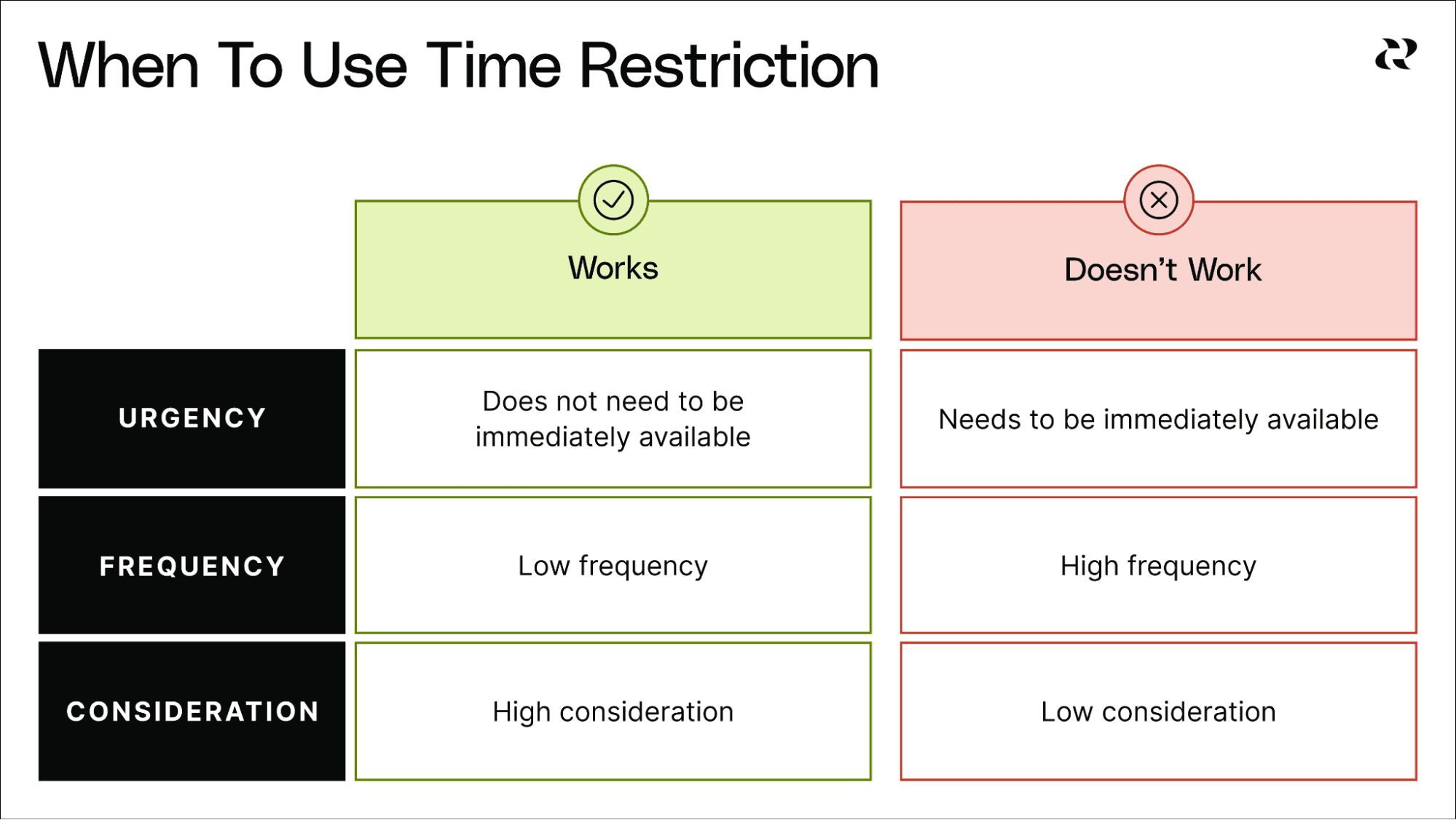
Because a time-restriction means there is a delay in accessing the other side of the marketplace, it does not work if the use case of the marketplace is around something with high urgency. For example, if you need to get to the airport, it is not helpful to not have immediate access to potential drivers. If you need to book an emergency medical appointment, you don’t want to be waiting for access to doctor’s offices or urgent care clinics.
Time-restriction also doesn’t work if the natural frequency of the use case happens more than once per week. For frequent use cases, it is important to build the habit of coming to the marketplace in order to build liquidity and restricting marketplace activity inhibits that. For example, if you are a grocery store delivery marketplace, you want to make sure shoppers always think to come to you. If a shopper comes to you and the stores are not available, they are likely not to come back the next time they need to shop.
While not all marketplaces can leverage time-restriction, those that can are able to really speed up learning velocity. Because the marketplace activity is limited, there should be immediate and high activity as soon as the marketplace is open. When there isn’t, this gives you an immediate signal that there is an issue in the marketplace dynamics. Especially early on in a marketplace, this can be a very helpful tool to see who is and is not successful.
Understand liquidity before expanding
Without a doubt, launching and growing a marketplace is extremely difficult. Especially in the early stages of your marketplace, developing a deep understanding of how your marketplace works is critical to setting the foundation for growth.
While it can be difficult to think about restricting marketplace activity, tightly defining the definition of supply and demand and time-restricting that activity can provide a strong user experience and fast learnings to facilitate growth.
To learn more about how to solve some of the hardest problems in growth and product, join Reforge today.
Launching a marketplace can be a tricky game. When it works, your users should have a frictionless experience: enough cars for a low wait time to go out to dinner, enough Airbnb hosts to meet your budget and location constraints, and enough profiles to swipe left or right on. But, it’s obvious when the marketplace is unbalanced. Suddenly your users are looking up taxi numbers, searching for hotels, or changing location settings just to solve their problem.
Established brands and marketplaces might have enough consumer loyalty to get away with a sub-par experience every now and then. But if you are looking to launch a new marketplace or in a new market, a sub-par user experience creates headwinds.
After you have confirmed there is demand for the marketplace idea, you likely will reach one of the most challenging parts of launching a marketplace: figuring out how to acquire enough supply for a positive marketplace experience.
While some product managers jump straight into different ways of acquiring a certain quantity of supply, there is an alternative option as well. Simply, restrict who or when folks can participate in a marketplace so that a good initial experience can happen with less supply.
“I repeatedly see people launching aspects of their marketplace where there’s not yet liquidity. They’re creating a really bad experience for people that hurts your brand and hurts your ability to re-engage consumers later.”
– Gemmy Tsai, former VP of Product at Solv Health
In this post, Gemmy Tsai will dive deep into exactly why you should restrict marketplace activity, and how to do it effectively.
Meet The Contributor
Why restricting marketplace activity can help find liquidity
In the early stages of a marketplace, you need to be very focused on figuring out how to get to liquidity. Liquidity is the measurement of the marketplace working: demand matched to supply.
To truly understand liquidity, marketplace product managers want to be able to understand who is successful in the marketplace and why they are successful. That gives you insight into the type of additional demand and supply you want to expand with. However, what most do not understand is it is equally as important to identify who is unsuccessful in a marketplace and define why.
Negative experiences in the marketplace, especially early on, can be detrimental.
“Users - on either side - who aren’t seeing activity are effectively detractors of your marketplace. They aren’t having a good experience, they will churn, and it will be nearly impossible to resurrect them.”
— Gemmy Tsai
This search for liquidity is very hard, but restricting a marketplace can actually make it easier. Restricted marketplaces make it easier for supply and demand to find each other, enabling marketplace teams to focus on acquiring the right supply and demand rather than simply on the quantity of supply and demand. Tighter signals of liquidity also have far less noise - enabling faster iteration and more confidence in your path forward.
There are two methods to restrict marketplace activity:
Tightly define the definition of supply and demand
Time-restrict the marketplace activity
Method 1: Tightly define the definition of supply and demand
At the beginning of a marketplace business, most are not rigorous enough in narrowing the definition of the marketplace in the beginning. Instead, they are hyper-focused on growth on the demand and the supply side assuming that more on each side will lead to more liquidity.
“It’s a mistake I see marketplaces do all the time. They create a general purpose platform, have some users and some suppliers, and there’s just not much activity happening because it’s too broad.”
— Gemmy Tsai
Gemmy has found time and time again that assumptions, pre-launch, of what core characteristics lead to liquidity are just the first layer of characteristics and don’t lead to a differentiated, valuable experience. Once you launch with those assumptions, the marketplace has to be rigorous with holding itself to an incredibly high bar of activity to ensure users, on both sides, are getting a ton of value from the product.
For newer marketplaces, he recommends launching, figuring out where you’re getting liquidity, narrowing the definition, and focusing on that narrow definition before expanding further.
For example, if you are launching a house-sharing platform in San Francisco, it is not enough to just onboard supply and demand in San Francisco with the assumption that location is enough of a characteristic to inform a match. Once launched, you want to analyze marketplace activity to understand who is matching.
On the demand side, are they individuals, couples, or families? Are they traveling for leisure or business? On the supply side, are they mansions or only one bedrooms? Is it second homes or primary residences when a person is out of town? If individuals are looking for one-bedroom homes for leisure, then increasing the number of mansions on the platform won’t actually be making a more liquid experience.
“I think the benchmark for matching should be really high, like 90% of users. Ultimately, you’re wasting money to acquire the users who aren’t seeing activity and that is not the best return on investment, especially early on.”
—Gemmy Tsai
At Hired, Gemmy’s team strived to get 95% of job seekers to have at least one company reach out to them and to have an average of 5 companies per week reaching per user. They absolutely did not hit this target on the first try.
It took multiple rounds for the product team to realize they needed to really narrow their supply and demand to build positive momentum in their marketplace. They narrowed in on Ruby engineers at series A/B companies, not just software engineers. This narrowing created so much positive marketplace activity that Hired truly had a differentiated value proposition, and could consider growth from that position of strength.
The great part about this method is that all marketplaces can leverage it. You might also be able to leverage this method in conjunction with time restrictions.
Method 2: Time-restrict the marketplace activity
A time-restricted marketplace is when you wait to make the marketplace available to specific groups during set windows. The goal is to reach a critical mass of demand and supply at the same time. You can think of a time-restricted marketplace like a networking event. Instead of having a few people show up at different times, the planning team selects a specific time and place and then works to get people to show up.
Time-restriction is a way to mitigate against a poor marketplace experience. If you showed up to a networking event and only a few people were there, you probably wouldn’t go back. Similarly, if a user is in a sub-liquid marketplace, there is a sizable risk of dissatisfaction and churn. While it can be tough to turn away the idea of constant activity, sometimes it’s better to optimize for quality and quantity of activity. The time in between the “open” marketplace allows the supply and demand teams to work on acquisition.
For example, Gemmy and his team were building a marketplace for job seekers and hiring companies at Hired. The marketplace experience would not have been interesting if a bunch of job seekers only had a couple companies to choose from. On the other side of the marketplace, companies would not have been happy if they only had a few applicants to consider. And it’s hard to get more of one side without the other!
In order to solve this problem, they decided to time-restrict the marketplace so job seekers could sign up in advance but could not interact with companies until enough companies were also acquired. Then, weekly, they would open the marketplace and in a concentrated amount of time, job seekers could demonstrate interest in a company and vice versa.
When to use time-restriction
Using time-restriction works best when the marketplace use case involves a high-consideration decision. On either side of the marketplace, people are usually willing to spend extra time waiting for a better outcome and are less likely to immediately jump to alternatives.
For example, in a talent marketplace, a job seeker is likely willing to wait to access as many top companies as possible because a job is a huge part of a person’s life.
Similarly, the company is likely to be willing to wait to see as many top candidates as possible because hiring a full-time employee can be a costly decision. In real estate, people selling homes want to optimize their chances of getting the best offer. People buying a home want to make sure they are picking the right one.
A time-restriction can even enhance your value proposition. Time-restriction provides a concentrated time to see all of the potential options. If you are on the demand side of the marketplace, you can compare all the suppliers against one another. If you are on the supply side of the marketplace, you have access to all the customers at the same time and can understand them relative to one another. Certain marketplace use cases become even more valuable if you can provide a high level of comparison between options.
However, unlike tightly defining supply and demand, a time-restriction does not work in every type of marketplace.
When time-restriction does not work
Time-restricted marketplaces do not work if the core use case is high urgency or if the use case frequency is once or more per week.
Because a time-restriction means there is a delay in accessing the other side of the marketplace, it does not work if the use case of the marketplace is around something with high urgency. For example, if you need to get to the airport, it is not helpful to not have immediate access to potential drivers. If you need to book an emergency medical appointment, you don’t want to be waiting for access to doctor’s offices or urgent care clinics.
Time-restriction also doesn’t work if the natural frequency of the use case happens more than once per week. For frequent use cases, it is important to build the habit of coming to the marketplace in order to build liquidity and restricting marketplace activity inhibits that. For example, if you are a grocery store delivery marketplace, you want to make sure shoppers always think to come to you. If a shopper comes to you and the stores are not available, they are likely not to come back the next time they need to shop.
While not all marketplaces can leverage time-restriction, those that can are able to really speed up learning velocity. Because the marketplace activity is limited, there should be immediate and high activity as soon as the marketplace is open. When there isn’t, this gives you an immediate signal that there is an issue in the marketplace dynamics. Especially early on in a marketplace, this can be a very helpful tool to see who is and is not successful.
Understand liquidity before expanding
Without a doubt, launching and growing a marketplace is extremely difficult. Especially in the early stages of your marketplace, developing a deep understanding of how your marketplace works is critical to setting the foundation for growth.
While it can be difficult to think about restricting marketplace activity, tightly defining the definition of supply and demand and time-restricting that activity can provide a strong user experience and fast learnings to facilitate growth.
To learn more about how to solve some of the hardest problems in growth and product, join Reforge today.