Reforge has joined Miro ↗
Ryan Berg shares the SEO and user acquisition strategies Zapier used to generate 7.3 million visitors per month.
Ryan Berg**, **growth marketing consultant, shares the SEO and user acquisition strategies Zapier used to generate 7.3 million visitors per month.
Key Quote
“Rather than trying to pitch users on the value of integrating tools, Zapier realized early on that people were already looking for specific integrations. To capture this existing intent, Zapier decided to make the app partners in their integration ecosystem the stars of their marketing and piggyback on their success.”
Our Key Takeaways
Ryan highlights the key strategies that have helped Zapier generate 7.3M visits a month, including 53% from organic search.
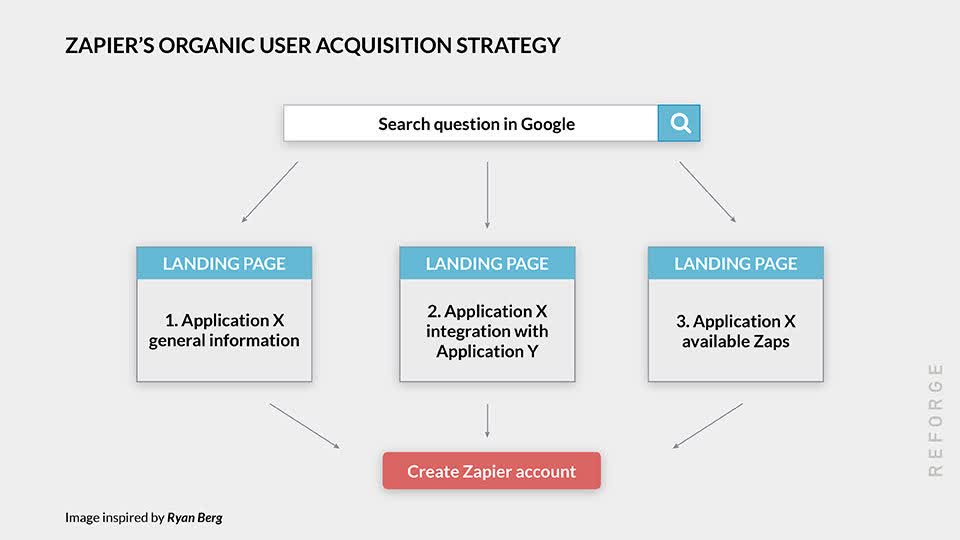
**Use multiple landing pages to capture maximum intent. **Zapier use three tiers of landing pages to capture a broad range of search intent: a landing page for every app (e.g., Gmail); another for every app-to-app integration (e.g., Gmail to Trello); and a final page for every app-to-app workflow (e.g., add email to a Trello card). Each page has a “templated structure and layout” combined with “human created descriptions.”
**Leverage partner resources. **Zapier encourages app partners to “write the content for these landing pages” and link to them once published. The team shares editorial guidelines to “clean up the content to make it a perfect fit for each landing page.”
**Scale quickly to build a moat. **The sheer scale of Zapier's content creation created a defensible moat. As Ryan explains, “Building 25,000 unique landing pages . . . adds an extra layer of difficulty for a competitor entering the same space.”
**Expand into new markets. **“Zapier also appears to be leveraging its network of app partners and landing pages to gain a foothold in the app discovery market, going up against players like G2crowd and Getapp for many of the same search terms.”
**Use context-specific CTAs to generate sign-ups. **“Zapier provides a call to action focused on the specific integration visitors were searching for.” The team keeps the sign-up flow as direct as possible, bypassing any *“central dashboard or control panel” *and allowing users to immediately set up a functioning integration.
Why We Think This Matters
Zapier's strategy is so effective because it triggers a powerful growth loop:
New app partners → new integrations and landing pages → new users → new app partners
As Brian Balfour, Casey Winters, Kevin Kwok, and Andrew Chen explored in Growth Loops are the New Funnels, it's these “virtuous cycles of growth” that create defensible, scalable businesses:
“The fastest growing products are better represented as a system of loops, not funnels. . . . Loops combine how your product, channel, and monetization model work together in a single system rather than treating them as silos. As a result they end up being more specific to your product and company making them harder for others to replicate."
Summarized by Reforge. Original article by Ryan Berg • Growth Marketing Consultant
Ryan Berg shares the SEO and user acquisition strategies Zapier used to generate 7.3 million visitors per month.
Ryan Berg**, **growth marketing consultant, shares the SEO and user acquisition strategies Zapier used to generate 7.3 million visitors per month.
Key Quote
“Rather than trying to pitch users on the value of integrating tools, Zapier realized early on that people were already looking for specific integrations. To capture this existing intent, Zapier decided to make the app partners in their integration ecosystem the stars of their marketing and piggyback on their success.”
Our Key Takeaways
Ryan highlights the key strategies that have helped Zapier generate 7.3M visits a month, including 53% from organic search.
**Use multiple landing pages to capture maximum intent. **Zapier use three tiers of landing pages to capture a broad range of search intent: a landing page for every app (e.g., Gmail); another for every app-to-app integration (e.g., Gmail to Trello); and a final page for every app-to-app workflow (e.g., add email to a Trello card). Each page has a “templated structure and layout” combined with “human created descriptions.”
**Leverage partner resources. **Zapier encourages app partners to “write the content for these landing pages” and link to them once published. The team shares editorial guidelines to “clean up the content to make it a perfect fit for each landing page.”
**Scale quickly to build a moat. **The sheer scale of Zapier's content creation created a defensible moat. As Ryan explains, “Building 25,000 unique landing pages . . . adds an extra layer of difficulty for a competitor entering the same space.”
**Expand into new markets. **“Zapier also appears to be leveraging its network of app partners and landing pages to gain a foothold in the app discovery market, going up against players like G2crowd and Getapp for many of the same search terms.”
**Use context-specific CTAs to generate sign-ups. **“Zapier provides a call to action focused on the specific integration visitors were searching for.” The team keeps the sign-up flow as direct as possible, bypassing any *“central dashboard or control panel” *and allowing users to immediately set up a functioning integration.
Why We Think This Matters
Zapier's strategy is so effective because it triggers a powerful growth loop:
New app partners → new integrations and landing pages → new users → new app partners
As Brian Balfour, Casey Winters, Kevin Kwok, and Andrew Chen explored in Growth Loops are the New Funnels, it's these “virtuous cycles of growth” that create defensible, scalable businesses:
“The fastest growing products are better represented as a system of loops, not funnels. . . . Loops combine how your product, channel, and monetization model work together in a single system rather than treating them as silos. As a result they end up being more specific to your product and company making them harder for others to replicate."
Summarized by Reforge. Original article by Ryan Berg • Growth Marketing Consultant