Reforge has joined Miro ↗
Patrick Campbell, Co-founder & CEO @ ProfitWell, takes a look at the data behind the content marketing efforts at 3,000 companies to see how it is working.
Patrick Campbell, Co-founder & CEO @ ProfitWell, takes a look at the data behind the content marketing efforts at 3,000 companies to see how it is working:
Key Quote
"When comparing overall growth rates between companies deploying a content strategy with those who aren’t, the content companies are seeing roughly 30% higher growth rates than folks not using content marketing."
Our Takeaways
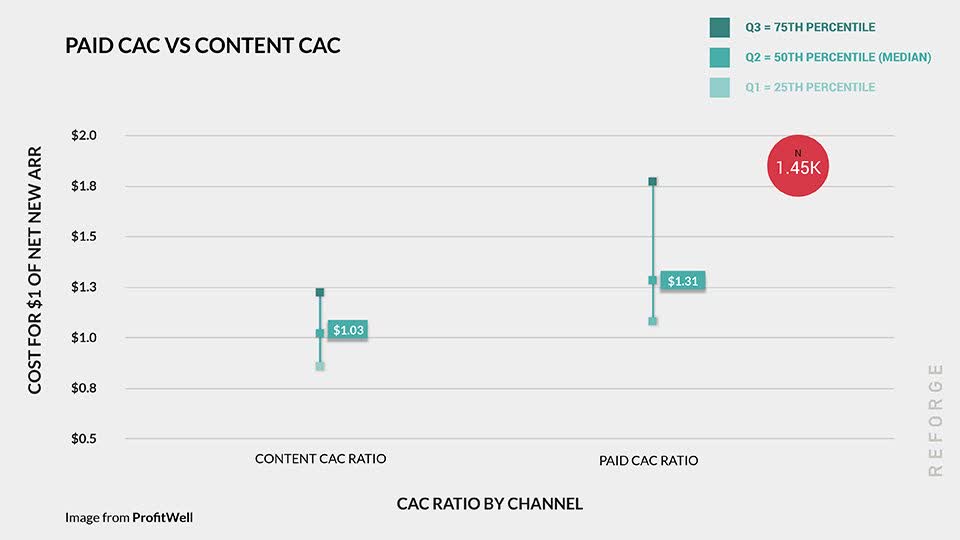
Lower customer acquisition costs. Customer acquisition costs from content marketing are 15% less than paid acquisition. Even as content is becoming more competitive, and building differentiated content is becoming increasingly challenging, the data from ProfitWell indicates lower expenses for content marketing.
Content enables the sales cycle. The data shows that 47% of buyers view 3-5 pieces of content before they talk with a sales rep. Inbound marketing close rates are 8 to 10 times those of outbound marketing. And companies with a blog generate 67% more leads than those without one.
Content fuels overall growth. Companies with a content strategy have a 30% higher growth rate than those who do not. In addition, the data shows that companies with a content strategy have a 5 to 10% better customer retention rate.
Why We Think It Matters
Creating great content is tough. Plus, it's only getting more difficult as content distribution channels become more saturated. Previously at Reforge, we talked with Ipsy's Spencer McClung about the role content plays with their customers in their product.
"Most customers don’t start as customers; they start as people looking for information around a general problem. The job of content marketing is to sharpen their awareness around that problem and then to offer trustworthy information about possible solutions (but not necessarily branded ones). Finally, in the last stages of customer awareness, when leads have been nurtured and qualified by the previous stages, content introduces a product — whether that’s a specific eyebrow pencil or a SaaS tool."
Summarized by Reforge. Original article by Patrick Campbell • CEO @ ProfitWell
Patrick Campbell, Co-founder & CEO @ ProfitWell, takes a look at the data behind the content marketing efforts at 3,000 companies to see how it is working.
Patrick Campbell, Co-founder & CEO @ ProfitWell, takes a look at the data behind the content marketing efforts at 3,000 companies to see how it is working:
Key Quote
"When comparing overall growth rates between companies deploying a content strategy with those who aren’t, the content companies are seeing roughly 30% higher growth rates than folks not using content marketing."
Our Takeaways
Lower customer acquisition costs. Customer acquisition costs from content marketing are 15% less than paid acquisition. Even as content is becoming more competitive, and building differentiated content is becoming increasingly challenging, the data from ProfitWell indicates lower expenses for content marketing.
Content enables the sales cycle. The data shows that 47% of buyers view 3-5 pieces of content before they talk with a sales rep. Inbound marketing close rates are 8 to 10 times those of outbound marketing. And companies with a blog generate 67% more leads than those without one.
Content fuels overall growth. Companies with a content strategy have a 30% higher growth rate than those who do not. In addition, the data shows that companies with a content strategy have a 5 to 10% better customer retention rate.
Why We Think It Matters
Creating great content is tough. Plus, it's only getting more difficult as content distribution channels become more saturated. Previously at Reforge, we talked with Ipsy's Spencer McClung about the role content plays with their customers in their product.
"Most customers don’t start as customers; they start as people looking for information around a general problem. The job of content marketing is to sharpen their awareness around that problem and then to offer trustworthy information about possible solutions (but not necessarily branded ones). Finally, in the last stages of customer awareness, when leads have been nurtured and qualified by the previous stages, content introduces a product — whether that’s a specific eyebrow pencil or a SaaS tool."
Summarized by Reforge. Original article by Patrick Campbell • CEO @ ProfitWell