Reforge has joined Miro ↗
Before a product team gets a feature from 0 to 1, or launches the next version of the iPhone on time, they have to figure out how to work together.
Yet, so many product leaders overlook the most important part of enabling the product team to work towards their goals.
You might think that the product roadmap is the foundation of a team's success or that a product requirements document is the foundation of a successful feature build, but it's actually the product team structure that gets the entire machine to work.
A well-built product team structure is the difference between a group of product managers getting bogged down in figuring out who is supposed to do what and every person knowing precisely what they are accountable to at every point in the product development process.
If product managers don't know what their role on the team is, success is an uphill battle.
“The org chart can either help you achieve your strategy or get completely in the way.”
*—*Ravi Mehta, Former Chief Product Officer at Tinder
And if product leaders don’t realize how critical team structure is, they usually organize the team based on what is easiest or most convenient. More times than not, this creates unnecessary challenges toward achieving a productive, efficient team.
On the other hand, a well-structured product team is greater than the sum of its parts.
It leads to an efficient product team where:
Strategic priorities are properly resourced
Goals are evident and task priorities are clear
Decisions are made and communicated quickly
Dependencies will make sense and operate efficiently
This article, inspired by a lesson in our Product Leadership Program and created with Ravi Mehta, will walk you through the four types of product team structures and how to determine what team structure is right for your product team.
The Product Organization Matrix
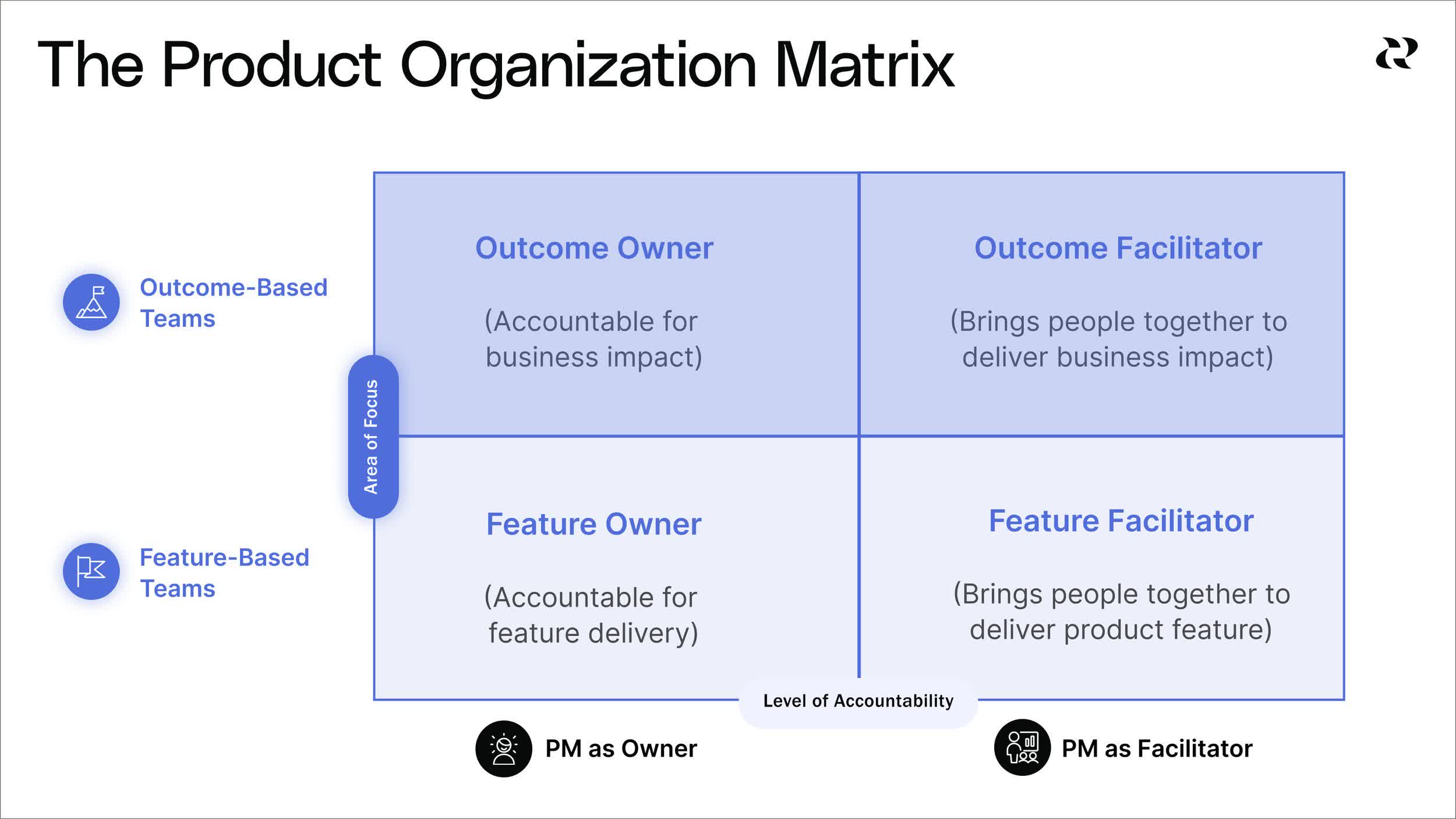
Because of the nature of product work, there are two vectors that product teams need to be organized around: area of focus and level of accountability.
For area of focus, product teams can align their work with either business outcomes or feature development.
When considering the level of accountability part of the structure, product managers either act as fully responsible owners of the work or as facilitators of the work, where they share metrics responsibilities with cross-functional partners.
By considering these two ways to evaluate the product manager role at your company, we can create what we call the Product Organization Matrix:
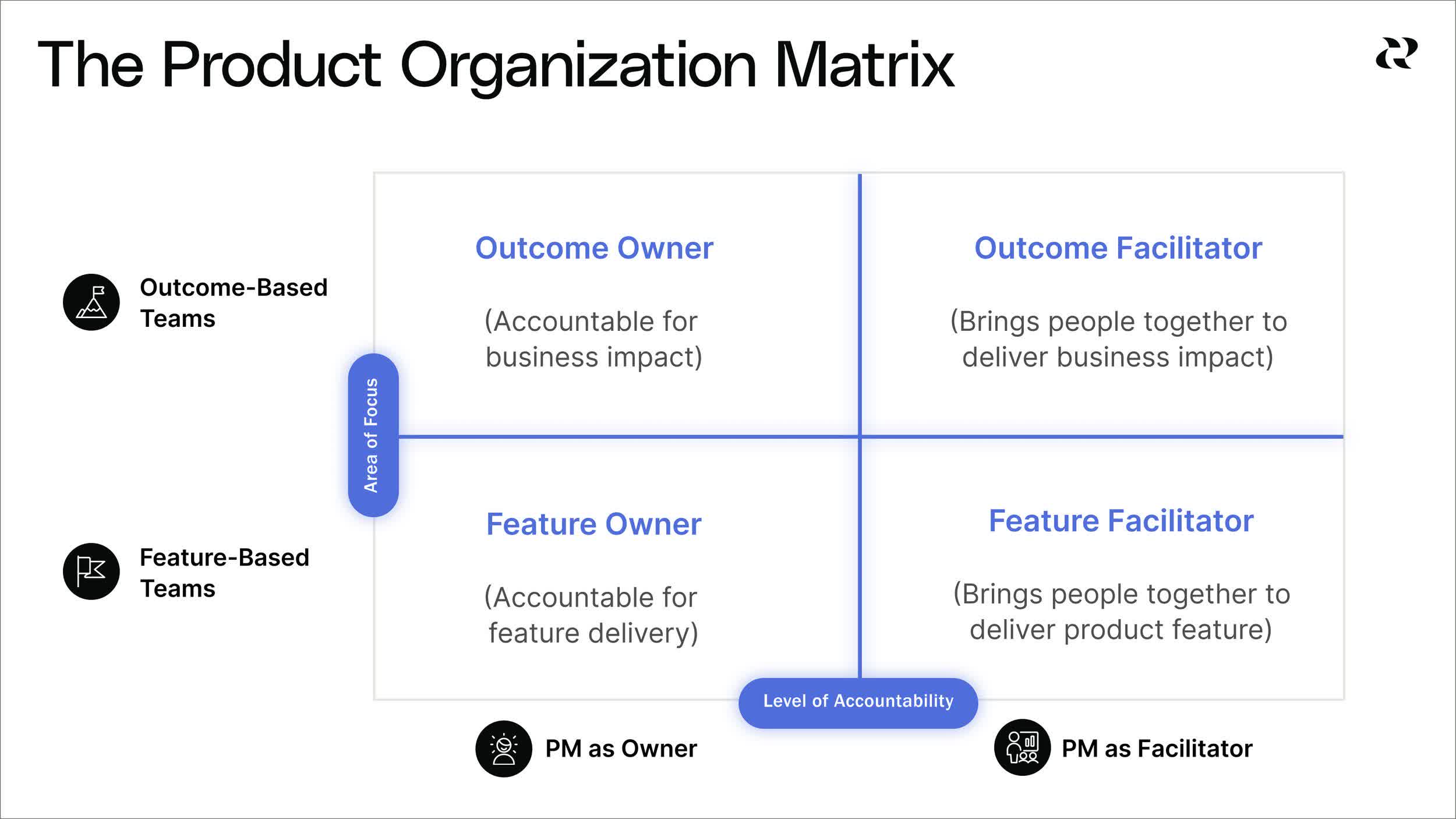
Designed by Ravi Mehta, the Product Organization Matrix helps product leaders see the tradeoffs and explicit decisions they need to make while building a product team structure.
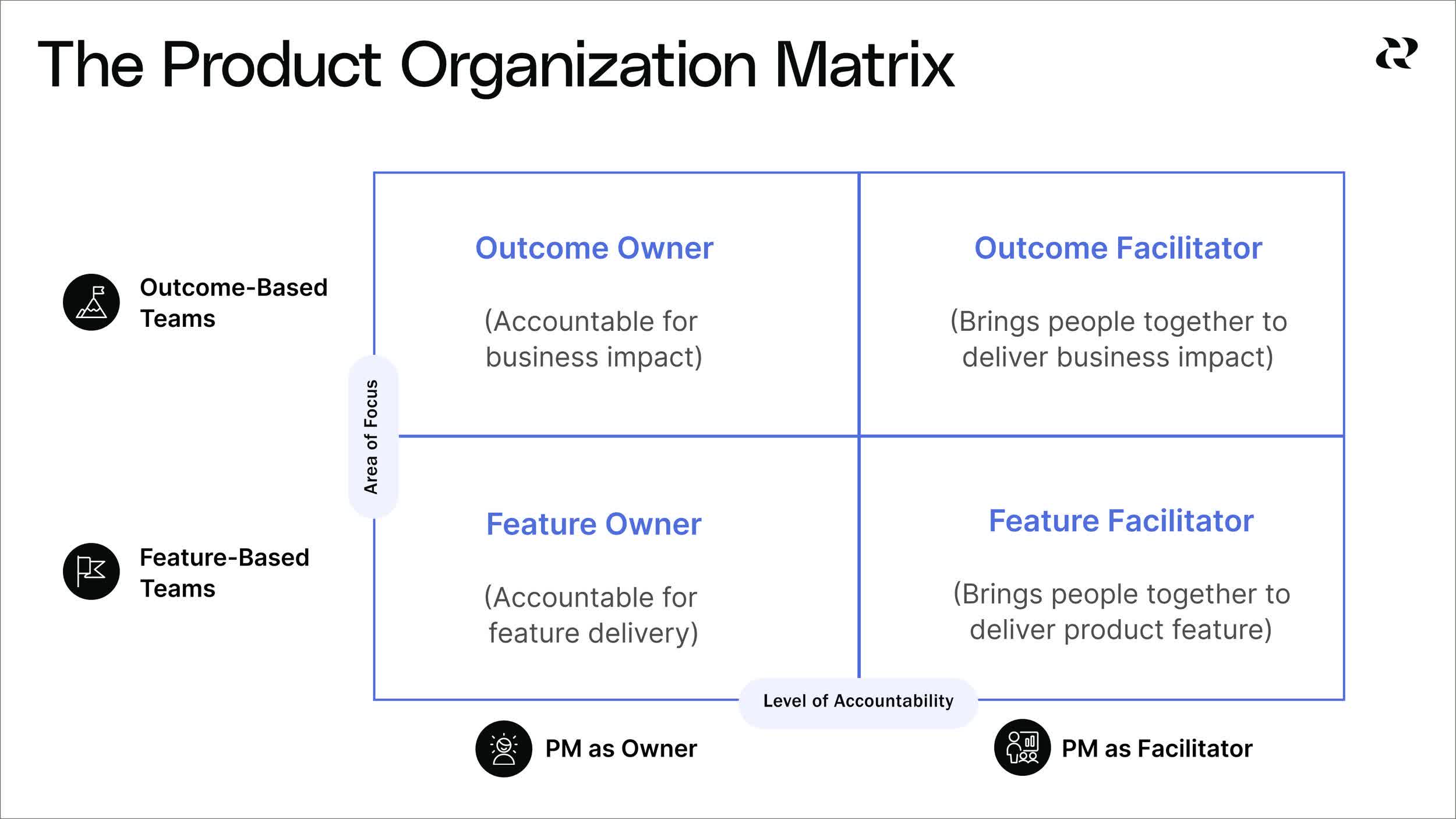
Based on where a team lands on the area of focus and level of accountability matrix, there are four possible product team structures:
Business Outcomes: Outcome Owner
Business Outcomes: Outcome Facilitator
Feature Development: Feature Development Owner
Feature Development: Feature Development Facilitator
Each of these team structures can maximize the impact and efficiency of your team, but you have to take the time to pick the right one using the Product Organization Matrix.
It’s important to remember that a team structure that works perfectly for one product team could be detrimental for another one.
4 Effective Product Team Structures
The Product Organization Matrix is an essential resource when you start thinking about how to organize your product team, whether you're structuring your first product team, joining a new organization, or restructuring your existing team to meet strategic needs.
Now let’s take a deeper dive into the different team structures.
Product Team Structure 1: Outcome Owner
In the upper left-hand corner of the Product Organization Matrix is the Outcome Owner team structure. The Outcome Owner team structure is exactly what it sounds like; the area of focus is business outcomes where the product manager holds the accountability.
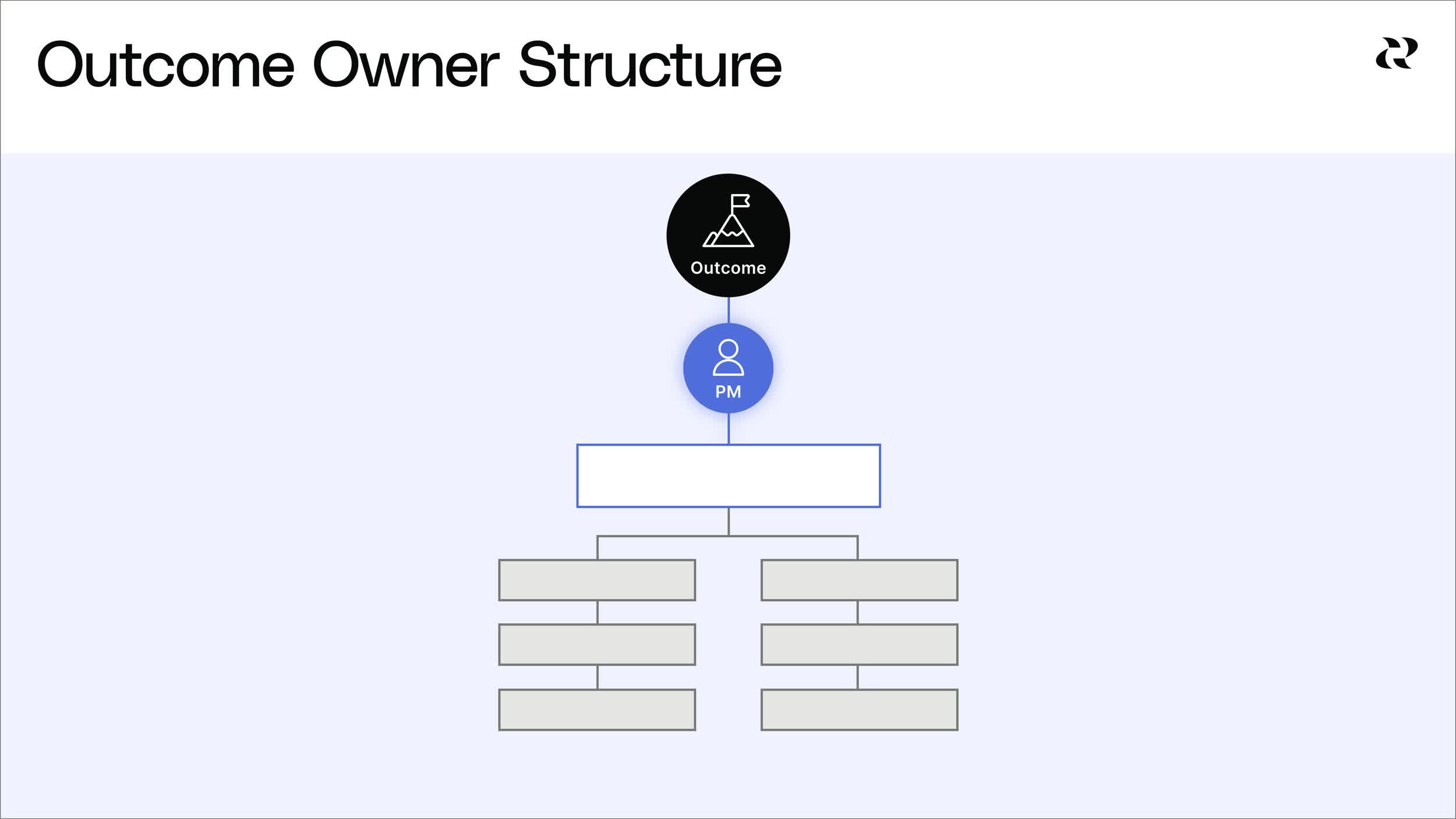
For example, for a social product like TikTok, a product manager might be focused on increasing the total direct messages sent per user. In the Outcome Owner structure, the decisions the product manager makes should tie back to that business outcome.
The product manager has the autonomy to make important decisions about how the team (the engineers, designers, and others who are working cross-functionally with the product organization) should drive the outcome they need to achieve. They are also responsible for what happens after they make those decisions.
Product Team Structure 2: Outcome Facilitator
On the top right of the Product Organization Matrix, you will find the Outcome Facilitator team structure.
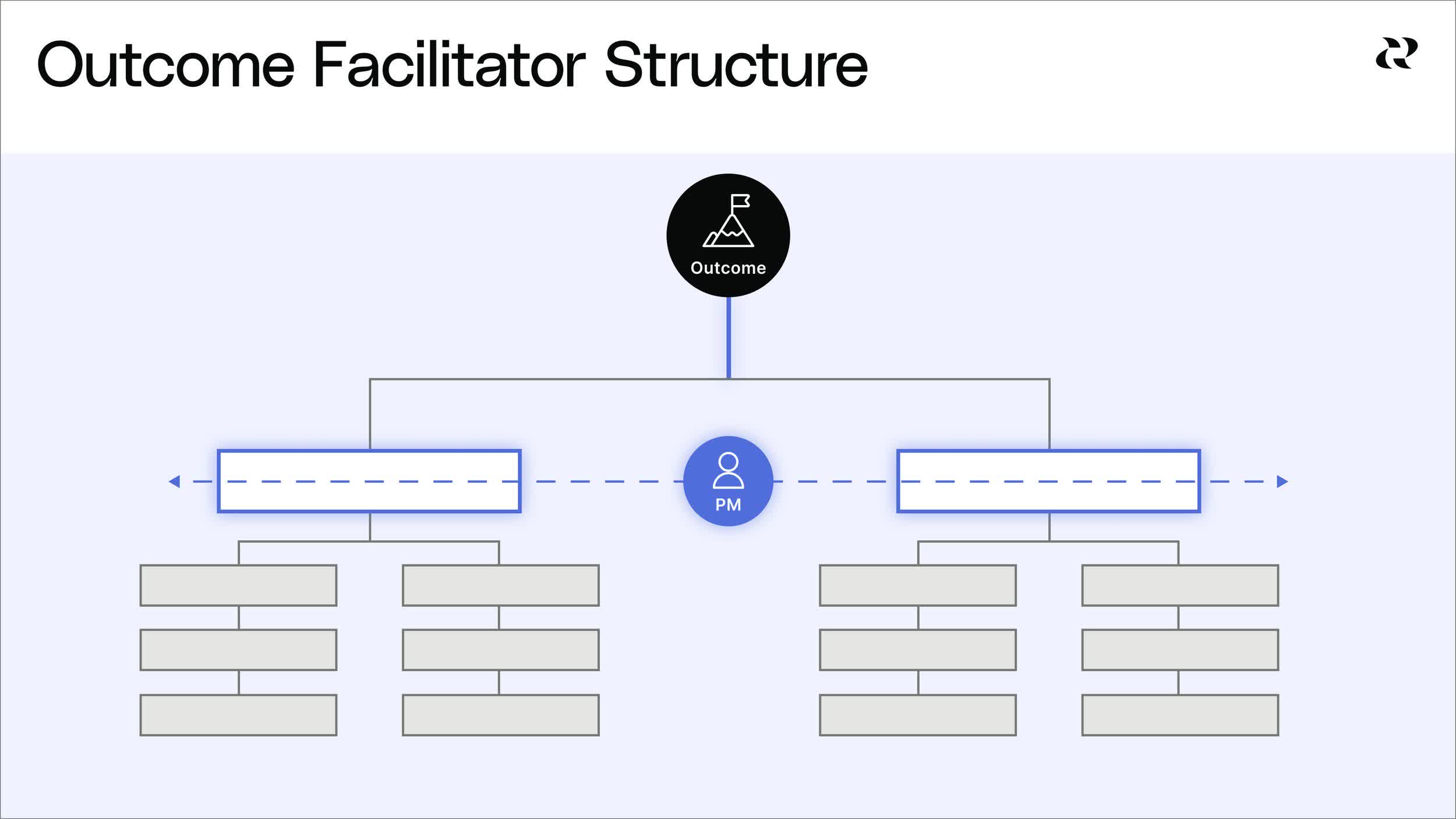
In this product team structure, the team is still highly focused on driving a business outcome, but the product manager is not solely accountable. Rather, the set of cross-functional leads are held equally accountable for this metric or outcome, and the product manager’s core role is to facilitate decision-making among the group.
Product Team Structure 3: Feature Owner
Now we are moving into the Feature-based product team structures, in the bottom half of the matrix. Instead of business outcomes, teams organized this way are divided by features or feature areas.
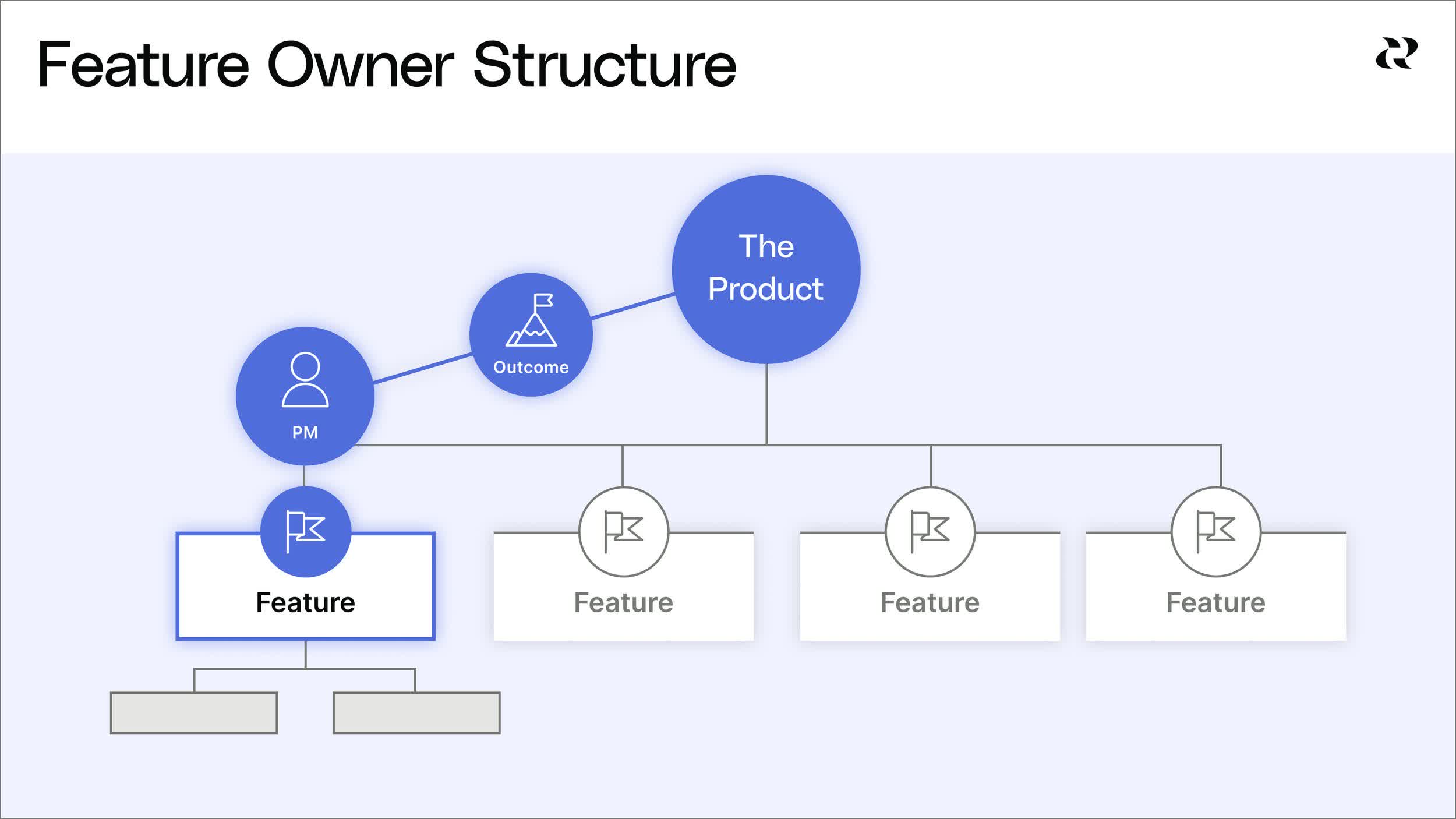
For example, a product manager for a social product might be focused on messaging, so would be looking at a suite of things related to the messaging tool rather than looking across features to increase direct messages per user (our outcomes based example).
In the Feature Owner structure, similar to the Outcome Owner structure, the product manager is fully responsible, making decisions about the feature area and being accountable for its success.
Product Team Structure 4: Feature Facilitator
The last product team structure is the Feature Facilitator, where the product manager, you guessed it, acts as a facilitator.
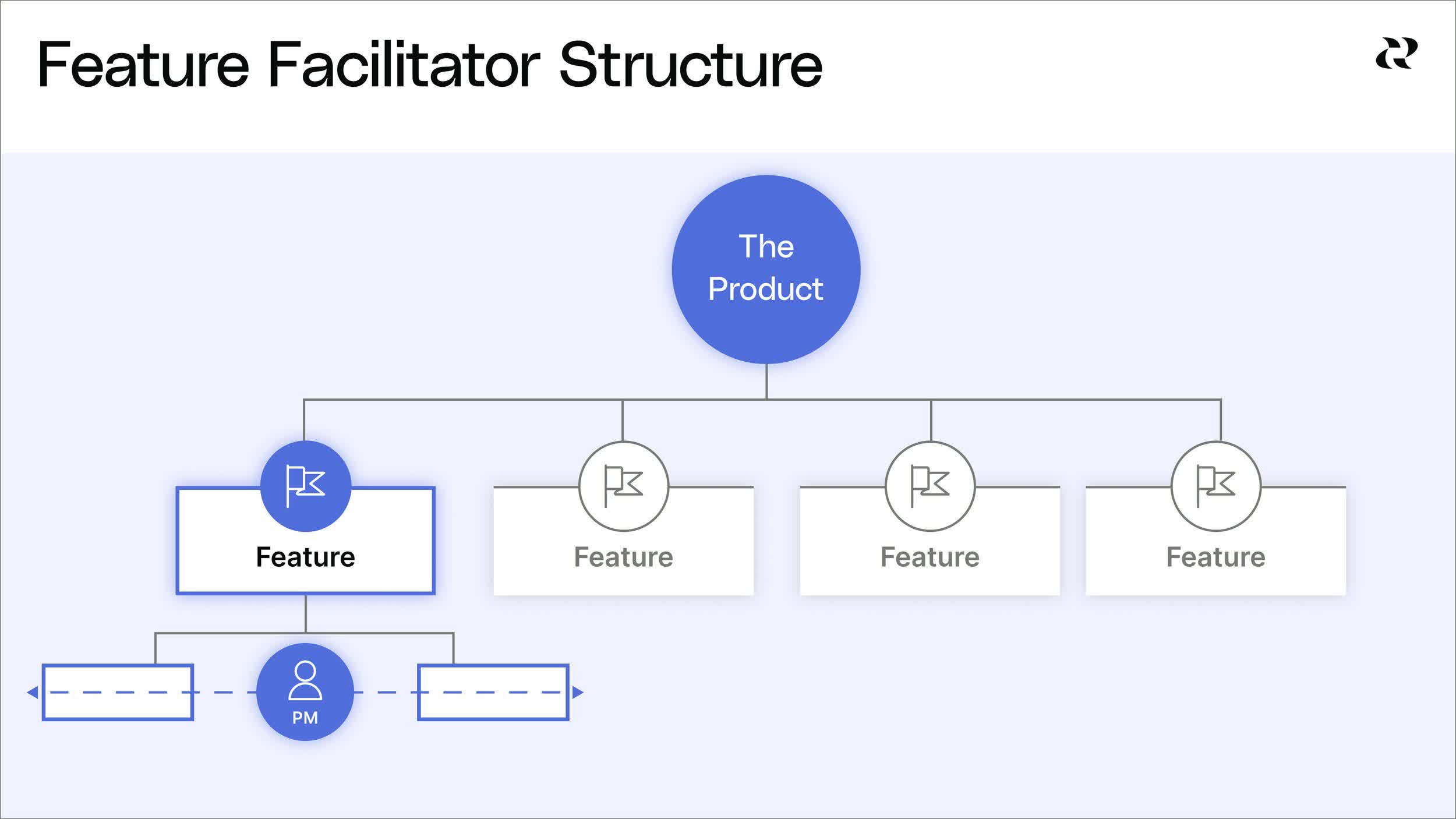
This team structure can be found on the bottom right of the Product Organization Matrix. Similar to the Outcome Facilitator structure, the product manager functions as a coordinator that works with the cross-functional team to define, develop, and deliver features.
How to Pick the Right Product Team Structure
With the four structure options in mind, the next step is to choose the structure that works best for your product.
There are instances in which you might want to combine structures, such as having some teams organized around outcomes and some teams organized around features.
The perfect organizational structure doesn’t exist, so what is most important?
“Pick a lane, and then optimize for the tradeoffs that come with that lane.”
— Ravi Mehta
To make that decision,we suggest thinking through two key questions:
Should your team be organized by outcomes or features?
Should your product team’s role be to own or to facilitate?
1. Should the product team organize by business outcomes or features?
Determining if you should organize by features versus outcomes is in large part determined by the stage and maturity of your company with its business metrics.
Organizing Product Teams By Features
Most product leaders organize teams by features because it’s an intuitive way to split up a product.
There are clear pros of building your team around features including:
It ensures no features fall through the cracks.
Product managers clearly understand their role.
Standing up a team is relatively easy because the work gets divided in a way that is clear-cut and intuitive.
However, there are a few things to watch out for with this team structure:
First, the team needs to map its features to the right outcomes to stay focused on driving business value, not just shipping features.
Second, if the team loses focus and begins creating features that don’t ladder up to the larger goals of the organization, they can become inefficient — even if the features they create deploy on time.
As the leader, it will be harder for you to objectively evaluate the team’s ability to deliver on business impact, given they aren’t mapped to specific outcomes.
Organizing Product Teams By Business Outcomes
Now let’s look at the implications of organizing your team structure by business outcomes.
First, it’s important to know that a prerequisite to using this model is that leaders must know what the business outcomes are. And teams need to have a strong grasp on what levers to pull to directly impact business outcomes.
As a result, this organizational structure works best for companies that have achieved product market fit and for features that have achieved feature-product fit.
If your company is ready to organize around business outcomes, the main benefit is simple but extremely compelling: Outcome-based models help clarify accountability to actual business outcomes.
In other words, your product team will know the type and level of impact they are making at the company.
If you choose to use an outcome-based model, there are two additional pitfalls to watch out for:
Outcomes can often be defined at too high a level.
Maintenance tasks can fall through the cracks because no team owns specific features.
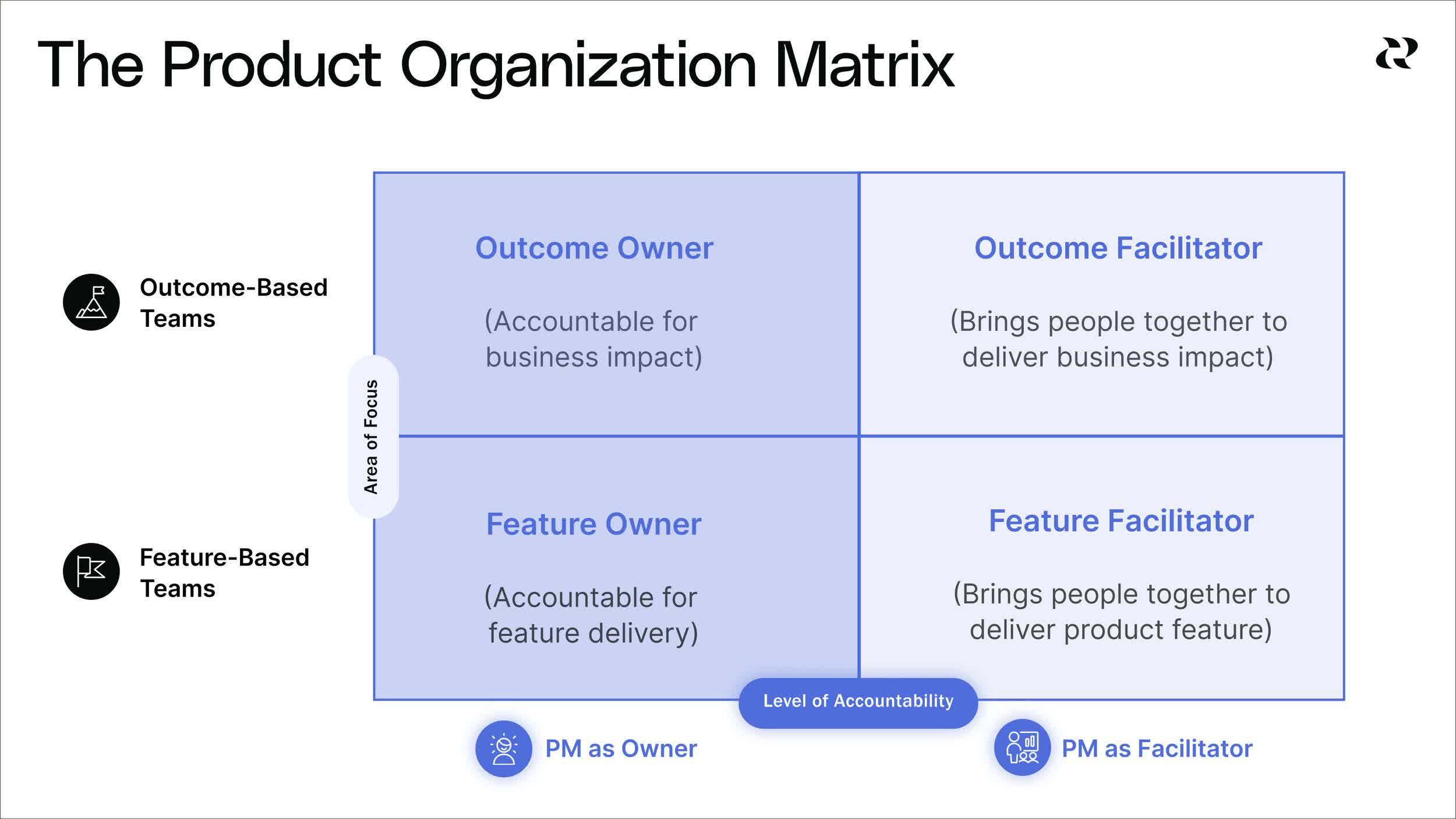
2. Should the product team's role be to own or to facilitate?
To be successful, product managers in your organization need to know if you expect them to own decisions and outcomes or facilitate them in coordination with cross-functional peers.
Both models require a cross-functional partnership with engineering, design, user research, and others, but the ways to engage and the expectations of different stakeholders change. Let’s review both models.
Product Team Owns Decisions & Outcomes
In team structures where product managers are owners, they are responsible for the decisions and accountable for the outcomes. Two things need to happen for this to work.
First, you must ensure that the product manager has the autonomy to make decisions. If a product manager’s decisions are constantly changed or overruled, the product manager will not be incentivized to make bold, opinionated decisions.
Additionally, you will need to monitor the product manager’s style to make sure it does not become dictatorial, which can demotivate and damage cross-functional relationships.
When set up correctly, this structure can help optimize organizations that have limited resources from cross-functional partners.
Product Team Facilitates Decisions & Outcomes
The alternative to fully owning decisions and outcomes is for the product manager to facilitate decisions among cross-functional partners. With the structures that use this model, cross-functional leads are equally accountable for the team’s output and share in the decision-making rights.
This team structure can be very powerful but it doesn’t work if only the product manager is accountable for the outcomes rather than the whole cross-functional team. This becomes apparent if cross-functional leads are promoted if the objective is not met but a product manager isn’t.
Slow decision-making can also result from this structure because there is a need to get buy-in from each member.
And finally, different team members and functions can suffer from lopsided resourcing. Partners need to be dedicated to adequate staffing if the facilitator team structure is going to work. This works best when cross-functional leads can be fully dedicated.
Despite the challenges, if you are able to stand up a facilitation model, it incentivizes the team to work together and the product decisions benefit from the collective wisdom of the group.
Picking the Perfect Product Team Structure is Difficult
Ultimately, there is no right or wrong answer.
If you have the staffing and internal communication to create shared accountability, a Feature-Facilitator or Outcome-Facilitator team structure could work really well for you. If you have not yet determined what the key levers of your business are, you might want to rely on a feature structure and task the team with constantly evaluating if their features are leading to business value.
As a company or team evolves, you might have to switch up the team structure. That’s not a negative thing at all — as the team structure should match the strategy — and it’s natural that a strategy will change.
What is most important is to be thoughtful about what model you choose, reduce uncertainty on the role of the product manager, and be open to optimizing for the tradeoffs your model choice brings.
Interested in digging deeper into leading and structuring your product team? Sign up now to join our*** Product Leadership Program****** to learn how to assess your current organization, determine if and when to re-organize, and create a supporting talent plan.***


Before a product team gets a feature from 0 to 1, or launches the next version of the iPhone on time, they have to figure out how to work together.
Yet, so many product leaders overlook the most important part of enabling the product team to work towards their goals.
You might think that the product roadmap is the foundation of a team's success or that a product requirements document is the foundation of a successful feature build, but it's actually the product team structure that gets the entire machine to work.
A well-built product team structure is the difference between a group of product managers getting bogged down in figuring out who is supposed to do what and every person knowing precisely what they are accountable to at every point in the product development process.
If product managers don't know what their role on the team is, success is an uphill battle.
“The org chart can either help you achieve your strategy or get completely in the way.”
*—*Ravi Mehta, Former Chief Product Officer at Tinder
And if product leaders don’t realize how critical team structure is, they usually organize the team based on what is easiest or most convenient. More times than not, this creates unnecessary challenges toward achieving a productive, efficient team.
On the other hand, a well-structured product team is greater than the sum of its parts.
It leads to an efficient product team where:
Strategic priorities are properly resourced
Goals are evident and task priorities are clear
Decisions are made and communicated quickly
Dependencies will make sense and operate efficiently
This article, inspired by a lesson in our Product Leadership Program and created with Ravi Mehta, will walk you through the four types of product team structures and how to determine what team structure is right for your product team.
The Product Organization Matrix
Because of the nature of product work, there are two vectors that product teams need to be organized around: area of focus and level of accountability.
For area of focus, product teams can align their work with either business outcomes or feature development.
When considering the level of accountability part of the structure, product managers either act as fully responsible owners of the work or as facilitators of the work, where they share metrics responsibilities with cross-functional partners.
By considering these two ways to evaluate the product manager role at your company, we can create what we call the Product Organization Matrix:
Designed by Ravi Mehta, the Product Organization Matrix helps product leaders see the tradeoffs and explicit decisions they need to make while building a product team structure.
Based on where a team lands on the area of focus and level of accountability matrix, there are four possible product team structures:
Business Outcomes: Outcome Owner
Business Outcomes: Outcome Facilitator
Feature Development: Feature Development Owner
Feature Development: Feature Development Facilitator
Each of these team structures can maximize the impact and efficiency of your team, but you have to take the time to pick the right one using the Product Organization Matrix.
It’s important to remember that a team structure that works perfectly for one product team could be detrimental for another one.
4 Effective Product Team Structures
The Product Organization Matrix is an essential resource when you start thinking about how to organize your product team, whether you're structuring your first product team, joining a new organization, or restructuring your existing team to meet strategic needs.
Now let’s take a deeper dive into the different team structures.
Product Team Structure 1: Outcome Owner
In the upper left-hand corner of the Product Organization Matrix is the Outcome Owner team structure. The Outcome Owner team structure is exactly what it sounds like; the area of focus is business outcomes where the product manager holds the accountability.
For example, for a social product like TikTok, a product manager might be focused on increasing the total direct messages sent per user. In the Outcome Owner structure, the decisions the product manager makes should tie back to that business outcome.
The product manager has the autonomy to make important decisions about how the team (the engineers, designers, and others who are working cross-functionally with the product organization) should drive the outcome they need to achieve. They are also responsible for what happens after they make those decisions.
Product Team Structure 2: Outcome Facilitator
On the top right of the Product Organization Matrix, you will find the Outcome Facilitator team structure.
In this product team structure, the team is still highly focused on driving a business outcome, but the product manager is not solely accountable. Rather, the set of cross-functional leads are held equally accountable for this metric or outcome, and the product manager’s core role is to facilitate decision-making among the group.
Product Team Structure 3: Feature Owner
Now we are moving into the Feature-based product team structures, in the bottom half of the matrix. Instead of business outcomes, teams organized this way are divided by features or feature areas.
For example, a product manager for a social product might be focused on messaging, so would be looking at a suite of things related to the messaging tool rather than looking across features to increase direct messages per user (our outcomes based example).
In the Feature Owner structure, similar to the Outcome Owner structure, the product manager is fully responsible, making decisions about the feature area and being accountable for its success.
Product Team Structure 4: Feature Facilitator
The last product team structure is the Feature Facilitator, where the product manager, you guessed it, acts as a facilitator.
This team structure can be found on the bottom right of the Product Organization Matrix. Similar to the Outcome Facilitator structure, the product manager functions as a coordinator that works with the cross-functional team to define, develop, and deliver features.
How to Pick the Right Product Team Structure
With the four structure options in mind, the next step is to choose the structure that works best for your product.
There are instances in which you might want to combine structures, such as having some teams organized around outcomes and some teams organized around features.
The perfect organizational structure doesn’t exist, so what is most important?
“Pick a lane, and then optimize for the tradeoffs that come with that lane.”
— Ravi Mehta
To make that decision,we suggest thinking through two key questions:
Should your team be organized by outcomes or features?
Should your product team’s role be to own or to facilitate?
1. Should the product team organize by business outcomes or features?
Determining if you should organize by features versus outcomes is in large part determined by the stage and maturity of your company with its business metrics.
Organizing Product Teams By Features
Most product leaders organize teams by features because it’s an intuitive way to split up a product.
There are clear pros of building your team around features including:
It ensures no features fall through the cracks.
Product managers clearly understand their role.
Standing up a team is relatively easy because the work gets divided in a way that is clear-cut and intuitive.
However, there are a few things to watch out for with this team structure:
First, the team needs to map its features to the right outcomes to stay focused on driving business value, not just shipping features.
Second, if the team loses focus and begins creating features that don’t ladder up to the larger goals of the organization, they can become inefficient — even if the features they create deploy on time.
As the leader, it will be harder for you to objectively evaluate the team’s ability to deliver on business impact, given they aren’t mapped to specific outcomes.
Organizing Product Teams By Business Outcomes
Now let’s look at the implications of organizing your team structure by business outcomes.
First, it’s important to know that a prerequisite to using this model is that leaders must know what the business outcomes are. And teams need to have a strong grasp on what levers to pull to directly impact business outcomes.
As a result, this organizational structure works best for companies that have achieved product market fit and for features that have achieved feature-product fit.
If your company is ready to organize around business outcomes, the main benefit is simple but extremely compelling: Outcome-based models help clarify accountability to actual business outcomes.
In other words, your product team will know the type and level of impact they are making at the company.
If you choose to use an outcome-based model, there are two additional pitfalls to watch out for:
Outcomes can often be defined at too high a level.
Maintenance tasks can fall through the cracks because no team owns specific features.
2. Should the product team's role be to own or to facilitate?
To be successful, product managers in your organization need to know if you expect them to own decisions and outcomes or facilitate them in coordination with cross-functional peers.
Both models require a cross-functional partnership with engineering, design, user research, and others, but the ways to engage and the expectations of different stakeholders change. Let’s review both models.
Product Team Owns Decisions & Outcomes
In team structures where product managers are owners, they are responsible for the decisions and accountable for the outcomes. Two things need to happen for this to work.
First, you must ensure that the product manager has the autonomy to make decisions. If a product manager’s decisions are constantly changed or overruled, the product manager will not be incentivized to make bold, opinionated decisions.
Additionally, you will need to monitor the product manager’s style to make sure it does not become dictatorial, which can demotivate and damage cross-functional relationships.
When set up correctly, this structure can help optimize organizations that have limited resources from cross-functional partners.
Product Team Facilitates Decisions & Outcomes
The alternative to fully owning decisions and outcomes is for the product manager to facilitate decisions among cross-functional partners. With the structures that use this model, cross-functional leads are equally accountable for the team’s output and share in the decision-making rights.
This team structure can be very powerful but it doesn’t work if only the product manager is accountable for the outcomes rather than the whole cross-functional team. This becomes apparent if cross-functional leads are promoted if the objective is not met but a product manager isn’t.
Slow decision-making can also result from this structure because there is a need to get buy-in from each member.
And finally, different team members and functions can suffer from lopsided resourcing. Partners need to be dedicated to adequate staffing if the facilitator team structure is going to work. This works best when cross-functional leads can be fully dedicated.
Despite the challenges, if you are able to stand up a facilitation model, it incentivizes the team to work together and the product decisions benefit from the collective wisdom of the group.
Picking the Perfect Product Team Structure is Difficult
Ultimately, there is no right or wrong answer.
If you have the staffing and internal communication to create shared accountability, a Feature-Facilitator or Outcome-Facilitator team structure could work really well for you. If you have not yet determined what the key levers of your business are, you might want to rely on a feature structure and task the team with constantly evaluating if their features are leading to business value.
As a company or team evolves, you might have to switch up the team structure. That’s not a negative thing at all — as the team structure should match the strategy — and it’s natural that a strategy will change.
What is most important is to be thoughtful about what model you choose, reduce uncertainty on the role of the product manager, and be open to optimizing for the tradeoffs your model choice brings.
Interested in digging deeper into leading and structuring your product team? Sign up now to join our*** Product Leadership Program****** to learn how to assess your current organization, determine if and when to re-organize, and create a supporting talent plan.***