Reforge has joined Miro ↗
Several years ago, Ravi Mehta, a trailblazer in the product field and Reforge expert collaborator, was working at TripAdvisor. Like many organizations, TripAdvisor was sort of inventing the wheel in terms of what to teach new product managers who were coming in without any prior product management experience. They were also figuring out how to help level up the existing product managers on their team.
Ravi says, “the best product managers figure out how to do whatever it takes to deliver strong outcomes for their users, their team, and their company.” But how do you explain that to someone wanting to improve their product management skills? It’s a bit difficult.
So Ravi, and his colleagues at TripAdvisor, collected and defined 12 essential product manager skills which they dubbed The Competency Model. According to Ravi, this model is the closest thing to a mutually exclusive, collectively exhaustive definition of product management in the world right now.
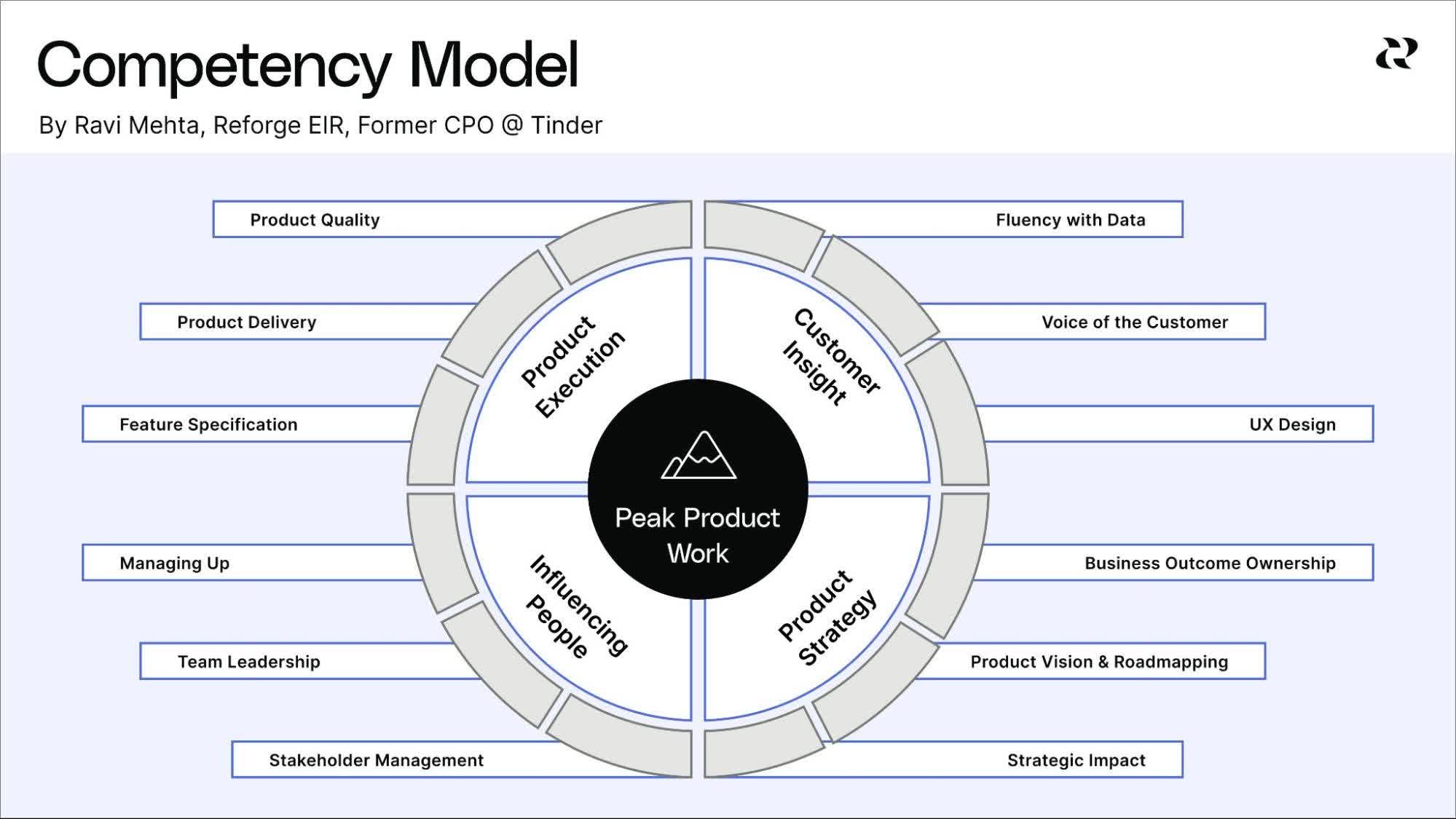
Here, we’re going to walk through the 12 essential skills in The Competency Model and how you should prioritize acquiring them. We’re also going to provide some advice you almost never hear when entering a new field of work: You don’t need to be great at everything, you probably never will be, and even the best of the best spike in certain places and rely on their teams to make up the gaps in others.
That said, you do need awareness and understanding of all 12 product manager skills, so let’s dig in and break down The Competency Model.
About The Contributors
What skills do Product Managers need to have?
The 12 product manager skills are broken into four distinct categories:
Product execution - product quality, product delivery, and feature specification
Customer insight - fluency with data, voice of the customer, and user experience design
Product strategy - business outcome ownership, product vision and roadmapping, and strategic impact
Influencing people - stakeholder management, team leadership, and managing up
One thing to remember before we dig into the individual skills is that no one can be proficient at all 12 skills. Ravi says that even the best product managers you know won’t master each skill.
“Most product managers — even peak product managers — excel at only a handful of these competencies. The difference between the average product manager and the peak product manager is an understanding of gaps and the ability to unite a team that fills those gaps.”
So instead of trying to master every single skill, think of the Competency Model as a key to unlocking product management in a systematic, thoughtful way. It’s also a way to identify your strengths or weaknesses and develop an action plan to level up your skills over time.
Let’s briefly look at each category of product manager skills.
Product Manager Skill Set 1: Product Execution
The first category of skills is product execution, which is the foundation of product management and includes the product development process. The three key product management skills to know in this category are product quality, product delivery, and feature specification.
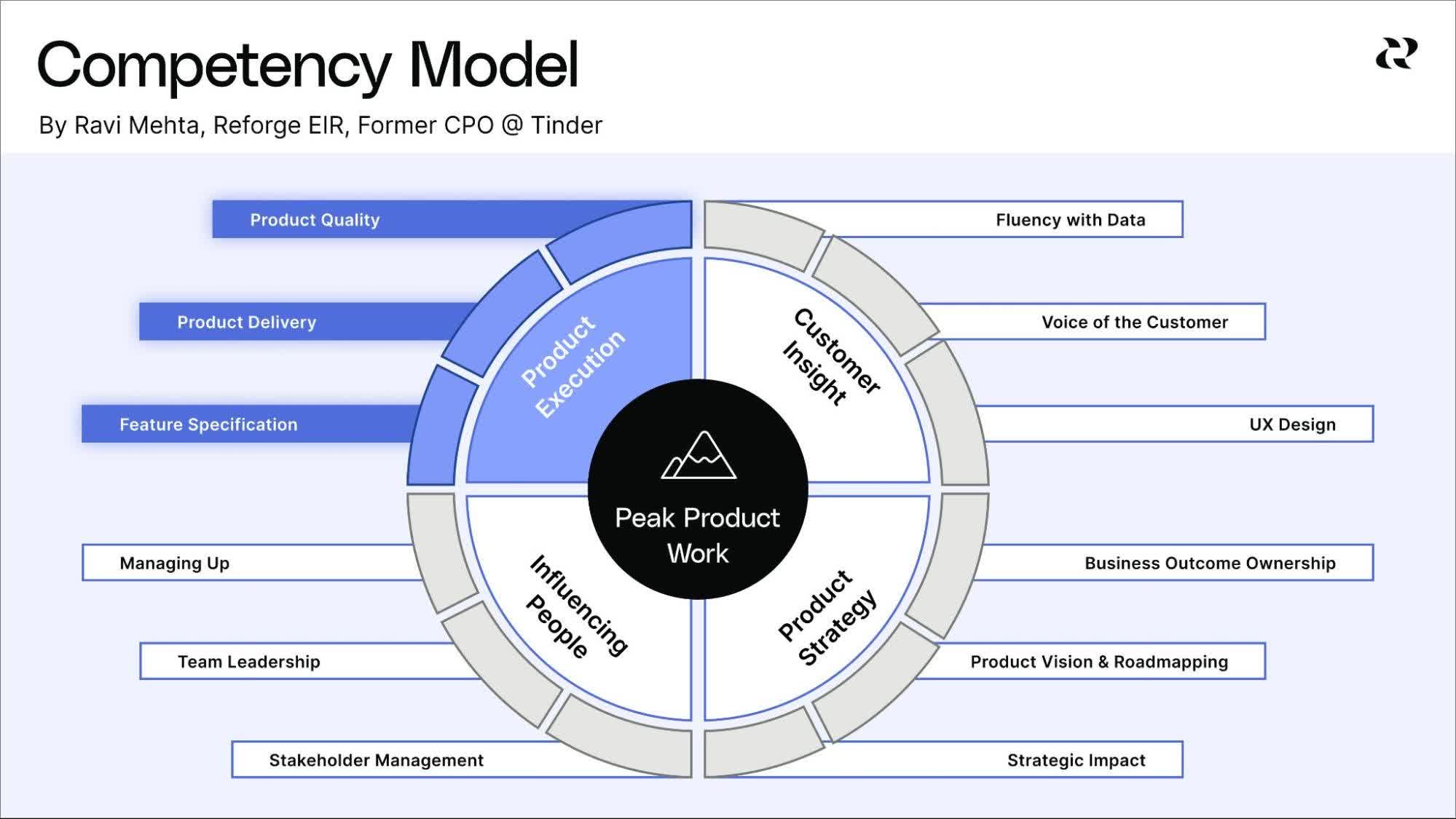
Skill 1: Feature specification is the ability of a product manager to gather requirements, define functionality, and set goals in a clear and actionable format.
Skill 2: Product delivery is when a product manager works closely with their immediate product team, including engineers and designers, to effectively turn good specs into working products.
Skill 3: Product quality refers to a product manager’s ability to prioritize and resolve technical, functional, and business quality issues across all devices, countries, and use cases.
Ravi tells us that the importance of each skill in the Competency Model evolves as a product manager becomes more senior, but that nailing flawless execution is especially important early in a product manager’s career.
Product Manager Skill Set 2: Customer Insight
The second category of skills that define the work of a product manager is **customer insight. **As the name suggests, this is all about a product manager’s capacity for understanding their customer! They should empathize with them, anticipate their customers’ existing and future needs, and communicate those needs to the rest of the team. The three customer insight competencies are fluency with data, voice of the customer, and user experience design.
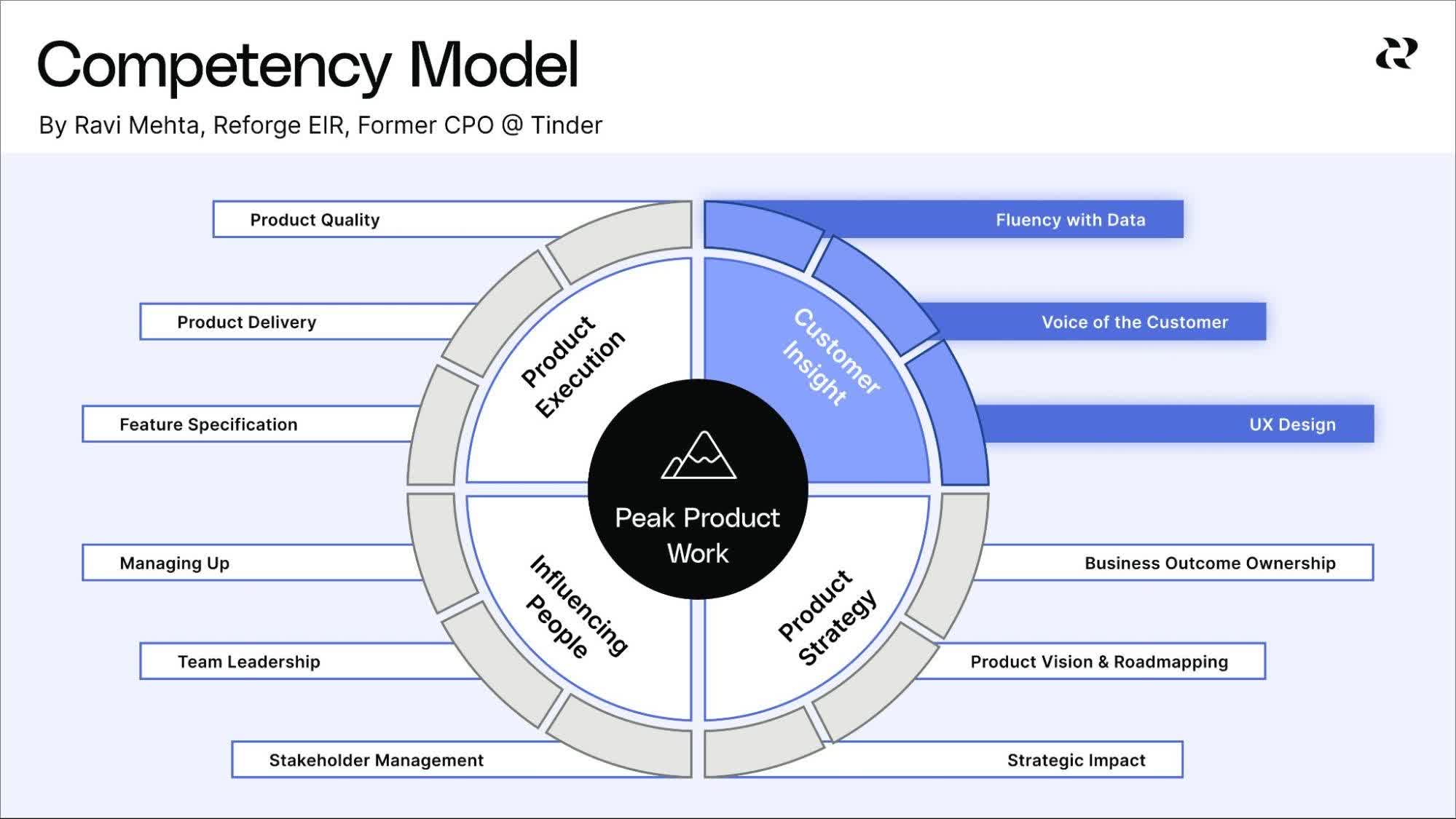
Skill 4: Fluency with data is when a product manager can generate actionable data-based insights, which they can leverage to achieve product goals, and connect those goals to larger business goals.
Skill 5: Voice of the customer is when a product manager leverages user feedback in all forms, from casual conversations to formal studies. While data is enormously useful for tracking customer behaviors, great product managers know they need to actually talk to customers to deeply understand their nuanced interests and concerns.
Skill 6: User experience design is when a product manager defines requirements and delivers designs that are easy to use.
Product Manager Skill Set 3: Product Strategy
The third category of product manager skills in the Competency Model is** product strategy.** We define product strategy as a targeted, long-term view of how product development achieves a company's long-term vision. The three skills Ravi identifies in the product strategy bucket are business outcome ownership, product vision and roadmapping, and strategic impact.
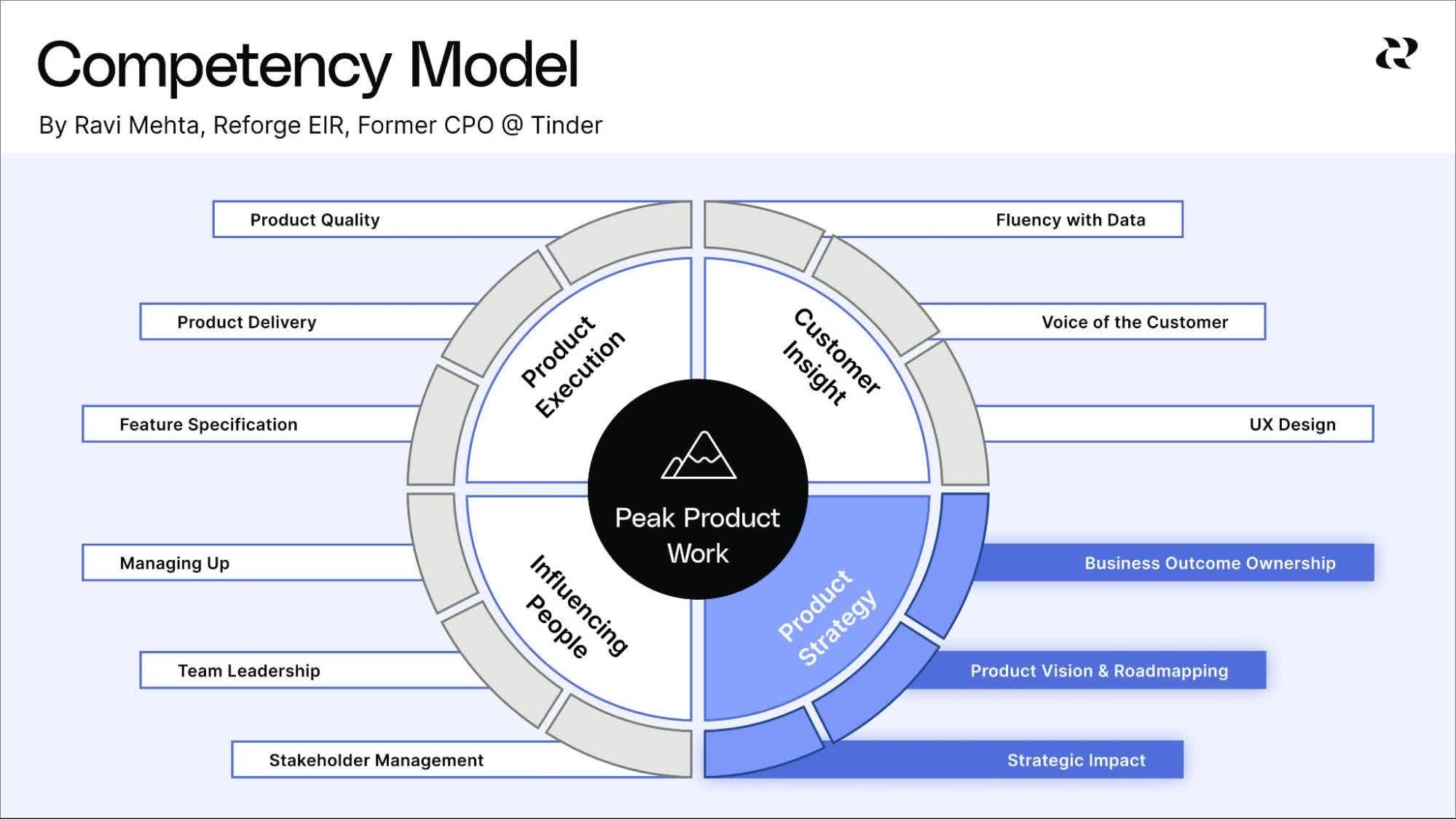
Skill 7: Business outcome ownership refers to a product manager’s ability to tether product functionality to the team and larger strategic organizational objectives.
Skill 8: Product vision and roadmapping is a product manager’s capacity for defining an overall vision for the product. A peak product manager can create a clear product roadmap of prioritized features and initiatives that work toward that broader vision.
Skill 9: Strategic impact is when a product manager understands and contributes to the business strategy for the team and company overall.
Ravi says, “as a product manager leader becomes more senior, the Product Strategy and Influencing People categories become the critical path to growth.”
Product Manager Skill Set 4: Influencing People
Product management requires fostering strong relationships with cross-functional peers and leadership, and eventually, building and leading product management teams. This category is all about what it means to lead, at a variety of levels in a multitude of ways. The three skills in this category are stakeholder management, team leadership, and managing up.
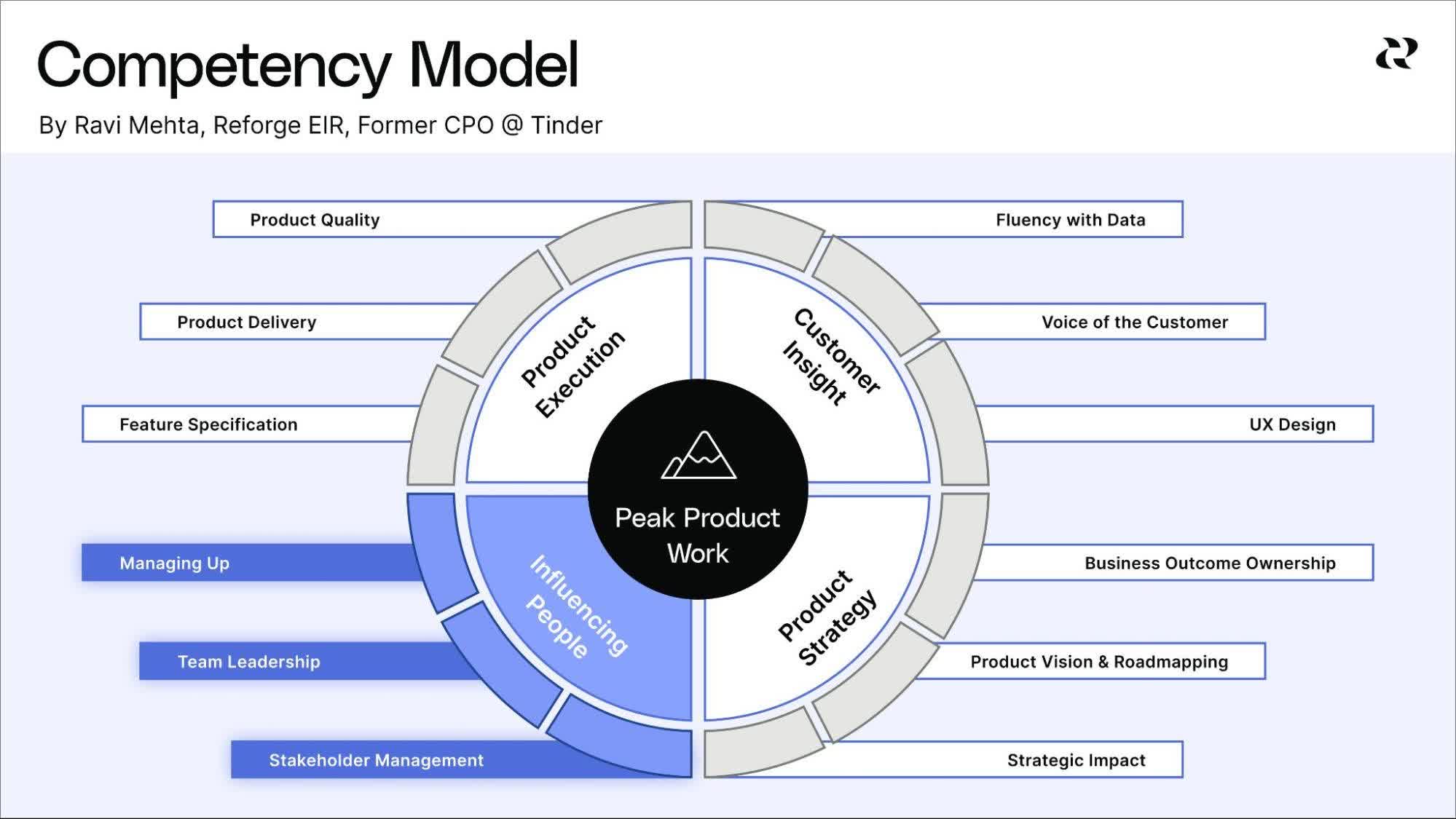
Skill 10: Stakeholder management is a product manager’s ability to proactively factor the needs of stakeholders into key product decisions.
Skill 11: Team leadership is when a product manager can manage and mentor direct reports, guide them towards successful product delivery, and work with them as they strive to achieve their career objectives.
**Skill 12: Managing up **— which we define differently than some — is the ability to leverage senior members of the organization to help product managers achieve their goals, deliver meaningful business outcomes, and positively influence the strategic direction of the team and company overall.
You know the 12 essential product manager skills. Now what?
We’ll wrap up with this reminder one more time: You do not need to become an expert at all 12 product manager skills to become a great product manager!
Let’s think about what comes next, now that you know the Competency Model. Ravi recommends a series of next steps.
Step 1: Become Aware. Awareness of the Competency Model will get you on the road to a richer understanding of the work as a starting place. Boom! You are now aware.
Step 2: ****Assess your skills. Ravi also has built a product manager skill assessment tool to help you visualize and understand where you are now — if in fact you are already a product manager. Here, you can identify one or two places where you naturally spike or areas you’ve already invested deep-learning into. Go deeper and become a standout performer in areas where you naturally thrive.
Step 3: Focus. Pick two or three skills where you want to increase your confidence. Find experts in those fields and get to know them. If you’re already a product manager, you probably work with them. Buy the data analyst and the designer a cup of coffee. Ask them to tell you everything they know. Or, ask them to give you foundational guidance on how you can improve your knowledge in a way that makes sense.
Step 4: Keep improving. As you grow in your career, return to the 12 skills to consider how you can deepen your knowledge of the work from the vantage point of a team leader or people manager.
Step 5: Go beyond these skills. While the 12 skills of the Competency Model are a great place to start, there’s of course more to the job We’ve partnered with even more product experts to build our program on Product Management Foundations. Sign up today to set yourself up for a high-growth trajectory as a product manager.


Several years ago, Ravi Mehta, a trailblazer in the product field and Reforge expert collaborator, was working at TripAdvisor. Like many organizations, TripAdvisor was sort of inventing the wheel in terms of what to teach new product managers who were coming in without any prior product management experience. They were also figuring out how to help level up the existing product managers on their team.
Ravi says, “the best product managers figure out how to do whatever it takes to deliver strong outcomes for their users, their team, and their company.” But how do you explain that to someone wanting to improve their product management skills? It’s a bit difficult.
So Ravi, and his colleagues at TripAdvisor, collected and defined 12 essential product manager skills which they dubbed The Competency Model. According to Ravi, this model is the closest thing to a mutually exclusive, collectively exhaustive definition of product management in the world right now.
Here, we’re going to walk through the 12 essential skills in The Competency Model and how you should prioritize acquiring them. We’re also going to provide some advice you almost never hear when entering a new field of work: You don’t need to be great at everything, you probably never will be, and even the best of the best spike in certain places and rely on their teams to make up the gaps in others.
That said, you do need awareness and understanding of all 12 product manager skills, so let’s dig in and break down The Competency Model.
About The Contributors
What skills do Product Managers need to have?
The 12 product manager skills are broken into four distinct categories:
Product execution - product quality, product delivery, and feature specification
Customer insight - fluency with data, voice of the customer, and user experience design
Product strategy - business outcome ownership, product vision and roadmapping, and strategic impact
Influencing people - stakeholder management, team leadership, and managing up
One thing to remember before we dig into the individual skills is that no one can be proficient at all 12 skills. Ravi says that even the best product managers you know won’t master each skill.
“Most product managers — even peak product managers — excel at only a handful of these competencies. The difference between the average product manager and the peak product manager is an understanding of gaps and the ability to unite a team that fills those gaps.”
So instead of trying to master every single skill, think of the Competency Model as a key to unlocking product management in a systematic, thoughtful way. It’s also a way to identify your strengths or weaknesses and develop an action plan to level up your skills over time.
Let’s briefly look at each category of product manager skills.
Product Manager Skill Set 1: Product Execution
The first category of skills is product execution, which is the foundation of product management and includes the product development process. The three key product management skills to know in this category are product quality, product delivery, and feature specification.
Skill 1: Feature specification is the ability of a product manager to gather requirements, define functionality, and set goals in a clear and actionable format.
Skill 2: Product delivery is when a product manager works closely with their immediate product team, including engineers and designers, to effectively turn good specs into working products.
Skill 3: Product quality refers to a product manager’s ability to prioritize and resolve technical, functional, and business quality issues across all devices, countries, and use cases.
Ravi tells us that the importance of each skill in the Competency Model evolves as a product manager becomes more senior, but that nailing flawless execution is especially important early in a product manager’s career.
Product Manager Skill Set 2: Customer Insight
The second category of skills that define the work of a product manager is **customer insight. **As the name suggests, this is all about a product manager’s capacity for understanding their customer! They should empathize with them, anticipate their customers’ existing and future needs, and communicate those needs to the rest of the team. The three customer insight competencies are fluency with data, voice of the customer, and user experience design.
Skill 4: Fluency with data is when a product manager can generate actionable data-based insights, which they can leverage to achieve product goals, and connect those goals to larger business goals.
Skill 5: Voice of the customer is when a product manager leverages user feedback in all forms, from casual conversations to formal studies. While data is enormously useful for tracking customer behaviors, great product managers know they need to actually talk to customers to deeply understand their nuanced interests and concerns.
Skill 6: User experience design is when a product manager defines requirements and delivers designs that are easy to use.
Product Manager Skill Set 3: Product Strategy
The third category of product manager skills in the Competency Model is** product strategy.** We define product strategy as a targeted, long-term view of how product development achieves a company's long-term vision. The three skills Ravi identifies in the product strategy bucket are business outcome ownership, product vision and roadmapping, and strategic impact.
Skill 7: Business outcome ownership refers to a product manager’s ability to tether product functionality to the team and larger strategic organizational objectives.
Skill 8: Product vision and roadmapping is a product manager’s capacity for defining an overall vision for the product. A peak product manager can create a clear product roadmap of prioritized features and initiatives that work toward that broader vision.
Skill 9: Strategic impact is when a product manager understands and contributes to the business strategy for the team and company overall.
Ravi says, “as a product manager leader becomes more senior, the Product Strategy and Influencing People categories become the critical path to growth.”
Product Manager Skill Set 4: Influencing People
Product management requires fostering strong relationships with cross-functional peers and leadership, and eventually, building and leading product management teams. This category is all about what it means to lead, at a variety of levels in a multitude of ways. The three skills in this category are stakeholder management, team leadership, and managing up.
Skill 10: Stakeholder management is a product manager’s ability to proactively factor the needs of stakeholders into key product decisions.
Skill 11: Team leadership is when a product manager can manage and mentor direct reports, guide them towards successful product delivery, and work with them as they strive to achieve their career objectives.
**Skill 12: Managing up **— which we define differently than some — is the ability to leverage senior members of the organization to help product managers achieve their goals, deliver meaningful business outcomes, and positively influence the strategic direction of the team and company overall.
You know the 12 essential product manager skills. Now what?
We’ll wrap up with this reminder one more time: You do not need to become an expert at all 12 product manager skills to become a great product manager!
Let’s think about what comes next, now that you know the Competency Model. Ravi recommends a series of next steps.
Step 1: Become Aware. Awareness of the Competency Model will get you on the road to a richer understanding of the work as a starting place. Boom! You are now aware.
Step 2: ****Assess your skills. Ravi also has built a product manager skill assessment tool to help you visualize and understand where you are now — if in fact you are already a product manager. Here, you can identify one or two places where you naturally spike or areas you’ve already invested deep-learning into. Go deeper and become a standout performer in areas where you naturally thrive.
Step 3: Focus. Pick two or three skills where you want to increase your confidence. Find experts in those fields and get to know them. If you’re already a product manager, you probably work with them. Buy the data analyst and the designer a cup of coffee. Ask them to tell you everything they know. Or, ask them to give you foundational guidance on how you can improve your knowledge in a way that makes sense.
Step 4: Keep improving. As you grow in your career, return to the 12 skills to consider how you can deepen your knowledge of the work from the vantage point of a team leader or people manager.
Step 5: Go beyond these skills. While the 12 skills of the Competency Model are a great place to start, there’s of course more to the job We’ve partnered with even more product experts to build our program on Product Management Foundations. Sign up today to set yourself up for a high-growth trajectory as a product manager.