Reforge has joined Miro ↗
Objectives and key results (OKRs) are usually thought of as the holy grail operating mechanism. Just recall how:
You spent hours and hours refining this quarter's OKRs, since it was the top priority for your manager and the company
Or, how the annual OKRs map to revenue growth goals to then go after the next funding round
In almost all operating conversations, OKRs come to the forefront to solve for the company level operating cadence. But, OKRs don't solve for the team level operating cadence. In practice, most leaders look to syncs and standing meetings to solve for team level operating.
When it comes down to it, they think of the value of team operating mechanisms incorrectly. The biggest mistake is holding team operating processes around syncing meetings to solely gain alignment. Rather than alignment meetings, it's necessary for team operating systems to solve for an underlying growth need like accelerating velocity of feature rollouts or evolving strategy based on new audience expansion. This is where rituals come in, as the building block for growth-oriented team operating.
"If teams meet for the sake of it, those meetings need to be cut since they aren't solving for anything. Instead, teams need to operate in a way that fortifies company growth by accelerating velocity, emphasizing learnings, connecting actions to outcomes, evolving strategy, or focusing on personal growth." - Elena Verna (EIR at Reforge, Growth Advisor at Miro, Netlify, MongoDB)
This post features operating tools at the team level, instead of the customary way of operating at the company level through OKRs. We'll specifically cover:
What team operating cadences should NOT look like and issues that syncs create
The 5 areas a team operating cadence should solve for, to fuel org growth
The building block of operating a team — the ritual
The top 5 rituals and structuring each to be effective
How rituals evolve over time, as a company changes
Why rituals are not all created equal and over-indexing in the right way
About the Authors
With contributions by Adam Grenier (EIR at Reforge, former Lambda School, Uber, HotelTonight), Bangaly Kaba (EIR at Reforge, Former Head of Growth at Instagram), Fareed Mosavat (VP Programs and Partners at Reforge, Ex-Director Product Growth at Slack) and Matt Greenberg (CTO at Reforge, Ex-VP Engineering at Credit Karma)
Biggest mistake: team operating cadence = syncing
Every team needs an operating cadence separate, but complementary, to the company level operating cycle that revolves around OKRs. When leaders introduce operating processes to their team, they often default to meetings to sync across cross-functional teams. Defaulting to these sync meetings is incorrect and creates the following 3 issues:
Fake alignment
Syncs don't scale
Purposeless purpose
Fake Alignment
Syncs create a false sense of people being on the same page, even when they are not.
This is due to the faulty conditions of a standing sync such as (a) having only a limited and scheduled amount of time to talk, (b) trying to please others, (c) processing thoughts in the moment instead of before a sync, or (d) falling into group think when seeing others' emotional response.
Each condition indirectly encourages alignment for the sake of alignment, instead of critically considering business decisions.
Syncs Don't Scale
Syncs may start with the best of intentions, with a core group of employees trying to accelerate decision making.
But, as an organization scales, the number of agenda items and additional meeting attendees becomes an unjustified, expensive waste of time.
This is because the sync slowly transformed from a valuable decision making space to a general bulletin board update.
Purposeless Purpose
Oftentimes syncs feel purposeful because of positive interactions with peers and a sense of 'fake alignment.'
Even if you look at the last few syncs on your schedule, it's likely there was no written or stated goal for the sync.
Although hard to admit, since there was no intended purpose for the sync, there's an underlying issue in how your team thinks about and uses meeting time.
Instead of being trapped into these pitfalls, team operating cadences should deliberately seek to drive company growth through processes that foster shared experiences, language, purpose, and mindset. The next section will detail out the 5 areas that fuel company growth.
Your team operating cadence should solve for 5 areas to fuel company growth
A team's operating system must contribute directly to the company's growth via the work the team does each day. To break it down even more, the team operating cadence should solve for the 5 areas below:
🚄 accelerating velocity
💡 emphasizing learnings
🔗 connecting actions to outcomes
♻️ evolving strategy
🧠 personal growth
🚄 Accelerating velocity
Accelerating velocity allows a team to move faster in decision making, testing hypotheses, development time, or shipping. The ultimate outcome, with accelerating velocity, is to move faster as a team to bring in even more customer value and revenue for the organization.
Example:
"On the Headspace Product team, we ran 1-2 experiments at any given time in late 2017. Accelerating experiment velocity was a key goal since more experiments could lead to company growth from a learnings, user engagement, and revenue perspective. For instance, running an additional 1-2 winning experiments per month could yield ~10% more monthly revenue. A large part of scaling up was tied to internal team operating cadences, like Work in ProgressExperiment Reviews every week. These reviews accelerated velocity by quickly vetting hypotheses, analyzing experiment setup, and preparing for results across analysts and PMs." - Keya Patel (OIR at Reforge, Ex-Director of Product Growth at Headspace)
💡Emphasizing learnings
Emphasizing learnings is crucial to an organization's growth because it helps a team understand the knowledge they have and the knowledge they still need to understand. Sharing learnings across teams also helps avoid repeating the same mistakes by building communal consciousness.
Example:
Say a support team requests a product team to add customer quotes on a purchasing page, based on receiving a high volume of support tickets asking for reviews and quotes.
After the product team experiments with adding generic customer quotes to the top of the checkout flow, they see no increase in conversion rates and share the learnings at the monthly company Demo Day.
The next month, the support team can reference the Demo Day learnings and request the product team tests again, this time using well-known celebrity quotes and logos of companies that use the product. From there, the product team might develop an updated hypothesis, related to adding celebrity and brand appeal as social proof.
In this situation, the support and product teams have shared emphasized learnings related to testing customer quotes that they can easily reference. Together, the teams have built upon those learnings to determine next steps that could impact company growth.
🔗 Connecting actions to outcomes
Consciously linking actions with an outcome lets teams truly unlock a growth mindset. If teams perform an action without being diligent about the resulting change, they do not gain all the benefits of the action. Similarly, if a team only looks at an outcome without identifying a cause, they are also lacking an understanding of the crux of the situation.
Example:
If, for example, Zoom sees a 10% lift in Android app installs today and doesn't take time to investigate why the lift happened, the team is missing an opportunity to understand a future growth lever.
If instead, they had a weekly Metrics Review email or a monthly Acquisition Recap Report, they might be forced to uncover the Zoom app was randomly featured in the Google Play Store today.
By connecting this action (Zoom being featured by Google) to the outcome (a 10% lift) through team operating cadences, the team unlocks information that can assist in future company growth situations.
The Zoom team now identified what impact to roughly expect for upcoming highlights by Google or could partner with Google to use this tactic for an end-of-quarter boost.
♻️ Evolving strategy
As a company scales, the strategy should also evolve to continue to support accelerated company growth. On first glance, it may not be clear why evolving strategy falls within the team level operating system versus the company level operating system. Although strategy change frequently originates at the leadership level (company level operating mechanism), it filters through the organization. Then, it's ultimately individuals and their working teams (team level operating mechanisms) who are charged with executing upon the strategy through quarterly Planning Cycles and kick offs.
Example:
Peloton went public in late 2019, with their core business areas focused on their Bike and digital subscription products.
Since then, in 2020, Peloton evolved to further grow their business by strategically going after a more price sensitive user segment. Peloton did this by pushing their $12.99/mo Digital Membership and decreasing the price of their original bike by 15% (from $2,245 to $1,895). In order to bring the new audience strategy to life, there were surely team operating mechanisms in place — like Planning Cycles, kick offs, and prioritization activities — dedicated to this refresh.
The strategic evolution and team execution directly played a role in Peloton's company growth: Peloton's 2019 revenue was ~$900M while their 2020 revenue was ~$1.8B. This yielded a 100% year over year revenue growth.
🧠 Personal growth
Personal growth may not immediately seem like it directly ladders into an organization's growth, but it very much does. Employees, and their personal and professional growth, matter. They are the people solving problems and exploring new ideas each day to take the organization to the next stage of growth.
Example:
*"As a people manager, it's my responsibility to hold a ****weekly Personal Growth Conversation ***(PGC) with anyone who reports into me directly. The PGC helps me gauge how much we're supporting their personal and professional goals. Without a regular PGC, I've seen invaluable employees take a step back from pushing themselves and their team. In a worst case scenario, company and team growth halts due to the expensive cost of having to backfill an individual who leaves because they no longer felt supported in skill progression or career planning." - Keya Patel (OIR at Reforge, Ex-Director of Product Growth at Headspace)
The ritual = building block of operating a team
As detailed in the previous section, your team operating cadence needs to solve for these areas to impact organizational growth: accelerating velocity, emphasizing learnings, connecting actions to outcomes, evolving strategy, personal growth. The building block of any good team operating cadence is the ritual (or rituals) that reinforces these goals.
Although traditional rituals are considered "necessary" 1 on 1s or demo days your team partakes in to be successful, this section demonstrates how to effectively use rituals to operate.
First off, each ritual needs to clearly reinforce an area that impacts organization growth — we'll show you how this plays out by ritual
Second, each ritual has a general structure and evolution, which helps it stick to the area the ritual reinforces
Third, teams fall into not so obvious mistakes within each ritual. We'll point these out, since it takes away from the ritual's purpose and what the ritual should help reinforce.
5 team operating rituals & what they reinforce...
Although leaders might believe their rituals are unique to them and their organization, there are rituals in common across organizations:
Work in Progress (WIP) Workshop
Leads Forum
Show and Tell
Planning Cycle
Personal Growth Conversation (PGC)
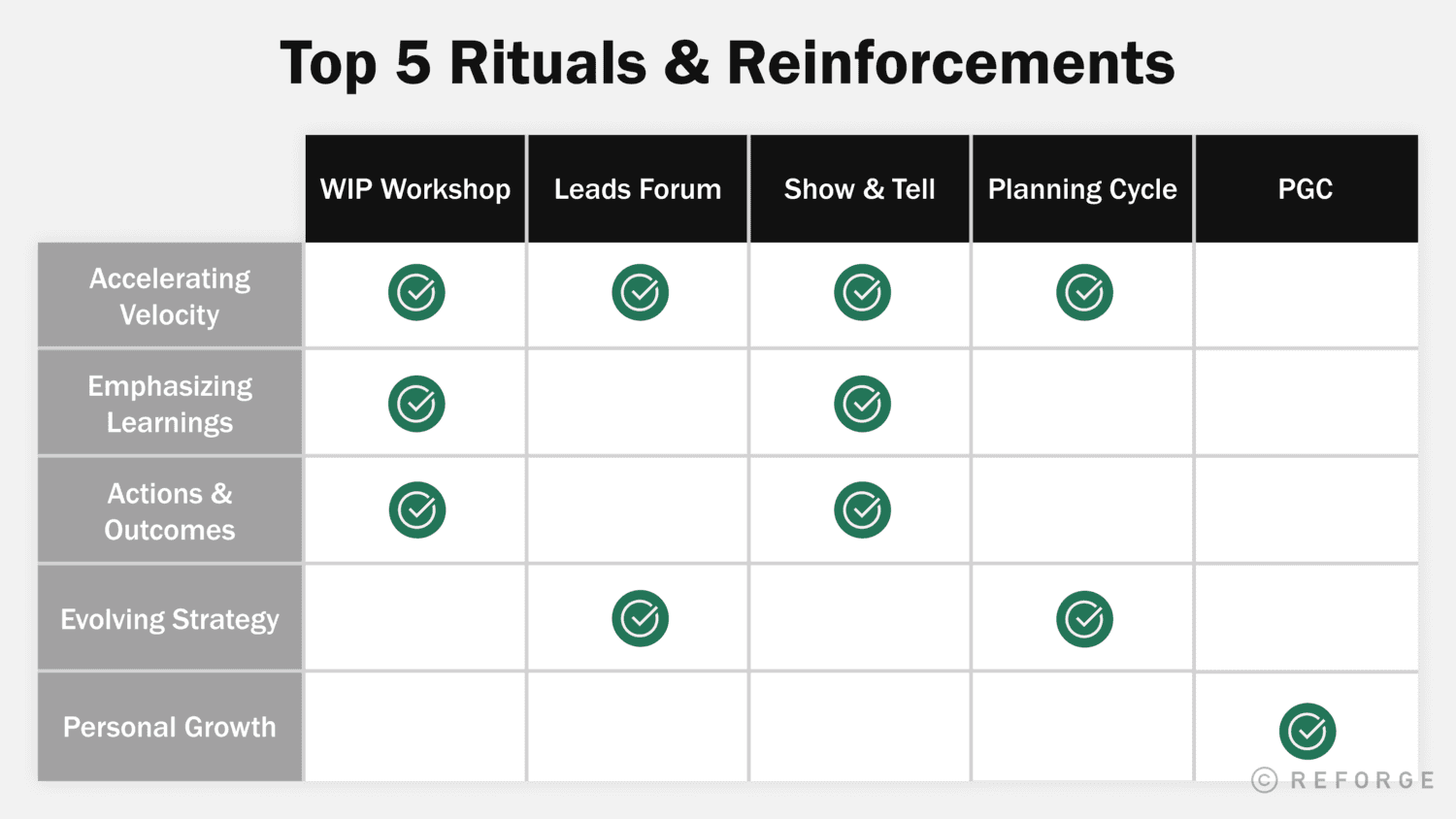
Ritual 1: WIP workshops (reinforces 🚄 💡🔗)
Work in progress workshops are also known within organizations as Product reviews, Product workshops, Feature reviews, Product Spec reviews, or Experiment reviews. To instill a growth mindset at an organization, this ritual is integral because it runs at a velocity faster than other rituals.
Ritual reinforces:
🚄 Accelerating velocity of development by unlocking feedback cycles on initiatives that are pre-build, in progress, or post-build. From Scaling Product Delivery: The "Dirty" Secret of High Performing Product Teams, unlocking feedback cycles early is pivotal in preventing late stage blow-ups where an executive drops in right before launch to say "this isn't right, we can't launch it." A late stage blow-up can altogether kill momentum and team morale.
A secondary objective of WIP Workshops is to 💡 emphasize learnings by requiring all projects be goaled against tangible metrics
The final area of emphasis is 🔗 connecting actions with outcomes for next iterations
Attendees: Product, Design, Engineering, and Data leads are the main providers of feedback. The guest to the workshop is the full working team (Product, Data, Creative, Research, Eng, etc). A project manager might help source guests and coordinate this workshop.
Structure: Guests are sourced through open invite. During the workshop, each team has 20 minutes to present an experiment or product initiative, zeroing in on challenges or open questions. To show progress and refinements, a team can visit the WIP workshop at different stages of development:
pre-build: 🚄 accelerating velocity by getting feedback on the hypothesis, purpose, and problem and get the experiment/initiative green lit by the leads
in progress: 🚄 accelerating velocity gathering feedback on areas that changed from pre-build stage and any anticipated challenges, 💡 emphasizing learnings by identifying metrics for success
post-build: 💡emphasizing learnings by sharing experiment/initiative results, 🔗 connecting actions with outcomes to determine how the learnings can be application for future iterations or improvements
Frequency: Weekly
How it evolves over time: Pair the WIP Workshop with a Slack channel where specs and designs are posted constantly for review. Only if there needs to be in-depth discussion will leads ask to meet to review, all other feedback or approvals take place over Slack. A different evolution of this workshop could involve creating five different Slack channels: hypothesis generation, spec review, design review, approvals, and results, to gather input during key parts of a WIP workshop and avoid meetings.
Common mistakes: Too many feedback cycles happening in person, instead of asynchronously, so velocity is slower. Feedback from leads needs should be called out as a suggestions versus mandates to allow the team to move quickly. Not enough emphasis on the goal or metrics of the project and more eyes on the design or product experience. Project management issues because of juggling many experiments in different stages. Lack of communicating out results because they happen in such fast cycles or feel like smaller wins, compared to a large feature or product change.
"Teams post what's in progress on Slack and then the leads can decide if they want to see it in person. You physically can't review everything in person, but everything should be posted in Slack to speed up decisions. After a team posts, the leads can say (1) yes, go forward, (2) no, bring this to the WIP workshop and we'll talk details, or (3) I need to escalate this so others can give input, then it's okay to move forward." - Fareed Mosavat (VP Programs and Partners at Reforge, Ex-Director Product Growth at Slack)
Ritual 2: Leads forum (reinforces ♻️ 🚅)
The Leads Forum is commonly thought of as an alignment platform across Product, Design, and Engineering. Although these three functions need to be cohesive, the Leads Forum needs to prioritize discussion of strategic growth and organizational changes rather than more generic alignment 'sync' topics.
Ritual reinforces: ♻️ Evolving strategy across team leaders, 🚅 Accelerating velocity to unblock team resourcing
Attendees: Product, Design, and Engineering leads
Structure:
The first 3 Leads Forums of the month should follow the format of reviewing business performance against OKRs, raising personnel issues and resourcing blockers, discussing updates to team charters/structure, and creating a plan on cascading evolving strategy to rest of team.
The final Leads Forum of the month should be devoted to evaluating the month's progress against set quarterly strategy by tracking metrics to forecast and reviewing a team health check of green/yellow/red by each team lead.
No general updates should take place in the Leads Forum. General updates and metrics updates should be shared by email each Friday via being written by each team and curated by each lead.
Frequency: Weekly
How it evolves over time: After a while, leads may choose to move this sync to be completely async or collapse this meeting to only take 15-20 minutes for more weighty and contentious discussion. Another transformation of the Leads Forum is to combine it with the WIP Workshop ritual, as described in Bangaly's quote below, to reduce the number of weekly meetings.
Common mistakes: Project or roadmap decisions are made without transparency of teams in the room, decelerating velocity. Leads Forum no longer prioritizes strategic discussions and general updates slip in, instead of utilizing weekly email updates.
"I had a 45 minute weekly*** leads meeting**** at Instagram. The leads would ask teams to come present for about 20 minutes of that time, if we wanted to see the WIP process behind a specific initiative or feature on a team's roadmap. The remaining 25 minutes went towards discussing strategic challenges or changes and how we would waterfall them through our teams over the next week." - Bangaly Kaba (EIR at Reforge, Former Head of Growth at Instagram)*
Ritual 3: Show and tell (reinforces 💡 🔗 🚅)
Depending on the organization, Show and Tells can also be named as Happy Hour Reviews, Numbers Reviews, Demo Days, Science Fairs, or included in All Hands. Successful Show and Tells bring together an entire organization and democratize access to learnings.
Ritual reinforces: 💡Emphasizing learnings, 🔗 Connecting actions with outcomes, 🚅 Accelerating velocity of shipping (since it looks bad if a team doesn't have meaningful accomplishments to show every month or two)
Attendees: Open invite across the organization, including Sales, Support, Data Eng, in addition to more traditionally visible product development functions
Structure: An informal visual presentation (1-3 slides) of what was what was shipped, learnings, and what's next as a result of those learnings. Each and every team is represented, whether they shipped something that was a success or failure.
Frequency: Monthly
How it evolves over time: The Show and Tell is driven by Product learnings and experiments, in the beginning. It evolves to cover Marketing, Research, Data, Sales, and Support learnings as well. Another evolution of the Show and Tell is that the presenter moves from the PM or business owner to others on the team in order to build communal ownership of learnings. As an organization continues to scale, the Show and Tell may be reserved for the 'best of' learnings in terms of customer and business impact, instead of every team presenting.
Common mistakes: Not emphasizing learnings and impact as the key takeaway of each presentation. Making this too formal in structure so teams are intimidated to present.
"At Uber we took a Show and Tell approach, where it was part of our monthly happy hour and over snacks and drinks. It was rarely the PMs showing the learnings but rather the designers, engineers, marketers and other people on the team that don't necessarily get recognition. So, in addition to celebrating learnings it also celebrated all individuals involved." - Adam Grenier (EIR at Reforge, former Lambda School, Uber, HotelTonight)
Ritual 4: Planning cycle (reinforces ♻️ 🚅)
Planning Cycles allow for almost everyone at an organization to zoom out to understand the larger strategy behind their work. This is the only ritual that should be done on a quarterly cadence, instead of weekly or monthly, since it pulls several contributors out of execution mode to think broadly. Additionally, the strategic work resulting from Planning Cycles should hold for an extended period of time so teams know what to run towards, without a moving target.
Ritual reinforces: ♻️ Evolving strategy across the organization, 🚅 Accelerating velocity by building a unified plan and pulling up dependency conversations between teams
Attendees: In the planning stages, this involve Product, Marketing, and Engineering with input from all other functions. In the rollout of the plan, everyone should be invited or review it on their own time.
Structure:
3 weeks before a quarter starts, the Product lead(s) should establish strategic themes and categorization of work. Categories could be around growth, innovation, competitive upkeep, differentiators, and platform infrastructure, for example. The Product team then leads filling out these categories with initiatives.
2 weeks before the quarter starts, Product begins to share with Marketing and other key functional stakeholders to augment chosen initiatives.
About a week before the quarter begins, Engineering helps to reconcile and draws the red line around final initiatives and categories of work that make it into the quarter.
Finally, a few days before the quarter begins, there should be detailed kick offs where every lead and individual contributor gets an elevated view of what's going on. They also then have a couple days to resolve dependencies between teams.
Reinforcement: During the last week of each month, check ins occur at the Leads Forum to evaluate delivery against what was anticipated for the month
Reinforcement: To reinforce the Planning Cycle and strategic themes, each project in a WIP Workshop directly ties to a line item in the quarterly plan.
Frequency: Quarterly. Though, since having a quarterly ritual is in the 'forgettable zone,' there has to be reinforcement constantly (in the last Leads Forum of the month and all projects shared in the WIP Workshops must reference directly to the quarterly plan).
How it evolves over time: Not as much in-person back and forth between teams. Instead, Product takes a first pass at defining the themes and initiatives for the quarter, then cross functional teams add in comments. In person conversations, between Product and Marketing & Product and Eng, are reserved for disagreements and discussions that aid with decision making.
Common mistakes: Too top-down without enough ideas generated from team members. Bypassing cross functional feedback or bringing it in too late during planning. No margin for change baked in, for major learnings or results that dictate a new direction.
"Traditionally, planning is done from an individual team perspective. But, I like to make sure it's not just from the functional Product, Marketing, or Design point of view. Tactically, I establish themes to solve for strategy. Each theme needs to have a summary and how to measure success of the theme to impact company growth." - Elena Verna (EIR at Reforge, Growth Advisor at Miro, Netlify, MongoDB)
Ritual 5: Personal growth conversation, or PGC (reinforces 🧠)
A result of bad rituals is that they are not focused on one of the outcomes that rituals should reinforce. As bad rituals take hold, conversations move out of a team forum and into a siloed situation, like a traditional 1 on 1. In practice, 1 on 1s should include nothing about business — if business decisions are made in these conversations then that's a poor use of time because the full context is not being given to the full team to learn. Simply put, 1 on 1s need to be entirely overhauled into PGCs.
Ritual reinforces: 🧠 Personal growth
Attendees: Manager and direct report
Structure: Can have an agenda doc or be informal (like a walk and talk). The conversation should be at least 30 minutes and spent on reflections on skills/situations, career development and progress against role competencies, and feedback for one another.
Frequency: Weekly or every other week
How it evolves over time: PGCs usually start by talking about working styles between the manager and direct report. They evolve to be about context setting on the organization and team or sharing strategic background. Eventually, the PGC should be solely about career growth, skills progression, situational development, and giving/receiving feedback. As organizational performance reviews and promotions take place, a direct report should already recognize their strengths and improvement areas based on past PGCs.
Common mistakes: Allowing business decisions to be made in PGC. Managers not being comfortable or equipped enough to discuss personal growth trajectories at an organization. Being uncomfortable giving direct, honest feedback in a productive way.
"My goal was to never talk business in 1 on 1s. When you make a decision in a siloed setting, without all the right people, you slow down the business decision and will inevitably need to hash it out again to others." - Adam Grenier (EIR at Reforge, former Lambda School, Uber, HotelTonight)
With org changes comes ritual changes
In addition to the 5 rituals and what they reinforce, all team operating rituals must evolve over time. The successful outcome of rituals is that they grow alongside the organization's growth, whether this means changing the agenda of a ritual or altogether removing the ritual that no longer fits a team's operating needs. Although it is difficult to see an organization's growth in the day-to-day, each week a leader should be asking if their rituals are evolving at the same rate as the organization:
Is it clear to all those involved what the ritual is solving for?
Is the ritual still solving for accelerating velocity, emphasizing learnings, connecting actions to outcomes, evolving strategy, or personal growth? Or has it moved to simply gaining alignment?
How can the ritual need to be tweaked to better solve for the growth of the organization?
Are there ways to move to asynchronous rituals, while still being just as effective at solving for the ritual's outcome?
Your team's operating flywheel for rituals
A way you can apply these questions is through the Rituals Flywheel below. Think of this as the evolving cycle that rituals need to be evaluated upon in order to be deemed successful. The lesser alternative is not measuring the evolution of a ritual, resulting in (a) the ritual no longer reinforcing anything meaningful, (b) dwindling participation, and (c) team members dreading the standing meeting, since they no longer connect to why the meeting might be important.
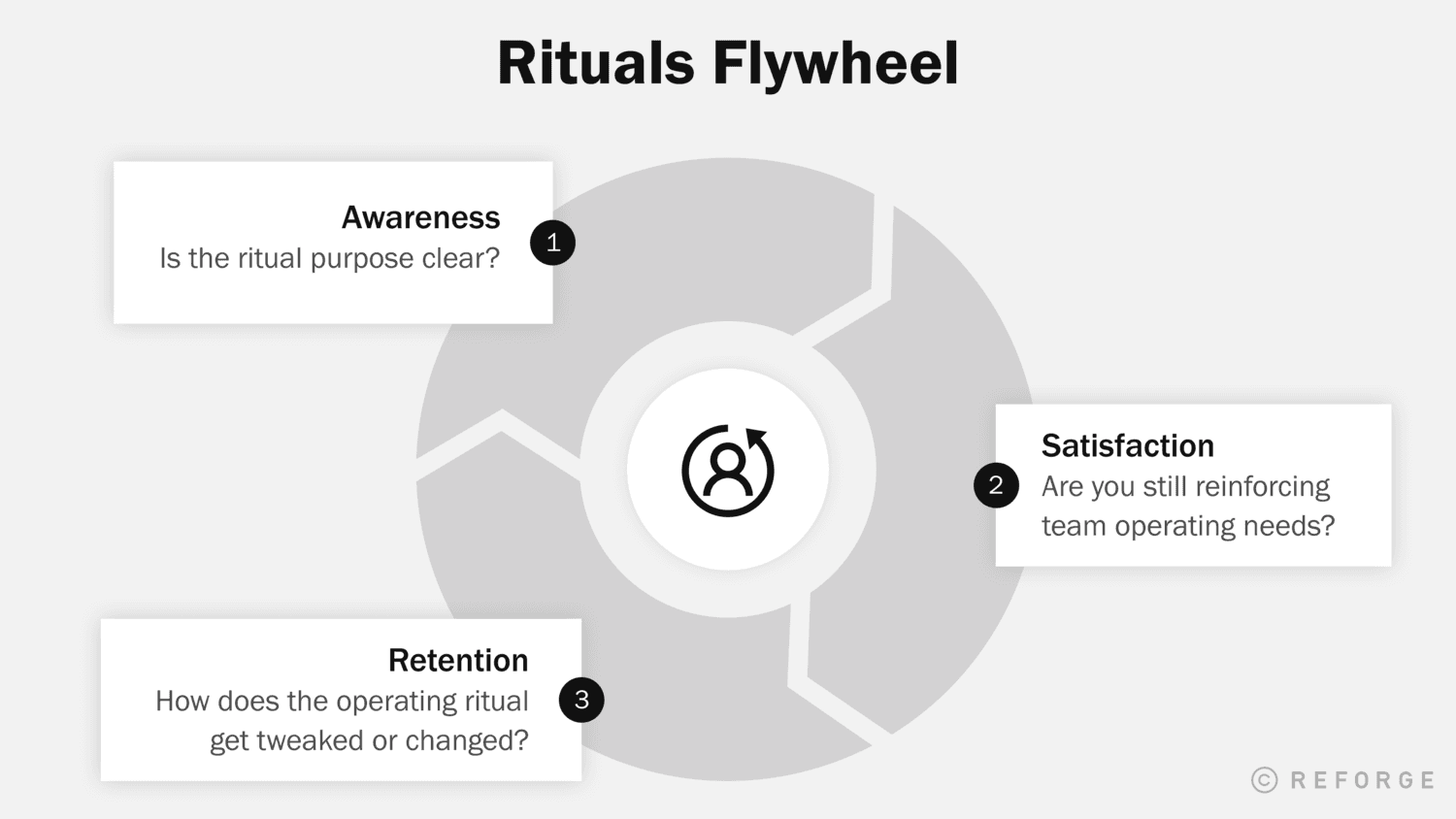
Step 1 Awareness: Is the ritual purpose clear?
Awareness establishes the purpose of the ritual clearly to yourself and to those who partake in the ritual. Some quick tips to make sure you have awareness:
At the beginning of the quarter, socialize the types of rituals you will be having and why. Which are mandatory versus optional? What are the rules of engaging in that ritual?
Clearly state what you are reinforcing with the ritual (accelerating velocity, emphasizing learnings, connecting actions to outcomes, evolving strategy, or personal growth) at the start of the ritual. Also put this in the agenda, or as a reminder in internal communications channels when the ritual takes on forms outside of a meeting.
Ask someone new to the team what they think the purpose of the ritual is and see if it matches what you're trying to reinforce
Step 2 Satisfaction: Are you still reinforcing team operating needs?
Satisfaction of the ritual is understanding if you are adequately reinforcing areas that the team operating cadence should solve for. Measuring satisfaction should take place weekly. Ways in which you can measure satisfaction include:
As you establish awareness around rituals you'll have and why (Flywheel step 1), also establish the cadence in which you will seek feedback. The cadence of feedback collection should be weekly, or in conjunction with a ritual's timing. Usually people seek feedback on a ritual monthly or quarterly — when it's already late to make quick updates. You need to begin measuring satisfaction early and often to know when the ritual is moving from being effective to ineffective, which allows more opportunities to adjust the ritual's format.
At the end of any meeting, ask all attendees to hold up a sticky note with a number 0 to 10, 10 being really effective in terms of what the ritual reinforces You can also do this by asking the team to show a thumbs up or down, for a more binary decision.
Each week, post an informal, anonymous poll in your team's internal messaging system asking how to make a specific ritual more effective. Ask team member to spend no more than 2 minutes on it to increase likelihood of receiving consistent feedback.
Step 3 Retention: How does the operating ritual get tweaked or changed?
Retention of the ritual is continuing to solve for the ritual's outcome over time as team restructures happen, growth / valuation trajectories change, company strategy shifts, or members are added or subtracted from a team. Retention of a ritual could look like:
Experiment with the ritual to change the format, while maintaining the goal of the ritual. This might mean a meeting transforms to be an active Slack discussion or all metrics conversations move to be via a Friday email update. In experimenting with the ritual's format, you are verifying the ritual has maximum distribution and impact for the team.
Test having a day or a week without any rituals and see where breakdowns occur. Reintroduce only critical rituals that reinforce a company growth area and push to have everything else via written communication.
Altogether remove one ritual so you can over-index on other rituals, since team members may not have enough time to actively participate in several rituals each week, in addition to performing in their role. Alternatively, collapse similar rituals into one ritual.
Not all rituals are created equal
After walking through the most common rituals for team operating cadences above, it may be obvious that it's not possible to do all these rituals consistently, let alone do each rituals well. Think of these rituals as starters for where to begin in solving for an organization's growth. As an organization progresses out of the building blocks, some rituals — and what they solve for — will play a more central role at the organization. The strongest product organizations tend to have a single ritual they rely on more than other rituals to reinforce team operating processes, with 3 examples from Amazon, Airbnb, and Spotify below.
Amazon press release
Ties to over-indexing on initial stages of WIP Workshop ritual
During the product development cycle, Amazon product managers think about the ideal end state of a customer experience or product. This starts by creating a pseudo press release announcing information about the future product, challenges, and what problem the product solves for. As the team formulates and finalizes the press release, they can then get buy-in to move forward with actual deve


Objectives and key results (OKRs) are usually thought of as the holy grail operating mechanism. Just recall how:
You spent hours and hours refining this quarter's OKRs, since it was the top priority for your manager and the company
Or, how the annual OKRs map to revenue growth goals to then go after the next funding round
In almost all operating conversations, OKRs come to the forefront to solve for the company level operating cadence. But, OKRs don't solve for the team level operating cadence. In practice, most leaders look to syncs and standing meetings to solve for team level operating.
When it comes down to it, they think of the value of team operating mechanisms incorrectly. The biggest mistake is holding team operating processes around syncing meetings to solely gain alignment. Rather than alignment meetings, it's necessary for team operating systems to solve for an underlying growth need like accelerating velocity of feature rollouts or evolving strategy based on new audience expansion. This is where rituals come in, as the building block for growth-oriented team operating.
"If teams meet for the sake of it, those meetings need to be cut since they aren't solving for anything. Instead, teams need to operate in a way that fortifies company growth by accelerating velocity, emphasizing learnings, connecting actions to outcomes, evolving strategy, or focusing on personal growth." - Elena Verna (EIR at Reforge, Growth Advisor at Miro, Netlify, MongoDB)
This post features operating tools at the team level, instead of the customary way of operating at the company level through OKRs. We'll specifically cover:
What team operating cadences should NOT look like and issues that syncs create
The 5 areas a team operating cadence should solve for, to fuel org growth
The building block of operating a team — the ritual
The top 5 rituals and structuring each to be effective
How rituals evolve over time, as a company changes
Why rituals are not all created equal and over-indexing in the right way
About the Authors
With contributions by Adam Grenier (EIR at Reforge, former Lambda School, Uber, HotelTonight), Bangaly Kaba (EIR at Reforge, Former Head of Growth at Instagram), Fareed Mosavat (VP Programs and Partners at Reforge, Ex-Director Product Growth at Slack) and Matt Greenberg (CTO at Reforge, Ex-VP Engineering at Credit Karma)
Biggest mistake: team operating cadence = syncing
Every team needs an operating cadence separate, but complementary, to the company level operating cycle that revolves around OKRs. When leaders introduce operating processes to their team, they often default to meetings to sync across cross-functional teams. Defaulting to these sync meetings is incorrect and creates the following 3 issues:
Fake alignment
Syncs don't scale
Purposeless purpose
Fake Alignment
Syncs create a false sense of people being on the same page, even when they are not.
This is due to the faulty conditions of a standing sync such as (a) having only a limited and scheduled amount of time to talk, (b) trying to please others, (c) processing thoughts in the moment instead of before a sync, or (d) falling into group think when seeing others' emotional response.
Each condition indirectly encourages alignment for the sake of alignment, instead of critically considering business decisions.
Syncs Don't Scale
Syncs may start with the best of intentions, with a core group of employees trying to accelerate decision making.
But, as an organization scales, the number of agenda items and additional meeting attendees becomes an unjustified, expensive waste of time.
This is because the sync slowly transformed from a valuable decision making space to a general bulletin board update.
Purposeless Purpose
Oftentimes syncs feel purposeful because of positive interactions with peers and a sense of 'fake alignment.'
Even if you look at the last few syncs on your schedule, it's likely there was no written or stated goal for the sync.
Although hard to admit, since there was no intended purpose for the sync, there's an underlying issue in how your team thinks about and uses meeting time.
Instead of being trapped into these pitfalls, team operating cadences should deliberately seek to drive company growth through processes that foster shared experiences, language, purpose, and mindset. The next section will detail out the 5 areas that fuel company growth.
Your team operating cadence should solve for 5 areas to fuel company growth
A team's operating system must contribute directly to the company's growth via the work the team does each day. To break it down even more, the team operating cadence should solve for the 5 areas below:
🚄 accelerating velocity
💡 emphasizing learnings
🔗 connecting actions to outcomes
♻️ evolving strategy
🧠 personal growth
🚄 Accelerating velocity
Accelerating velocity allows a team to move faster in decision making, testing hypotheses, development time, or shipping. The ultimate outcome, with accelerating velocity, is to move faster as a team to bring in even more customer value and revenue for the organization.
Example:
"On the Headspace Product team, we ran 1-2 experiments at any given time in late 2017. Accelerating experiment velocity was a key goal since more experiments could lead to company growth from a learnings, user engagement, and revenue perspective. For instance, running an additional 1-2 winning experiments per month could yield ~10% more monthly revenue. A large part of scaling up was tied to internal team operating cadences, like Work in ProgressExperiment Reviews every week. These reviews accelerated velocity by quickly vetting hypotheses, analyzing experiment setup, and preparing for results across analysts and PMs." - Keya Patel (OIR at Reforge, Ex-Director of Product Growth at Headspace)
💡Emphasizing learnings
Emphasizing learnings is crucial to an organization's growth because it helps a team understand the knowledge they have and the knowledge they still need to understand. Sharing learnings across teams also helps avoid repeating the same mistakes by building communal consciousness.
Example:
Say a support team requests a product team to add customer quotes on a purchasing page, based on receiving a high volume of support tickets asking for reviews and quotes.
After the product team experiments with adding generic customer quotes to the top of the checkout flow, they see no increase in conversion rates and share the learnings at the monthly company Demo Day.
The next month, the support team can reference the Demo Day learnings and request the product team tests again, this time using well-known celebrity quotes and logos of companies that use the product. From there, the product team might develop an updated hypothesis, related to adding celebrity and brand appeal as social proof.
In this situation, the support and product teams have shared emphasized learnings related to testing customer quotes that they can easily reference. Together, the teams have built upon those learnings to determine next steps that could impact company growth.
🔗 Connecting actions to outcomes
Consciously linking actions with an outcome lets teams truly unlock a growth mindset. If teams perform an action without being diligent about the resulting change, they do not gain all the benefits of the action. Similarly, if a team only looks at an outcome without identifying a cause, they are also lacking an understanding of the crux of the situation.
Example:
If, for example, Zoom sees a 10% lift in Android app installs today and doesn't take time to investigate why the lift happened, the team is missing an opportunity to understand a future growth lever.
If instead, they had a weekly Metrics Review email or a monthly Acquisition Recap Report, they might be forced to uncover the Zoom app was randomly featured in the Google Play Store today.
By connecting this action (Zoom being featured by Google) to the outcome (a 10% lift) through team operating cadences, the team unlocks information that can assist in future company growth situations.
The Zoom team now identified what impact to roughly expect for upcoming highlights by Google or could partner with Google to use this tactic for an end-of-quarter boost.
♻️ Evolving strategy
As a company scales, the strategy should also evolve to continue to support accelerated company growth. On first glance, it may not be clear why evolving strategy falls within the team level operating system versus the company level operating system. Although strategy change frequently originates at the leadership level (company level operating mechanism), it filters through the organization. Then, it's ultimately individuals and their working teams (team level operating mechanisms) who are charged with executing upon the strategy through quarterly Planning Cycles and kick offs.
Example:
Peloton went public in late 2019, with their core business areas focused on their Bike and digital subscription products.
Since then, in 2020, Peloton evolved to further grow their business by strategically going after a more price sensitive user segment. Peloton did this by pushing their $12.99/mo Digital Membership and decreasing the price of their original bike by 15% (from $2,245 to $1,895). In order to bring the new audience strategy to life, there were surely team operating mechanisms in place — like Planning Cycles, kick offs, and prioritization activities — dedicated to this refresh.
The strategic evolution and team execution directly played a role in Peloton's company growth: Peloton's 2019 revenue was ~$900M while their 2020 revenue was ~$1.8B. This yielded a 100% year over year revenue growth.
🧠 Personal growth
Personal growth may not immediately seem like it directly ladders into an organization's growth, but it very much does. Employees, and their personal and professional growth, matter. They are the people solving problems and exploring new ideas each day to take the organization to the next stage of growth.
Example:
*"As a people manager, it's my responsibility to hold a ****weekly Personal Growth Conversation ***(PGC) with anyone who reports into me directly. The PGC helps me gauge how much we're supporting their personal and professional goals. Without a regular PGC, I've seen invaluable employees take a step back from pushing themselves and their team. In a worst case scenario, company and team growth halts due to the expensive cost of having to backfill an individual who leaves because they no longer felt supported in skill progression or career planning." - Keya Patel (OIR at Reforge, Ex-Director of Product Growth at Headspace)
The ritual = building block of operating a team
As detailed in the previous section, your team operating cadence needs to solve for these areas to impact organizational growth: accelerating velocity, emphasizing learnings, connecting actions to outcomes, evolving strategy, personal growth. The building block of any good team operating cadence is the ritual (or rituals) that reinforces these goals.
Although traditional rituals are considered "necessary" 1 on 1s or demo days your team partakes in to be successful, this section demonstrates how to effectively use rituals to operate.
First off, each ritual needs to clearly reinforce an area that impacts organization growth — we'll show you how this plays out by ritual
Second, each ritual has a general structure and evolution, which helps it stick to the area the ritual reinforces
Third, teams fall into not so obvious mistakes within each ritual. We'll point these out, since it takes away from the ritual's purpose and what the ritual should help reinforce.
5 team operating rituals & what they reinforce...
Although leaders might believe their rituals are unique to them and their organization, there are rituals in common across organizations:
Work in Progress (WIP) Workshop
Leads Forum
Show and Tell
Planning Cycle
Personal Growth Conversation (PGC)
Ritual 1: WIP workshops (reinforces 🚄 💡🔗)
Work in progress workshops are also known within organizations as Product reviews, Product workshops, Feature reviews, Product Spec reviews, or Experiment reviews. To instill a growth mindset at an organization, this ritual is integral because it runs at a velocity faster than other rituals.
Ritual reinforces:
🚄 Accelerating velocity of development by unlocking feedback cycles on initiatives that are pre-build, in progress, or post-build. From Scaling Product Delivery: The "Dirty" Secret of High Performing Product Teams, unlocking feedback cycles early is pivotal in preventing late stage blow-ups where an executive drops in right before launch to say "this isn't right, we can't launch it." A late stage blow-up can altogether kill momentum and team morale.
A secondary objective of WIP Workshops is to 💡 emphasize learnings by requiring all projects be goaled against tangible metrics
The final area of emphasis is 🔗 connecting actions with outcomes for next iterations
Attendees: Product, Design, Engineering, and Data leads are the main providers of feedback. The guest to the workshop is the full working team (Product, Data, Creative, Research, Eng, etc). A project manager might help source guests and coordinate this workshop.
Structure: Guests are sourced through open invite. During the workshop, each team has 20 minutes to present an experiment or product initiative, zeroing in on challenges or open questions. To show progress and refinements, a team can visit the WIP workshop at different stages of development:
pre-build: 🚄 accelerating velocity by getting feedback on the hypothesis, purpose, and problem and get the experiment/initiative green lit by the leads
in progress: 🚄 accelerating velocity gathering feedback on areas that changed from pre-build stage and any anticipated challenges, 💡 emphasizing learnings by identifying metrics for success
post-build: 💡emphasizing learnings by sharing experiment/initiative results, 🔗 connecting actions with outcomes to determine how the learnings can be application for future iterations or improvements
Frequency: Weekly
How it evolves over time: Pair the WIP Workshop with a Slack channel where specs and designs are posted constantly for review. Only if there needs to be in-depth discussion will leads ask to meet to review, all other feedback or approvals take place over Slack. A different evolution of this workshop could involve creating five different Slack channels: hypothesis generation, spec review, design review, approvals, and results, to gather input during key parts of a WIP workshop and avoid meetings.
Common mistakes: Too many feedback cycles happening in person, instead of asynchronously, so velocity is slower. Feedback from leads needs should be called out as a suggestions versus mandates to allow the team to move quickly. Not enough emphasis on the goal or metrics of the project and more eyes on the design or product experience. Project management issues because of juggling many experiments in different stages. Lack of communicating out results because they happen in such fast cycles or feel like smaller wins, compared to a large feature or product change.
"Teams post what's in progress on Slack and then the leads can decide if they want to see it in person. You physically can't review everything in person, but everything should be posted in Slack to speed up decisions. After a team posts, the leads can say (1) yes, go forward, (2) no, bring this to the WIP workshop and we'll talk details, or (3) I need to escalate this so others can give input, then it's okay to move forward." - Fareed Mosavat (VP Programs and Partners at Reforge, Ex-Director Product Growth at Slack)
Ritual 2: Leads forum (reinforces ♻️ 🚅)
The Leads Forum is commonly thought of as an alignment platform across Product, Design, and Engineering. Although these three functions need to be cohesive, the Leads Forum needs to prioritize discussion of strategic growth and organizational changes rather than more generic alignment 'sync' topics.
Ritual reinforces: ♻️ Evolving strategy across team leaders, 🚅 Accelerating velocity to unblock team resourcing
Attendees: Product, Design, and Engineering leads
Structure:
The first 3 Leads Forums of the month should follow the format of reviewing business performance against OKRs, raising personnel issues and resourcing blockers, discussing updates to team charters/structure, and creating a plan on cascading evolving strategy to rest of team.
The final Leads Forum of the month should be devoted to evaluating the month's progress against set quarterly strategy by tracking metrics to forecast and reviewing a team health check of green/yellow/red by each team lead.
No general updates should take place in the Leads Forum. General updates and metrics updates should be shared by email each Friday via being written by each team and curated by each lead.
Frequency: Weekly
How it evolves over time: After a while, leads may choose to move this sync to be completely async or collapse this meeting to only take 15-20 minutes for more weighty and contentious discussion. Another transformation of the Leads Forum is to combine it with the WIP Workshop ritual, as described in Bangaly's quote below, to reduce the number of weekly meetings.
Common mistakes: Project or roadmap decisions are made without transparency of teams in the room, decelerating velocity. Leads Forum no longer prioritizes strategic discussions and general updates slip in, instead of utilizing weekly email updates.
"I had a 45 minute weekly*** leads meeting**** at Instagram. The leads would ask teams to come present for about 20 minutes of that time, if we wanted to see the WIP process behind a specific initiative or feature on a team's roadmap. The remaining 25 minutes went towards discussing strategic challenges or changes and how we would waterfall them through our teams over the next week." - Bangaly Kaba (EIR at Reforge, Former Head of Growth at Instagram)*
Ritual 3: Show and tell (reinforces 💡 🔗 🚅)
Depending on the organization, Show and Tells can also be named as Happy Hour Reviews, Numbers Reviews, Demo Days, Science Fairs, or included in All Hands. Successful Show and Tells bring together an entire organization and democratize access to learnings.
Ritual reinforces: 💡Emphasizing learnings, 🔗 Connecting actions with outcomes, 🚅 Accelerating velocity of shipping (since it looks bad if a team doesn't have meaningful accomplishments to show every month or two)
Attendees: Open invite across the organization, including Sales, Support, Data Eng, in addition to more traditionally visible product development functions
Structure: An informal visual presentation (1-3 slides) of what was what was shipped, learnings, and what's next as a result of those learnings. Each and every team is represented, whether they shipped something that was a success or failure.
Frequency: Monthly
How it evolves over time: The Show and Tell is driven by Product learnings and experiments, in the beginning. It evolves to cover Marketing, Research, Data, Sales, and Support learnings as well. Another evolution of the Show and Tell is that the presenter moves from the PM or business owner to others on the team in order to build communal ownership of learnings. As an organization continues to scale, the Show and Tell may be reserved for the 'best of' learnings in terms of customer and business impact, instead of every team presenting.
Common mistakes: Not emphasizing learnings and impact as the key takeaway of each presentation. Making this too formal in structure so teams are intimidated to present.
"At Uber we took a Show and Tell approach, where it was part of our monthly happy hour and over snacks and drinks. It was rarely the PMs showing the learnings but rather the designers, engineers, marketers and other people on the team that don't necessarily get recognition. So, in addition to celebrating learnings it also celebrated all individuals involved." - Adam Grenier (EIR at Reforge, former Lambda School, Uber, HotelTonight)
Ritual 4: Planning cycle (reinforces ♻️ 🚅)
Planning Cycles allow for almost everyone at an organization to zoom out to understand the larger strategy behind their work. This is the only ritual that should be done on a quarterly cadence, instead of weekly or monthly, since it pulls several contributors out of execution mode to think broadly. Additionally, the strategic work resulting from Planning Cycles should hold for an extended period of time so teams know what to run towards, without a moving target.
Ritual reinforces: ♻️ Evolving strategy across the organization, 🚅 Accelerating velocity by building a unified plan and pulling up dependency conversations between teams
Attendees: In the planning stages, this involve Product, Marketing, and Engineering with input from all other functions. In the rollout of the plan, everyone should be invited or review it on their own time.
Structure:
3 weeks before a quarter starts, the Product lead(s) should establish strategic themes and categorization of work. Categories could be around growth, innovation, competitive upkeep, differentiators, and platform infrastructure, for example. The Product team then leads filling out these categories with initiatives.
2 weeks before the quarter starts, Product begins to share with Marketing and other key functional stakeholders to augment chosen initiatives.
About a week before the quarter begins, Engineering helps to reconcile and draws the red line around final initiatives and categories of work that make it into the quarter.
Finally, a few days before the quarter begins, there should be detailed kick offs where every lead and individual contributor gets an elevated view of what's going on. They also then have a couple days to resolve dependencies between teams.
Reinforcement: During the last week of each month, check ins occur at the Leads Forum to evaluate delivery against what was anticipated for the month
Reinforcement: To reinforce the Planning Cycle and strategic themes, each project in a WIP Workshop directly ties to a line item in the quarterly plan.
Frequency: Quarterly. Though, since having a quarterly ritual is in the 'forgettable zone,' there has to be reinforcement constantly (in the last Leads Forum of the month and all projects shared in the WIP Workshops must reference directly to the quarterly plan).
How it evolves over time: Not as much in-person back and forth between teams. Instead, Product takes a first pass at defining the themes and initiatives for the quarter, then cross functional teams add in comments. In person conversations, between Product and Marketing & Product and Eng, are reserved for disagreements and discussions that aid with decision making.
Common mistakes: Too top-down without enough ideas generated from team members. Bypassing cross functional feedback or bringing it in too late during planning. No margin for change baked in, for major learnings or results that dictate a new direction.
"Traditionally, planning is done from an individual team perspective. But, I like to make sure it's not just from the functional Product, Marketing, or Design point of view. Tactically, I establish themes to solve for strategy. Each theme needs to have a summary and how to measure success of the theme to impact company growth." - Elena Verna (EIR at Reforge, Growth Advisor at Miro, Netlify, MongoDB)
Ritual 5: Personal growth conversation, or PGC (reinforces 🧠)
A result of bad rituals is that they are not focused on one of the outcomes that rituals should reinforce. As bad rituals take hold, conversations move out of a team forum and into a siloed situation, like a traditional 1 on 1. In practice, 1 on 1s should include nothing about business — if business decisions are made in these conversations then that's a poor use of time because the full context is not being given to the full team to learn. Simply put, 1 on 1s need to be entirely overhauled into PGCs.
Ritual reinforces: 🧠 Personal growth
Attendees: Manager and direct report
Structure: Can have an agenda doc or be informal (like a walk and talk). The conversation should be at least 30 minutes and spent on reflections on skills/situations, career development and progress against role competencies, and feedback for one another.
Frequency: Weekly or every other week
How it evolves over time: PGCs usually start by talking about working styles between the manager and direct report. They evolve to be about context setting on the organization and team or sharing strategic background. Eventually, the PGC should be solely about career growth, skills progression, situational development, and giving/receiving feedback. As organizational performance reviews and promotions take place, a direct report should already recognize their strengths and improvement areas based on past PGCs.
Common mistakes: Allowing business decisions to be made in PGC. Managers not being comfortable or equipped enough to discuss personal growth trajectories at an organization. Being uncomfortable giving direct, honest feedback in a productive way.
"My goal was to never talk business in 1 on 1s. When you make a decision in a siloed setting, without all the right people, you slow down the business decision and will inevitably need to hash it out again to others." - Adam Grenier (EIR at Reforge, former Lambda School, Uber, HotelTonight)
With org changes comes ritual changes
In addition to the 5 rituals and what they reinforce, all team operating rituals must evolve over time. The successful outcome of rituals is that they grow alongside the organization's growth, whether this means changing the agenda of a ritual or altogether removing the ritual that no longer fits a team's operating needs. Although it is difficult to see an organization's growth in the day-to-day, each week a leader should be asking if their rituals are evolving at the same rate as the organization:
Is it clear to all those involved what the ritual is solving for?
Is the ritual still solving for accelerating velocity, emphasizing learnings, connecting actions to outcomes, evolving strategy, or personal growth? Or has it moved to simply gaining alignment?
How can the ritual need to be tweaked to better solve for the growth of the organization?
Are there ways to move to asynchronous rituals, while still being just as effective at solving for the ritual's outcome?
Your team's operating flywheel for rituals
A way you can apply these questions is through the Rituals Flywheel below. Think of this as the evolving cycle that rituals need to be evaluated upon in order to be deemed successful. The lesser alternative is not measuring the evolution of a ritual, resulting in (a) the ritual no longer reinforcing anything meaningful, (b) dwindling participation, and (c) team members dreading the standing meeting, since they no longer connect to why the meeting might be important.
Step 1 Awareness: Is the ritual purpose clear?
Awareness establishes the purpose of the ritual clearly to yourself and to those who partake in the ritual. Some quick tips to make sure you have awareness:
At the beginning of the quarter, socialize the types of rituals you will be having and why. Which are mandatory versus optional? What are the rules of engaging in that ritual?
Clearly state what you are reinforcing with the ritual (accelerating velocity, emphasizing learnings, connecting actions to outcomes, evolving strategy, or personal growth) at the start of the ritual. Also put this in the agenda, or as a reminder in internal communications channels when the ritual takes on forms outside of a meeting.
Ask someone new to the team what they think the purpose of the ritual is and see if it matches what you're trying to reinforce
Step 2 Satisfaction: Are you still reinforcing team operating needs?
Satisfaction of the ritual is understanding if you are adequately reinforcing areas that the team operating cadence should solve for. Measuring satisfaction should take place weekly. Ways in which you can measure satisfaction include:
As you establish awareness around rituals you'll have and why (Flywheel step 1), also establish the cadence in which you will seek feedback. The cadence of feedback collection should be weekly, or in conjunction with a ritual's timing. Usually people seek feedback on a ritual monthly or quarterly — when it's already late to make quick updates. You need to begin measuring satisfaction early and often to know when the ritual is moving from being effective to ineffective, which allows more opportunities to adjust the ritual's format.
At the end of any meeting, ask all attendees to hold up a sticky note with a number 0 to 10, 10 being really effective in terms of what the ritual reinforces You can also do this by asking the team to show a thumbs up or down, for a more binary decision.
Each week, post an informal, anonymous poll in your team's internal messaging system asking how to make a specific ritual more effective. Ask team member to spend no more than 2 minutes on it to increase likelihood of receiving consistent feedback.
Step 3 Retention: How does the operating ritual get tweaked or changed?
Retention of the ritual is continuing to solve for the ritual's outcome over time as team restructures happen, growth / valuation trajectories change, company strategy shifts, or members are added or subtracted from a team. Retention of a ritual could look like:
Experiment with the ritual to change the format, while maintaining the goal of the ritual. This might mean a meeting transforms to be an active Slack discussion or all metrics conversations move to be via a Friday email update. In experimenting with the ritual's format, you are verifying the ritual has maximum distribution and impact for the team.
Test having a day or a week without any rituals and see where breakdowns occur. Reintroduce only critical rituals that reinforce a company growth area and push to have everything else via written communication.
Altogether remove one ritual so you can over-index on other rituals, since team members may not have enough time to actively participate in several rituals each week, in addition to performing in their role. Alternatively, collapse similar rituals into one ritual.
Not all rituals are created equal
After walking through the most common rituals for team operating cadences above, it may be obvious that it's not possible to do all these rituals consistently, let alone do each rituals well. Think of these rituals as starters for where to begin in solving for an organization's growth. As an organization progresses out of the building blocks, some rituals — and what they solve for — will play a more central role at the organization. The strongest product organizations tend to have a single ritual they rely on more than other rituals to reinforce team operating processes, with 3 examples from Amazon, Airbnb, and Spotify below.
Amazon press release
Ties to over-indexing on initial stages of WIP Workshop ritual
During the product development cycle, Amazon product managers think about the ideal end state of a customer experience or product. This starts by creating a pseudo press release announcing information about the future product, challenges, and what problem the product solves for. As the team formulates and finalizes the press release, they can then get buy-in to move forward with actual deve