Reforge has joined Miro ↗
Article details
This article is excerpted from our new AI Growth course and was created in partnership with Notion product leader Lauryn Motamedi. Reforge’s Fall Cohort of AI courses starts October 14th and includes guests from OpenAI, Canva, GitLab, Descript, Laurel and many more. Enroll now to secure a spot.
AI Growth | AI Leadership | AI Strategy | AI Foundations | AI Productivity
In late 2024, Canva announced a price increase that was a perfect lesson in the difficulty of monetizing AI products.
The company was steadily marching upmarket and had added an enterprise plan as well as an enterprise sales motion. It was trying to preserve the PLG ethos of the product while rolling out plans that would be priced and sold differently. It was rapidly adding an entire menu of AI features into its suite of products. And because users were eager to test AI features, Canva had to include some free usage even though LLM costs were starting to strain its freemium unit economics.
Monetization was getting complex. Canva found itself in a position that a lot of companies are dealing with right now, albeit at a larger scale than most. The product was evolving, the customer base was growing and changing, and the old “gym membership” pricing was clearly not working any longer. But customers were frustrated by the price increase, despite the clear value of the new AI tools, which were the primary driver of the change.
AI changes monetization in a few very important ways. One is that the pricing floor is higher because of the new costs to use LLM APIs. The more challenging part is the ceiling, which is determined by perceived value and competitive pressure. For the most part, AI features are too new for companies to have found a consensus on perceived value. Canva iterated on its pricing to grandfather early adopters of its Team plan on the old pricing and clarified how new features will streamline customers’ work.
As many SaaS companies roll out AI features, they’ll have to run through not just a pricing assessment, but a monetization assessment. Every monetization model breaks down into four fundamental components, each of which is essential to get right. Whether you're pricing a traditional SaaS product or an AI-powered platform, these four parts remain constant, though AI has changed elements of each one.
It’s not just pricing: Monetization is a four-part framework
Think of monetization as a puzzle with four interlocking pieces. Miss one piece, and your entire monetization strategy may not work. Get all four right, and you create sustainable revenue growth that scales with your product's value.
Here are the four components:
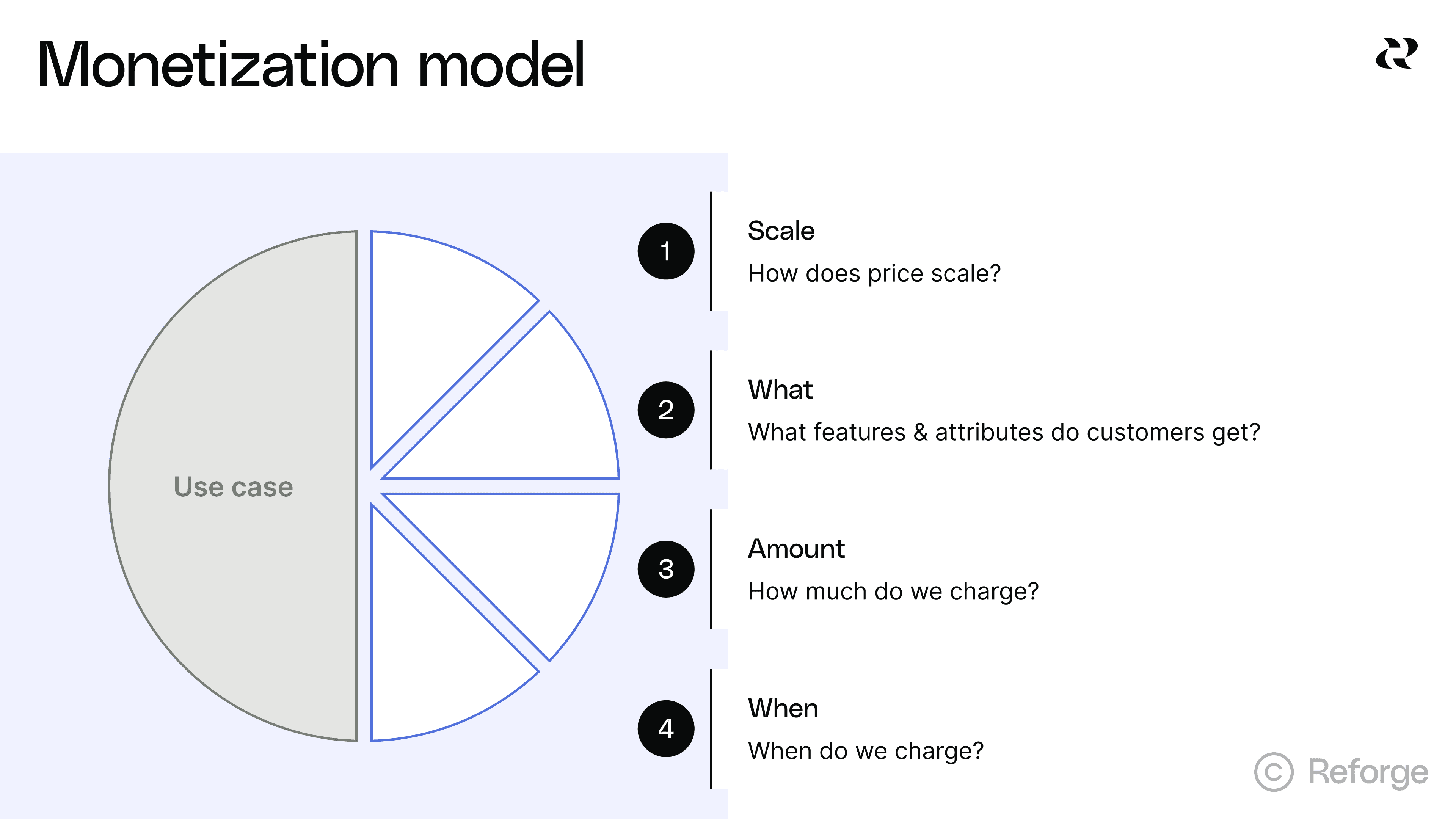
1. Scale: How does your price change as customers use it more?
This is your value metric. It’s the unit that determines pricing tiers. Slack prices per user. Stripe prices per transaction volume. OpenAI developer products price per token consumed.
2. What: Which features, capabilities, or attributes do you charge for?
This determines your packaging strategy. Do you gate advanced features? Limit usage? Restrict integrations? Your "what" creates clear differentiation between pricing tiers and options.
3. Amount: How much money do you charge for each tier?
This is your actual price point—$19/month, $99/seat, $0.002/token, etc. The amount must balance value perception, competitive positioning, and unit economics.
4. When: At what point in the customer journey do you ask for payment?
Do customers pay upfront, get a free trial, use a freemium tier, or pay based on usage? The timing of payment affects willingness to pay, conversion rates and more.
In our recent update to the Four Fits growth framework, we discussed the ripple effect of change. Similarly, these four parts don't operate in isolation. Change your scale from per-seat to usage-based, and you'll likely need to adjust your what (feature gating), your amount (pricing levels), and your when (payment timing).
The most successful monetization strategies treat these four parts as a connected system, not independent variables.
Why this framework matters more than ever
AI has scrambled traditional pricing playbooks. A simple AI query might cost $0.001 or $0.10 depending on complexity. The same feature that was once bundled unlimited now carries variable costs that swing wildly based on usage patterns.
Traditional software pricing followed predictable patterns because the underlying costs were predictable. Once you built a feature, serving it to additional customers cost almost nothing. This allowed for simple per-seat pricing or flat monthly fees. AI fundamentally breaks the way SaaS products are priced and this variability forces companies to reconsider all four monetization levers simultaneously.
This shift represents more than just a pricing adjustment. It's a fundamental change in how software companies think about value creation, cost structure, and customer relationships. Understanding these four parts gives you the framework to navigate this new landscape strategically rather than reactively.
Let’s go through each one individually to discuss what is the same and what is new with AI.
1. Scale: How does price scale with value?
Your price must move in lockstep with customer value. When these two elements disconnect, you create friction that kills growth. Customers either feel ripped off paying high prices for low value, or you leave massive revenue on the table by underpricing heavy usage. (The latter is critical to get right for AI features.)
This scaling relationship is your value metric—the unit that determines how price scales with value. Slack prices per active user. Stripe prices per transaction volume. Clay prices on AI credits. Each choice creates a different relationship between customer usage and your revenue.
Get this right, and you are able to capture more of the value your product creates. Get it wrong, and every pricing conversation becomes a battle.
There are three ways that price scales
There are exactly three approaches to scaling price with value. Each works in specific situations, but picking the wrong one breaks your entire monetization strategy.
Feature Differentiated: Price scales as customers want access to more sophisticated capabilities. Figma charges more for Professional plans because advanced features like SSO and admin controls serve enterprise needs that basic design tools cannot. In B2C, Netflix tiers pricing-based on video quality and simultaneous streams. More features cost more money. The key insight is that customers pay for capability levels, not usage volume. A small startup using Figma's enterprise features pays the same as a Fortune 500 company using identical features.
Usage-Based: Price scales directly with how much customers use your product. HubSpot charges based on contacts in your database because marketing reach grows with list size. In B2C, Spotify charges per family member because music streaming value increases with household size. This approach works when usage correlates strongly with value received. More usage means more value, so customers accept paying more. The challenge is defining the right usage unit that feels fair to customers.
Outcome-Based: Price ties directly to business results your product delivers. Thumbtack charges per qualified lead because leads convert to revenue. In B2C, Uber charges per trip completion because transportation value comes from successful rides, not app downloads. This creates the strongest customer alignment but requires reliable outcome measurement. You succeed when customers succeed, which builds long-term relationships.
The pricing playbook is currently being rewritten. Traditional software had predictable cost structures. Build a feature once, serve it to millions of customers at virtually zero marginal cost. This enabled simple scaling models like unlimited usage within feature differentiated pricing tiers.
AI changes this because processing costs vary dramatically per interaction. A basic AI response might cost $0.001. A complex analysis could cost $1.00 or more. Same feature, same customer, hundred-fold cost difference.
Consider what this means for unlimited usage models. Offer unlimited AI writing assistance for $20/month, and a single power user running complex document analysis could generate $500 in processing costs. The traditional "build once, serve forever" economics collapse.
AI opens the door to new pricing variations
This cost variability is creating new variations of feature, usage, outcome, and hybrid based models. Many companies are rolling out AI features and therefore reconsidering pricing. Remember that this feels different to customers and prospects too and they will likely need some education around your plans, usage caps, feature availability, etc.
Feature Differentiated: AI has created new types of features you can differentiate your plans on. For example, Midjourney differentiates some of their tiers on things like “Stealth Mode,” concurrent jobs, maximum queued jobs, and more.
Usage-Based: New units of usage-based models are emerging such as per token, per AI credit, per AI action, and more.
Outcome-Based: AI is enabling the use of outcome-based models in more use cases. Salesforce's Agentforce charges $2 per customer conversation because successful interactions deliver measurable business value. This shifts from paying for software access to paying for work completed.
Hybrid Models: Many AI companies combine two or more of these together. Clay includes AI credits in its plans and customers can purchase top-ups if needed. This protects against cost spikes while allowing value-based scaling. The variations above create new permutations of hybrid models that we didn’t see before.
The most challenging aspect is that identical features can cost radically different amounts based on usage complexity. Customer service AI might handle simple questions for pennies but require expensive processing for technical troubleshooting. You're essentially pricing both economy and luxury experiences within the same feature.
Companies that master this variable cost scaling early will build sustainable advantages. Those clinging to unlimited usage models may find AI costs quickly become unsustainable as customers discover high-value, high-cost use cases.
2. What: Which features or attributes are we charging for?
The "what" of monetization determines which capabilities customers get at each price tier. This shapes your product packaging strategy and creates clear differentiation between pricing plans. When done well, customers have natural triggers for upsell and expansion. Done poorly, and you create confusion that kills conversion.
The traditional feature differentiation patterns
Traditional software made this straightforward. You charged for feature access, integrations, or usage limits. You could build features once, serve them to customers at essentially zero marginal cost. This created clean feature bundling where advanced capabilities that targeted higher willingness to pay customers would be bundled in higher tiers.
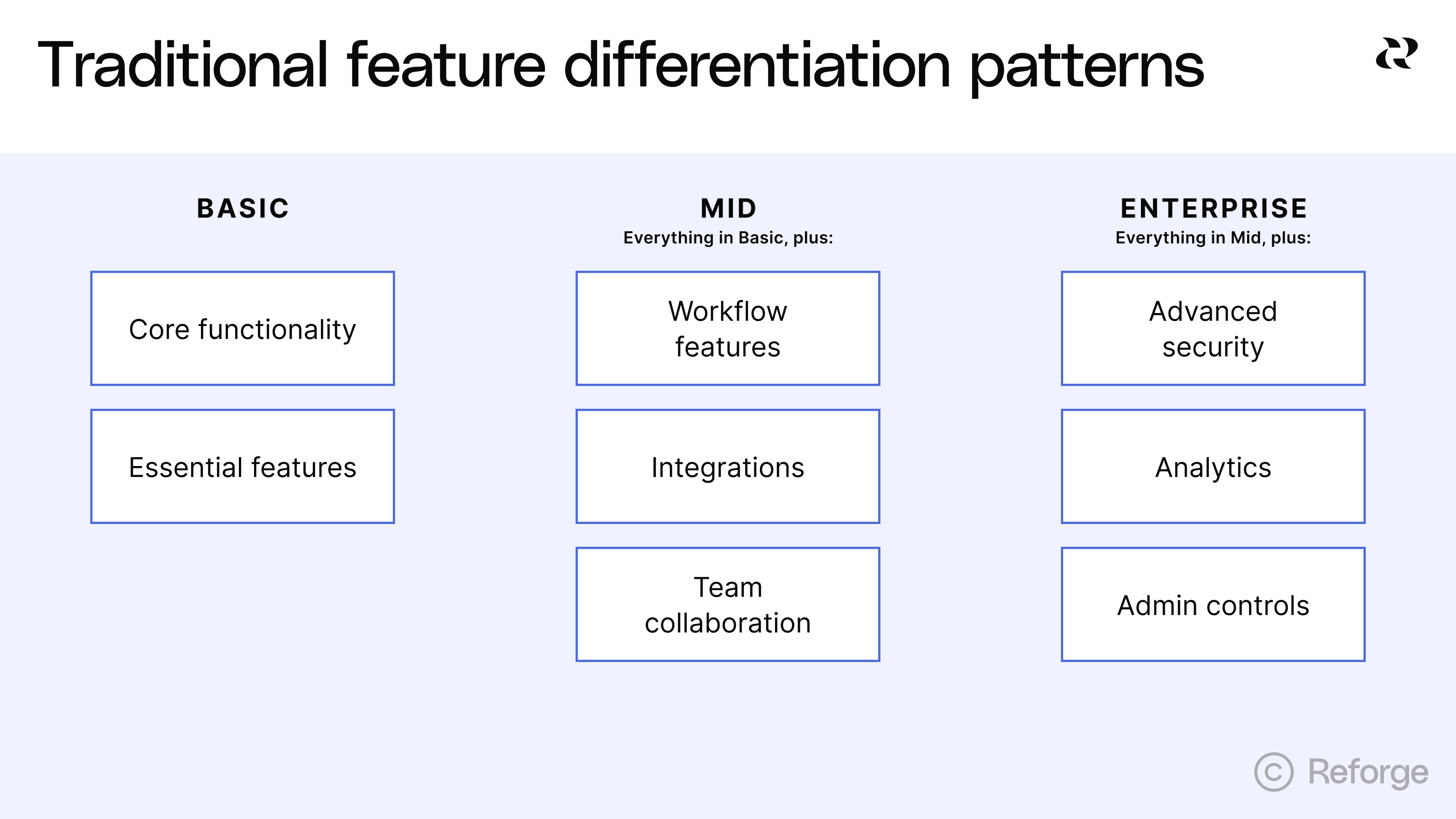
Traditional feature differentiation followed predictable patterns based on complexity and sophistication. For example, in B2B:
Basic tiers: Core functionality with essential features
Mid-tier plans: Workflow features, integrations, and team collaboration
Enterprise tiers: Advanced security, analytics, and admin controls
Example: Slack
Each tier represents progressively more sophisticated business needs at corresponding price points.
Free tier gets basic messaging with 10,000 message history.
Pro tier gets unlimited message history plus guest access and app integrations.
Business tier adds compliance features, single sign-on, and advanced security controls.
Example: Netflix
In B2C, Netflix follows similar logic.
Basic tier gets standard video quality on one screen.
Standard tier gets HD quality on two screens.
Premium tier gets Ultra HD on four screens with HDR support.
Features scale with complexity, sophistication, and willingness to pay.
How AI changes feature packaging
AI creates new variations for traditional feature packaging for two reasons:
The same feature across two different users can have dramatically different costs depending on usage complexity.
AI introduces new types of features to differentiate pricing options.
This creates new variations of what we charge for and how we package capabilities.
Example: Access to the best models (ChatGPT)
OpenAI charges for access to its best intelligence (GPT-5 at the time of this writing) in addition to usage and collaboration features.
Free: Limited access to GPT-5 (10 messages every 5 hours), then downgraded other models
Plus: Extended access to GPT-5 (160 messages every 3 hours), then downgraded to other models
Pro: Unlimited access to GPT-5
OpenAI's ChatGPT illustrates this across their plans. More expensive plans have access to Deep Research and models with more complex reasoning. While less expensive or free plans have access to less sophisticated models that are adequate for smaller tasks. Usage of different intelligence levels serve different use cases at different price points.
From feature access to value-based packaging
AI changes how you think beyond simple feature access to value-based packaging that may reflect the actual intelligence and outcomes delivered.
3. Amount: How much do we charge for the what?
The "amount" is your actual price point. It’s the amount you charge for the value metric and what parts of your monetization model.
Understanding pricing amounts requires balancing three critical factors:
Customer willingness to pay
Competitive positioning
Your unit economics.
When these three elements align, you create sustainable revenue growth. SaaS companies had mostly figured this out and pricing converged into predictable ranges and structures. For example, most SaaS products that charge per seat are priced in these ranges:
$5-15/month: Individual productivity tools and basic team collaboration
$15-50/month: Professional business software with advanced features
$10K+ / year: Business products that need user permissions, admin controls, and more.
$100K+ / year: Enterprise tools that need advanced security, compliance, and more.
In B2C markets, the anchors were even more rigid. Netflix at $6.99-$19.99/month or Spotify at $9.99/month. These price points became reference points that customers used to evaluate all software purchases.
Price competition often focused on feature differentiation and customer acquisition efficiency rather than variable cost management.
How AI changes pricing amount dynamics
AI fundamentally changes traditional pricing strategies because it introduces variable costs that can swing wildly based on usage patterns. This forces companies to rethink not just how much they charge, but how they justify and communicate pricing to customers who are still learning to value AI capabilities.
A few of the changes:
Customers are willing to pay a premium for AI features
The most significant shift is customer willingness to pay premium prices for AI-powered capabilities. Analysis of 44 leading tech companies shows AI features commanding $4-30 per month, with many products significantly exceeding their traditional software counterparts.
This premium pricing reflects a fundamental shift in value perception. Traditional software automated tasks within existing workflows. AI replaces human cognitive work, justifying the comparison to labor costs.
The price of AI compared to…what?
Despite the premium willingness to pay, the market is still learning how to value AI capabilities. Customers struggle with fundamental questions: Should I compare AI costs to software budgets, employee salaries, or outsourced services?
Consider the pricing evolution at companies building AI agents. 11x and Harvey price their AI agents at $2,000/month by positioning them as digital employee replacements. This reframing enables premium pricing that would seem outrageous in traditional software contexts.
To be clear, this can both be friction and used to your advantage. The value comparison confusion means that you will need to educate customers more, but in cases where customers are convinced of high value (i.e. Harvey in legal) you can anchor customers against a much higher priced alternative.
“Cost-Plus” reality forces higher prices
Unlike traditional software with near-zero marginal costs, AI features carry substantial variable expenses that force higher pricing regardless of customer value perception. This cost reality creates pricing floors that didn't exist in traditional software. Companies can't simply undercut competitors through aggressive pricing because the underlying AI processing costs remain constant.
The result is a new pricing dynamic where costs partially determine pricing floors, while value perception and competitive positioning set pricing ceilings. Companies that master this balance—protecting margins while maximizing customer value—will build the most sustainable AI monetization strategies.
4. When: When do we charge for the what?
The "when" component determines the timing of payment in your customer journey. This decision directly affects conversion rates, customer lifetime value, and your company's cash flow patterns.
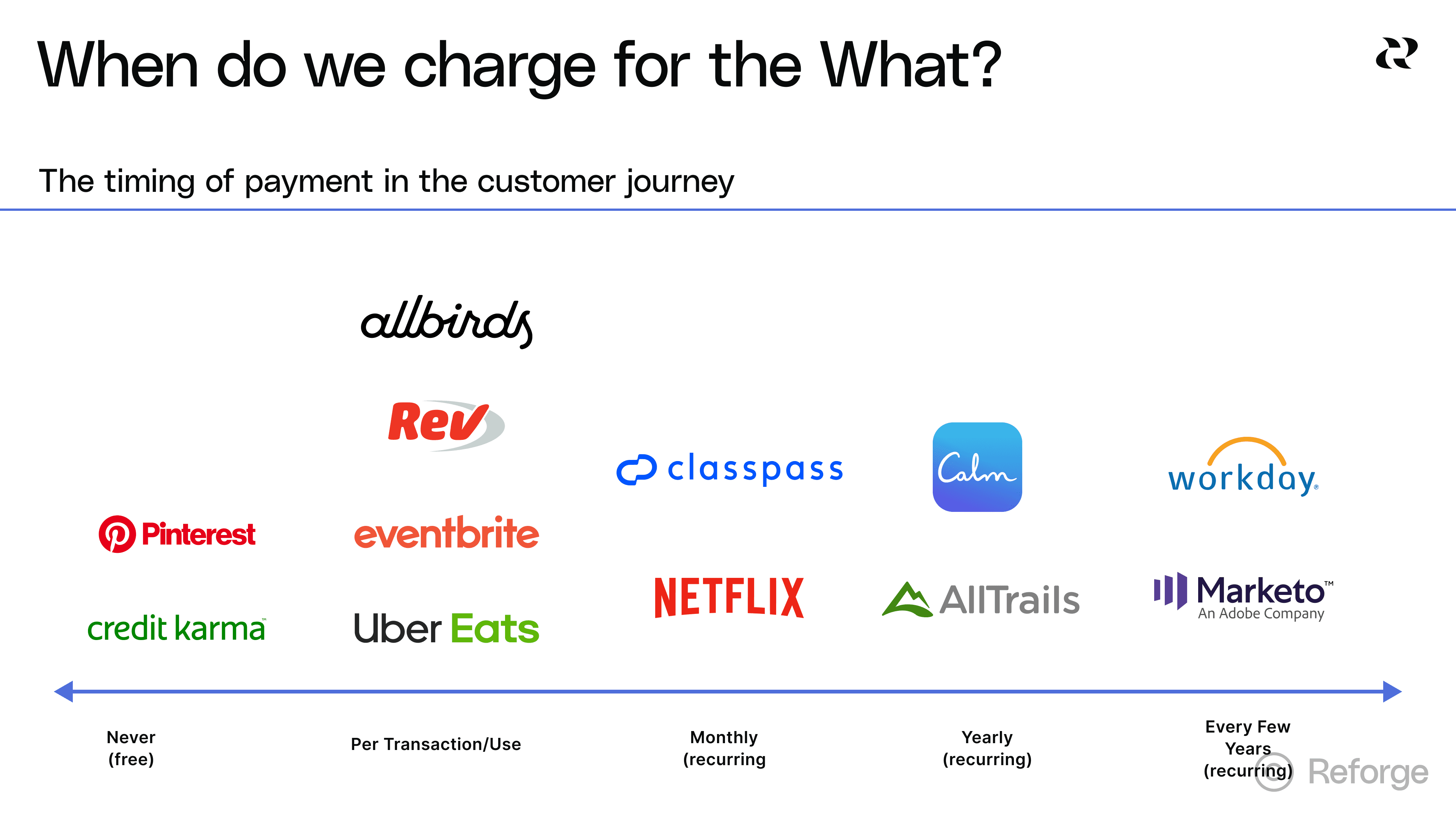
The Growth Series talks about how payment timing exists on a spectrum with five primary approaches:
never (free)
every transaction or use
every month (recurring)
every year (recurring)
every few years (recurring)
Different use cases within the same company often live at different points on this spectrum based on customer needs and value delivery patterns.
Additionally, there are different models on when you ask for that first payment.
Time-based trials (e.g. 7, 14 or 30 day free trials)
Freemium (free access to basic features in perpetuity)
Reverse trials (time-based trial that downgrades to freemium)
These too are changing. Customers want to test AI tools, but free trials carry higher costs than they used to. To read more on how this affects your growth loops, check out The Four Fits: A Growth Framework for the AI Era.
A quick look at traditional payment timing models
Traditional software followed predictable payment timing patterns based on the complexity of the buying decision and the customer's ability to evaluate value quickly.
Time-Based Free Trials
A lot of B2B software offered 14-30 day free trials because customers needed time to evaluate features, integrate with existing workflows, and demonstrate value to stakeholders. The underlying assumption: given enough time, customers could experience the product's value and make informed purchase decisions.
Freemium with Feature Limits
B2C products and some B2B tools used freemium models where basic functionality remained free forever, but advanced features required payment. This approach worked because:
Low cost to serve: Once built, software features cost virtually nothing to serve additional users
Network effects: Free users often increased value for paying customers
Clear upgrade path: Advanced needs naturally drove conversions to paid tiers
Figma's model illustrates this perfectly. Their starter tier remains free with basic design functionality, professional plans add unlimited projects and version history, while organization tiers include enterprise features like SSO and advanced admin controls.
“When” to charge for AI tools and features
AI changes payment timing because it introduces variable costs, requires different evaluation patterns, and creates new user behavior challenges that traditional trials weren't designed to handle.
Example: Credit-based trials replace time-based approaches
One example is from time-based to credit-based trials. Instead of "try for 30 days," AI companies offer "use 10 AI actions" before requiring payment. This change reflects AI's variable cost structure and usage-dependent value delivery.
Notion used this approach with 10 AI credits that customers can use on any AI feature before needing to choose a paid plan. This strategy manages costs while letting customers experience AI value across different use cases. The credit system works because:
Cost management: Companies can predict and control trial costs regardless of time spent
Value demonstration: Customers can try multiple AI features to find their highest-value use cases
Natural conversion point: Credits run out when customers are actively using and seeing value
Example: Customers want to work with real data
Hype has created a lot of false starts with AI. Big promises, with underwhelming results. As a result, for many use cases, customers often want to see what the AI can produce in a real situation with their actual data.
You can’t just do a demo or give a quick trial so customers can check off features on an evaluation list. Traditional CRM trials worked fine with sample contacts and fake sales data. AI-powered sales tools need access to real conversation transcripts, actual customer interactions, and genuine business context to show meaningful insights. The value isn't in the feature itself—it's in how the AI interprets and acts on customer-specific information.
This creates new challenges and friction. Customers often are unable to connect real data without privacy sign-offs and concerns.
Example: The cold start problem is acute for AI tools
The biggest challenge is that many customers don't know how to use AI effectively during trials. AI typically requires prompting skills that most customers haven't developed yet. Chat experiences with empty boxes create a paradox of choice and possibilities. This means getting users to experience the value, and correspondingly when to charge them, is different in AI experiences.
Monetization is more than price. It’s a growth lever.
Understanding these four parts as an interconnected system is critical for building sustainable AI monetization strategies. As we wrote in Monetization vs Growth? It's a False Choice, “it's about how monetization feeds growth as part of a holistic system.”
While traditional software allowed companies to set pricing and iterate slowly, AI's variable costs and evolving customer expectations require constant rebalancing of scale, what, amount, and when.
The companies winning in AI aren't just building better technology, they're evolving monetization models that capture value while managing cost volatility. As you design your own AI pricing strategy, remember that changing any one of these four elements creates ripple effects across the others.
The framework gives you a systematic way to think through these trade-offs rather than making pricing decisions reactively as costs spiral or customer expectations shift.


This article is excerpted from our new AI Growth course and was created in partnership with Notion product leader Lauryn Motamedi. Reforge’s Fall Cohort of AI courses starts October 14th and includes guests from OpenAI, Canva, GitLab, Descript, Laurel and many more. Enroll now to secure a spot.
AI Growth | AI Leadership | AI Strategy | AI Foundations | AI Productivity
In late 2024, Canva announced a price increase that was a perfect lesson in the difficulty of monetizing AI products.
The company was steadily marching upmarket and had added an enterprise plan as well as an enterprise sales motion. It was trying to preserve the PLG ethos of the product while rolling out plans that would be priced and sold differently. It was rapidly adding an entire menu of AI features into its suite of products. And because users were eager to test AI features, Canva had to include some free usage even though LLM costs were starting to strain its freemium unit economics.
Monetization was getting complex. Canva found itself in a position that a lot of companies are dealing with right now, albeit at a larger scale than most. The product was evolving, the customer base was growing and changing, and the old “gym membership” pricing was clearly not working any longer. But customers were frustrated by the price increase, despite the clear value of the new AI tools, which were the primary driver of the change.
AI changes monetization in a few very important ways. One is that the pricing floor is higher because of the new costs to use LLM APIs. The more challenging part is the ceiling, which is determined by perceived value and competitive pressure. For the most part, AI features are too new for companies to have found a consensus on perceived value. Canva iterated on its pricing to grandfather early adopters of its Team plan on the old pricing and clarified how new features will streamline customers’ work.
As many SaaS companies roll out AI features, they’ll have to run through not just a pricing assessment, but a monetization assessment. Every monetization model breaks down into four fundamental components, each of which is essential to get right. Whether you're pricing a traditional SaaS product or an AI-powered platform, these four parts remain constant, though AI has changed elements of each one.
It’s not just pricing: Monetization is a four-part framework
Think of monetization as a puzzle with four interlocking pieces. Miss one piece, and your entire monetization strategy may not work. Get all four right, and you create sustainable revenue growth that scales with your product's value.
Here are the four components:
1. Scale: How does your price change as customers use it more?
This is your value metric. It’s the unit that determines pricing tiers. Slack prices per user. Stripe prices per transaction volume. OpenAI developer products price per token consumed.
2. What: Which features, capabilities, or attributes do you charge for?
This determines your packaging strategy. Do you gate advanced features? Limit usage? Restrict integrations? Your "what" creates clear differentiation between pricing tiers and options.
3. Amount: How much money do you charge for each tier?
This is your actual price point—$19/month, $99/seat, $0.002/token, etc. The amount must balance value perception, competitive positioning, and unit economics.
4. When: At what point in the customer journey do you ask for payment?
Do customers pay upfront, get a free trial, use a freemium tier, or pay based on usage? The timing of payment affects willingness to pay, conversion rates and more.
In our recent update to the Four Fits growth framework, we discussed the ripple effect of change. Similarly, these four parts don't operate in isolation. Change your scale from per-seat to usage-based, and you'll likely need to adjust your what (feature gating), your amount (pricing levels), and your when (payment timing).
The most successful monetization strategies treat these four parts as a connected system, not independent variables.
Why this framework matters more than ever
AI has scrambled traditional pricing playbooks. A simple AI query might cost $0.001 or $0.10 depending on complexity. The same feature that was once bundled unlimited now carries variable costs that swing wildly based on usage patterns.
Traditional software pricing followed predictable patterns because the underlying costs were predictable. Once you built a feature, serving it to additional customers cost almost nothing. This allowed for simple per-seat pricing or flat monthly fees. AI fundamentally breaks the way SaaS products are priced and this variability forces companies to reconsider all four monetization levers simultaneously.
This shift represents more than just a pricing adjustment. It's a fundamental change in how software companies think about value creation, cost structure, and customer relationships. Understanding these four parts gives you the framework to navigate this new landscape strategically rather than reactively.
Let’s go through each one individually to discuss what is the same and what is new with AI.
1. Scale: How does price scale with value?
Your price must move in lockstep with customer value. When these two elements disconnect, you create friction that kills growth. Customers either feel ripped off paying high prices for low value, or you leave massive revenue on the table by underpricing heavy usage. (The latter is critical to get right for AI features.)
This scaling relationship is your value metric—the unit that determines how price scales with value. Slack prices per active user. Stripe prices per transaction volume. Clay prices on AI credits. Each choice creates a different relationship between customer usage and your revenue.
Get this right, and you are able to capture more of the value your product creates. Get it wrong, and every pricing conversation becomes a battle.
There are three ways that price scales
There are exactly three approaches to scaling price with value. Each works in specific situations, but picking the wrong one breaks your entire monetization strategy.
Feature Differentiated: Price scales as customers want access to more sophisticated capabilities. Figma charges more for Professional plans because advanced features like SSO and admin controls serve enterprise needs that basic design tools cannot. In B2C, Netflix tiers pricing-based on video quality and simultaneous streams. More features cost more money. The key insight is that customers pay for capability levels, not usage volume. A small startup using Figma's enterprise features pays the same as a Fortune 500 company using identical features.
Usage-Based: Price scales directly with how much customers use your product. HubSpot charges based on contacts in your database because marketing reach grows with list size. In B2C, Spotify charges per family member because music streaming value increases with household size. This approach works when usage correlates strongly with value received. More usage means more value, so customers accept paying more. The challenge is defining the right usage unit that feels fair to customers.
Outcome-Based: Price ties directly to business results your product delivers. Thumbtack charges per qualified lead because leads convert to revenue. In B2C, Uber charges per trip completion because transportation value comes from successful rides, not app downloads. This creates the strongest customer alignment but requires reliable outcome measurement. You succeed when customers succeed, which builds long-term relationships.
The pricing playbook is currently being rewritten. Traditional software had predictable cost structures. Build a feature once, serve it to millions of customers at virtually zero marginal cost. This enabled simple scaling models like unlimited usage within feature differentiated pricing tiers.
AI changes this because processing costs vary dramatically per interaction. A basic AI response might cost $0.001. A complex analysis could cost $1.00 or more. Same feature, same customer, hundred-fold cost difference.
Consider what this means for unlimited usage models. Offer unlimited AI writing assistance for $20/month, and a single power user running complex document analysis could generate $500 in processing costs. The traditional "build once, serve forever" economics collapse.
AI opens the door to new pricing variations
This cost variability is creating new variations of feature, usage, outcome, and hybrid based models. Many companies are rolling out AI features and therefore reconsidering pricing. Remember that this feels different to customers and prospects too and they will likely need some education around your plans, usage caps, feature availability, etc.
Feature Differentiated: AI has created new types of features you can differentiate your plans on. For example, Midjourney differentiates some of their tiers on things like “Stealth Mode,” concurrent jobs, maximum queued jobs, and more.
Usage-Based: New units of usage-based models are emerging such as per token, per AI credit, per AI action, and more.
Outcome-Based: AI is enabling the use of outcome-based models in more use cases. Salesforce's Agentforce charges $2 per customer conversation because successful interactions deliver measurable business value. This shifts from paying for software access to paying for work completed.
Hybrid Models: Many AI companies combine two or more of these together. Clay includes AI credits in its plans and customers can purchase top-ups if needed. This protects against cost spikes while allowing value-based scaling. The variations above create new permutations of hybrid models that we didn’t see before.
The most challenging aspect is that identical features can cost radically different amounts based on usage complexity. Customer service AI might handle simple questions for pennies but require expensive processing for technical troubleshooting. You're essentially pricing both economy and luxury experiences within the same feature.
Companies that master this variable cost scaling early will build sustainable advantages. Those clinging to unlimited usage models may find AI costs quickly become unsustainable as customers discover high-value, high-cost use cases.
2. What: Which features or attributes are we charging for?
The "what" of monetization determines which capabilities customers get at each price tier. This shapes your product packaging strategy and creates clear differentiation between pricing plans. When done well, customers have natural triggers for upsell and expansion. Done poorly, and you create confusion that kills conversion.
The traditional feature differentiation patterns
Traditional software made this straightforward. You charged for feature access, integrations, or usage limits. You could build features once, serve them to customers at essentially zero marginal cost. This created clean feature bundling where advanced capabilities that targeted higher willingness to pay customers would be bundled in higher tiers.
Traditional feature differentiation followed predictable patterns based on complexity and sophistication. For example, in B2B:
Basic tiers: Core functionality with essential features
Mid-tier plans: Workflow features, integrations, and team collaboration
Enterprise tiers: Advanced security, analytics, and admin controls
Example: Slack
Each tier represents progressively more sophisticated business needs at corresponding price points.
Free tier gets basic messaging with 10,000 message history.
Pro tier gets unlimited message history plus guest access and app integrations.
Business tier adds compliance features, single sign-on, and advanced security controls.
Example: Netflix
In B2C, Netflix follows similar logic.
Basic tier gets standard video quality on one screen.
Standard tier gets HD quality on two screens.
Premium tier gets Ultra HD on four screens with HDR support.
Features scale with complexity, sophistication, and willingness to pay.
How AI changes feature packaging
AI creates new variations for traditional feature packaging for two reasons:
The same feature across two different users can have dramatically different costs depending on usage complexity.
AI introduces new types of features to differentiate pricing options.
This creates new variations of what we charge for and how we package capabilities.
Example: Access to the best models (ChatGPT)
OpenAI charges for access to its best intelligence (GPT-5 at the time of this writing) in addition to usage and collaboration features.
Free: Limited access to GPT-5 (10 messages every 5 hours), then downgraded other models
Plus: Extended access to GPT-5 (160 messages every 3 hours), then downgraded to other models
Pro: Unlimited access to GPT-5
OpenAI's ChatGPT illustrates this across their plans. More expensive plans have access to Deep Research and models with more complex reasoning. While less expensive or free plans have access to less sophisticated models that are adequate for smaller tasks. Usage of different intelligence levels serve different use cases at different price points.
From feature access to value-based packaging
AI changes how you think beyond simple feature access to value-based packaging that may reflect the actual intelligence and outcomes delivered.
3. Amount: How much do we charge for the what?
The "amount" is your actual price point. It’s the amount you charge for the value metric and what parts of your monetization model.
Understanding pricing amounts requires balancing three critical factors:
Customer willingness to pay
Competitive positioning
Your unit economics.
When these three elements align, you create sustainable revenue growth. SaaS companies had mostly figured this out and pricing converged into predictable ranges and structures. For example, most SaaS products that charge per seat are priced in these ranges:
$5-15/month: Individual productivity tools and basic team collaboration
$15-50/month: Professional business software with advanced features
$10K+ / year: Business products that need user permissions, admin controls, and more.
$100K+ / year: Enterprise tools that need advanced security, compliance, and more.
In B2C markets, the anchors were even more rigid. Netflix at $6.99-$19.99/month or Spotify at $9.99/month. These price points became reference points that customers used to evaluate all software purchases.
Price competition often focused on feature differentiation and customer acquisition efficiency rather than variable cost management.
How AI changes pricing amount dynamics
AI fundamentally changes traditional pricing strategies because it introduces variable costs that can swing wildly based on usage patterns. This forces companies to rethink not just how much they charge, but how they justify and communicate pricing to customers who are still learning to value AI capabilities.
A few of the changes:
Customers are willing to pay a premium for AI features
The most significant shift is customer willingness to pay premium prices for AI-powered capabilities. Analysis of 44 leading tech companies shows AI features commanding $4-30 per month, with many products significantly exceeding their traditional software counterparts.
This premium pricing reflects a fundamental shift in value perception. Traditional software automated tasks within existing workflows. AI replaces human cognitive work, justifying the comparison to labor costs.
The price of AI compared to…what?
Despite the premium willingness to pay, the market is still learning how to value AI capabilities. Customers struggle with fundamental questions: Should I compare AI costs to software budgets, employee salaries, or outsourced services?
Consider the pricing evolution at companies building AI agents. 11x and Harvey price their AI agents at $2,000/month by positioning them as digital employee replacements. This reframing enables premium pricing that would seem outrageous in traditional software contexts.
To be clear, this can both be friction and used to your advantage. The value comparison confusion means that you will need to educate customers more, but in cases where customers are convinced of high value (i.e. Harvey in legal) you can anchor customers against a much higher priced alternative.
“Cost-Plus” reality forces higher prices
Unlike traditional software with near-zero marginal costs, AI features carry substantial variable expenses that force higher pricing regardless of customer value perception. This cost reality creates pricing floors that didn't exist in traditional software. Companies can't simply undercut competitors through aggressive pricing because the underlying AI processing costs remain constant.
The result is a new pricing dynamic where costs partially determine pricing floors, while value perception and competitive positioning set pricing ceilings. Companies that master this balance—protecting margins while maximizing customer value—will build the most sustainable AI monetization strategies.
4. When: When do we charge for the what?
The "when" component determines the timing of payment in your customer journey. This decision directly affects conversion rates, customer lifetime value, and your company's cash flow patterns.
The Growth Series talks about how payment timing exists on a spectrum with five primary approaches:
never (free)
every transaction or use
every month (recurring)
every year (recurring)
every few years (recurring)
Different use cases within the same company often live at different points on this spectrum based on customer needs and value delivery patterns.
Additionally, there are different models on when you ask for that first payment.
Time-based trials (e.g. 7, 14 or 30 day free trials)
Freemium (free access to basic features in perpetuity)
Reverse trials (time-based trial that downgrades to freemium)
These too are changing. Customers want to test AI tools, but free trials carry higher costs than they used to. To read more on how this affects your growth loops, check out The Four Fits: A Growth Framework for the AI Era.
A quick look at traditional payment timing models
Traditional software followed predictable payment timing patterns based on the complexity of the buying decision and the customer's ability to evaluate value quickly.
Time-Based Free Trials
A lot of B2B software offered 14-30 day free trials because customers needed time to evaluate features, integrate with existing workflows, and demonstrate value to stakeholders. The underlying assumption: given enough time, customers could experience the product's value and make informed purchase decisions.
Freemium with Feature Limits
B2C products and some B2B tools used freemium models where basic functionality remained free forever, but advanced features required payment. This approach worked because:
Low cost to serve: Once built, software features cost virtually nothing to serve additional users
Network effects: Free users often increased value for paying customers
Clear upgrade path: Advanced needs naturally drove conversions to paid tiers
Figma's model illustrates this perfectly. Their starter tier remains free with basic design functionality, professional plans add unlimited projects and version history, while organization tiers include enterprise features like SSO and advanced admin controls.
“When” to charge for AI tools and features
AI changes payment timing because it introduces variable costs, requires different evaluation patterns, and creates new user behavior challenges that traditional trials weren't designed to handle.
Example: Credit-based trials replace time-based approaches
One example is from time-based to credit-based trials. Instead of "try for 30 days," AI companies offer "use 10 AI actions" before requiring payment. This change reflects AI's variable cost structure and usage-dependent value delivery.
Notion used this approach with 10 AI credits that customers can use on any AI feature before needing to choose a paid plan. This strategy manages costs while letting customers experience AI value across different use cases. The credit system works because:
Cost management: Companies can predict and control trial costs regardless of time spent
Value demonstration: Customers can try multiple AI features to find their highest-value use cases
Natural conversion point: Credits run out when customers are actively using and seeing value
Example: Customers want to work with real data
Hype has created a lot of false starts with AI. Big promises, with underwhelming results. As a result, for many use cases, customers often want to see what the AI can produce in a real situation with their actual data.
You can’t just do a demo or give a quick trial so customers can check off features on an evaluation list. Traditional CRM trials worked fine with sample contacts and fake sales data. AI-powered sales tools need access to real conversation transcripts, actual customer interactions, and genuine business context to show meaningful insights. The value isn't in the feature itself—it's in how the AI interprets and acts on customer-specific information.
This creates new challenges and friction. Customers often are unable to connect real data without privacy sign-offs and concerns.
Example: The cold start problem is acute for AI tools
The biggest challenge is that many customers don't know how to use AI effectively during trials. AI typically requires prompting skills that most customers haven't developed yet. Chat experiences with empty boxes create a paradox of choice and possibilities. This means getting users to experience the value, and correspondingly when to charge them, is different in AI experiences.
Monetization is more than price. It’s a growth lever.
Understanding these four parts as an interconnected system is critical for building sustainable AI monetization strategies. As we wrote in Monetization vs Growth? It's a False Choice, “it's about how monetization feeds growth as part of a holistic system.”
While traditional software allowed companies to set pricing and iterate slowly, AI's variable costs and evolving customer expectations require constant rebalancing of scale, what, amount, and when.
The companies winning in AI aren't just building better technology, they're evolving monetization models that capture value while managing cost volatility. As you design your own AI pricing strategy, remember that changing any one of these four elements creates ripple effects across the others.
The framework gives you a systematic way to think through these trade-offs rather than making pricing decisions reactively as costs spiral or customer expectations shift.