Reforge has joined Miro ↗
Prototypes are about product discovery and coming up with the fastest, cheapest way to test your assumptions. But when people think of a "prototype," they tend to think of the first type of prototype they experienced.
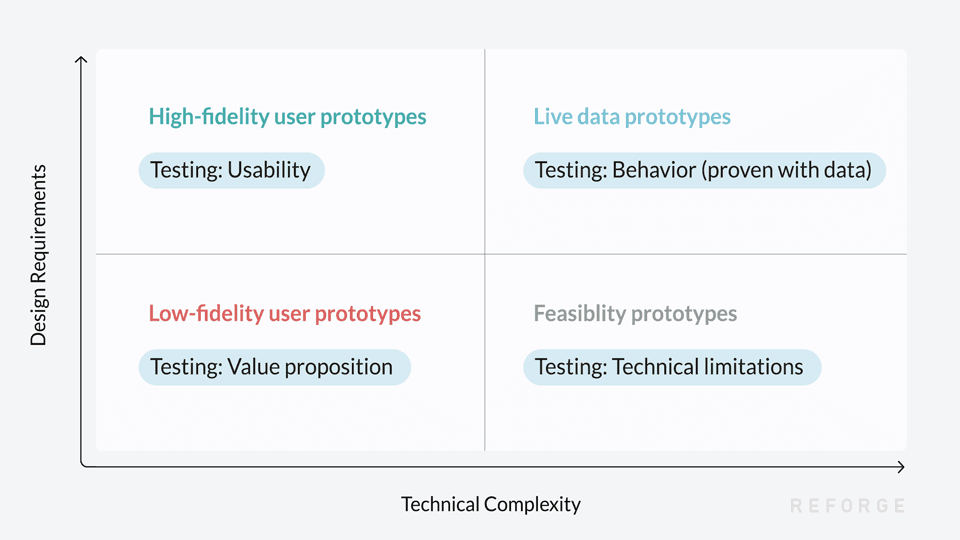
However, there are actually four distinct types of prototypes, each suited for testing different assumptions.
Prototypes are about product discovery and coming up with the fastest, cheapest way to test your assumptions.
But when people think of a "prototype," they tend to think of the first type of prototype they experienced.
However, there are actually four distinct types of prototypes, each suited for testing different assumptions.
1. Feasibility Prototypes
For prototyping new technology (ex. updated algorithm).
Engineer writes just enough code to see if it's feasible.
Helps understand technical risk, often related to performance.
2. Low-fidelity User Prototypes
Essentially an interactive wireframe (doesn't look real).
Created by interactive designers to test the workflow.
Simulates process to identify usability issues early.
3. High-fidelity User Prototypes
Realistic looking, working simulation.
Good for communicating a proposed product to stakeholders.
Used in defensive user testing, not to see if they'll like it, but to learn if they won't.
4. Live-data Prototypes
Very limited implementation created by developers to actually prove it works.
Has access to real data and is sent real live traffic.
Hasn't been "productized" (no test automation, SEO, localization, etc).
Summarized by Reforge. Original article by Marty Kagan • Partner @ Silicon Valley Product Group
Prototypes are about product discovery and coming up with the fastest, cheapest way to test your assumptions. But when people think of a "prototype," they tend to think of the first type of prototype they experienced.
However, there are actually four distinct types of prototypes, each suited for testing different assumptions.
Prototypes are about product discovery and coming up with the fastest, cheapest way to test your assumptions.
But when people think of a "prototype," they tend to think of the first type of prototype they experienced.
However, there are actually four distinct types of prototypes, each suited for testing different assumptions.
1. Feasibility Prototypes
For prototyping new technology (ex. updated algorithm).
Engineer writes just enough code to see if it's feasible.
Helps understand technical risk, often related to performance.
2. Low-fidelity User Prototypes
Essentially an interactive wireframe (doesn't look real).
Created by interactive designers to test the workflow.
Simulates process to identify usability issues early.
3. High-fidelity User Prototypes
Realistic looking, working simulation.
Good for communicating a proposed product to stakeholders.
Used in defensive user testing, not to see if they'll like it, but to learn if they won't.
4. Live-data Prototypes
Very limited implementation created by developers to actually prove it works.
Has access to real data and is sent real live traffic.
Hasn't been "productized" (no test automation, SEO, localization, etc).
Summarized by Reforge. Original article by Marty Kagan • Partner @ Silicon Valley Product Group