Reforge has joined Miro ↗
How are companies actually making money selling AI software?
Customer demand for AI is insanely high, but that doesn’t automatically translate into profit or sustainable businesses. Depending on how you price your product, you can turn that demand into high gross margins and happy customers, or broken unit economics that quickly lead to unprofitability.
Even the biggest and most successful companies of this era are still figuring how to price their products. Cursor, which reached $100m ARR in 12 months, recently had to change their pricing three times in two months because power users were burning through $500+ in compute costs while paying $20/month.
Pricing changed overnight. What happened?
Claude rolled out pricing changes in summer 2025 when it discovered 5% of users were generating usage costs that far exceeded their subscription revenue.
When Replit launched its AI coding assistant, heavy users burned through compute costs so quickly that the company had to implement emergency usage caps within weeks. What used to be a manageable loss-leader strategy became a threat to cash flow.
Traditional SaaS pricing relied on a fundamental economic principle: build software once, then serve it to customers at essentially zero marginal cost. A Slack message, a Figma design file, or a Salesforce record cost virtually nothing to process after the initial development. This predictable cost structure enabled the "unlimited usage" promises that defined SaaS pricing for two decades.
AI breaks this. A simple chatbot response might cost fractions of a penny, while a complex document analysis could cost several dollars. Same customer, same feature, wildly different costs.
These changes happened virtually overnight as AI capabilities exploded into mainstream consciousness. Companies that built their entire business models around predictable costs and unlimited usage promises now find themselves scrambling to rebuild their pricing strategies before variable costs destroy their unit economics.
5 AI pricing myths masquerading as conventional wisdom
We've seen some pricing ideas floating around social media that look and sound good. This makes them feel true. But the dust won’t settle for another year or two, and in the meantime most companies are still figuring out how to price their products in a way that customers are comfortable with while still generating strong gross margins.
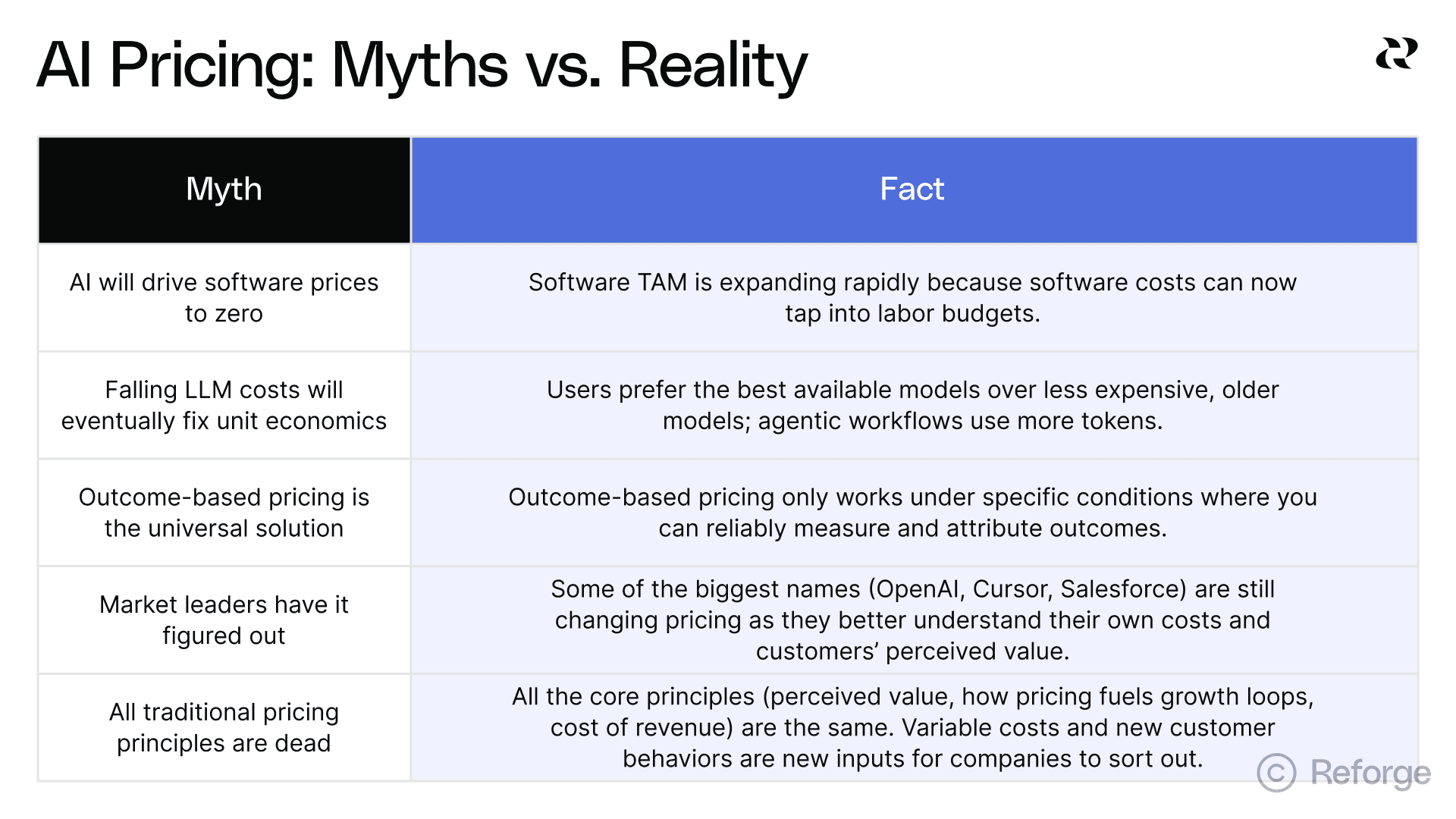
There is no conventional wisdom around AI pricing just yet. Here are the most common misconceptions that you have to be aware of.
Myth #1: AI will drive software prices to zero
The logic seems sound. If anyone can vibe code DocuSign in a weekend with AI, or if Klarna claims they can replace Salesforce with homegrown tools, why pay for software at all?
But this isn’t how it’s playing out because software TAM is increasing massively. Where SaaS products are used by people to handle parts of a workflow, AI tools are increasingly able to handle entire workflows on their own. Software is covering a growing surface area.
AI can be positioned both as a massive productivity enhancer and in some cases, a replacement for human labor. Instead of $50/month seats, AI companies are thinking about how to price if their tools enhance an employee’s productivity 5x or eliminate the human component altogether. These companies want to tap into labor budgets, not just software budgets.
As an example, Intercom Fin charges $0.99 per AI resolution for customer support tickets. Traditional human agents cost companies around $10 per ticket resolution. Fin resolves 60% of tickets autonomously, delivering massive cost savings while generating more revenue per interaction than it could earn with traditional seat-based pricing. (As of August 2025, Fin resolves more than 1 million tickets per week.)
Myth #2: Falling LLM costs will eventually fix unit economics
The assumption is that you can break even today and achieve massive margins as model costs plummet. But while older model costs decrease, cutting-edge models maintain premium pricing because customers consistently choose the highest quality available. When Claude 3 Opus launched at higher pricing, users switched from GPT-4 despite price cuts on OpenAI’s older model.
As TextQL founder Ethan Ding wrote on Substack:
When you're spending time with an AI—whether coding, writing, or thinking—you always max out on quality. Nobody opens Claude and thinks, "you know what? let me use the sh*tty version to save my boss some money.
More critically, AI usage patterns consume exponentially more tokens. Agentic workflows now burn 100x more tokens than simple text generation.
And we are still early in this trend. Studies from nonprofit AI research organization METR found that current models can easily handle tasks that take humans less than four minutes to do without AI. When given complex, multi-step tasks that take humans more than four hours, AI succeeds only about 10% of the time.
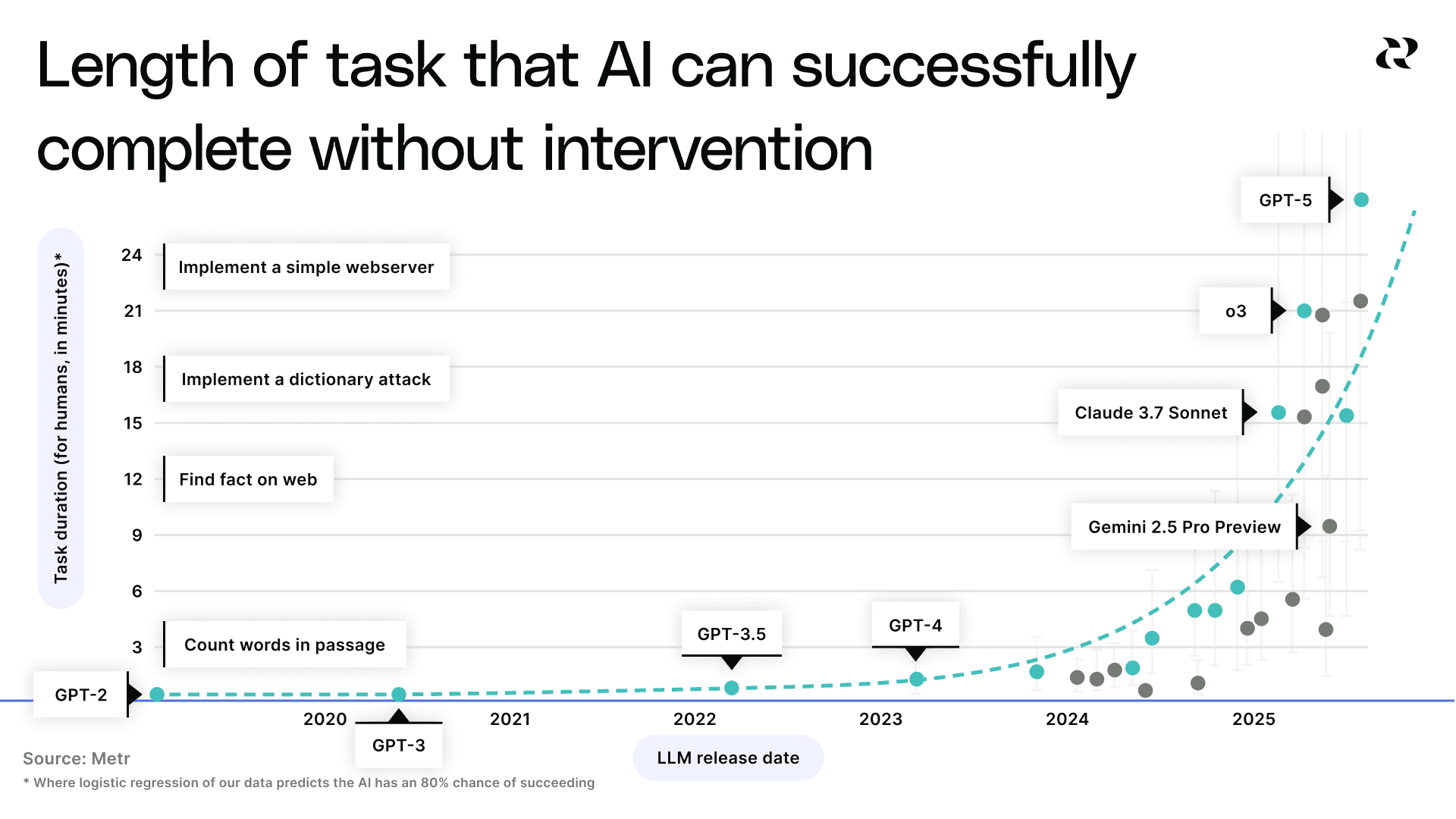
*Source: *METR
But it also found that the length of tasks that AI can handle—which is a proxy for complexity and token usage—is doubling every seven months. The trend suggests that AI will eventually handle work that currently takes humans days, weeks or even months.
The formula looks like this:
Users want the best model *
Increasing token usage for new use cases =
rising LLM costs
Myth #3: Outcome-based pricing is the universal solution
Chargeflow is an example of company where outcome-based pricing is a perfect fit for the business. It integrates with payment platforms to manage fraudulent chargebacks end-to-end with no subscription fee. Instead, they take 25% of recovered funds.
But research from Kyle Poyar shows only 5% of companies currently use outcome-based pricing successfully. It only works under specific conditions where you can reliably measure and attribute outcomes. AI does enable outcome-based pricing in a way that SaaS mostly couldn’t, but it will never be a universal solution.
Myth #4: Market leaders have it figured out
It's natural to look at the biggest and most successful companies for guidance. Many assume that AI market leaders like OpenAI or Cursor have cracked the pricing code.
Even market leaders are experimenting heavily. OpenAI CEO Sam Altman openly admits that the company doesn't fully understand customer value or internal costs by customer segment. As of early 2025, OpenAI was losing money on its $200/month ChatGPT Pro offering.
Salesforce's AgentForce launched at $2 per conversation plus additional costs for AI needed to resolve those conversations. Customers weren’t able to forecast costs and Salesforce quickly moved to offer a new pricing model based on Flex Credits, which is a much more granular way to measure AI usage.
There’s a lot to learn from the way large companies price AI products, but copying them isn’t the answer.
Myth #5: All traditional pricing principles are dead
The excitement around AI capabilities has led many to believe that traditional monetization frameworks no longer apply. The thinking goes that AI is so fundamentally different that you need entirely new approaches to pricing.
Core pricing principles remain constant while tactics evolve. Customers still need to perceive value exceeding price. Growth loops still require monetization models that enable rather than disable viral mechanics. Unit economics still determine business viability. What's changed is how these principles get applied in practice with variable costs and new customer behaviors.
Understanding these myths helps you approach AI pricing with the right foundation rather than chasing trends that may not fit your specific situation.
An evergreen pricing framework: The Monetization Triad
Kyle Poyar’s research found that hybrid pricing models are on the rise and that “hybrid pricing is a natural evolution from seats or flat-rate subscriptions.”
But don’t jump ahead and just borrow a pricing model from a company like Clay. Your pricing sits at the center of three forces that determine success or failure. Traditional software companies like Netflix, Spotify, and Zoom succeeded because they aligned all three components. AI makes this alignment both more critical and more challenging.
Once you’ve dispelled the above myths, use the monetization triad to decide how to price your product.
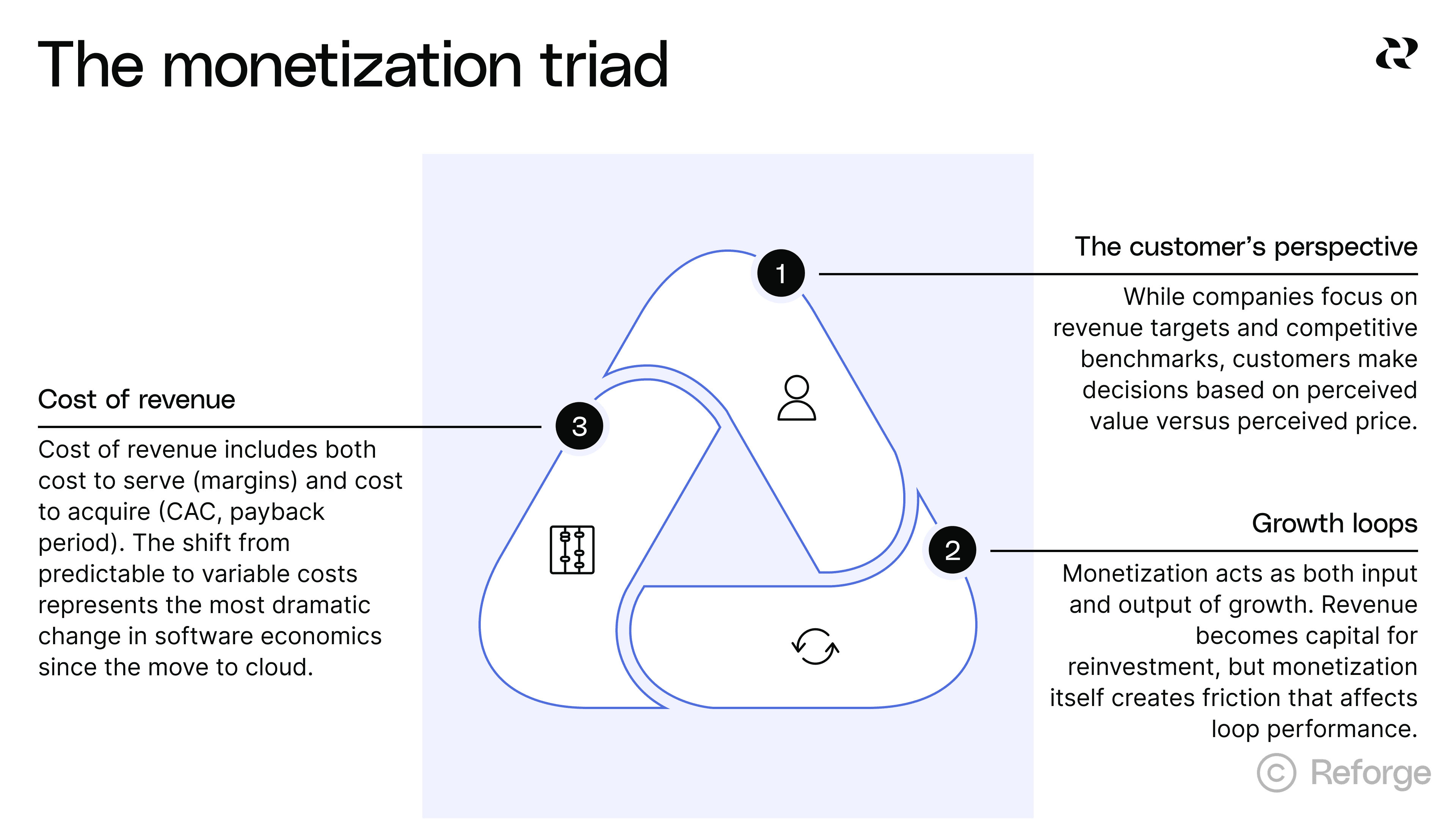
1. Customer view: What customers value and will pay for
This represents how users think about value and what they're willing to pay. While companies focus on revenue targets and competitive benchmarks, customers make decisions based on perceived value versus perceived price.
AI has created a psychological paradox. Customers simultaneously expect magic while forgiving mistakes, pay premium prices while fearing costs, and desperately seek solutions while constantly shopping for alternatives.
Most companies struggle with the customer view for three reasons:
Decision makers are often distant from actual customers
It's hard to understand audiences we don't personally relate to
Getting accurate customer insights requires time-intensive qualitative research (as a side note, this is exactly why we built Reforge Insights)
And that’s before factoring in new dynamics like inflated expectations of AI tools, low loyalty, low switching costs, and anxiety around how credits or tokens translate into dollars.
2. Growth loops: How monetization feeds growth
We’ve written extensively about growth loops. Monetization and pricing are important both as inputs and outputs. Zoom's viral loop illustrates this perfectly. Users host meetings, invite attendees, and some attendees convert to hosts themselves. Zoom's free plan removes friction between these steps. If they required payment upfront, fewer attendees would convert to hosts and acquisition would never have grown like it did.
But AI products are working with a new set of dynamics:
Freemium costs - Viral and content loops typically need freemium models. This worked when free user costs were negligible. AI can shift freemium costs from negligible to significant, exploding CAC and margins.
Data network effects - These effects are primary AI defensibility, but they're driven by usage. The more AI features you lock behind paywalls, the less usage you get, weakening the network effect.
Bundling vs. forking - Bundling AI features into existing plans leads to higher adoption but margin pressure. Forking might improve monetization per user but lower AI feature adoption.
3. Cost of revenue: The economics of sustainability
If it costs too much to create and serve revenue, you don't have a viable business. Cost of revenue includes both cost to serve (margins) and cost to acquire (CAC, payback period). This has always been true but SaaS costs were both low and predictable. AI blows this up.
The shift from predictable to variable costs represents the most dramatic change in software economics since the move to cloud. Traditional SaaS enjoyed 80-90% gross margins with predictable scaling. AI companies celebrate 50-60% gross margins while worrying that single power users could destroy their economics.
AI changes cost of revenue in four ways:
High variance per user - The cost to serve individual users varies dramatically based on usage complexity
Low predictability - It's difficult to predict usage and cost curves before launching new AI features
External dependencies - Model providers like OpenAI, Anthropic, and Google can change pricing anytime
Increased acquisition costs - Customer pilots may cost real money to run with actual user data
The promise of decreasing AI costs provides false comfort. While API prices dropped 90% in two years, usage has grown faster. Models get cheaper but customers expect more sophisticated applications. What once required one API call now needs ten for competitive experience.
Now is the right time to re-assess your pricing
Pricing a software product has always been complex. AI has created some new dynamics, like variable costs, that most companies are dealing with for the first time. On the other side, customers still have a wide range of perceived value. The confluence of variables makes it a great time to review your pricing to make sure it’s aligned both with the value it offers customers and the value customers perceive that it delivers.
Pricing and monetization are a significant part of our upcoming AI Growth course. It’s a massive overhaul of our 10-year old Growth course, which has been taken by thousands of product builders and has been a staple of our business for a decade now. You can join the waitlist here.


How are companies actually making money selling AI software?
Customer demand for AI is insanely high, but that doesn’t automatically translate into profit or sustainable businesses. Depending on how you price your product, you can turn that demand into high gross margins and happy customers, or broken unit economics that quickly lead to unprofitability.
Even the biggest and most successful companies of this era are still figuring how to price their products. Cursor, which reached $100m ARR in 12 months, recently had to change their pricing three times in two months because power users were burning through $500+ in compute costs while paying $20/month.
Pricing changed overnight. What happened?
Claude rolled out pricing changes in summer 2025 when it discovered 5% of users were generating usage costs that far exceeded their subscription revenue.
When Replit launched its AI coding assistant, heavy users burned through compute costs so quickly that the company had to implement emergency usage caps within weeks. What used to be a manageable loss-leader strategy became a threat to cash flow.
Traditional SaaS pricing relied on a fundamental economic principle: build software once, then serve it to customers at essentially zero marginal cost. A Slack message, a Figma design file, or a Salesforce record cost virtually nothing to process after the initial development. This predictable cost structure enabled the "unlimited usage" promises that defined SaaS pricing for two decades.
AI breaks this. A simple chatbot response might cost fractions of a penny, while a complex document analysis could cost several dollars. Same customer, same feature, wildly different costs.
These changes happened virtually overnight as AI capabilities exploded into mainstream consciousness. Companies that built their entire business models around predictable costs and unlimited usage promises now find themselves scrambling to rebuild their pricing strategies before variable costs destroy their unit economics.
5 AI pricing myths masquerading as conventional wisdom
We've seen some pricing ideas floating around social media that look and sound good. This makes them feel true. But the dust won’t settle for another year or two, and in the meantime most companies are still figuring out how to price their products in a way that customers are comfortable with while still generating strong gross margins.
There is no conventional wisdom around AI pricing just yet. Here are the most common misconceptions that you have to be aware of.
Myth #1: AI will drive software prices to zero
The logic seems sound. If anyone can vibe code DocuSign in a weekend with AI, or if Klarna claims they can replace Salesforce with homegrown tools, why pay for software at all?
But this isn’t how it’s playing out because software TAM is increasing massively. Where SaaS products are used by people to handle parts of a workflow, AI tools are increasingly able to handle entire workflows on their own. Software is covering a growing surface area.
AI can be positioned both as a massive productivity enhancer and in some cases, a replacement for human labor. Instead of $50/month seats, AI companies are thinking about how to price if their tools enhance an employee’s productivity 5x or eliminate the human component altogether. These companies want to tap into labor budgets, not just software budgets.
As an example, Intercom Fin charges $0.99 per AI resolution for customer support tickets. Traditional human agents cost companies around $10 per ticket resolution. Fin resolves 60% of tickets autonomously, delivering massive cost savings while generating more revenue per interaction than it could earn with traditional seat-based pricing. (As of August 2025, Fin resolves more than 1 million tickets per week.)
Myth #2: Falling LLM costs will eventually fix unit economics
The assumption is that you can break even today and achieve massive margins as model costs plummet. But while older model costs decrease, cutting-edge models maintain premium pricing because customers consistently choose the highest quality available. When Claude 3 Opus launched at higher pricing, users switched from GPT-4 despite price cuts on OpenAI’s older model.
As TextQL founder Ethan Ding wrote on Substack:
When you're spending time with an AI—whether coding, writing, or thinking—you always max out on quality. Nobody opens Claude and thinks, "you know what? let me use the sh*tty version to save my boss some money.
More critically, AI usage patterns consume exponentially more tokens. Agentic workflows now burn 100x more tokens than simple text generation.
And we are still early in this trend. Studies from nonprofit AI research organization METR found that current models can easily handle tasks that take humans less than four minutes to do without AI. When given complex, multi-step tasks that take humans more than four hours, AI succeeds only about 10% of the time.
*Source: *METR
But it also found that the length of tasks that AI can handle—which is a proxy for complexity and token usage—is doubling every seven months. The trend suggests that AI will eventually handle work that currently takes humans days, weeks or even months.
The formula looks like this:
Users want the best model *
Increasing token usage for new use cases =
rising LLM costs
Myth #3: Outcome-based pricing is the universal solution
Chargeflow is an example of company where outcome-based pricing is a perfect fit for the business. It integrates with payment platforms to manage fraudulent chargebacks end-to-end with no subscription fee. Instead, they take 25% of recovered funds.
But research from Kyle Poyar shows only 5% of companies currently use outcome-based pricing successfully. It only works under specific conditions where you can reliably measure and attribute outcomes. AI does enable outcome-based pricing in a way that SaaS mostly couldn’t, but it will never be a universal solution.
Myth #4: Market leaders have it figured out
It's natural to look at the biggest and most successful companies for guidance. Many assume that AI market leaders like OpenAI or Cursor have cracked the pricing code.
Even market leaders are experimenting heavily. OpenAI CEO Sam Altman openly admits that the company doesn't fully understand customer value or internal costs by customer segment. As of early 2025, OpenAI was losing money on its $200/month ChatGPT Pro offering.
Salesforce's AgentForce launched at $2 per conversation plus additional costs for AI needed to resolve those conversations. Customers weren’t able to forecast costs and Salesforce quickly moved to offer a new pricing model based on Flex Credits, which is a much more granular way to measure AI usage.
There’s a lot to learn from the way large companies price AI products, but copying them isn’t the answer.
Myth #5: All traditional pricing principles are dead
The excitement around AI capabilities has led many to believe that traditional monetization frameworks no longer apply. The thinking goes that AI is so fundamentally different that you need entirely new approaches to pricing.
Core pricing principles remain constant while tactics evolve. Customers still need to perceive value exceeding price. Growth loops still require monetization models that enable rather than disable viral mechanics. Unit economics still determine business viability. What's changed is how these principles get applied in practice with variable costs and new customer behaviors.
Understanding these myths helps you approach AI pricing with the right foundation rather than chasing trends that may not fit your specific situation.
An evergreen pricing framework: The Monetization Triad
Kyle Poyar’s research found that hybrid pricing models are on the rise and that “hybrid pricing is a natural evolution from seats or flat-rate subscriptions.”
But don’t jump ahead and just borrow a pricing model from a company like Clay. Your pricing sits at the center of three forces that determine success or failure. Traditional software companies like Netflix, Spotify, and Zoom succeeded because they aligned all three components. AI makes this alignment both more critical and more challenging.
Once you’ve dispelled the above myths, use the monetization triad to decide how to price your product.
1. Customer view: What customers value and will pay for
This represents how users think about value and what they're willing to pay. While companies focus on revenue targets and competitive benchmarks, customers make decisions based on perceived value versus perceived price.
AI has created a psychological paradox. Customers simultaneously expect magic while forgiving mistakes, pay premium prices while fearing costs, and desperately seek solutions while constantly shopping for alternatives.
Most companies struggle with the customer view for three reasons:
Decision makers are often distant from actual customers
It's hard to understand audiences we don't personally relate to
Getting accurate customer insights requires time-intensive qualitative research (as a side note, this is exactly why we built Reforge Insights)
And that’s before factoring in new dynamics like inflated expectations of AI tools, low loyalty, low switching costs, and anxiety around how credits or tokens translate into dollars.
2. Growth loops: How monetization feeds growth
We’ve written extensively about growth loops. Monetization and pricing are important both as inputs and outputs. Zoom's viral loop illustrates this perfectly. Users host meetings, invite attendees, and some attendees convert to hosts themselves. Zoom's free plan removes friction between these steps. If they required payment upfront, fewer attendees would convert to hosts and acquisition would never have grown like it did.
But AI products are working with a new set of dynamics:
Freemium costs - Viral and content loops typically need freemium models. This worked when free user costs were negligible. AI can shift freemium costs from negligible to significant, exploding CAC and margins.
Data network effects - These effects are primary AI defensibility, but they're driven by usage. The more AI features you lock behind paywalls, the less usage you get, weakening the network effect.
Bundling vs. forking - Bundling AI features into existing plans leads to higher adoption but margin pressure. Forking might improve monetization per user but lower AI feature adoption.
3. Cost of revenue: The economics of sustainability
If it costs too much to create and serve revenue, you don't have a viable business. Cost of revenue includes both cost to serve (margins) and cost to acquire (CAC, payback period). This has always been true but SaaS costs were both low and predictable. AI blows this up.
The shift from predictable to variable costs represents the most dramatic change in software economics since the move to cloud. Traditional SaaS enjoyed 80-90% gross margins with predictable scaling. AI companies celebrate 50-60% gross margins while worrying that single power users could destroy their economics.
AI changes cost of revenue in four ways:
High variance per user - The cost to serve individual users varies dramatically based on usage complexity
Low predictability - It's difficult to predict usage and cost curves before launching new AI features
External dependencies - Model providers like OpenAI, Anthropic, and Google can change pricing anytime
Increased acquisition costs - Customer pilots may cost real money to run with actual user data
The promise of decreasing AI costs provides false comfort. While API prices dropped 90% in two years, usage has grown faster. Models get cheaper but customers expect more sophisticated applications. What once required one API call now needs ten for competitive experience.
Now is the right time to re-assess your pricing
Pricing a software product has always been complex. AI has created some new dynamics, like variable costs, that most companies are dealing with for the first time. On the other side, customers still have a wide range of perceived value. The confluence of variables makes it a great time to review your pricing to make sure it’s aligned both with the value it offers customers and the value customers perceive that it delivers.
Pricing and monetization are a significant part of our upcoming AI Growth course. It’s a massive overhaul of our 10-year old Growth course, which has been taken by thousands of product builders and has been a staple of our business for a decade now. You can join the waitlist here.