Reforge has joined Miro ↗
Today, Reforge is excited to announce the acquisition of The Marketing Technology Academy, and that Austin Hay — the owner of the academy, and industry-leading martech expert — will be joining Reforge as an EIR.
As part of this acquisition, we’ll be folding the academy courses into Reforge over the next few months, building new martech-specific case studies, and offering new frameworks, blogs, mini-lessons, and other content to help our members prepare for and better manage the growing challenges that arise from using these tools and systems.
What is Martech?
Martech is a misunderstood and neglected part of most marketing organizations, but if you’ve ever used a third party tool in Growth, then you’ve tango’d with martech.
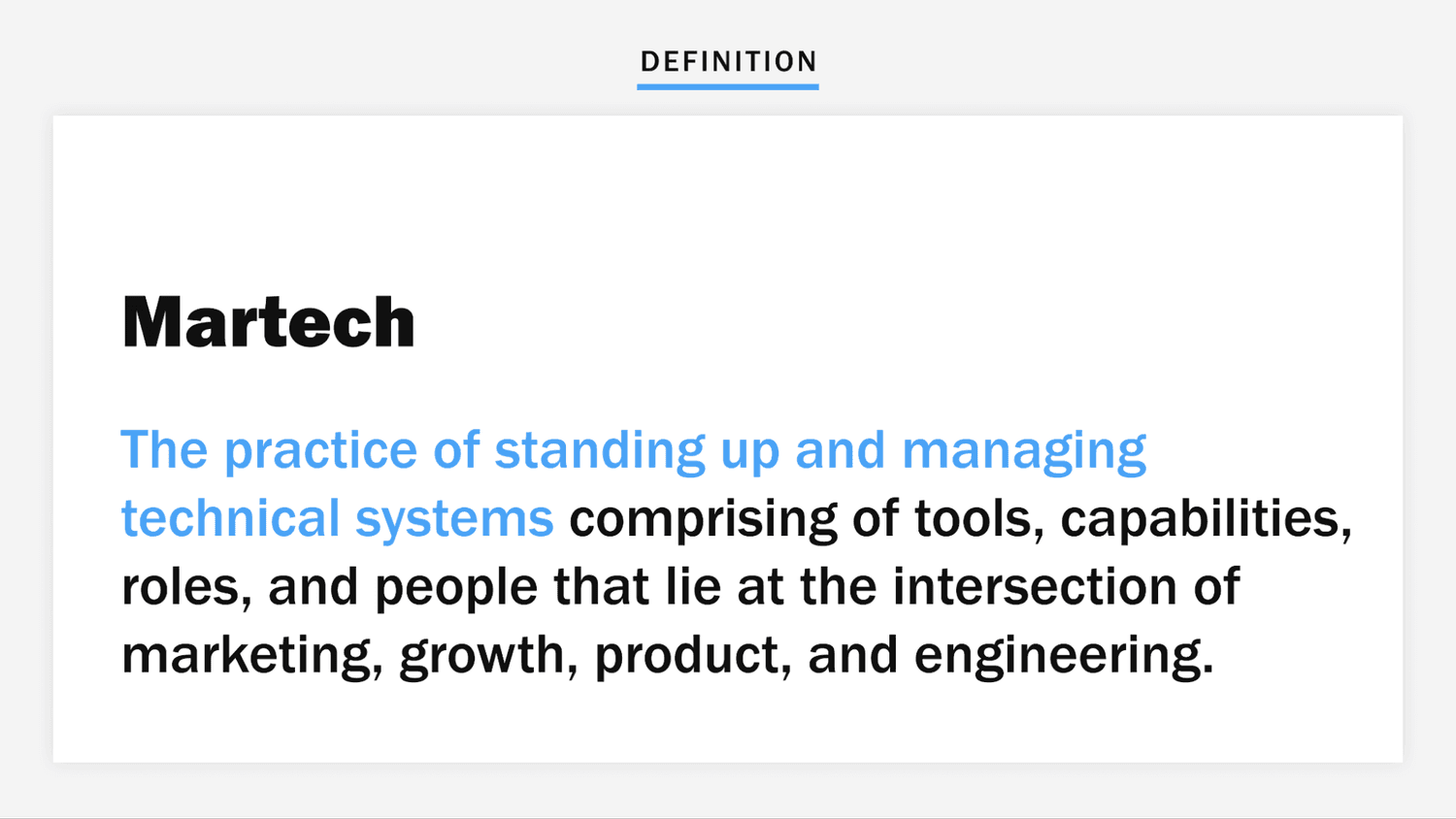
We define martech as **the practice of standing up and managing technical systems **comprising of tools, capabilities, roles, and people that lie at the intersection of marketing, growth, product, and engineering.
At its core, martech is about:
Understanding the technical goals and ambitions of these domains.
Supporting marketing in synthesizing, communicating, and solving requirements with third and first-party solutions.
Managing, codifying, evangelizing, and consistently improving these systems over time.
Martech is complex, multidisciplinary, and cross-functional
The complexity of martech lies in its multidisciplinary and cross-functional nature. For some organizations, martech has its own defined namespace within a marketing team and connection points across engineering and product.
But too often this is not the case. Nobody owns the system and domain as a whole, and problems abound as the organization scales: lack of data control, third party pricing overages, missing capabilities, duplicative workflows, unclear processes, lack of ownership, no clear operating model for fixing, updating, and maintaining tools, security breaches. The list goes on.
Adding to the complexity is the diverse range of thinking on the topic. In some discussions, martech includes any tool and capability that touches marketing. From our perspective, this is a shallow and limited view.
If you look more narrowly at B2B and B2C marketing for growth-first organizations, a very clear set of capabilities and tools emerges such as:
Attributing installs and web traffic from source campaigns
User identity and event data collection
Crafting custom audiences and piping these to relevant downstream destinations
Sending emails and push notifications to engage users and retain them over time
Calculating LTV and monitoring metrics about your source campaigns and your product features
All these capabilities narrowly align to categories of tools that any consumer-based marketer will know well: attribution, deeplinking, CDPs, ESPs, SMS/Push, lifecycle tools, product analytics.
Martech in the age of unbundling
We’ve all seen how technology has unbundled, rebundled, and everything in between. While Austin defined the common growth stack through his consulting work for B2C marketing in 2017, a rethinking of the martech stack has occurred. There’s been:
A consolidation of the tools used. (example: CDPs & ETLs, attribution & deeplinking, marketing engagement & underlying ESPs)
An explosion of B2B martech (example: HubSpot, Customer.io, Zapier, Automate, Segment)
Growth of integrations between vendors (example: HubSpot & Canva, Snowflake & every tool, the emergence of Fivetran … integrations are table stakes!)
Today, every marketing tech vendor under the sun has built and is continuing to build data connectors. Zapier, Fivetran, and Snowplow are examples of tools that have led to the great unbundling of the mature “growth stack.”
At the same time, the martech ecosystem has matured. Braze and Amplitude are two notable examples of martech vendors that have gone public.
As they have scaled, so too has their ambition to design systems that do more for their customers with less. Amplitude’s acquisition of Iteratively is one example of how martech tools are growing in their complexity.
Martech practitioners have many different ways of achieving their goals and too few frameworks to help guide their decision-making.
Why martech matters for Reforge
Given this emergent complexity, there is a clear opportunity to help operators understand the types of capabilities that different organizations might need as a function of both their stage and size.
When a startup first begins collecting data, building a robust, pure martech stack may not be the right solution. In a similar vein, given a company's growth goal and product strategy stack, planning for the future may save them years in pain and inefficiency costs.
There is an even more compelling opportunity to help organizations course correct, maintain, and improve these systems over time as they scale.
So what if you implemented two tools that do the same thing? So what if you’re incurring overages because you’re pooling data in your CDP, analytics tool, and cloud database? Helping practitioners understand how to engage in these problems in a systems-thinking way will help the whole industry move to a place of strategic engagement in martech.
As we have mentioned, most modern business knowledge is trapped in the heads of a small group of frontier leaders working on the fastest-growing companies. They go from operating role to operating role, not being able to take the time to pause and synthesize what they know to pass it on.
As a result, unless you are one of the few lucky people to work closely with these frontier leaders, that knowledge tends to remain trapped.
That’s why we feel especially lucky to bring Austin, a frontier martech leader, onboard as a partner. Austin is the current Head of Growth and GTM Operations at Runway, an A16Z fintech company pioneering the way teams understand, plan, and execute their business plans.
Previously, Austin served as the Vice President of Growth Consulting at mParticle, a leading CDP provider, and built and sold a small consulting practice in 2018. He started his career as an early employee at Branch Metrics, an attribution provider.
In his time as a martech consultant and advisor, he has worked with and served at Walmart, Airbnb, Postmates, Warby Parker, Notion, Mars, Foursquare, Soulcycle, Turner, and Peet’s Coffee. As a martech practitioner, he has also advised and spoken at conferences and internal meetings with a wide range of martech providers including mParticle, Segment, Branch, Appsflyer, Braze, Iterable, and Amplitude.
We are excited for the first-hand experience he will bring to the Reforge community and the lessons and frameworks that will emerge from his incorporation into the growing suite of Reforge programs.
Over the upcoming months, you can expect to see the academy integrated into Reforge, and some new programs being launched. Stay subscribed here to be the first to hear when our new programs go live. And until then, we have two new marketing programs you can apply for now!


Today, Reforge is excited to announce the acquisition of The Marketing Technology Academy, and that Austin Hay — the owner of the academy, and industry-leading martech expert — will be joining Reforge as an EIR.
As part of this acquisition, we’ll be folding the academy courses into Reforge over the next few months, building new martech-specific case studies, and offering new frameworks, blogs, mini-lessons, and other content to help our members prepare for and better manage the growing challenges that arise from using these tools and systems.
What is Martech?
Martech is a misunderstood and neglected part of most marketing organizations, but if you’ve ever used a third party tool in Growth, then you’ve tango’d with martech.
We define martech as **the practice of standing up and managing technical systems **comprising of tools, capabilities, roles, and people that lie at the intersection of marketing, growth, product, and engineering.
At its core, martech is about:
Understanding the technical goals and ambitions of these domains.
Supporting marketing in synthesizing, communicating, and solving requirements with third and first-party solutions.
Managing, codifying, evangelizing, and consistently improving these systems over time.
Martech is complex, multidisciplinary, and cross-functional
The complexity of martech lies in its multidisciplinary and cross-functional nature. For some organizations, martech has its own defined namespace within a marketing team and connection points across engineering and product.
But too often this is not the case. Nobody owns the system and domain as a whole, and problems abound as the organization scales: lack of data control, third party pricing overages, missing capabilities, duplicative workflows, unclear processes, lack of ownership, no clear operating model for fixing, updating, and maintaining tools, security breaches. The list goes on.
Adding to the complexity is the diverse range of thinking on the topic. In some discussions, martech includes any tool and capability that touches marketing. From our perspective, this is a shallow and limited view.
If you look more narrowly at B2B and B2C marketing for growth-first organizations, a very clear set of capabilities and tools emerges such as:
Attributing installs and web traffic from source campaigns
User identity and event data collection
Crafting custom audiences and piping these to relevant downstream destinations
Sending emails and push notifications to engage users and retain them over time
Calculating LTV and monitoring metrics about your source campaigns and your product features
All these capabilities narrowly align to categories of tools that any consumer-based marketer will know well: attribution, deeplinking, CDPs, ESPs, SMS/Push, lifecycle tools, product analytics.
Martech in the age of unbundling
We’ve all seen how technology has unbundled, rebundled, and everything in between. While Austin defined the common growth stack through his consulting work for B2C marketing in 2017, a rethinking of the martech stack has occurred. There’s been:
A consolidation of the tools used. (example: CDPs & ETLs, attribution & deeplinking, marketing engagement & underlying ESPs)
An explosion of B2B martech (example: HubSpot, Customer.io, Zapier, Automate, Segment)
Growth of integrations between vendors (example: HubSpot & Canva, Snowflake & every tool, the emergence of Fivetran … integrations are table stakes!)
Today, every marketing tech vendor under the sun has built and is continuing to build data connectors. Zapier, Fivetran, and Snowplow are examples of tools that have led to the great unbundling of the mature “growth stack.”
At the same time, the martech ecosystem has matured. Braze and Amplitude are two notable examples of martech vendors that have gone public.
As they have scaled, so too has their ambition to design systems that do more for their customers with less. Amplitude’s acquisition of Iteratively is one example of how martech tools are growing in their complexity.
Martech practitioners have many different ways of achieving their goals and too few frameworks to help guide their decision-making.
Why martech matters for Reforge
Given this emergent complexity, there is a clear opportunity to help operators understand the types of capabilities that different organizations might need as a function of both their stage and size.
When a startup first begins collecting data, building a robust, pure martech stack may not be the right solution. In a similar vein, given a company's growth goal and product strategy stack, planning for the future may save them years in pain and inefficiency costs.
There is an even more compelling opportunity to help organizations course correct, maintain, and improve these systems over time as they scale.
So what if you implemented two tools that do the same thing? So what if you’re incurring overages because you’re pooling data in your CDP, analytics tool, and cloud database? Helping practitioners understand how to engage in these problems in a systems-thinking way will help the whole industry move to a place of strategic engagement in martech.
As we have mentioned, most modern business knowledge is trapped in the heads of a small group of frontier leaders working on the fastest-growing companies. They go from operating role to operating role, not being able to take the time to pause and synthesize what they know to pass it on.
As a result, unless you are one of the few lucky people to work closely with these frontier leaders, that knowledge tends to remain trapped.
That’s why we feel especially lucky to bring Austin, a frontier martech leader, onboard as a partner. Austin is the current Head of Growth and GTM Operations at Runway, an A16Z fintech company pioneering the way teams understand, plan, and execute their business plans.
Previously, Austin served as the Vice President of Growth Consulting at mParticle, a leading CDP provider, and built and sold a small consulting practice in 2018. He started his career as an early employee at Branch Metrics, an attribution provider.
In his time as a martech consultant and advisor, he has worked with and served at Walmart, Airbnb, Postmates, Warby Parker, Notion, Mars, Foursquare, Soulcycle, Turner, and Peet’s Coffee. As a martech practitioner, he has also advised and spoken at conferences and internal meetings with a wide range of martech providers including mParticle, Segment, Branch, Appsflyer, Braze, Iterable, and Amplitude.
We are excited for the first-hand experience he will bring to the Reforge community and the lessons and frameworks that will emerge from his incorporation into the growing suite of Reforge programs.
Over the upcoming months, you can expect to see the academy integrated into Reforge, and some new programs being launched. Stay subscribed here to be the first to hear when our new programs go live. And until then, we have two new marketing programs you can apply for now!